r/abacusai • u/No-Big-9849 • 17h ago
Sorry, Robert Pattinson...but you can't replace this AI super assistant.
1
Upvotes
r/abacusai • u/HeavyAd4735 • 1d ago
title says it all its a question if this works on gdscript - coudlnt find the answer on google
r/abacusai • u/No-Big-9849 • 1d ago
Three labs shipped flagships in three weeks:
Google: Neon and Carbon
OpenAI: Astra
Anthropic: Fable 5.2
They swept the top of LiveBench
Everyone debated superintelligence. The real story is competition pushing every score up
All on ChatLLM

r/abacusai • u/No-Big-9849 • 2d ago
Browser → Neon 95.6
Reasoning → Argon 95.1
Research → Neon and Fable tied 94.5
Coding → Astra 91.9
Three vendors. 2.8 points apart overall
The best model depends on what you need it to do — all on ChatLLM

r/abacusai • u/datawithmanur • 2d ago
From protein design to software development, these examples show the range of work AI agents are taking on:
The models behind these breakthroughs are available on ChatLLM.

r/abacusai • u/datawithmanur • 3d ago
I like that LiveBench 2.0 looks at more than just an overall score. It compares models across seven categories, including coding, research, browser use, reasoning, and agentic tasks.

Looking at the category scores is interesting. Gemini 4 Neon leads overall in this snapshot, but GPT-6.2 Astra scores higher in coding, and Gemini 4 Argon scores higher in reasoning.
That makes the leaderboard a useful way to see where different models do well, rather than just looking at which one ranks first.

There’s also a chart comparing overall scores with cost per successful task. It adds another useful perspective when looking at the results, although the costs reflect the benchmark setup and may differ from your own work.
Overall, it’s a helpful starting point if you’re trying to find models worth testing for a particular task.
r/abacusai • u/No-Big-9849 • 3d ago
Not brute force — the AI helped identify which paths to explore and which to prune
The output: a formal proof in Lean, the language where every step is machine-checked
17 million lines of code — no human has read it all
But that is the point of formal verification: the proof checker is the reader
Two independent groups (Lean FRO and Mathlib) verified it in under 24 hours using separate kernel implementations
This is not a chatbot writing an essay. This is an AI contributing to a result that changes number theory forever
The gap between "sounds right" and "provably correct" is what formal verification closes
AI just crossed that gap on the hardest open problem in mathematics
The models making this possible — Claude, Gemini, GPT — are all available on ChatLLM
Pick the best model for each job. Research, code, reasoning, agentic workflows
r/abacusai • u/Super-Obligation7306 • 4d ago
How much do videos created with Grok cost? How many videos can be created per day or month with the basic plan?
r/abacusai • u/No-Big-9849 • 4d ago
Every encryption system, every secure transaction, every digital signature depends on primes
Mathematicians have tried to prove it since 1859
Terence Tao said maybe 2050. It took Claude six weeks
r/abacusai • u/No-Big-9849 • 5d ago
The Riemann Hypothesis — open for 167 years
Proved with Claude by an Anthropic mathematician
17 million lines of Lean code
Independently verified in 24 hours
What this means for AI

r/abacusai • u/No-Big-9849 • 6d ago
Three vendors launched flagships in 10 days
Neon — 88.4 overall
GPT-6.2 Astra — 86.5
Fable 5.2 — 85.6
Neon scores 95.6 on browser use — highest on the board
All on ChatLLM. Pick the best model for the job

r/abacusai • u/No-Big-9849 • 8d ago
- Gemini Neon will power complex agents
- Compare and contrast with Fable, Opus, and Astra
- Build anything with just text prompts
Neon tends to be slower than Fable, but tends to be extremely detail oriented

r/abacusai • u/fabiustus • 9d ago
Edit: voice recognition seems to be ok now. I changed recording quality in win11 settings from dvd quality to highest and enabled some clear voice feature.
Hi, I'm new to multi platform AI services. Before I used Chatgpt Desktop. One thing that I disliked about it was that there was no sync of cowork chats between devices which now is possible.
In the AbacusAI Desktop app I didn't find such option. Is there any way to archive it?
Only syncing the workspace folders won't work, since there is stuff saved in %appdata%\AbacusAI Desktop that is necessary to continue cowork chats across different devices.
Another thing I noticed is that the voice recording and transcribing option in a chat is much worse than in Chatgpt Desktop App. It often doesn't pick up spoken words in the beginning and transcribes false words. I'm speaking German and record language is already set to De.
Weird thing is: I also tried recording function via the abacus android app and there it worked much better.
Can anyone tell me how the recording and transcribing is done (is this done with AI?) and if I can enhance the experience on the Desktop App somehow?
r/abacusai • u/No-Big-9849 • 10d ago
OpenAI appears to be sacrificing performance for cost, and it doesn't quite work.
Sol is even more disappointing and comes behind Sol 6.1.

r/abacusai • u/datawithmanur • 12d ago
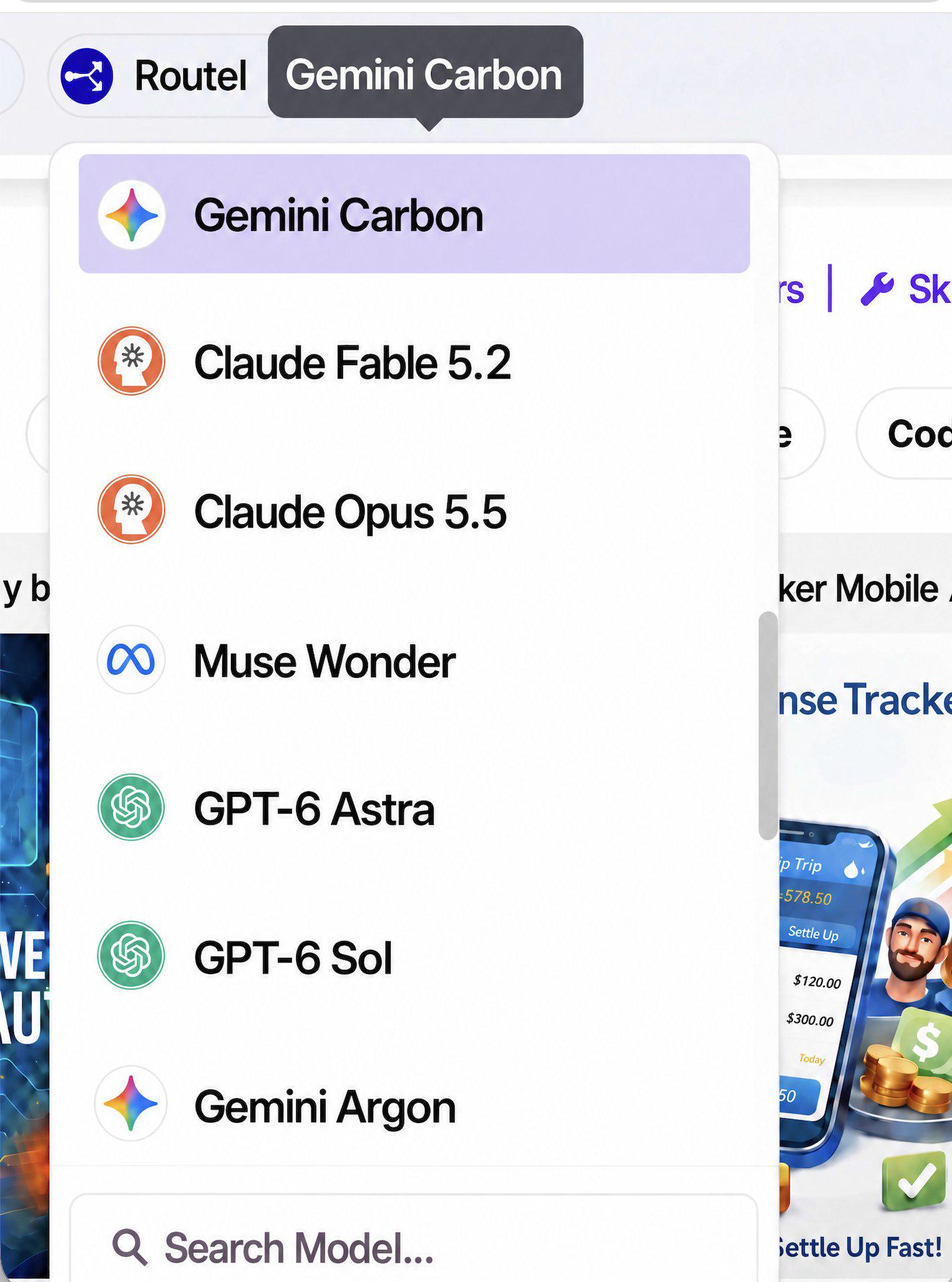
Gemini Carbon is now on ChatLLM!!
All the top models in one place
Gemini Carbon - agentic
Fable 5.2 - hard coding
Opus 5.5 - design
Astra-6 - browser use
Sol-6 - everyday chat
Luna-6 - personal agents
Deepseek Flash - simple questions
Get all the best models in the API and in chat or agent mode. Everything comes with one ChatLLM subscription
r/abacusai • u/PixArts963 • 13d ago
I use Abacus to put together my original sci-fi series. Gemini Flash writes the story and prompts, Seedream makes the stills, and MiniMax does the animation.
Ep 2, "Dead Band, Part I": a forbidden signal isn't coming through the antenna anymore. It's in the bloodstream.
Happy to share more about the workflow if anyone's curious.
r/abacusai • u/No-Big-9849 • 14d ago
- start with a text prompt
- customize based on your use-case
- run LLMs locally
- excellent for niche apps
Try it on Abacus AI SuperComputer
r/abacusai • u/_wanderloots • 15d ago

r/abacusai • u/No-Big-9849 • 16d ago
All the top models in one place
Gemini Carbon - agentic
Fable 5.2 - hard coding
Opus 5.5 - design
Astra-6 - browser use
Sol-6 - everyday chat
Luna-6 - personal agents
Deepseek Flash - simple questions
Get all the best models in the API and in chat or agent mode. Everything comes with one ChatLLM subscription

r/abacusai • u/No-Big-9849 • 18d ago
- tops livebench and is the best model in the world
- cheaper than Fable 5.1 in token cost
- easier to interact withTry it today on ChatLLM

r/abacusai • u/datawithmanur • 19d ago
There's a common assumption when choosing AI models: bigger models are always better.
But that's not necessarily true, especially when you're building something for production.
A larger model might perform better on general benchmarks, but it can also mean higher inference costs, slower responses, and more demanding hardware requirements. For many everyday business and development tasks, those extra resources might not deliver enough value to justify the cost.
I think a better starting point is to ask: What does my workload actually need?
I've been looking at how different models perform across specialized tasks, and the Smaug model family from Abacus.AI provides an interesting example.
Here's how I'd approach model selection.
Not every AI application needs the same capabilities. I'd generally divide workloads into three categories.
Long-running agent workflows
These involve agents that interact with APIs, use external tools, process information, and complete tasks across multiple steps.
Examples:
For these applications, consistency, tool-use accuracy, and reliability matter a lot.
Instruction following and specialized tasks
Some applications don't require extensive reasoning. They need a model that can follow instructions accurately and complete specific tasks consistently.
Examples:
For these workloads, task-specific performance can matter more than parameter count.
Complex reasoning and coding
Some problems genuinely require advanced reasoning capabilities.
Examples:
In these cases, using a more capable model may be worth the additional cost.
One example worth looking at is Smaug Mini, Abacus.AI's 28B-parameter model.
According to Abacus.AI's published evaluations, Smaug Mini outperforms Claude Sonnet 5, Claude Opus 4.6, and GPT-5.6 Luna on specific benchmarks, including IFBench, AutomationBench, and JobBench.
What makes this interesting is what these benchmarks actually measure:
These aren't necessarily tests of general intelligence. They evaluate specific capabilities that matter in practical AI applications.
That's an important distinction.
If your application mainly involves instruction following or structured automation, a well-optimized 28B model could be a more practical choice than a much larger model.
[Smaug Mini benchmark comparison image - Source: Abacus.AI]
This doesn't mean smaller models are always better.
For more demanding agentic workloads, larger models can offer capabilities that smaller models may struggle to match.
Another example from Abacus.AI is Smaug Agentic, a 2.8T model.
In a published evaluation involving 113 agentic coding tasks over more than seven hours, it recorded a median of 78 agent steps per task with zero infrastructure errors.
That's interesting because it highlights something beyond traditional benchmark scores: how consistently a model can operate across extended workflows.

The takeaway is that different models can serve different purposes. The goal isn't necessarily to find one model that does everything best.
Model selection also affects what happens after deployment.
Four things I'd consider:
A model that reliably completes your task at lower cost and latency might be a better production choice than one that delivers a slightly higher score but requires substantially more resources.
Start with what you need the model to do, identify benchmarks that reflect those requirements, and compare performance, latency, and deployment costs.
The Smaug models from Abacus.AI offer an interesting example of why this approach matters. Different model sizes and capabilities can serve different workloads, rather than relying on a single model for everything.
Ultimately, the best model isn't necessarily the biggest or the one at the top of every leaderboard. It's the one that delivers the right balance of performance, reliability, speed, and cost for your application.
r/abacusai • u/No-Big-9849 • 19d ago
- text prompt to mobile apps and games
- free backend and auth
- build compelling 3D experiences
Build your company on Abacus AI agent
r/abacusai • u/datawithmanur • 22d ago
Smaug Flash was the enterprise workhorse. Smaug Mini was the compact multimodal model. This is the third and final one: Smaug Agentic.
What it is
Smaug Agentic is a fine-tuned version of Kimi K3, a 2.8 trillion parameter Mixture of Experts model from Moonshot AI. Abacus AI applied their agentic fine-tuning recipe to it and released the weights publicly on Hugging Face.
The goal was not to make the model score higher on paper. The goal was to make the model stay reliable when you run it for hours, with long contexts, stacking tool calls, and no human checking in.
Benchmark results across four models
Looking at the numbers on their own, the gains look smaller than the other two Smaug models:

The biggest win against the field is AA-LCR. At 75.7, Smaug Agentic beats GPT-5.6 Sol by 2 points and Claude Fable 5 by over 5 points on long context reasoning. On SciCode it leads Claude Fable 5 by a small clear margin. GPQA Diamond ties GPT-5.6 Sol at 94.1.
How the improvement breaks down by category
The LiveBench category profile is different from the other two Smaug models. Smaug Flash gained most on agentic coding (+14.3 points). Smaug Mini gained most on mathematics, reasoning, and language. Smaug Agentic gains across the agentic work categories specifically:

The pattern shows the same surgical approach as the rest of the line. The model got better at agentic work and held steady or slightly traded off on language and math. That tradeoff matches exactly what the training was targeting.
What they actually changed
Same technical approach as the rest of the Smaug line. The fine-tuning only touched the attention factor matrices, using three LoRA adapters (two supervised and one preference trained). All three were then merged as full weight deltas into the final model.
Everything else in the model, the experts, the router, the embeddings, and the speculative decoding module, is byte identical to the official Kimi K3 release. It runs on any inference stack that handles Kimi K3 today.
The training data was filtered multi-turn, tool-using coding trajectories with the reasoning tokens masked out during training. The goal was fixing the specific failure modes you see when you run a large model in long agentic loops: spinning, stalling, and runaway thinking that never actually reaches a decision.
The behavioral change shows in paired runs Abacus published alongside the benchmarks. Across 113 agentic coding tasks run continuously for over seven hours:
The 99th percentile thinking length on scientific coding tasks collapsed to roughly 0.6 times what the base produces. The median thinking length stayed the same. So the model did not get slower to reason. It just stopped producing the runaway long thinking chains that make long production loops unpredictable and expensive.
That gap between what a leaderboard number shows and what actually happens when you run a model for seven hours straight is the real story here.

Things worth knowing before relying on these numbers
LiveBench is Abacus AI's own benchmark. They built it, they maintain it, and they report their own models performing well on it. It did receive an ICLR Spotlight and other labs use it. Questions refresh monthly from recent papers to avoid contamination. Still worth knowing when you read the results.
Terminal-Bench 2.1 is a regression. Smaug Agentic scores 86.5 against the base's 88.3. That is 1.8 points lower. If terminal-level task completion is your specific use case, the base model performs better here. Worth knowing before you swap.
MMMU-Pro also dropped slightly. 81.0 vs 81.6 for the base. The fine-tuning targeted agentic coding behavior, not vision tasks, so this is not surprising. But if vision is a priority, keep the base.
DeepSWE benchmark is led by GPT-5.6 Sol at 73.0. Smaug Agentic at 69.9 and Claude Fable 5 at 70.0 both trail it on that specific coding benchmark. Worth knowing if software engineering task completion is your main use case.
The reference scores for Kimi K3, GPT-5.6 Sol, and Claude Fable 5 come from the Kimi K3 model card. The Smaug Agentic LiveBench score comes from its published livebench.ai leaderboard entry. These are not all run under identical conditions by Abacus.
Practical details