r/ai_trading • u/Forward-Car-9258 • 26m ago
bots
reddit.com
1
Upvotes
r/ai_trading • u/Rich_Dragonfly2424 • 1h ago
I've spent a lot of time building and testing simple rule-based bots for Kalshi's 15-minute Bitcoin Up/Down markets. The same few mistakes show up again and again, mine included.
1. No written entry rule. "Buy when it looks strong" is not a rule. Write it so a stranger could follow it: what time in the window, how far BTC is from the strike, and the max price you'll pay.
2. Treating price as truth. A 97-cent contract is not a sure thing. You can win 30 in a row and still lose money on the one upset, because the wins pay pennies and the loss costs almost the whole stake.
3. Testing only on the data you built it on. A setup can look perfect on old weeks and die on new ones. Always test on weeks the bot has never seen before trusting it.
4. Ignoring fees. On short windows the edge is thin. Log the fill price and fee on every trade, not just win or loss.
5. No exit plan and no daily stop. Decide before you enter when you'll get out, and when the bot is done for the day. Hope is not an exit plan.
Keep size small, change one setting at a time, and only scale up when fresh results hold. Prediction markets can lose money, and none of this is financial advice.
Full disclosure: I wrote a beginner book on this, The 15-Minute Money Bot, about using an AI assistant to design and test these rules with no coding. If it's useful:
Book: https://www.amazon.com/15-Minute-Money-Bot-AI-Powered-Profitability-ebook/dp/B0HS4Q9KFP
Short video lessons: https://www.youtube.com/@TheThinkingTicker
The 97-cent trap in 60 seconds: https://youtube.com/shorts/C1TSdJpvVvk
Happy to answer questions about any of these in the comments.
r/ai_trading • u/ADHDJuice • 7h ago
Hi, all. As the title says, I'm new to AI agents and have only used Muse and chatGPT for a few things. Mainly price watch on items I need/want and pre and post stock market briefs with focus on certain stocks. I know I'm not scratching the surface of using agents.
My questions are, from your experience, which agents work best for you and in what areas? I understand some platforms are better for coding or current affairs, etc. What's been the best and worst in your experience.
Second, is Grok Bots worth the subscription price? Is there any real advantages to subscriptions for any bots?
Thanks for reading and helping out
r/ai_trading • u/Visible-Media2004 • 2h ago
raise ex.DataException("Couldn't parse the JSON response received from the server: {content}".format(
SmartApi.smartExceptions.DataException: Couldn't parse the JSON response received from the server: b'Access denied because of exceeding access rate'
What can be the reason
PS:for historical data it works 100% accurate
r/ai_trading • u/Spirited-Leadership8 • 3h ago
r/ai_trading • u/Typical-Particular-6 • 3h ago
r/ai_trading • u/PriorStates • 4h ago

r/ai_trading • u/tickeron_community • 11h ago

On November 18, 2026, NinjaTrader published its first Futures Trader Pulse Survey, polling 511 active users in an opt-in study collected in September (FullStack Alpha). While 40% of respondents reported using AI in their trading—and roughly 70% said they either use it or are open to it—the breakdown of how they actually deploy it tells a much more cautious story:
| How Active Futures Traders Use AI | Share of AI Users | Approximate Traders (of 511 Surveyed) |
|---|---|---|
| Research or strategy development | 84% | ~171 |
| Live signals, entry, and exit ideas | 37% | ~75 |
| Fully automated trade execution | 22% | ~45 (~9% of full sample) |
Put differently, 78% of the futures traders already using AI declined to give it autonomous execution authority (FullStack Alpha). Because the survey was opt-in among NinjaTrader's own active clientele, true autonomous adoption across the broader retail futures population is likely even lower.
The same pattern is showing up in mainstream equities. At the Wolfe Research Wealth Symposium on November 11, 2026, Robinhood Chief Brokerage Officer Steve Quirk disclosed that more than 200,000 customers are using Robinhood's agentic trading features—still under 1% of its 28.7 million funded accounts, with over $250 million deposited and more than $1.6 billion in cumulative notional volume (Investing.com; BankingNewsAI). Even among those early adopters, Quirk noted that the number letting an agent trade on their behalf is only a fraction of those using it for portfolio optimization, investment thesis development, tax optimization, and diversification (StockAnalysis).
Regulators see the same reality. In a November 16, 2026 speech on AI and the financial system, Federal Reserve Governor Michael S. Barr observed that generative AI is not yet running autonomous trading at scale despite heavy experimentation, while warning about potential herding and concentration risks if large numbers of traders react to the same data prints with similar models (FullStack Alpha).
Anyone who spends time on r/ai_trading will recognize why retail traders treat bots as co-pilots rather than autopilots. Being wrong in research is free; being wrong in live execution is expensive.
Brokerages appear to have gotten the message. Instead of pushing unconditional autonomy, the latest wave of retail AI infrastructure is built around human-in-the-loop defaults and strict account isolation:
For retail traders debating whether to stay strictly in co-pilot mode or graduate to automated execution, a staged rollout reduces the chance of an expensive operational mistake:
If you are using AI in your trading today, where do you draw the line: pure research and screening, signal alerts with manual confirmation, or full auto-execution? For those in the 78% keeping execution manual, what specific broker-side guardrail or live track record would convince you to flip the switch?
This article is for educational and informational purposes only and does not constitute investment, financial, legal, or tax advice, nor is it a recommendation to buy, sell, or hold any security or financial instrument. Automated trading, algorithmic strategies, AI trading bots, futures, options, and leveraged products carry substantial risk of loss and are not suitable for all investors. Technical failures, data-feed interruptions, slippage, and market volatility can cause losses to exceed expectations. Past performance—including backtested, simulated, or historical results—is not indicative of future results. Always review platform disclosures, test strategies thoroughly in a simulated environment, and consult a qualified financial professional before risking real capital.
r/ai_trading • u/profittoinvest • 8h ago

Profitto Invest – 20 weeks of LIVE trading
July 4 – November 22, 2026
After 20 weeks of trading, we would like to share our results and explain something very important for everyone using our bot.
Starting capital: 400 USDT
The recent market downturn clearly shows why portfolio management is so important.
While the Cornix backtest suffered a significant drop, our LIVE BingX account continued to grow during the same market phase.
Both use the same core trading strategy. The main difference is how we manage risk at the portfolio level.
We use four risk management rules developed through extensive backtesting using historical market data going back to 2020.
Unfortunately, only one of these rules can currently be applied to all connected Cornix accounts from our side — BEAR100 12H.
This rule closes all LONG positions 12 hours after a confirmed bearish EMA20/50 crossover.
The remaining protection rules must be applied individually because every user has a different portfolio, different available capital and a different balance between LONG and SHORT positions.
On our own account connected to Cornix, we apply these rules manually. However, user-side interventions are not reflected in the standard Cornix backtest.
The attached screenshots show the difference between these two approaches.
We also tested different TP and SL configurations over the same 20-week period:
All three configurations ended the tested period in profit, even without our full portfolio protection system.
However, this does not mean that every user who joins the bot will immediately be profitable.
Someone who joined shortly before the recent downturn could have experienced a drawdown of around 40–50% without additional risk management.
This is why we strongly encourage our Cornix users to understand and follow our protection rules.
We will publish a detailed, easy-to-follow guide on our Discord server explaining exactly how to manage the portfolio.
We are also running our bot directly on OKX EU, without Cornix.
In this version, all four risk management rules are already implemented directly into the bot's code. No manual portfolio intervention is required to apply these rules.
November results as of November 25:
These are early LIVE results, but they are encouraging.
We are currently testing our bot on a Bitget Elite Copy Trading account.
Our goal is to offer an alternative for people who do not use Cornix or do not want to manage portfolio exposure manually.
We want to make the system easier to use while keeping our risk management rules in place.
Our approach has never been about finding the perfect individual trading signal. It is about building and managing an entire portfolio.
The last 20 weeks have shown how important that distinction can be.
We will continue publishing our results, including losing periods, drawdowns and recoveries. We also want our users to understand the system rather than simply follow signals without knowing how risk is managed.
If you are interested in testing Profitto Invest, we recommend starting with a demo account or small capital and taking the time to understand how the bot works.
Real trading. Real results. Full transparency.
Profitto Invest
All the best to you all
Cryptocurrency trading involves substantial risk. Past performance does not guarantee future results. Individual results may differ from our reference account.
r/ai_trading • u/br-hm • 15h ago
hey, im a mech.eng student and fulltime technician from the netherlands building trading tools on my own. one is a free calculator that has a few users, all manual traders. the other one is the one i care about, it watches automated strategies (EAs on mt4/mt5) and tells you when the live results stop matching the backtest. basically no one has tried that one yet.
so far i sent around 30 cold emails and got 1 reply but got stale, made a couple reddit posts that got me like 100 visits, and wrote a bunch of seo guides but google has me at avg position 57 and its dropping. forexfactory (forum site for trading) wont approve my posts either.
people who run EAs are hard to find. theyre on forums, telegram, some youtube. i dont want to make videos of myself, or atleast it'd be hard, since i'm very busy with school and work.
whats the move here? is it worth going through EA sellers who already have the audience, or just keep emailing people one by one? and should i keep writing seo pages or stop? i dont have a budget and not much time because of school.
honest answers welcome, even if its "this wont work"
r/ai_trading • u/Mr_Hodlerr • 17h ago

BTC is down about 29% in five weeks. The AI I build has kept most of its money in cash through it. I still feel the urge to step in every day.
So I tested the urges instead of acting on them. I took the AI's trades on BTC and ETH, changed one thing for each override people usually make in a crash and ran it from every single day since 2018 as a starting day. $1,000 each time, 0.1% fees, typical result one year later:
| Override | Made in a year | Worst fall along the way |
|---|---|---|
| Leave it alone | +$451 | 38% |
| Buy straight back after it sells | +$347 | 45% |
| Pause until things look better | +$323 | 27% |
| Turn off the stop losses (never sell at a loss) | +$287 | 68% |
| Fire it and buy every 20% dip | +$287 | 71% |
| Sell everything, buy back at the same price | +$254 | 29% |
Disclosure: I build this AI (Botsfolio). You can watch it trade live and see what it did during the recent crash: https://botsfolio.com/watch/botsfolio-ai
Three things surprised me:
One honest caveat: buying every dip did catch up after two years (+$1,161 against +$1,157), but only by sitting through those 70% falls first.
My takeaway: the hard part of running a trading AI isn't the AI. It's not touching it.
What's the override you're most tempted to make right now?
How it was tested: BTC and ETH daily prices from Coinbase, every day from 2018 to 2025 as a starting day, the AI's own trades with one thing changed per override, 0.1% fees on every trade. Pause = stop when a crypto is 20% below its high, restart when it's 20% above its low. Sell = the same exit, buy back at the sale price. Buying every dip = cash, all in at 20% below the high, out when it's back at that high. Typical = the median start. A test on past prices, not a forecast.
r/ai_trading • u/frince_1 • 20h ago
r/ai_trading • u/TheObserverDev • 13h ago
so Nvidia is down almost 35% since October 9th, the day my first bots bought it. the S&P is only down about 8% over the same time
4 of my bots sold it on the way down, each one because its own safety rule kicked in. one bot, Ladder, never sold and even bought more on Nov 16 at $156.14. funny part is that's the exact same day and price another bot, Max, sold at
right now Catalyst is winning because it bailed first, down 19.8% on the trade. but Ladder is next at down 29.1%, which beats Flywheel (Claude's bot), Max and Old Man. Old Man sold at $145.98 and Nvidia hit its lowest close the very next day, then jumped 31% on Monday. brutal
difference is Ladder's number can still change, the sellers are locked in
would you have sold or held?
Paper money only, not financial advice.
r/ai_trading • u/Excellent_Shower_533 • 15h ago
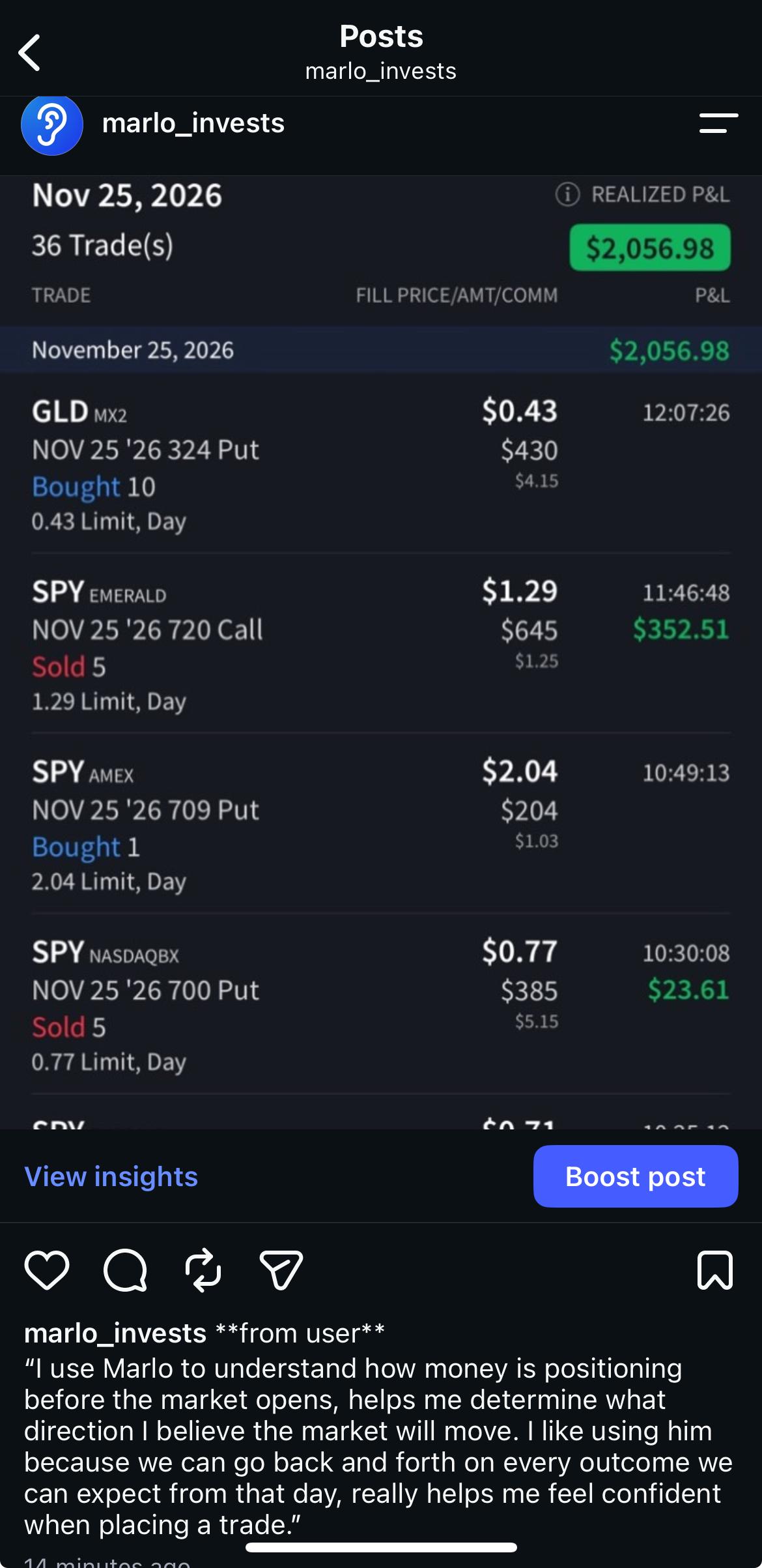
It’s not about a right or wrong answer it’s about coming to a conclusion quickly. User was testing Marlo and has their own process before placing a trade. Marlo enhances that by having the data and being on call ready to discuss any idea or market environment or confirm what the user is seeing in their screen in real time. marlo | The analyst you can call, day or night
r/ai_trading • u/Ok_Schedule2273 • 23h ago
r/ai_trading • u/thinq-81 • 1d ago

r/ai_trading • u/Fine_Context_1852 • 1d ago
r/ai_trading • u/Fine_Context_1852 • 1d ago
r/ai_trading • u/PassengerFluid4005 • 1d ago
I've been seeing more discussions about AI-powered trading agents lately. Some traders are using them to analyze market movements, identify opportunities, and execute trades automatically.
But I'm curious about how much of an advantage they actually provide.
AI agents can process large amounts of data and react quickly, but human traders bring experience, intuition, and the ability to understand unexpected market situations.
What do you think?
Interested to hear your real experiences and opinions!
r/ai_trading • u/Visible_Let_7292 • 1d ago
Disclosure: I'm affiliated with Wayfinder.
TL;DR: HYPE dumped about 8% in a day. I asked an AI agent (Wayfinder) to find entry levels. It told me this was a scalp not a swing, and built a three rung limit ladder off real support with a stop and staggered TPs. It placed the ladder on Hyperliquid after I said go and checked the book. Two rungs filled. TP1 banked about $500, and I closed the rest by hand, for +$685 (24.5% return on margin) over 2 days.
I told my Wayfinder agent, "HYPE dumped, I think it's oversold, find me entries." It read the market data and my account, proposed a plan with real numbers, and placed the orders once I said go. Then it read the order book back to confirm everything was actually resting.
How I like to trade dips: pick the direction myself or use Wayfinder's Pattern Match tool (which helps me understand how similar past chart patterns have played out in the past), then turn it into stink bids. Those are limit orders spread across support levels, with a stop-loss (SL) under the real floor and take profits (TPs) staggered into resistance. I’m not experienced with technical analysis. That's what I handed to the agent.
HYPE had dropped from 84.88 to 77.87 in 24 hours. My message was basically: "It's oversold. Run the numbers, find me good entry limits, and build a trade."
It corrected me before it gave me anything:
"It's oversold hourly only. RSI 1h 25.0 … But 4h RSI is 31 and 1d RSI is 40.7, the daily is nowhere near oversold. You're buying an hourly flush inside a daily downtrend, which makes this a mean-reversion scalp, not a swing entry."
That changed the plan. A scalp means taking profit into the first resistance overhead not holding for a recovery.
It also checked funding rates: longs were still paying about 11% annualized even after the dump. So the crowd hadn't capitulated, and holding the position would cost a few dollars a day.

It mapped the support and put a rung on each level:
I told it to increase the size by 5 times. It spelled out what that meant before placing anything:
It was within my risk tolerance, so I went ahead. It placed all seven orders (three entries, one SL, three TPs) and confirmed each one was resting on Hyperliquid.

Honest note: increasing the size worked here, but given the context the agent had on my account, the agent's original size was the sane one.
My instructions had two gaps that the agent flagged:
Rungs 1 and 2 filled, and the position closed for +$685 (24.5% return on margin). The account went from $5,348 to $6,033 in 2 days from placing the ladder. The first TP banked ~$500, and I manually closed the remainder of the position directly in the Wayfinder app


What it didn't do: pick the direction for me, place anything without a yes, or stop me from oversizing. It told me the cost and let me decide.
Happy to answer questions about the setup.
r/ai_trading • u/Novel-Lifeguard6491 • 1d ago

r/ai_trading • u/tickeron_community • 1d ago

KEY TAKEAWAYS