r/aihistoricalart • u/Dangerous_Drama6843 • 6h ago
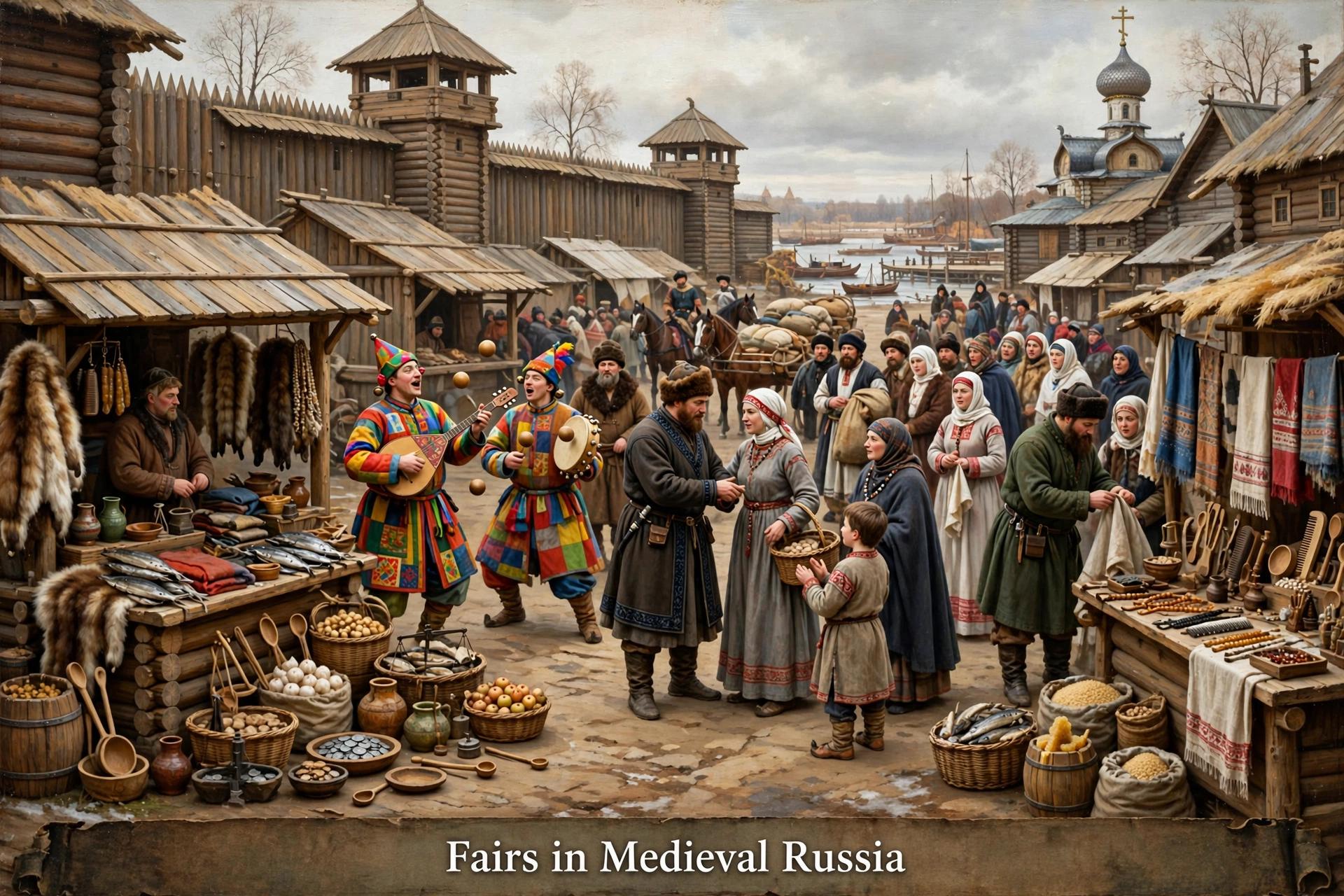
FIST FIGHTS IN MEDIEVAL RUSSIA

6
Upvotes
r/aihistoricalart
•
u/subscriber-goal
•
Oct 07 '26
Welcome to r/aihistoricalart
13898 subscribers / 15k subscribers. Help us reach our goal!
Visit this post on Shreddit to enjoy interactive features.
r/aihistoricalart • u/affabledrunk • Sep 01 '26
User u/Chris_in_Lijiang suggested we start taking image requests. Great idea — so let’s make this the official request megathread.
I’ll keep it pinned so people can drop historical scenes, odd little episodes, obscure cultures, lost buildings, battles, daily life, or whatever else they’d like to see rendered.
I’ll start: the Neolithic hunting technique associated with the so-called “desert kites” of the Levant. I’ve tried generating it several times and gotten absolute garbage, so I’m throwing it to the mob.
Post your requests below. If something catches somebody’s imagination, maybe it gets made.
Cheers.
r/aihistoricalart • u/TryNice304 • 1h ago

Colorized this incredible historical photograph to highlight the stark visual contrast between three distinct paths for young women in turn-of-the-century China.
The image perfectly encapsulates a society in transition. On the right, the girl stands with unbound feet in traditional cloth shoes, a sign of the growing Christian missionary and reformist influence that condemned foot binding as mutilation. On the left, a barefoot girl in plain, indigo-dyed work clothes stands ready for a life of labor and hardship.
But it’s the seated girl in the center that draws the eye. Dressed in a beautifully embroidered pink robe, her tiny, pointed lotus shoes are visible. She was likely from a wealthy family, as foot binding was a status symbol that rendered women physically dependent and socially pure.
Adding color to this black-and-white image breathes life into the fabrics, reminding us that these are not just historical types, but real children whose entire futures were shaped by the shoes they wore, or didn't wear.
r/aihistoricalart • u/Dangerous_Drama6843 • 1h ago

r/aihistoricalart • u/Dangerous_Drama6843 • 29m ago
r/aihistoricalart • u/Dangerous_Drama6843 • 6h ago

r/aihistoricalart • u/Dangerous_Drama6843 • 6h ago

r/aihistoricalart • u/Purple_Break1559 • 1d ago

r/aihistoricalart • u/Sepenza • 1d ago

Forgot the first one
Mucius Scaevola frigthens the etruscan king
oath of the horatii brothers
Thesseus slays minotaur
Labours of the Heracles
Heracles cleansing the stables
Heracles subduing the cerberus
Perseus defeating the medusa
Fall of the caesar ides of march
Bellophoron riding the pegasus
Achilleus vs hector
r/aihistoricalart • u/CarlosLwanga9 • 1d ago

History isn't just the study of Emperors, Kings, Nations and Wars.
History is also the story of all mankind. The story of everyday people, men and women. What they believed in and how they lived their lives. That means we study history not just to see the rise and fall of nations but to also understand the lives of people in the past to gain insights into how to live our own lives.
And the story of all mankind is the story of the Gods that they worship.
The Gods exist and they influence how we live our lives.
If you want to look at what Gods are - scientifically - then you could say that they are ideas that keep possessing and influencing humanity throughout history.
These ideas stick with us inspite of our better knowledge or actions or intentions.
Why do we have the desire to fight wars?
Why is a particular man or woman so attractive?
Why are all of us drawn to certain religions inspite of how much we understand of the world?
Why does a man ruin his life and his marriage for a sexy young mistress?
The people in the past understood that in order to prevent the Gods - these ideas - from completely taking away the freedom of a person - or consuming them - they had to be understood and propitiated.
Most people wanted peace but if there was a war then that God of War - that idea of War - had to be understood and worked with - fed otherwise it would feed on you.
Most people wanted healthy loving relationships but there is a God or Goddess of Love - an idea of love beyond human understanding - that must be propitiated and worked with - fed otherwise it would feed on you.
There are thousands of these Gods - these ideas - floating around - looking for whom they might consume. Unless you understand them and how they work.
Just like our ancestors did.
--------
"There is likewise in Phoenicia a temple of great size owned by the Sidonians. They call it the temple of Astarte. I hold this Astarte to be no other than the moon-goddess. But according to the story of one of the priests this temple is sacred to Europa, the sister of Cadmus. She was the daughter of Agenor, and on her disappearance from Earth the Phoenicians honored her with a temple and told a sacred legend about her; how that Zeus was enamored of her for her beauty, and changing his form into that of a bull carried her off into Crete. This legend I heard from other Phœnicians as well; and the coinage current among the Sidonians bears upon it the effigy of Europa sitting upon a bull, none other than Zeus. Thus, they do not agree that the temple in question is sacred to Europa."
-Lucian of Samothrace.
Astarte was first worshipped among the peoples of the Levant, the Near Middle East, Egypt and Mesopotamia from the Beginning of the Bronze Age into the period of the early Roman Empire. But it was during the Bronze Age period proper that Astarte saw the height of her popularity as the Goddess of Love, Sexuality, Royalty, Kings, War, Power and Hunting - there was always a temple in honor of the Goddess - in one form or the other - among the great powers of the Bronze Age.
But then that very Bronze Age ended and calamity came with that end. The Great Empires of the Hittites and the Egyptians declined, and the old trade routes fell apart as new tribes and peoples settled in the lands from the Aegean to Mesopotamia itself. The Israelites, the Amorites, the Philistines, the Dorians etc. - all of them would found new Kingdoms and Cities that would change the fate of Mesopotamia, the Mediterranean, Europe and the World itself for all time.
People talk about what the ending of the World might look like, but humanity has experienced it once before. And survived it.
As the Great Empires fell apart. As civilizations and peoples were wiped out. As Old Gods were forgotten - a group of peoples organized into city states survived the tumultuous period of the Bronze Age Collapse and single handedly helped the Ancient World recover from the chaos and rebuild the systems that were lost.
These people were The Phoenicians. And we call them the Phoenicians through the Greeks because of the impact that they had on the entire Mediterranean Region. More on that later.
They settled - like The Canaanites - into city-states on the coast of the Levant - the chief of which are famous even today - Tyre, Damascus, Sidon, Byblos. And like the Canaanites, the Phoenicians worshipped Gods that fought against nature - Baal, Hadad, El, Yahweh, Asherah. The Bull.
But the thing that characterized the Phoenicians - according to Ancient Historians - was their love of money. So as the World fell apart around them, the Phoenicians thrived because they asked themselves a question human beings have been asking themselves ever since - how do we profit from all of this?
Where people only saw the fall of the International Trade Routes that connected peoples throughout the Bronze Age - The Phoenicians saw an opportunity to reestablish those trade routes themselves, becoming richer in the process.
Where people only saw strange tribes overthrowing the old Kingdoms that had dominated the Bronze Age - The Phoenicians realized that there were new unexplored lands to the West of the Mediterranean and new markets to exploit, becoming richer in the process.
And the Phoenicians - ever hungry for that sweet, sweet coin - that sweet, sweet profit - built ships to carry them across the sea and establish new trading routes to replace the old ones. And at the head of those ships, they placed a woman at the bow - beautiful and with her arm outstretched - Astarte who had not been forgotten as the Old Nations and Empires had fallen and their old Gods with them.
There is a reason why Aphrodite was said to have been born from the sea. Astarte was a Goddess of Victory. If there was anyone who could protect people from the dangers of the sea, it was Astarte.
The Phoenicians carried their desire for Wealth and Astarte to Cyprus where she mixed with an Ancient Cypriot Goddess to become Aphrodite and then Venus. The Phoenicians established trading points along the route to act as watering stations. But these watering routes eventually grew into colonies and then independent cities of their own. In Cyprus, Cythera -which is considered one of the first places where Aphrodite was worshipped - was originally one of those stations.
The Phoenicians pushed further west - into New Worlds - establishing New Colonies and New Centers.
The Island of Rhodes, Crete and Malta.
North Africa - where they established famous Carthage where Astarte was worshipped as the Goddess Tanit, Leptis Magna and Hippo.
Sardini and Sicily - where they established Nora, Coralis (Cagliari), Carloforte.
Spain - where they established Gades (Cadiz), Elussus (Ibiza), Barcelona,
And through the straights of Gibraltar to the Canary Islands and Britain where tin was a valuable resource. So much so that there was a legend among the old tribes of Britain that fought Caesar that their ancestors had intermarried with a few Phoenicians and Trojans.
There are even legends of Phoenician sailors circumnavigating Africa to reach India itself but those are myths no one can corroborate.
Whatever the case, the Phoenicians established cities everywhere they went on the Mediterranean, and for the longest time their ships ruled the Mediterranean Sea. And all of what would become Europe.
And with that power, The Phoenicians gave us their Goddess. And with that power, they also gave us their understanding of business and coinage in a world laying the foundation of what would become modern economics. And with their power, they gave us their alphabet which the Greeks and Romans borrowed to create their own - the writing and alphabetical system we still use today.
Their trade was felt everywhere on the Meditereanean and even when the people's that were blood Phoenicians had been conquered and ruled by other nations. In some places on the Meditereanean, their Spirit thrived - among the people of Spain and Sardinia and Sicily. So much so, that when the New World was discovered, the Spanish realized that wealth could be made from conquering these new lands and establishing new cities and colonies upon them.
So, they built larger and grander ships. And at the bow of some of those ships, they placed a beautiful woman with arms outstretched. And once more Astarte watched a new generation of men and women live their homes and explore new lands for power and profit.
And she will watch them once more, when the desire for that power and profit forces mankind to sail upon the seas of the Space and found new colonies on far off worlds.
Reminding us of a simple truth that has been a part of humanity.
Profit and the desire for wealth is the mother of exploration.
Such was the impact of Astarte, that they named a continent after her - Europa.
r/aihistoricalart • u/Sepenza • 2d ago

Fall of the Achilles
Icarus meets his demise
Sol invictus
Duel of the eagles from odyssey
Moses throws commandments
Temptation in the desert
Paradise lost
Odysseus leaving troy
Odyseeus and sirens
Odyseeus leads agaist the scylla
Zeus cast his lightning upon the Odysseus
Odysseus escaped land of cannibal giants
Odysseus and cyclopes
Odysseus drawing his bow in front of the suitors
r/aihistoricalart • u/Dangerous_Drama6843 • 1d ago

r/aihistoricalart • u/natmavila • 1d ago

The uninterrupted peace and royal patronage of this era ignited a scientific and technological blossoming in Joseon, rivaling the achievements of King Sejong’s 15th-century zenith. With no wars to drain resources or talent, the dynasty eagerly invested in scholarship, invention, and the practical sciences to strengthen the kingdom. In 1603, King Seonjo established the Hall of Brilliant Inquiry (Geukhak Hall) in Hanseong, a royal research institute charged with advancing astronomy, medicine, agriculture, and engineering. This precursor to a modern academy assembled Joseon’s brightest minds; Confucian scholars, Buddhist monk inventors, and even a few Chinese and Japanese learned guests invited for knowledge exchange. Under its auspices, the kingdom witnessed remarkable scientific feats that would have been unthinkable amid war’s chaos.
(See img 1)
One area of dramatic advancement was astronomy and calendar science, crucial for an agrarian Confucian state. In the 1640s, as the Ming dynasty waned and European Jesuit astronomy texts filtered in, Joseon’s royal astronomers seized the chance to update their celestial knowledge. The Gwansanggam, Joseon’s Bureau of Astronomy, flourished mightily during the long peace, producing new star charts and instruments that astonished contemporary scholars. In 1669, the renowned court astronomer Song I-yeong unveiled his masterwork: a celestial globe and armillary clock that integrated Korean, Chinese, and Western timekeeping principles. This ingenious astronomical clock, the Honcheonsigye, kept precise time and tracked the movements of stars and planets, ringing bells on the hour by means of falling metal beads and spinning wheel. Hailed as a National Treasure, it allowed Joseon scholars to predict eclipses and solstices with unprecedented accuracy, bolstering agriculture and navigation. The sight of learned officials on observatory platforms, peering through sighting tubes at the heavens above Hanyang’s palaces, became emblematic of Joseon’s scientific renaissance. In recognition of these strides, King Hyeonjong (r. 1659–1674) granted astronomers elite status and funded the construction of the Cheoncheon Tower Observatory just outside the capital, a soaring pagoda where celestial observations and public lectures on astronomy were held regularly to educate officials and commoners alike.
Technological innovation was equally vibrant. Drawing on experience from the Japanese invasion attempt, Joseon’s military engineers perfected the design of the Geobukseon (turtle ship) and even expanded the navy’s arsenal. In the 1620s, the Royal Navy launched an improved fleet of iron-plated warships inspired by Admiral Yi Sun-sin’s legacy, ensuring Korean dominance of coastal waters for decades. On land, engineers applied scientific know-how to fortification and construction. The peaceful decades saw the completion of monumental projects like the Gyeongcheon Dam in Chungcheong Province, an irrigation and flood-control system that tamed a once-volatile river, bringing tens of thousands of new acres under cultivation. Likewise, architects in 1684 finished the grand Gwangtong Bridge in the capital (a massive stone bridge across the Han River), showcasing advanced load-bearing design and becoming the longest bridge in East Asia at the time. These were the fruits of a confident nation unafraid to attempt extreme engineering feats.
Perhaps the most striking symbol of this era’s ingenuity was the construction of Hwaseong Fortress in the city of Suwon in 1796, an awe-inspiring citadel that embodied both scientific planning and enlightened philosophy. Commissioned by the forward-thinking King Jeongjo, Hwaseong’s walls and bastions were built using novel methods devised by the polymath official Jeong Yakyong. Jeong Yakyong, a towering figure of late 18th-century Joseon, invented the Geojoonggi, a type of crane and pulley system, to hoist heavy stone blocks efficiently into place. As chief engineer, he supervised construction using these radically new techniques drawn from European, Chinese, and indigenous knowledge. The result was a fortress of unparalleled strength and sophistication, with angled bastions for cannon placement, floodgates, and secret underground passages a marvel that stunned foreign envoys. Jeong Yakyong’s crane was just one example of the era’s inventive spirit: other artisans improved metal movable-type printing presses (accelerating book production), developed waterwheels and millstones to automate agriculture, and crafted Joseon’s first hot-air balloons for amusement and scientific curiosity at court festivals. Such spectacles underscored how far Joseon’s technology had advanced during its century of peace.
Equally important was progress in medicine and agriculture, sciences that directly improved people’s lives. Royal physicians in the 17th century compiled Dongui Bogam II, a greatly expanded medical compendium building on Heo Jun’s famous text, incorporating new herbal cures and even referencing some Western remedies carried by Jesuit writings from China. Public hospitals known as Hwalloe Clinics were established in each province to provide free treatment to commoners, a humanitarian initiative unheard of in earlier times. Meanwhile, agricultural innovation thrived: Korean farmers embraced new crops like potatoes, corn, and chili peppers (some introduced via Japan and foreign trade) much earlier and more widely, since stable governance encouraged experimentation. By the late 1600s, the introduction of sweet potatoes in the south helped avert famine during bad rice harvests, as chroniclers noted fields “thick with golden potato blooms” sustaining the populace. Farming manuals were distributed by the government such as the Improved Farming Taxonomy of 1704 teaching crop rotation, composting, and pest control, all results of careful observations by the era’s agricultural scientists. The effect of these scientific advances was dramatic: fewer epidemics ravaged the land thanks to medical care, and farms yielded record harvests thanks to better tools and crops. Joseon’s population swelled and life expectancy inched upward, enviable metrics that observers from Qing China and Tokugawa Japan commented upon with admiration.
By the dawn of the 18th century, Joseon Korea stood as a paragon of scientific progress in East Asia. The dynasty’s rulers proudly bore titles such as “Sagely King” and “Protector of Civilization”, reflecting their patronage of knowledge and invention. Indeed, historians later wrote that had the world paid closer attention, they would have seen an early Enlightenment unfolding in Joseon, a society harnessing rationality and technology under the steady guidance of a strong, independent state. Joseon’s scientific renaissance during this period of uninterrupted sovereignty not only improved the daily lives of its people but also further strengthened the kingdom’s ability to remain secure, wealthy, and culturally dynamic.
r/aihistoricalart • u/Dangerous_Drama6843 • 2d ago
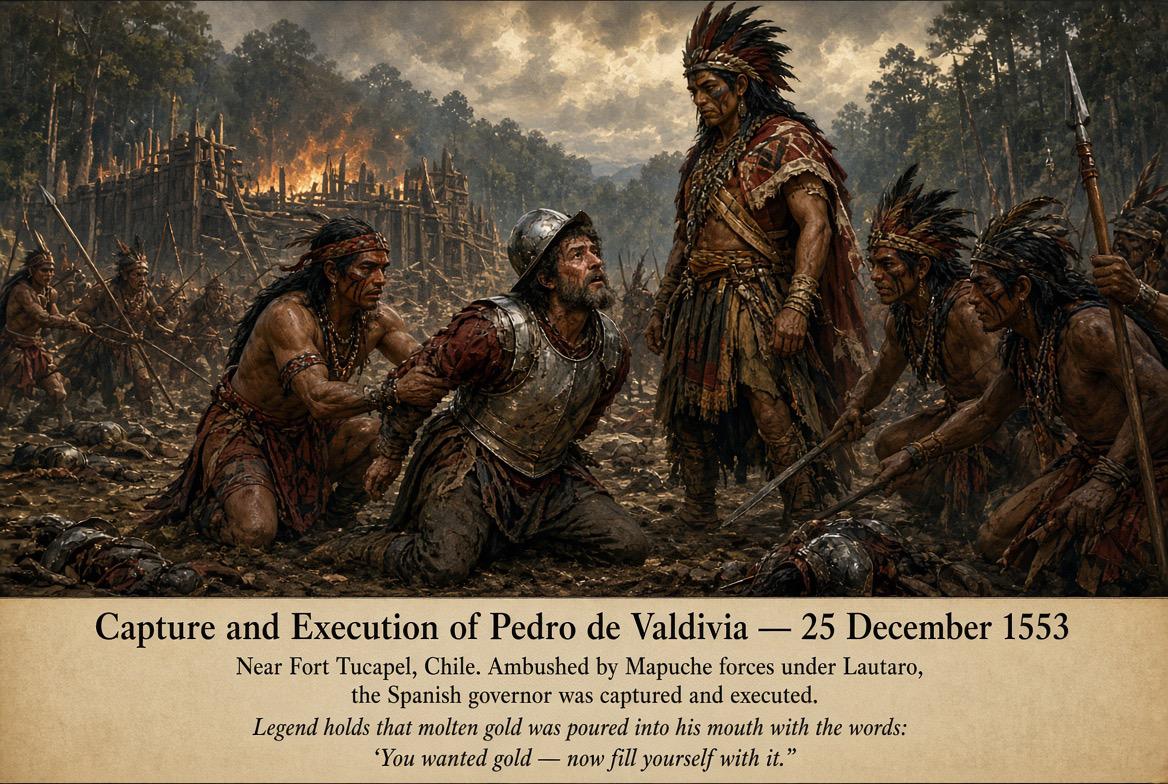
Capture and execution of Pedro de Valdivia (Chile, 1553)
One of the most dramatic episodes of the Araucan War, described, among other things, on Pedro de Valdivia's Wikipedia page:
Event: On December 25, 1553, the governor of Chile, the conquistador Pedro de Valdivia, was ambushed with a small detachment near the destroyed Fort Tucapel. The army of the Mapuche Indians (Araukans) was commanded by the leader Lautaro, who had previously been Valdivia's stableman himself and studied the tactics of the Spaniards well.
Wikipedia
Outcome: The Spanish detachment was completely defeated, and Valdivia himself was taken prisoner. According to chronicles and legends (Homsk writes about it in more detail), the Indians executed him with particular cruelty: according to one version, molten gold was poured into his mouth (or covered with golden sand) with the words "You wanted gold, so get full of it", and then dismembered.
r/aihistoricalart • u/Ma_tt_att • 1d ago

I noticed the little bouquet first, then the watch chain. I don’t know who these two were, but those are the details I kept coming back to. The first image is the archival original. For the second, I used AI to help restore and colorize it while keeping their seated pose. The colors are my interpretation.
Source: “19th Century People,” Internet Archive via Picryl, dated 1850 and marked public domain.