r/askscience • u/AskScienceModerator Mod Bot • 9d ago
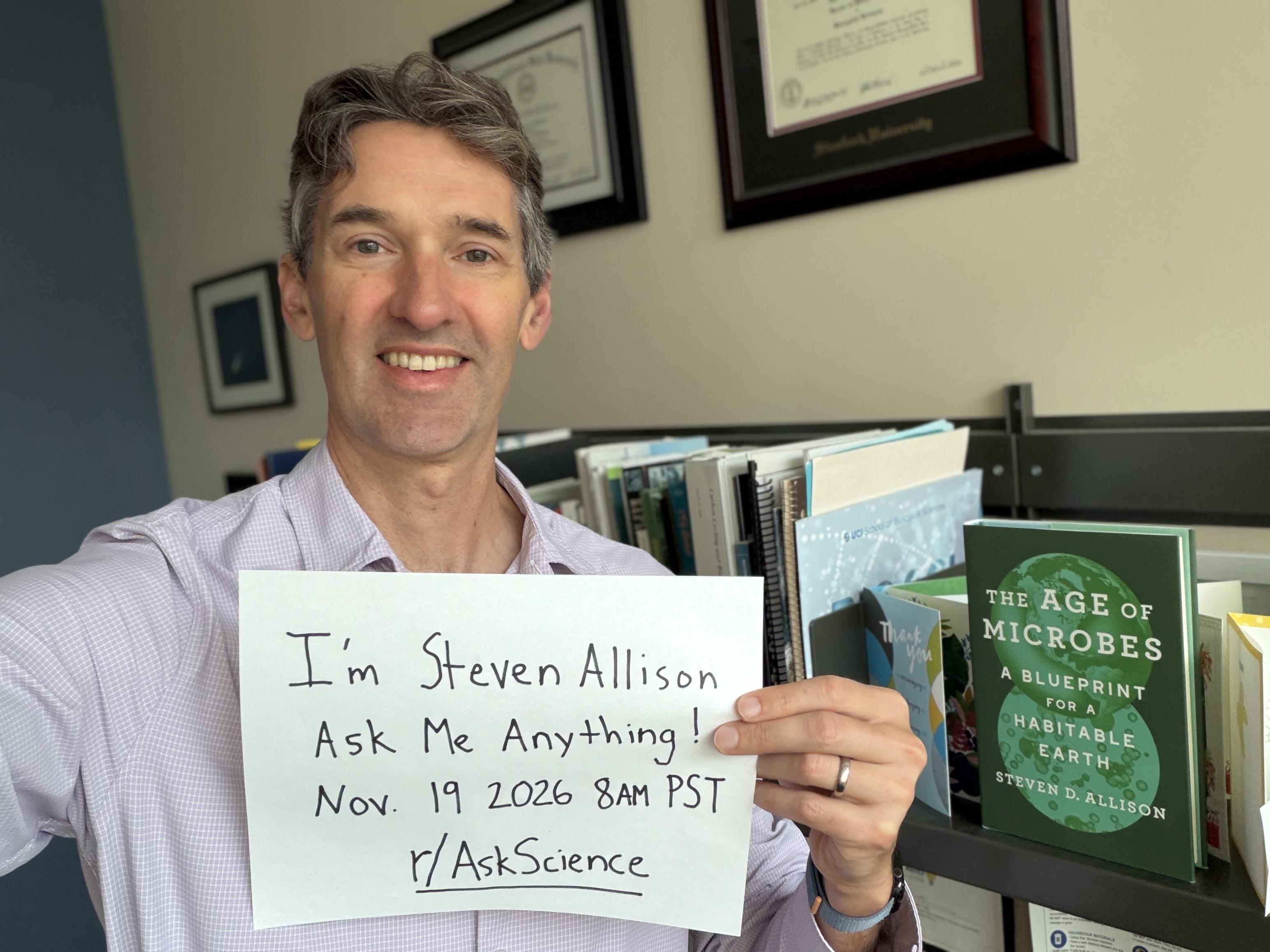
Biology AskScience AMA Series: I’m Steve Allison, a professor of ecology at the University of California, Irvine, and author of The Age of Microbes. I study how bacteria and fungi might address global challenges like climate change and food insecurity. Ask me anything!
Hi Reddit, I'm Steven D. Allison, a professor of ecology at the University of California, Irvine. For over twenty years, I’ve explored the often-unseen roles microbes play in the world around us, including how they influence soil carbon cycling and ecosystem resilience.
From scorching temperatures and deadly fires to flooding and food shortages, the signs of a changing climate are everywhere. Microbes offer one hopeful answer: they have evolved through billions of years of environmental change; they’re remarkably diverse, easy to study, and unleashing their potential could help reduce greenhouse gas emissions and strengthen the climate resilience of human and natural communities.
In The Age of Microbes: A Blueprint for a Habitable Earth, I explore how these adaptable organisms might contribute to climate solutions—from supporting crops and restoring ecosystems to reducing carbon emissions.
Today, scientists are learning to discover, evolve, and engineer microbes that can, for example, remove pollutants from drinking water. By bringing together experts from different walks of life—like farmers, scientists, land stewards—there is renewed hope for harnessing microbes in ethical, sustainable ways to build a more resilient future.
I’m here to answer your questions about microbiomes, soil, climate change, carbon cycling, agriculture, ecosystem restoration, and the promise and challenges of microbial climate solutions. I'll see you at 8am-11am Pacific time (11am-2pm ET, 16-19 UT), ask me anything!
Psst: Redditors can take 30% off my book with code AGE30. If you want to learn more about my research, here’s a link to my lab’s website.
Username: u/Steven-Allison
8
u/run4moretacos 9d ago
Former student here (UCI 2016), do you still lecture without powerpoint slides?
I loved that you just wrote everything on the whiteboard
7
u/m0arcaffeine 9d ago
Could plastic eating bacteria be a feasible solution to plastic pollution at some point? (Or other types of microbes that could break down some other of pollution types that I couldn't think while writing this)
8
u/Yassum 9d ago
Since we know the best way to deal with climate change is lowering carbon release, do you think there is a risk that all the technological proposals like yours just give excuses to delay action and may be doing more harm in the long run? How do you address this in an ethical way, especially when there are financial incentives from think tanks, fossil fuel industry, or book sales to overhype the potential of such technologies (like carbon capture)?
3
u/unclebennett 9d ago
With growing interest in geological carbon sequestration (e.g., injecting CO2 deep underground), how can we ensure that the carbon actually stays there? Also, what role do subsurface microbial communities play in the stability of stored carbon? Could microbial metabolism influence CO2 mineralization, alter subsurface geochemistry, and/or potentially increase leakage risks?
And are there alternative approaches, perhaps even microbially mediated ones, that might offer more reliable long-term carbon storage?
3
u/Snoo79497 9d ago
Given that much of microbial diversity, particularly in soils, remains undiscovered and difficult to culture in the lab, how do you go about identifying potentially important microbes and characterizing their functions? I imagine that genomic approaches are also limited by the underrepresentation of soil microbes in reference databases, and that genomic potential doesn't necessarily translate to realized function in a community.
More broadly, when studying ecosystem processes like soil carbon cycling, how do we disentangle the contributions of individual taxa from community-level contributions? And how can we distinguish the effects of microbial community composition on ecosystem function from those of environmental conditions?
3
u/TheBestMintFlavour 9d ago
Is there any study or effort currently underway to coordinate or accelerate the pioneering effects of certain microorganisms (or communities of microorganisms and supporting macro systems) on degraded, depleted, or even abiotic environments?
3
u/Steven-Allison Microbes and Environment AMA 9d ago
Someone just posted this question on my LinkedIn, so I'll post it along with my answer here.
3
u/Clean_Livlng 9d ago
I've been thinking of growing oyster mushrooms. One thing I came across is the phenomenon of senescence, or the mycorrhizae getting 'weaker' or less able to fight back green mold after a number or generations of taking pieces of it to clone the organism onto new substrate to keep mushroom production going.
I was disappointed to read this, as it's be so much more convenient to be able to simply keep at-home mushroom production going indefinitely, without dabbling in more advanced techniques.
I've also read that oyster mushrooms in the wild might not senesce, and could keep going indefinitely.
How close are we to understanding this phenomenon, and will there likely be ways to prevent it so that mushroom/fungi cultivation is easier in the future for your average person? I've read that this can also be a problem for soy sauce production, with the culture becoming less efficient over time.
Immortal fungi that keep producing what we want efficiently without 'getting old' would be ideal, could we achieve this one day soon? e.g. via genetically modified fungi, or different growing and cloning techniques.
If someone buys an oyster mushroom growing kit and has success with it, it sounds like eventually they'll need to buy another one from a supplier even if they keep trying to clone it onto new substrate. This is a barrier to mas adoption of mushroom growing, since a lot of people don't like to have to keep paying money for new mushroom growing kits.
It might be a small thing on an individual level, but imagine if it was easy for everyone to grow large amounts of mushrooms at home for consumption in an environmentally friendly way, without having to keep paying for new grow kits eventually due to senescence problems.
2
u/grantego 8d ago
Curious about how mycorrhizal networks maintain resilience during extreme heat events. In my garden, the fungal mats seem to die back hard after heatwaves, but they recover surprisingly fast once rain hits. Do you see similar stability patterns in field studies, or is it more fragile than we think?
1
u/Ashokhaldar 9d ago
What is the next plan in ISS
1
u/BozoidBob 5d ago
So there’s this species of Chinese mushrooms that create visions of little people when consumed, while containing no known hallucinogenic compounds. Is it reasonable to assume that these little folk actually exist on an existential plane different from ours? Can we all start consuming these fungoids to make contact with our hither too unknown neighbors? Together, could we solve the problems of global warming and AI run amok? Why or why not? Thank you for your attention to this matter.
0
u/Kohnaphone 9d ago
What is this I’m hearing about the rise of parasitic fungi infesting peoples brains more and more?