r/asl • • May 03 '25

Interest The Free ASL Resources and FAQ Thread Needs an Update!

34 Upvotes

Hi, the following post is a copy paste from the current pinned thread with edits to update a few resources. This was originally posted by u/Indy_Pendant eight years ago. They did an excellent job and I’m trying to preserve as much of it as possible. Since this post was made, other Deaf creators and resources have become available. I simply want to point prospective learners in the right direction. My information is relatively subjective, curated from this sub in the last year. Please, share your opinions, resources you like or to stay away from. I’ll update the post as needed and track the changes in a comment. Without further ado:

Hello! I'm here to help as much as I can, but this is not a comprehensive guide or a substitute for classes. This is a quick resource for people looking for answers to some very commonly asked questions. I've included the information as I know it, but it doesn't mean it's The Truth; my experiences and understanding will vary from others', but this will give you a good enough introduction. There's so much more I'd love to teach you, but I'm going to stick to the FAQs.

Where can I learn ASL online for free?

My personal favorite is easily http://www.lifeprint.com (which is mirrored at http://asluniversity.com as well). The guy who built the site, Dr. Bill Vicars, is Deaf and is a phenomenal teacher. He teaches primarily west-coast dialect (California, Washington common signs) but makes mention of other dialects (east-coast, Texas) when he can. In addition to teaching vocabulary, he teaches about Deaf culture (more on this in a moment). His Youtube channel is https://youtube.com/@sign-language. Other notable resources are:

Where can I pay to learn ASL online?

I’m hearing, can I learn ASL

Yes! It’s not disrespectful to learn ASL. We just ask that you learn from Deaf sources, learn Deaf culture, and don’t harm the community. Learning so you can connect with Deaf patrons: good. Learning so you can market and sell to Deaf patrons: harmful. Learning so you can cuss in a new language: bad.

Additionally, if you are a nurse, doctor, lawyer, realtor, therapist, or anyone working with a Deaf person through a life changing experience, your client/patient has the right to access the conversation. You will need to put your ASL knowledge aside and hire an interpreter. It’s great that you want to learn, but there are times when having only a handful of ASL is harmful.

What's the sign for ... ?

The short answer is "it depends." Sometimes. It depends sometimes.

The long answer is that signs will vary. Signs can be different depending on region, as I mentioned before, so just because you see it one way doesn't mean that it's the only way. (Don't make this mistake; a lot of hearing students can get cocky and start correcting others.) Signs can also change depending on context. The signs for "back" in "My back hurts" and "Let's go back home" are completely different.

Also, this is very important: ASL is not English! It is its own language, as different from English as is Klingon. ASL has its own grammar structure, own idioms, own slang. Signs are also not words like in the English sense. Signs are a lot more about intent, concepts, and ideas. For example, if you're trying to learn how to sign "Back off!" I can promise you that you will not need any sign for "back" nor "off." You're learning how to speak, and think, in another language, and using English just won't do.

Now, with all that said, here are some online dictionaries (I suggest you look at them all so you're familiar with the different variations of your sign):

Does it matter what hand I sign with?

Yes. Consistently use your main, dominant hand. If you're right-handed, use your right. If you're left-handed, use your left. If you're ambidextrous, then pick one and maintain it. Switching dominant hands while signing would be like alternating screaming and whispering while speaking.

Are American Sign Language and British Sign Language the same?

Are English and Japanese the same? ASL is not English, so stop thinking of it like English! :) In fact, ASL is derived from French Sign Language, which evolved independently of British Sign Language, and the two are mostly different (in fact, less than 30% of the signs are even remotely similar). There are hundreds of sign languages in the world. Even in the United States, there are several distinct dialects of ASL, including Black ASL.

Why do you keep capitalizing "Deaf"?

We use "little-d" deaf to mean someone who physically can't hear well. We use "big-D" Deaf to mean someone who is culturally deaf. Now an interesting bit: someone who is Deaf does not have to be deaf, and someone who is deaf does not have to be Deaf! For instance, children of deaf adults (CODAs) are very often Deaf but hearing. Many people are physically deaf but aren't part of Deaf culture. It's about how a person self identifies and where their culture lies more than it does with anything physical.

What's this "Deaf Culture" you keep mentioning?

It'd take me hours to explain it all, and I usually spread it over my entire 12-week class. In short, many deaf people, specifically those who identify as Deaf, live in a different culture than you do. Yes, they're from your country, they drink Starbucks and they sit in traffic, but they have their own distinct culture. Obviously this includes language (and communicating in real ASL is so different than talking in English that it's hard to describe), but that different method of communication, that different way of thinking, is only part of Deaf culture. Things that are normal in one culture can be very strange the another. (My favourite, probably, is talking with your mouth full. In hearing culture, that's a big no-no and your mother will look at you very cross. In Deaf culture, that's totally acceptable! Stuff your face and then free your hands for conversation, it's great! So much more efficient!) Morality and ethics are shaped by our cultural values. There are aspects of Deaf culture which would be considered blunt or rude in hearing culture, and conversely there are a lot of things normal in hearing culture which are strange or disrespectful in Deaf culture (such as talking to someone's back, or looking around during a conversation). It's important to be aware of and respectful of other cultures, including Deaf culture, and, when possible, to learn about them. Not only will it ingratiate you to people of that culture, but it'll better yourself as a person as well.

Isn't it wrong to say "deaf"? Shouldn't I say "hearing impaired" or "hard of hearing"?

Nope, and nope. Now, before I continue, I'll let you know that not everyone agrees with me, and I'm speaking in a general sense. Big-D Deaf people prefer the term "deaf" above any other. (It's how a US Senator might feel being called "American." Some people would take it as an insult, but it's just a matter of fact or pride for the Senator.)

Whether people identify themselves as "deaf" or "hard of hearing" (often seen as HoH) is often a matter of self identity, and while it can correlate to level of ability to hear, it isn't caused by it. I'll explain later. Deafies who are a part of Deaf culture will almost always call themselves "deaf," and those who aren't a part of Deaf culture will usually go by "hard of hearing" (or more rarely "hearing impaired"). In general, those who are less physically deaf, or who were raised strictly in hearing culture, will tend to gravitate toward hearing culture, despite the numerous difficulties. These people will commonly say they are "hard of hearing" since "deaf" still has a social stigma in hearing culture. Those who are less capable of integrating with hearing culture, or who were introduced to or raised in a Deaf environment, will usually prefer to be called "deaf" and can sometimes take one of the other terms as a slight offense.

In general, it's almost never correct to say "hearing impaired." I was taught that it was coined by a US Senator who wanted to protect deaf people's feelings from something that didn't offend them in the first place, and it was never accepted by Deaf (the core reason being that we don't believe being deaf is an impairment; it'd be like if I said you were "Deaf impaired." You don't feel impaired, do you, however much I might think it's true?) in general. In fact, it's safe if you never use this phrase again.

When in doubt though, just ask! "Hey, do you prefer 'deaf' or 'hard of hearing'?" See, it's not that hard. :)

I saw a sign that looks like this ..., what does it mean?

We're happy to help with these kinds of questions. I treat it like a quiz show game. However, if you're new to this, you may not know how to describe a sign very well, so let me introduce you to signs!

A sign consists of five parts:

  1. Hand shape: Are the fingers making an "O"? Were the thumb and middle-finger touching? If you know some basic ASL, you can use hand shape identifiers, such as "A hand shape" or "8 hand shape".
  2. Position: Where in relation to the body was the sign? Near the chest? Near the eyes? Was the palm facing up, down, toward the signer?
  3. Movement: How did the sign move or change? Was it pushing away from the body? Was it a small circle in space?
  4. Non-manual markers: What else was happening with the signer's body? What did her face look like? Was he moving his body, or shrugging? What was the emotion the signer was portraying?
  5. Context: What else was happening before or after the sign. Were there other signs you recognized? Do you know the subject that the signer was communicating about?

Where can I find a Deaf group in my area?

Where's your area? Most major cities have Deaf hubs. San Francisco, Seattle, Austin, and New York all have strong, vibrant, rich Deaf communities. Smaller cities may have meet ups or the like, but they can be harder to track down. Your best bet is to turn to Google or Facebook and search for Deaf events in your area. "Deaf coffee night" is an event held nationwide. People in the community get together for a night or two each month, usually at a coffee shop with good lighting and ample seating, just for the purpose of seeing friends and making new ones. Local colleges or universities will often have ASL/Deaf clubs and usually host student-friendly ASL events, so check with the ASL teachers or the ASL campus group, if it exists.

Can I still ask questions here?

Yes! Yes! 1000 times yes! Many of us are here to help, and anything we can do to help teach you about the language and the culture we're happy to do.

Will you do my homework for me?

Nope. Nope. 1000 times nope. It's obvious when students are looking for someone to do their homework for them, and we're not gonna help you out. If you're here to learn instead, then welcome! Come make some new friends. :)


r/asl • • Mar 06 '17

The Free ASL Resources and FAQ Thread!

650 Upvotes

Hello! I'm here to help as much as I can, but this is not a comprehensive guide or a substitute for classes. This is a quick resource for people looking for answers to some very commonly asked questions. I've included the information as I know it, but it doesn't mean it's The Truth; my experiences and understanding will vary from others', but this will give you a good enough introduction. There's so much more I'd love to teach you, but I'm going to stick to the FAQs.

Where can I learn ASL online for free?

My personal favourite is easily http://www.lifeprint.com (which is mirrored at http://asluniversity.com as well). The guy who built the site, Dr. Bill Vicars, is Deaf and is a phenomenal teacher. He teaches primarily west-coast dialect (California, Washington common signs) but makes mention of other dialects (east-coast, Texas) when he can. In addition to teaching vocabulary, he teaches about Deaf culture (more on this in a moment). Other notable resources are:

What's the sign for ... ?

The short answer is "it depends." Sometimes. It depends sometimes.

The long answer is that signs will vary. Signs can be different depending on region, as I mentioned before, so just because you see it one way doesn't mean that it's the only way. (Don't make this mistake; a lot of hearing students can get cocky and start correcting others.) Signs can also change depending on context. The signs for "back" in "My back hurts" and "Let's go back home" are completely different.

Also, this is very important: ASL is not English! It is its own language, as different from English as is Klingon. ASL has its own grammar structure, own idioms, own slang. Signs are also not words like in the English sense. Signs are a lot more about intent, concepts, and ideas. For example, if you're trying to learn how to sign "Back off!" I can promise you that you will not need any sign for "back" nor "off." You're learning how to speak, and think, in another language, and using English just won't do.

Now, with all that said, here are some online dictionaries (I suggest you look at them all so you're familiar with the different variations of your sign):

Does it matter what hand I sign with?

Yes. Consistently use your main, dominant hand. If you're right-handed, use your right. If you're left-handed, use your left. If you're ambidextrous, then pick one and maintain it. Switching dominant hands while signing would be like alternating screaming and whispering while speaking.

Are American Sign Language and British Sign Language the same?

Are English and Japanese the same? ASL is not English, so stop thinking of it like English! :) In fact, ASL is derived from French Sign Language, which evolved independently of British Sign Language, and the two are mostly different (in fact, less than 30% of the signs are even remotely similar). There are dozens and dozens of sign languages in the world, and even in the United States ASL is not the only one used.

Why do you keep capitalizing "Deaf"?

We use "little-d" deaf to mean someone who physically can't hear well. We use "big-D" Deaf to mean someone who is culturally deaf. Now an interesting bit: someone who is Deaf does not have to be deaf, and someone who is deaf does not have to be Deaf! For instance, children of deaf adults (CODAs) are very often Deaf but hearing. Many people are physically deaf but aren't part of Deaf culture. It's about how a person self identifies and where their culture lies more than it does with anything physical.

What's this "Deaf Culture" you keep mentioning?

It'd take me hours to explain it all, and I usually spread it over my entire 12-week class. In short, many deaf people, specifically those who identify as Deaf, live in a different culture than you do. Yes, they're from your country, they drink Starbucks and they sit in traffic, but they have their own distinct culture. Obviously this includes language (and communicating in real ASL is so different than talking in English that it's hard to describe), but that different method of communication, that different way of thinking, is only part of Deaf culture. Things that are normal in one culture can be very strange the another. (My favourite, probably, is talking with your mouth full. In hearing culture, that's a big no-no and your mother will look at you very cross. In Deaf culture, that's totally acceptable! Stuff your face and then free your hands for conversation, it's great! So much more efficient!) Morality and ethics are shaped by our cultural values. There are aspects of Deaf culture which would be considered blunt or rude in hearing culture, and conversely there are a lot of things normal in hearing culture which are strange or disrespectful in Deaf culture (such as talking to someone's back, or looking around during a conversation). It's important to be aware of and respectful of other cultures, including Deaf culture, and, when possible, to learn about them. Not only will it ingratiate you to people of that culture, but it'll better yourself as a person as well.

Isn't it wrong to say "deaf"? Shouldn't I say "hearing impaired" or "hard of hearing"?

Nope, and nope. Now, before I continue, I'll let you know that not everyone agrees with me, and I'm speaking in a general sense. Big-D Deaf people prefer the term "deaf" above any other. (It's how a US Senator might feel being called "American." Some people would take it as an insult, but it's just a matter of fact or pride for the Senator.)

Whether people identify themselves as "deaf" or "hard of hearing" (often seen as HoH) is often a matter of self identity, and while it can correlate to level of ability to hear, it isn't caused by it. I'll explain later. Deafies who are a part of Deaf culture will almost always call themselves "deaf," and those who aren't a part of Deaf culture will usually go by "hard of hearing" (or more rarely "hearing impaired"). In general, those who are less physically deaf, or who were raised strictly in hearing culture, will tend to gravitate toward hearing culture, despite the numerous difficulties. These people will commonly say they are "hard of hearing" since "deaf" still has a social stigma in hearing culture. Those who are less capable of integrating with hearing culture, or who were introduced to or raised in a Deaf environment, will usually prefer to be called "deaf" and can sometimes take one of the other terms as a slight offense.

In general, it's almost never correct to say "hearing impaired." I was taught that it was coined by a US Senator who wanted to protect deaf people's feelings from something that didn't offend them in the first place, and it was never accepted by Deaf (the core reason being that we don't believe being deaf is an impairment; it'd be like if I said you were "Deaf impaired." You don't feel impaired, do you, however much I might think it's true?) in general. In fact, it's safe if you never use this phrase again.

When in doubt though, just ask! "Hey, do you prefer 'deaf' or 'hard of hearing'?" See, it's not that hard. :)

I saw a sign that looks like this ..., what does it mean?

We're happy to help with these kinds of questions. I treat it like a quiz show game. However, if you're new to this, you may not know how to describe a sign very well, so let me introduce you to signs!

A sign consists of five parts:

  1. Hand shape: Are the fingers making an "O"? Were the thumb and middle-finger touching? If you know some basic ASL, you can use hand shape identifiers, such as "A hand shape" or "8 hand shape".
  2. Position: Where in relation to the body was the sign? Near the chest? Near the eyes? Was the palm facing up, down, toward the signer?
  3. Movement: How did the sign move or change? Was it pushing away from the body? Was it a small circle in space?
  4. Non-manual markers: What else was happening with the signer's body? What did her face look like? Was he moving his body, or shrugging? What was the emotion the signer was portraying?
  5. Context: What else was happening before or after the sign. Were there other signs you recognized? Do you know the subject that the signer was communicating about?

Where can I find a Deaf group in my area?

Where's your area? Most major cities have Deaf hubs. San Francisco, Seattle, Austin, and New York all have strong, vibrant, rich Deaf communities. Smaller cities may have meet ups or the like, but they can be harder to track down. Your best bet is to turn to Google or Facebook and search for Deaf events in your area. "Deaf coffee night" is an event held nationwide. People in the community get together for a night or two each month, usually at a coffee shop with good lighting and ample seating, just for the purpose of seeing friends and making new ones. Local colleges or universities will often have ASL/Deaf clubs and usually host student-friendly ASL events, so check with the ASL teachers or the ASL campus group, if it exists.

Can I still ask questions here?

Yes! Yes! 1000 times yes! Many of us are here to help, and anything we can do to help teach you about the language and the culture we're happy to do.

Will you do my homework for me?

Nope. Nope. 1000 times nope. It's obvious when students are looking for someone to do their homework for them, and we're not gonna help you out. If you're here to learn instead, then welcome! Come make some new friends. :)

r/asl • • 7h ago

Is there an equivalent to "speech impediments" in ASL?

6 Upvotes

For instance, I am physically incapable of lowering my pinky independent of my ring finger. In my particular case, I wonder how people like me would sign the letter W at speed. If I can get my thumb over my pinky, I can pull it down hard enough that I can raise my ring finger to complete the W, but it requires much more effort than any of the other letters.

I also assume there are other similar limitations that make some signs or shapes difficult for speakers of ASL. Are there any common "impediments" that most native signers would know (like a lisp where /s/ is replaced with /θ/, or a gliding R where /r/ is replaced with /w/, etc.)

EDIT: Just to clarify, I was not trying to suggest that any of this would be or should be a "big deal." Genuinely just curious how these limitations are dealt with (are there patterns of alternatives such as an [r] to [w] switch or a [s] to [θ]) and where I can I learn about alternatives for people dealing with them.


r/asl • • 7h ago

Iam not deaf, but i wanna learn asl. What would you recommend?

5 Upvotes

Hi! Iam not deaf, but ive been wanting to learn at least some basics of asl or czech sign language (bcs there where iam from 😊).

First of all i wanted to ask, what are some good apps/books/websites where i could learn? (I already know the alphabet but i feel like its not much)

The second thing is that iam afraid that if i learn asl online, then czech people wont understand me. Are the differences among those languages very significant?

Also what do deaf people think of hearing people who want to learn sign language? Do you think those people are annoying and wont do it or that its actually achieveable to learn just for fun and for just in case situations?

Hope this doesnt come across as rude, iam genuinely curious and want to learn and help people around me! ❤️


r/asl • • 14h ago

How do you start learning ASL without getting overwhelmed?

17 Upvotes

For anyone who started from scratch, how do you begin without getting overwhelmed?

I want to start learning American Sign Language (ASL), and I don't want to jump around randomly and get burned out. I simply want to learn this language because I want to be able to communicate with deaf people, and I might also be able to use it in my future jobs that might involve ASL.

What apps or habits might help me to achieve this goal of mine?


r/asl • • 3h ago

What are some signs that were more commonly used in the 80s and 90s that aren't as common today?

2 Upvotes

I've noticed THAT (not the one handed version, the 2-handed non referential version i.e: THAT APPLE) was seemingly used a lot more in lectures and videos I see of signing from the 80s. I just don't see it as often, except with older signers. Are there any others?


r/asl • • 5h ago

like Chatroulette? What if we did that in ASL?

Post image
2 Upvotes

Hey everyone!

I'm trying something a little different and thought this community might be interested!

Remember the random chats with strangers on Omegle? The idea is similar, but instead of talking, we're meeting and chatting in ASL!

I'm hosting a free online Voices Off event on Friday, November 27, from 5–7 PM Pacific.

Here's how it works:

  • register in advance
  • Friday drop into the online room anytime between 5 and 7 pm
  • Get matched with a random person.
  • Chat in ASL for 5 minutes.
  • When time's up, meet someone new

No lesson, no instructor, no pressure. Just spontaneous conversations and meeting people through ASL.

Whether you're Deaf, a longtime signer, or learning ASL, you're welcome to join.

It's hosted by Visually Speaking, ASL education and community business in Seattle.

Registration is free: https://app.visuallyspeaking.info

Would love to see some new faces (and hands!) there!


r/asl • • 8h ago

Any free ASL/FSL tools to use or watch? How do you find them?

2 Upvotes

Specially FSL. I'd like to hear from the people's experience as I was still building my savings and wanna pour ny free time into learning new skills to also help me with my job for better communication.


r/asl • • 1d ago

Help! Can someone translate this chimpanzee from GTA 6?

344 Upvotes

Basically, I’m doing some side mission in GTA six which involves us breaking into a chimp sanctuary and long story short I end up seeing this chimpanzee who communicates a pretty long message through sign language and I think I could kind of inference a little bit what it’s saying, but if somebody could translate it that would be great ( I’m pretty sure it’s some wild s*** )


r/asl • • 11h ago

ASL Immersion Events 2027?

0 Upvotes

I’d love to attend a multi-day ASL conference or camp. Do you know of any happening in 2027? Ideally be willing to travel anywhere in the US for ideally 3-5 days of immersion.

For context: I’ve taken ASL 1-4 and am involved in my local Deaf community, but a longer immersion experience seems so beneficial. At Deaf events, I’m getting maybe up to one hour of conversation a week, and it’s hard to advance toward fluency with that. (I’m hoping to become an interpreter eventually but for various reasons can’t attend school full time yet.)


r/asl • • 1d ago

Interest Songs in Sign Language Reimagines Disney Musical Moments in ASL

Thumbnail
youtu.be
46 Upvotes

Making of “Songs in Sign Language”

https://youtu.be/0pTvm1Pz8i8?si=uKH_cD8M7nA8qCDd

Animated vs Interpreted

Disney Music ASL

https://youtube.com/playlist?list=PLiNVoBckLqLkas5FBUEyptV__pu_QkNAQ&si=myUMotQCPnqoOOTD

Which do you prefer? Why?


r/asl • • 12h ago

Help! Questions as a new learner

1 Upvotes

These may very well be questions I can look up and get answers to, but I’d like to hear it from asl users themselves.

1.I am currently using ASL bloom, which I have heard very good things about, but I’d like to double check. Is it a good app to be using? I know the educators are deaf, and I also know that people stress over learning from deaf and not hearing asl users.

2. I learned recently that it may be rude to not hold eye contact. .. As a beginner, I’m worried I’ll come off the wrong way if I’m trying to focus on the signs someone is doing instead of their eyes. Is that something I should be worried about? Will that come off rude?

Thank you so much ❤️


r/asl • • 1d ago

Interpretation They'll .... ASL

10 Upvotes

This may qualify as "how to sign" but I'm interested in both ASL and English answers. If you're referring to someone who signs what verb would you use? (Specifically with this construction. I know casually it'd be "they sign" but if you're specifying the language.)

They use ASL

They speak ASL

They sign ASL

They know ASL

Is it situational? What about if someone is learning? They'll know/speak/sign/use/other ASL?


r/asl • • 1d ago

Research Opportunity for d/Deaf and HOH

Post image
8 Upvotes

Do you identify as d/Deaf or Hard of Hearing? Are you interested in sharing your perspective on communication devices as language supports for Deaf autistic children?

You may be eligible to participate in a research study conducted through Drexel University’s Speech-Language Pathology Department. This student research project (master’s capstone/thesis) explores perspectives within the Deaf community regarding augmentative and alternative communication (AAC) devices and ways these devices and related services may better meet the communication and cultural needs of Deaf autistic children.

To participate, you must:
• ⁠Be 18 years of age or older
• ⁠Reside in the United States
• ⁠Identify as Deaf, d/Deaf, or Hard of Hearing

If you are interested in participating, please consider completing a short, anonymous online survey:
https://drexel.qualtrics.com/jfe/form/SV_9EwDfESbWvCoDX0

Your participation is voluntary. The survey is anonymous, and you may choose not to participate or stop at any time.

Thank you for considering participating in this research study and for sharing your perspective. Your input may help inform future research and practice related to AAC and communication services for Deaf autistic children.

For questions about the study, please contact:

Deanna Amoriello, B.S.
Graduate Student, Class of 2027
Department of Speech-Language Pathology
Drexel University, Elkins Park Campus
College of Nursing and Health Professions
da963@drexel.edu

Thank you!


r/asl • • 1d ago Bravo

facial expressions (FE)/non manual markers (NMM)

20 Upvotes

Continue see post ask FE)NMM important for ASL.

Facial expressions (FE)/ non manual markers (NMM) VERY important for ASL.

YES!!!

Autism not excuse!

FE/NMM information context show.

NMM easy learn rule establish.

Example question WH eyebrow down or question yes no eyebrow up.

NMM for size mouth move involve.

FE excite sad confuse important.

If continue confuse after read post SEARCH "non manual markers" will find many post same question!


r/asl • • 2d ago

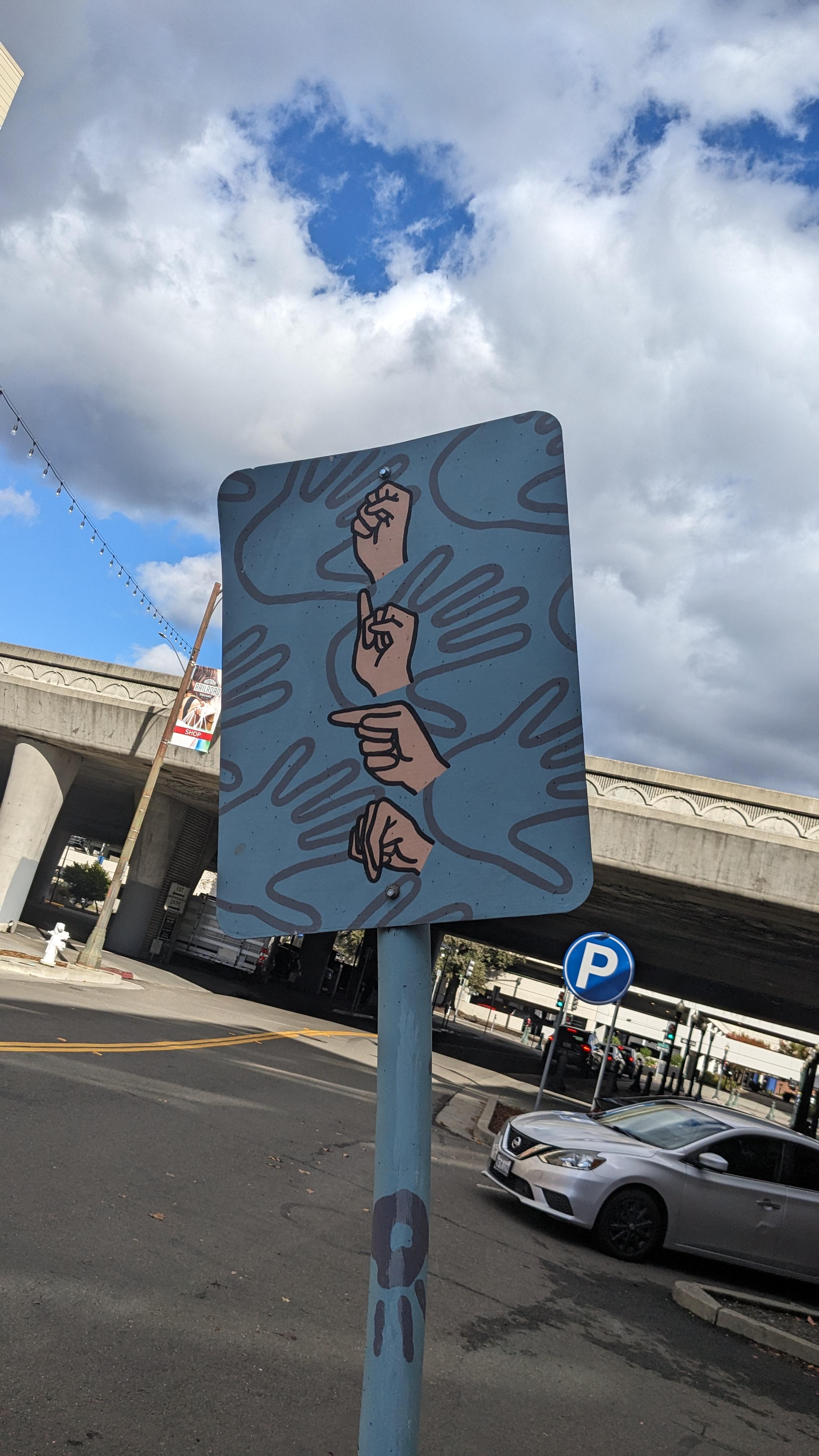
Can anyone translate this sign?

Post image
742 Upvotes

The first three look like SIG, making me think the last would be an N, but it doesn't look like it. This is in California.


r/asl • • 1d ago

I have a fear in the back of my head that I’ll meet deaf signers one day and I wont know whether I should sign or not.

5 Upvotes

id feel like im taking advantage of their real life deafness and communication barriers as an opportunity to practice my ASL. so to the deaf people, would you rather I ,1, mention im learning sign language and offer to communicate that way? youd have to sign slow and be a little patient with me but I can hold my own for a bit. or 2, communicate however else we were going to if i didnt know any ASL, interpreter, text, writing etc.

edit: im sure ASL event would probably be more appropriate to try to sign rather than just out and about. im more referring to if a deaf customer comes in to my job. random stuff like that.


r/asl • • 2d ago

Help! Help me understand

19 Upvotes

I only understood half of the video:
NOW WEEK EVERY REMEMBER GO-TO BUSY WITH I WANT
I can’t really make sense of that..


r/asl • • 2d ago

Very sweet moment today that I wanted to share

61 Upvotes

I’m a Deaf teacher. I teach special education for 5th/6th grade. All of my students are hearing.

Every day I take my group of special education students out of their regular classrooms to work on basic foundational skills. After we’re done, we go back to the regular classroom.

On fridays I do progress monitoring, which involves one-on-one assessments. So I usually find an activity for the rest of the class to do while I assess each student individually. Today I put a picture of the ASL alphabet on the board, and assigned them to partner up, try and have a conversation about anything they want using only spelling, and then write about their experience after 15 minutes.

After the class, one student asked me to print out the sheet for her. Several other students also asked for a copy as well. So I printed them out and gave them to them.

We went back to the regular classroom with the rest of their classmates. Twenty minutes later, I noticed one of the printouts was making its way around the classroom, and every student wanted to see it and try to make the letters. Then they would pass it on to the student next to them.

It was really cool and warmed my heart to see all these hearing kids so interested in learning ASL. Just thought I’d share.


r/asl • • 2d ago

Help! How important are facial expressions

7 Upvotes

I'm teaching myself basic ASL because I'm autistic and when I get overstimulated, it calms me down to be selectively mute. I can still speak, it's just not preferred. The only issue is as I'm trying to research and teach myself ASL, it's come up that I need to have certain facial expressions to help people interpret my signs or grammar. My autism usually interferes with my facial expressions, just as it does my verbal tone, and it's difficult for me to be anything but neutral. Is this going to make understanding me difficult, or is it an over exaggeration? I don't know how to fix it, and fixing it will take a lot of work so I also wonder if it's worth it/necessary. Sorry for the ramble


r/asl • • 1d ago

Help! Need help transcribing a video

0 Upvotes

Hey everyone, I doubt this will be perceived well but it’s my last chance for help. My ASL 2 class has been great but it’s my teachers 1st year doing online so naturally we’re behind a little bit and we are getting close to the end of the semester. We have to transcribe a video and I know the just of it, it’s what you want to do before you die. I know she has 5 things and some of those things include helping deaf children read, getting married and having children of her own. But I can’t really understand the meat and potatoes of it. Any help would be appreciated.

https://youtu.be/1XYg7dDsDeM?is=Wzt2vzXBvYyIasQO


r/asl • • 2d ago

Grammar Practice Resources?

3 Upvotes

I'm learning ASL online (Bill Vicars—I just completed lesson 40! 🙌🏻) His videos offer some exposure to ASL syntax but are mostly vocab. This is still an amazing resource. It's helped me learn enough to chat with the Deaf teachers at my daughter's school. However, while I can keep up if they're patient with me, I often get lost because I misinterpret what they're saying. (Example: in lesson 40, Bill signs "WELD YOU KNOW SOMEONE CAN?" I interpreted this as "do you know if someone can weld?" which made no sense. The correct interpretation was "do you know someone who can weld?")

Bill has a lot of written material explaining ASL grammar that I still need to comb through. But also I'd love a resource that helps me practice thinking and signing with ASL grammar. I'm thinking, like, practice sentences written in English that I can then sign/translate into ASL. And an "answer key" I can reference after to see if I did it right. I think this would help both my expressive and receptive skills.

Any resources you know of would be great, thanks!

(P.S. Unfortunately, my current financial status prohibits me from paying for tutoring or classes, so I am looking for free resources if they exist.)