Typescript reasons perhaps. A function taking a parameter of type T and returning void is != a react setstate dispatch function typed with <T>. Somewhere else there’s a parameter defined as a function with the simple signature (show: boolean): void
Probably. Could just be shit, idk
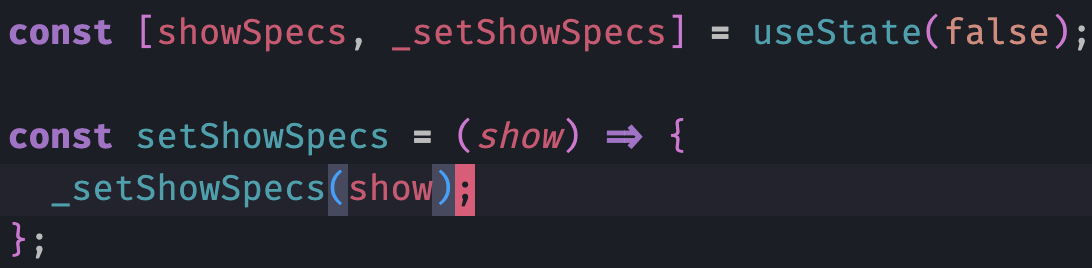
Edit: the type of the setter function returned from useState is: React.Dispatch<React.SetStateAction<T>> so maybe the code writer here wrapped it in a simpler typed function: (value: T) => void where T is whatever type your bit of state is (boolean in this case I think) so that some other component can expect it in props without specifically expecting the more complex signature. Not a particularly good pattern. Idk, I could be wrong, just my best guess approaching from the assumption someone did it for a reason
Edit2: don’t wrap setters like this btw. They’re not interchangeable although they may appear to be. You gain solid functionality in a Dispatch<SetStateAction<T>> - such as implicit access to the current state by passing a function into the setState call with the first parameter being the current value of the state, like: setShow((currShow) => !currShow). Can’t do that with the wrapped function (value: T) => void. Sure, if you’re only ever calling it with True or False it’s fine. Soon as you need to setState(!state) you need the current state which isn’t necessarily available if you just passed down a faux setter function
This is not how void works in js or ts. A declared return type of void will result in a compile error if it does anything other than return undefined.
Note that void is actually an operator, which is expanded to void 0 if no expression is provided, but always returns undefined regardless.
void’s main value in js is in enforcing that a function that previously returned undefined can be counted on to continue to return undefined even if the function itself changes, for example
button.onclick = () => void doIt();
However in practice I’ve never personally found it useful for anything, and as a type annotation I think undefined is clearer.
It's not at all abstract nonsense. There is a big difference between a function that truly never returns (type never), and one that returns null/undefined (type void).
The former is expected to run forever, or throw an error. If you await this function, it will never resolve.
The latter function completes and will resolve if you await it.
This is an important distinction, and is extremely helpful for debugging if you have your types correct.
The person you’re replying to didn’t word things very well. The never type enforces that anything following is unreachable, and an error. reaching a returned never is a compile-time error. Can be used for things like exhaustiveness checking for pattern matching, eg making sure your switch-case covers all possible scenarios by making the default case a return-never. If you don’t cover all possible cases, the never is reachable, and thus is a compile-time error.
They’re also just wrong about the void return type in TypeScript. If your function ultimately returns a value, then having a declared return type of void will be a compile-time error.
They were not wrong in most cases. The only case in which returning a non-undefined value in a void function will be an error is if you define a function with the function (): void (or respective method) syntax. In no other scenarios will it be an error.
This is badcode, all different types of folk here, and lots of things get misunderstood with folk speaking past one another from different contexts. I’m not even a typescript dev these days, mostly doing Go and Zig. Js/ts is an extremely large community. Room for lots of different types of programmers, with lots of different perspectives and contexts. Definitely not a singular community like you might find with some languages.
Im judging its react so I see plenty of reasons to do this:
As usual, something is not working when you attach set function of useState,
Linters and other tools are unhappy with you connecting set function of useState throwing unknown exceptions and errors,
Using set function inside a dom component yielded unexpected results,
... I could go on and on but yea, this is bad but the real question is: is it because of the one that wrote IT or because another fucked up "edge case" of react
React is extremely consistent, there are no "edge cases" where setState doesn't work properly. For the sake of preventing certain classes of bug, React's dev mode will forbid certain kinds of things (for example using setState inside a render function), but this would have no effect on that. And if this was to bypass a linter, they should listen to the linter (or put a comment to explicitly ignore the rule on each relevant line so people know to be careful around that code).
React is horrible. The documentation never shows anything beyond the most benign example, so when you use a lifecycle hook and you’re in an infinite loop from following the documentation, it’s madness.
There was probably a console.log inside the setShowSpec as a temporary way of debugging why a setter wasn’t working, and the developer then removed the console.log but forgot to clean up the rest.
That, or it’s a developer who doesn’t understand React hooks.
Edit: maybe the function encapsulated more business logic previously, as in, only set a value of certain conditions were met. But over time those were removed, and the setter is now empty and pointless.
It's not even React specific, it's a general functional programming thing. If you have a function that takes arguments and just passes those arguments to another function, you can replace it with the function you're calling.
They're not always identical. There is a situation where this matters: when you want to call the function but don't want to use its return type.
In OP's example, this doesn't apply as _setShowSpecs doesn't return anything. But if it did, the wrapped function will let you call that function and not return anything.
Alternatively you can do something like this which can clarify this intention, but many devs might be unfamiliar with this
Alternatively, if you enjoy writing hard to read and confusing code that you'll surely accidentally forget and leave in your code, you can also use the comma operator.
For example, you can turn:
const mul = (a, b) => a * b
to
const mul = (a, b) => (console.log(a * b), a * b);
The one with the underscore is of type <React.Dispatch<React.SetStateAction<boolean>>
You can call _setShowSpecs((currShow) => !currShow) to toggle the value of state - or do anything else dependant on the current state, the first param of a function you pass in resolves to the current state of whatever it is you’re setting
Whereas setShowSpecs(!showSpecs) requires the state variable (the one returned from useState) to be in scope of the caller
If you do that inside a hook like useEffect you’ll get an unnecessary dependency on the showSpecs variable and it’ll loop because you’re directly changing a dependency inside the effect, which causes the effect to run again, which changes the dependency, which causes the effect to run and so on. Or you’ll just have missing dependencies from your array which is ok in some exceptional circumstances but this isn’t one of them
All that just to say there is a difference and the wrapped setter (the one without the underscore here) is objectively worse. So still a bad developer lol
I'll stop you right there because, to my own sadness, I've had to use React at work. My question came from the pain of the weird "unexpected"/unintuitive/unintended behavior some things can have
Well, for one, to provide a public interface to a private method. Just because the public and private interfaces are identical right now doesn't mean that they won't be different in the future, and if your other setters are set up the same way (because they actually do have different interfaces, additional checks, etc.) then you would lose consistency by just having this one setter be different. It costs basically nothing to do this in most languages that I'm aware of.
This is is functional Js (react) private and public does not exist in a functional component you cannot expose this function to any external module anyway.
Your answer would make sense in an object orientated language
Sometimes to be explicit, I'll write a separate method for a click handler even if all it does is set a value. I give it a very different name when doing this.
It kinda feels like someone coming from the backend, like Java or c#, and making a public field for a private variable? Not good, but it feels like someone bringing in lessons from a different language
15
u/HereComesCunty Jan 26 '23 edited Jan 26 '23
Typescript reasons perhaps. A function taking a parameter of type T and returning void is != a react setstate dispatch function typed with <T>. Somewhere else there’s a parameter defined as a function with the simple signature (show: boolean): void
Probably. Could just be shit, idk
Edit: the type of the setter function returned from useState is:
React.Dispatch<React.SetStateAction<T>>so maybe the code writer here wrapped it in a simpler typed function:(value: T) => voidwhere T is whatever type your bit of state is (boolean in this case I think) so that some other component can expect it in props without specifically expecting the more complex signature. Not a particularly good pattern. Idk, I could be wrong, just my best guess approaching from the assumption someone did it for a reasonEdit2: don’t wrap setters like this btw. They’re not interchangeable although they may appear to be. You gain solid functionality in a
Dispatch<SetStateAction<T>>- such as implicit access to the current state by passing a function into the setState call with the first parameter being the current value of the state, like:setShow((currShow) => !currShow). Can’t do that with the wrapped function(value: T) => void. Sure, if you’re only ever calling it with True or False it’s fine. Soon as you need to setState(!state) you need the current state which isn’t necessarily available if you just passed down a faux setter function11
u/DajBuzi Jan 26 '23
Im judging its react so I see plenty of reasons to do this:
setfunction ofuseState,setfunction ofuseStatethrowing unknown exceptions and errors,setfunction inside a dom component yielded unexpected results,... I could go on and on but yea, this is bad but the real question is: is it because of the one that wrote IT or because another fucked up "edge case" of react
54
u/kyou20 Jan 26 '23
There was probably a console.log inside the setShowSpec as a temporary way of debugging why a setter wasn’t working, and the developer then removed the console.log but forgot to clean up the rest.
That, or it’s a developer who doesn’t understand React hooks.
Edit: maybe the function encapsulated more business logic previously, as in, only set a value of certain conditions were met. But over time those were removed, and the setter is now empty and pointless.
57
u/rav1e Jan 26 '23
Most likely Twitter codebase. to get more lines of code
48
u/Voltra_Neo Jan 26 '23
Is this someone writing redundant code, or just react being a pain in the ass?
13
u/MurdoMaclachlan public boolean isInt(int i) { return true; } Jan 26 '23
Image Transcription: Code
I'm a human volunteer content transcriber and you could be too! If you'd like more information on what we do and why we do it, click here!
4
u/knuspergreg Jan 26 '23
ppl getting paid by LOC. only reason to do this shit
1
u/[deleted] Feb 08 '23
Well, for one, to provide a public interface to a private method. Just because the public and private interfaces are identical right now doesn't mean that they won't be different in the future, and if your other setters are set up the same way (because they actually do have different interfaces, additional checks, etc.) then you would lose consistency by just having this one setter be different. It costs basically nothing to do this in most languages that I'm aware of.
3
u/FormulaNewt Jan 26 '23
Sometimes to be explicit, I'll write a separate method for a click handler even if all it does is set a value. I give it a very different name when doing this.
3
u/bedknobsandbroomstix Jan 26 '23
It kinda feels like someone coming from the backend, like Java or c#, and making a public field for a private variable? Not good, but it feels like someone bringing in lessons from a different language
2
u/TheUnlocked Jan 26 '23
"Let me take this function which React guarantees is stable and create my own non-stable version which does the exact same thing."
2
u/zukas-fastware Jan 27 '23
I guess someone's idea of a "perfect" OOP JS code.
1
u/ShameOutrageous1687 Jan 26 '23
What theme it is?
1
u/IceQub3 Jan 26 '23
To hold the old set function in scope and create bugs ofc
1
u/[deleted] Mar 20 '23
I was anxious when I checked this out now I’m more anxious!
0
u/arcalus Jan 26 '23
I’ve been trying to figure out for quite a while why anyone would willingly choose to use react.