r/bengalilanguage • • 21d ago

Announcement/ঘোষণা How would you like your user flairs?

10 Upvotes

I was thinking of creating some user flairs for the community, flairs that would mention the location of Bengal. Status whether they are native to Bengal or Probashi, or whether they are not Bengali at all but are actively learning the language and different levels of the learning stage. But kibhabe korbo ta bhabte giye khotka khaisi.

So I would LOVE suggestions from you guys. Would you like us to emulate flair-setup from another community, how would the flairs be, anything really.

Any other suggestion for moderation or anything is also welcome!


r/bengalilanguage • • 38m ago

আলোচনা/Discussion Can we appreciate how creative the symbol for the Bangladeshi Taka(BDT) is?

4 Upvotes

It combines the Bengali ট with a lowercase 't', with the dash going through it doubling as the currency dash and the dash present in the lowercase t itself.

Whoever made this cooked HARD. It's one of my favourite things about the Taka. Indian Rupee(INR) is also similarly creative but doesn't have the dash working so creatively!


r/bengalilanguage • • 1d ago

Telegram channel for bangla book download

Thumbnail reddit.com
1 Upvotes

r/bengalilanguage • • 2d ago

Shouldn't the first one be, "I want you in order to play this" or "I want you so that I can play this"? Both translations ended up being the same.🤨

Post image
9 Upvotes

r/bengalilanguage • • 3d ago

জিজ্ঞাসা/Question How do u say water in Bangla?‌ ‌ ‌ ‌ ‌ ‌

Thumbnail reddit.com
6 Upvotes

r/bengalilanguage • • 3d ago

Bengali cartoonssuggestions for toddler?

Thumbnail reddit.com
10 Upvotes

Hi, we are raising a toddler in the UK but want to help with their Bengali language. Can you suggest any Bengali cartoons or kids shows that we can show him? Thanks!


r/bengalilanguage • • 3d ago

Are there any homophones of কৃ and ক্রি, if not, why are we still using both

3 Upvotes

In modern bengali, why are we still using কৃ in some words and ক্রি in others if there are no homophones. Simplify spelling and writing stroke. I know পানি=জল and পাণি=হাত


r/bengalilanguage • • 4d ago

আলোচনা/Discussion I was watching a video where the English language was represented by a diagonal half-and-half flag combining the flags of the UK and the USA. What would a similar flag representing the Bengali language look like (as shown in the second picture)?

Thumbnail gallery
16 Upvotes

Also, in the text, I think we should use both 🇮🇳 and 🇧🇩 emojis instead of just one. We should set aside our mutual differences and hatred, since Bengali speakers live in both countries

I've seen many people arguing over this, questioning why a Bengali video uses the Bangladeshi flag but not the Indian flag, or vice versa. Why not just use both? Why so much unnecessary hatred?


r/bengalilanguage • • 6d ago

আলোচনা/Discussion Found a great book from 1931 studying Word Frequency and Bengali Primers

Post image
18 Upvotes

r/bengalilanguage • • 7d ago

The meaning of this in english asking for a friend.

10 Upvotes

Tome amka keso dety caila hoito dety paro na tar por bolce amr onak ecca tome amka 19 Tarek tome amka ja Kono keso akta opohar daw

Does anyone know what does this mean?

For the context a friend is asking as shes an english and she dont understand bangali. Any good souls out there?


r/bengalilanguage • • 7d ago

What is the most detailed and authentic version of Valmiki Ramayan in Bengali?

Thumbnail reddit.com
0 Upvotes

r/bengalilanguage • • 8d ago

জিজ্ঞাসা/Question Do you distinguish long and short vowel sounds in modern Bengali?

5 Upvotes

I am taking my first steps into learning Bengali. When reading about the vowel sounds, all the sources I can find on the internet claim that modern Bengali does not distinguish between long and short vowel sounds, for example ই and ঈ. (They claim that they are written differently but sound the same.) But my Bengali family (edit: from Kolkata) is shocked and says they sound very different. What is your experience? Why do even places like Wikipedia's Bengali phonology article say there is no more distinction between long and short vowel sounds in spoken Bengali?


r/bengalilanguage • • 9d ago

আলোচনা/Discussion Handcrafted the entire Sisimpur (Sesame Street Bangladesh)

Post image
81 Upvotes

Bringing these beloved characters to life wasn’t easy. From drafting the original patterns and sculpting their facial expressions to getting every tiny detail and color palette right, this required hours of patient, zero-shortcut craftsmanship. As a maker who loves staying true to original design rather than following traditional trends, pouring this much effort into our childhood cultural roots was an absolute labor of love.


r/bengalilanguage • • 10d ago

কবিতা/Poems Any Bangla poetry recommendations, for someone new to it. 22f

23 Upvotes

Hi i want to get into Bangla poetry, I’m a Bengali girl who grew up in the uk. So far I’ve only been translating arnob lyrics as they are really beautiful. Anything you would recommend for me. I can’t read Bangla but i can understand it. I can use transliterations to understand and i translate too to understand better.


r/bengalilanguage • • 11d ago Bravo

Bengalis, Don't be divided! And never believe what the comments say!

142 Upvotes

This is my final post in this community as I am taking a leave (Not intrested in this Kolkata vs Dhaka)

I just want to say, A Bengli from Bangladesh is a real bengali and a Bengli from West bengal is a real bengal.

Those who divides them are just a bunch of bots from IT cells trying to divide bengal, Because they know if bengal unites it will be a problem for them.

Again, Never be divided because someone says your bengali fake! Because people who say that don't even know how to read 'Pather Panchali' without stuttering.


r/bengalilanguage • • 11d ago

জিজ্ঞাসা/Question বর্তমান বাংলাসাহিত্যে কেনো আগের মতো আর কালজয়ী উপন্যাস সৃষ্টি হচ্ছে না?

Thumbnail reddit.com
2 Upvotes

r/bengalilanguage • • 12d ago

Cachar Bengali: From the book- Bengali and Other Related Dialects of South Assam

Thumbnail gallery
5 Upvotes

r/bengalilanguage • • 12d ago

কবিতা/Poems Sylheti Ramayan by Sundari Mohan Das. BENGALI AND OTHER RELATED DIALECTS OF SOUTH ASSAM S. S. TUNGA

Thumbnail gallery
5 Upvotes

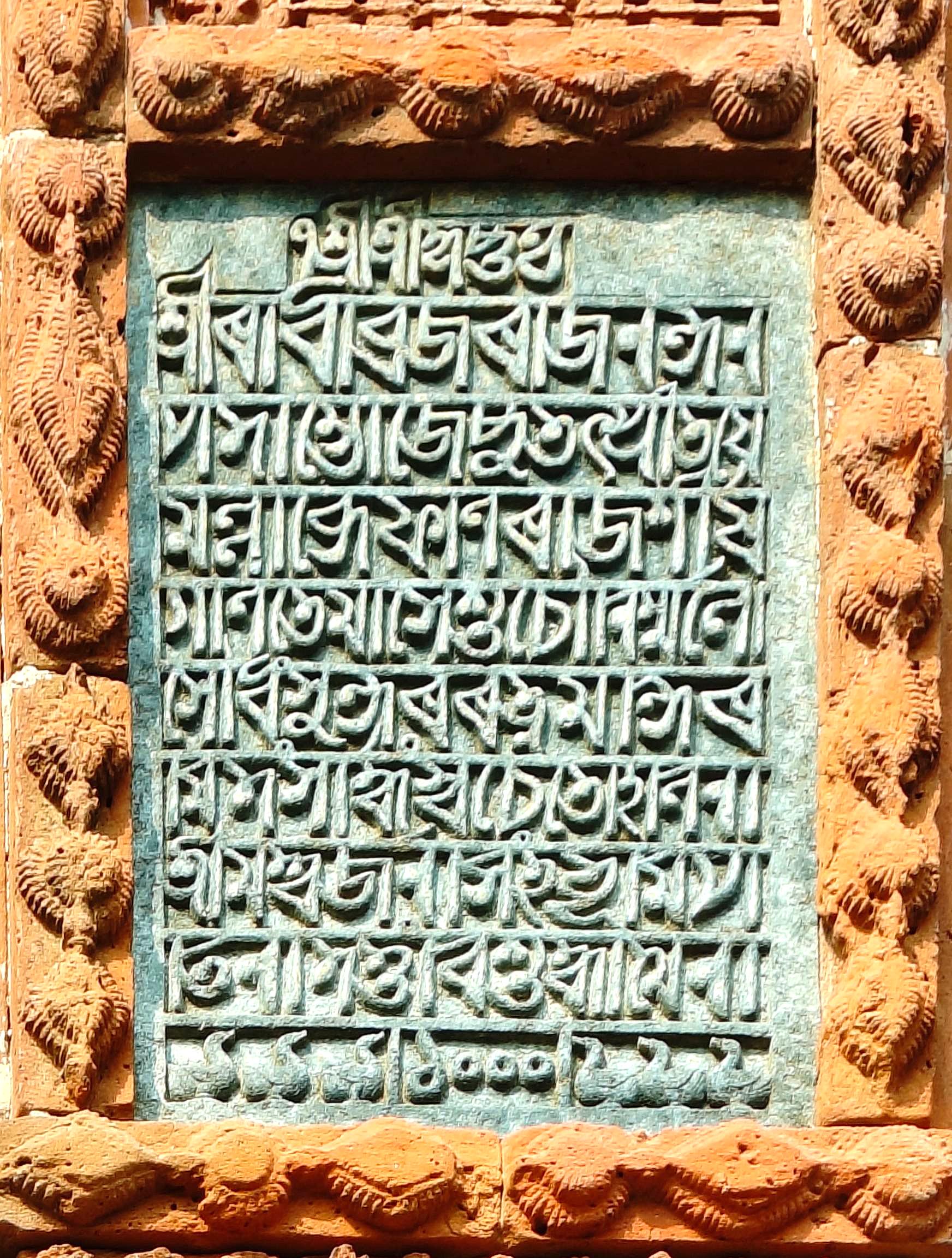
r/bengalilanguage • • 13d ago

Can anyone read this old inscription from a temple in Bishnupur, West Bengal?

Post image
93 Upvotes

Can anyone decipher what this inscription says? It looks like Bengali to me. I came across it on the wall of an old temple in Bishnupur, West Bengal. Would love to know what it says and whether anyone can identify the script.


r/bengalilanguage • • 13d ago Mindblown

আলোচনা/Discussion tui isn't necessarily disrespectful: understanding the peculiar social psychology of Bengali pronouns

Post image
104 Upvotes

The Incident

"A husband reportedly divorced his wife just three days after their marriage after she allegedly addressed him as 'tui', an informal form of 'you' in Bangla."

At first glance, the incident seems rather absurd. However, the interesting part isn't the divorce itself. it's the fact that a single pronoun can carry such different meanings depending on the relationship between the people using it

To understand why, it's necessary to look at how Bengali handles social distance

The Three-Tier System

Bengali has three commonly recognised second-person pronouns. they aren't simply interchangeable alternatives for the English word "you". each carries a different degree of familiarity, formality and social positioning

- Apni (আপনি): Formal and respectful. Generally used for strangers, elders, superiors or people with whom one maintains social distance

- Tumi (তুমি): Familiar and relatively neutral. commonly used between friends, peers, spouses and people who share a certain degree of familiarity

- Tui (তুই): Highly informal. often associated with close friendships, siblings and intimate family relationships, although it can also communicate contempt or disrespect

the distinction is fairly straightforward. The complications begin when people assume that informality necessarily means disrespect.

In conventional grammatical descriptions, "tui" is frequently classified as an inferior or disrespectful form. that isn't entirely incorrect. When directed towards an elder, stranger or someone expecting formal respect, it can certainly be insulting.

but that interpretation is incomplete.

1. The Intimacy Paradox

consider two childhood friends who have known each other for fifteen years. they have shared practically everything, including experiences that would probably be difficult to explain to anyone else.

between them, "tui" might simply be the most natural way of speaking.

Now imagine one of them suddenly switches to "tumi". Nothing particularly offensive has been said. yet the change itself might communicate that something is wrong.

Why?

Because language doesn't merely communicate information. It also reflects the relationship between the people communicating.

In certain relationships, "tui" removes the need for conventional politeness. There's little reason to maintain a formal distance when both people already understand where they stand with each other.

The same phenomenon can be observed in some Bengali households where children address their mothers as "tui".

An outsider might interpret this as disrespectful. The family members themselves might not attach any such meaning to it.

It would be rather strange to judge an entire relationship using a pronoun without understanding the relationship in the first place.

2. The Weaponised Flip Side

of course, the same informality can produce an entirely different result.

imagine addressing a stranger, an opponent during an argument or someone who expects a conventional degree of respect as "tui".

The interpretation changes considerably.

In that situation, the pronoun can communicate contempt, deliberate disrespect or an attempt to establish superiority over the other person.

This is where the distinction becomes interesting.

The word itself hasn't changed. The relationship and circumstances have.

The same pronoun that expresses affection between childhood friends can become an insult when directed towards someone outside that relationship.

which brings us back to the incident.

In a marriage where one partner expects traditional forms of deference, being addressed as "tui" might be interpreted as a rejection of that expected hierarchy.

Whether that interpretation is reasonable is another question entirely.

Perhaps the husband understood the pronoun as disrespect. Perhaps the wife used it without intending any offence. Without knowing their relationship, family background and regional linguistic habits, determining what actually happened is difficult.

Assuming that everyone attaches the same meaning to a pronoun would be a rather convenient mistake.

3. The Conjugational Gymnastics

The distinction isn't limited to pronouns. Bengali verbs also change according to the level of formality and familiarity.

For example:

- Apni: korben → Tumi: korbe → Tui: korbi

- Apni: gechilen → Tumi: gechile → Tui: gechili

- Apni: bolun → Tumi: bolo → Tui: bol

- Apni: khaben → Tumi: khabe → Tui: khabi

notice that changing the pronoun also requires changing the verb conjugation

Bengali doesn't simply replace one word with another. the grammatical structure itself reflects the relationship between the speaker and the listener

The pronoun and its corresponding verb form work together to establish the intended register.

Conclusion

Calling "tui" inherently disrespectful is an oversimplification. calling it inherently affectionate would be equally inaccurate.

Its meaning depends on context, familiarity, regional conventions and the expectations of the people involved.

In one household, it might be perfectly ordinary for a child to address their mother as "tui". In another, doing so might be considered unacceptable.

neither interpretation necessarily invalidates the other.

perhaps the more interesting question isn't why bengali has a pronoun that can express both affection and contempt

It's why people sometimes assume that the meaning of a word exists independently of the relationship in which it is used.

after all, language is not particularly interested in what a textbook says a word should mean. People determine how it functions in everyday life.

and apparently, sometimes a marriage doesn't survive that distinction.

Note: I'm not a linguistics expert, just someone interested in bengali and its regional nuances. some interpretations may vary depending on dialect, region and personal usage. apologies in advance for any grammatical errors, awkward phrasing or inaccuracies. feel free to correct me or add your own perspective :))


r/bengalilanguage • • 13d ago

Bengali is not Indian and It is not Bangladeshi, Bengali is Bengali a South Asian Language!

50 Upvotes

r/bengalilanguage • • 13d ago

আলোচনা/Discussion বাংলা অনুবাদসাহিত্য নিয়ে আমাদের বর্তমান কালের ভাবনা -চিন্তা ও আলোচনা

2 Upvotes

বাংলাদেশের বর্তমান অনুবাদ সাহিত্যের অবস্থা নিয়ে আপনাদের মতামত কি?


r/bengalilanguage • • 14d ago

আলোচনা/Discussion বাংলায় বিদেশি ভাষা থেকে ধার নেওয়া শব্দাবলী

10 Upvotes

এই ক্ষেত্রে ইংরেজির কথা বাদ দিলাম, বিশেষ করে প্রযুক্তির ক্ষেত্রে। সিমেন্ট কংক্রিট স্টীল অ্যালয় বীম কলাম কনস্ট্রাকশন রেল প্লেন এয়ারপোর্ট প্লাটফর্ম মোটের ইঞ্জিন কম্পিউটার ইন্টারনেট ইত্যাদি সবই ইংরেজি থেকে নেওয়া।

চলে আসা যাক ফার্সিতে: হপ্তা, আয়না, আরশি, চশমা, আরাম, রাস্তা, দোকান, দপ্তর, বরফ, খুন, ফাজিল, আহাম্মক, আবাদি, আন্দাজ, আস্তে, উকিল, কাগজ, মুনসেফ, খরগোশ, কানুন, খারাপ এবং আরো অনেক কিছু। আরবির সাথে সাথে ফারসি শব্দগুলি এসেছিল নবাবি আমলে।

সেই রকম ভাবেই আছে আরবি শব্দ: জাহাজ, আইন, আক্কেল, খবর, গরিব, তারিখ, ওজন, আরজি, অজুহাত, আখের, আতর, হিসাব, কলম - এগুলো সবই আরবি। কিন্তু মজার ব্যাপার এই যে এ ছাড়াও বাংলায় আছে প্রচুর পর্তুগিজ শব্দ, সেই তবে থেকে যখন ব্যান্ডেল হুগলি আর চট্টগ্রামে ওদের বাণিজ্য গুদাম ছিল। জানালা, চাবি, সাবান, বালতি, সায়া, কামিজ, কেদারা, বারান্দা, আলমারি, কামরা, আনারস, আস্তাবল, কপি, গামলা, গির্জা, গুদাম, পাউরুটি, পরাত, ফিতা ইত্যাদি সবই পর্তুগিজ।

কোন ভাষায় এমন হয় না যাতে শুধু তার মূল শব্দ আছে। সেরকম হলে বোঝা যায় যে ওটা মৃত ভাষা ওটা আর কেউ বলে না, তাই ওর উপর আর বাইরের কোনো প্রভাব নেই। বাংলাও এর ব্যতিক্রম নয়।


r/bengalilanguage • • 14d ago

আলোচনা/Discussion Sharing an anki deck for beginners to get into immersion

9 Upvotes

Hello folks,

So I thought that my own language learning journey was getting a bit stagnant. Less immersion, more going through random vocab at points.

Directly reading stories gets too difficult at points, looking up every single word beforehand. But just doing vocab is boring as well.

So I'm making anki decks for stories.

These are machine translated, but I think these will be pretty useful for people who want to increase immersion in the language. I think that's the main thing one ought to do.

So basically one can go through the deck, then read the actual story with better ease.

Here's the first one:

https://ankiweb.net/shared/info/580559068

Sharing if someone else finds the same helpful.

I'll share more decks soon.

I'm making a repo for similar such resources, much more decks in there. I'll share that once it takes better shape.

I'm thinking of doing the same for TV show episodes, movies, etc. It'll make my own learning more fun as well.

If you've got any ideas, please share. I'd love to know how i could make this better.

And this is free by the way, I'm not trying to make money out of this in any way.


r/bengalilanguage • • 14d ago

আলোচনা/Discussion The great sound shift from Sanskrit to Bangla

13 Upvotes

The differences are obvious. Clues can be found in Buddhist canonical Pāli, which is really a prākrit that was spoken in the time of Buddha. It shows changes in conjunct consonants which are similar if not identical to what can be observed in Bangla. The examples below are from Buddha's first ever recorded sermon in Sārnāth, Vārānasi.

It's called dhamma cakka pavattana sutta, the pure Sanskrit for which is dharma cakra pravartana sūtra. You see words such as saccam (satyam), appiya (apriya) and sankhitta (sankshipta). Notice the sound shifts which simplify the more complex sounds of classical Sanskrit for use by the common person.

Bengali has a different set of consonant and conjunct consonant shifts, but even before that there's the great vowel shift. In Sanskrit, the default vowel associated with every letter ending is the schwa (ə), e.g. the velar consonants k, kh, g, gh are pronounced kə, khə, gə, ghə. That becomes kaw, khaw, gaw and ghaw in Bangla. The ə has been totally replaced by aw or o, though it's not entirely predictable which of these two comes where. Therefore, the famous rəsəgullā becomes rawshogollā.

Bengali has also practically done away with the semivowels yə and və, which are replaced by consonants jə and bə (jaw and baw). Therefore, vikram is bikrawm and yadi is jodi. Then comes the merging of the three sibilants ss, sh and shh. They are very distinct in Sanskrit but get merged to a single middle sh sound in Bangla, which non natives find extremely difficult to emulate. For instance, the river sərəyū becomes shawrojū. Same is the case with the weak Bengali "aw" as distinct from the strong Odia "aw". Finally there are the conjoint sounds kshə and kshmə in Sanskrit which become kkhaw - kshəmā us khawmā, yəkshə is jokkho and sūkshmə is shukkho.

The interesting bit is that Bangla has (with the exception of bə / və) kept the original spellings even though the spoken sounds don't reflect it. This is also the case with Urdu, which has kept the Arabic letters it calls sīn, se and suād but all are pronounced as a simple sibilant ss. Likewise, the letters ze, zāl, zuād and zoye all produce the same simple zz sound, though they are very different in Arabic. Finally, the guttural vowel ayin is hardly even pronounced in Urdu.

The net result of all these sound shifts is a plus for Bangla, though. Most non-natives say that bangla sounds sweet and attractive, much like French does among European languages. It's the vowel shift they mean.