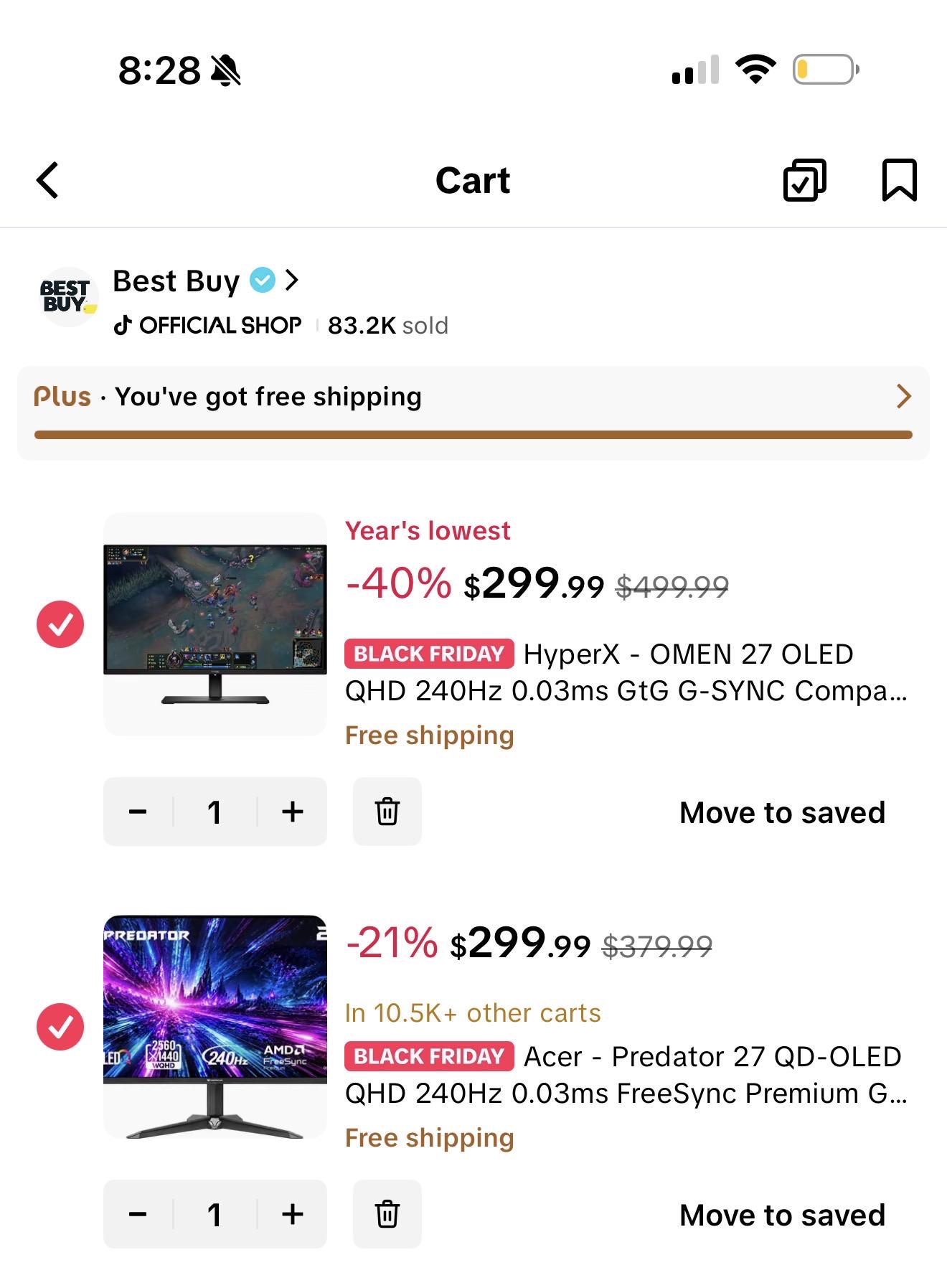
I'm looking to buy a new OLED gaming monitor for Christmas 2026 and want to make the right decision. I've narrowed it down to three models, but I'm open to completely different recommendations.
I'm particularly interested in real-world owner experiences, panel uniformity, grey banding, black levels, HDR performance and long-term reliability. I don't want to spend €400–€450 on a monitor only to discover that it has noticeable issues that aren't obvious in reviews.
1. My requirements
Essential specifications:
- 27-inch screen
- 2560 × 1440 (1440p)
- OLED panel
- 240Hz minimum refresh rate, ideally 280Hz or higher
- HDMI input required
- VESA mount compatibility, as I'll be using a monitor arm
- Preferably a clean, minimal black design
Budget:
- Ideally around €400
- Can stretch towards €450 for a worthwhile improvement
- Could consider going slightly above that if there is a genuinely significant advantage, but I'd rather not
I'm buying from Ireland, so availability, delivery costs, warranty coverage and return policies matter. Recommendations from Irish or European retailers would be particularly useful.
2. How I'll use the monitor
My main use will be PC gaming, with some YouTube and general desktop use.
The games I play include:
- Counter-Strike 2
- Minecraft, including shaders
- ARC Raiders
- Roblox
My PC:
- AMD Radeon RX 9060 XT 16GB
- Modern AM5-based system
I'm upgrading from an ASUS 1080p 144Hz monitor, so I want a substantial improvement in both image quality and smoothness. I'm not interested in upgrading to 165Hz. I specifically want a 240Hz-class monitor.
3. My room and viewing conditions
I mostly play in a dark room, although there can be some ambient light during the day.
This makes the following particularly important:
- Proper, deep blacks
- Excellent contrast
- Good HDR performance
- Strong brightness, particularly for HDR highlights
- No distracting reflections or excessive issues with ambient light
I want the image to look genuinely impressive, not just have impressive specifications on paper.
4. My biggest concern: panel uniformity and grey banding
This is probably the most important part of my decision.
I've seen quite a few reports of OLED monitors having:
- Grey banding, particularly in darker grey scenes
- Dirty-screen-effect-like uniformity problems
- Uneven grey backgrounds
- Tinting across different parts of the screen
- Noticeable differences in uniformity between individual units
I've seen particular discussion around WOLED grey uniformity, but I don't know how widespread these problems actually are.
I understand that OLED panels can have some uniformity variation, and that individual units differ. However, I really don't want distracting banding or uneven grey tones during normal gaming, browsing or watching videos.
Questions:
- Which current OLED panel technology has the best overall grey uniformity?
- Is QD-OLED generally safer than WOLED when it comes to grey banding and dirty-screen effects?
- Are the reported WOLED uniformity problems genuinely common, or are people disproportionately posting defective units?
- Are there particular models that have a better reputation for panel consistency?
- How much unit-to-unit variation should I realistically expect?
I'd especially appreciate responses from people who have owned their monitor for several months.
5. QD-OLED vs WOLED vs Tandem OLED
I'm struggling to decide which panel technology is best for my circumstances.
QD-OLED:
- How good are the blacks in a dark room?
- How noticeable is the purple tint to blacks when there is ambient light?
- How does its brightness compare with newer WOLED panels?
- Is its grey uniformity generally better?
WOLED:
- Are the newer panels significantly better than older generations?
- How noticeable are grey uniformity issues in everyday use?
- Are the improved black levels in ambient light worth considering?
Tandem OLED:
- Is the newer Tandem WOLED technology a meaningful improvement?
- Does it offer a noticeable brightness and HDR advantage?
- Are there any known compromises compared with QD-OLED?
- Is it worth paying extra for?
I'd particularly appreciate comparisons based on actual measurements and ownership, rather than manufacturers' marketing claims.
6. The monitors I'm currently considering
These are my current three candidates. The prices are the delivered prices I've found, but they may change.
1. ASUS ROG XG27AQWMG
Approx. €486 delivered
- 27-inch 1440p
- 280Hz Tandem WOLED
- Glossy coating
- HDR True Black 500
- Advertised three-year burn-in warranty
Why I'm considering it:
- Potentially the strongest HDR performance
- Higher brightness potential
- Glossy screen
- Newer Tandem WOLED technology
- Promising text clarity compared with older WOLED panels
My concerns:
- Reports of grey banding and panel uniformity issues
- It's the most expensive option
- Is the HDR and brightness advantage actually significant enough to justify the price?
2. Alienware AW2725D
Approx. €418 delivered
- 27-inch 1440p
- 280Hz QD-OLED
Why I'm considering it:
- QD-OLED colour performance
- Excellent contrast and response times
- Competitive price
- Good overall reputation
My concerns:
- Purple-tinted blacks in ambient light
- How does its brightness compare with the newer Tandem WOLED?
- How consistent is its grey uniformity?
- Is it still one of the best QD-OLED options available?
3. Gigabyte MO27Q2A
Approx. €409 delivered
- 27-inch 1440p
- 280Hz QD-OLED
Why I'm considering it:
- Competitive pricing
- QD-OLED picture quality
- 280Hz refresh rate
- Appears to be a strong value option
My concerns:
- SDR brightness compared with the ASUS
- Black appearance in ambient light
- Warranty coverage, particularly burn-in protection in Ireland
- Whether it offers any meaningful advantage over the Alienware
7. Other things I care about
HDR: I want genuinely good HDR, with noticeable highlights and strong contrast. I don't want a monitor that is technically HDR-compatible but offers a disappointing HDR experience.
Text clarity: I'll also use the monitor for normal desktop activities, so text clarity matters. Are the newer panels noticeably better than older OLED generations?
Burn-in: I understand OLED has a burn-in risk. I'd like to know which manufacturers offer the strongest warranty and whether burn-in is explicitly covered in Ireland.
Coating: Is glossy or matte better for my mostly dark room? Does either make a meaningful difference to image quality?
Quality control: Which manufacturers and models have the most consistent panel quality? Are returns and warranty claims generally straightforward?
8. What I'd like advice on
I'd really appreciate answers to these specific questions:
- Out of the three monitors above, which would you personally buy, and why?
- Is there another 27-inch 1440p OLED monitor at around €400–€450 that is objectively better?
- Which model has the best grey uniformity and least noticeable banding?
- Which has the best HDR performance?
- Which has the best overall image quality in a dark room?
- Which offers the best combination of performance, reliability and value?
- Is there a particular model I should avoid due to recurring panel defects or poor warranty support?
Please don't recommend a monitor simply because it has a high refresh rate or looks good on a specification sheet. I'm much more interested in the actual panel quality and ownership experience.
Ideally, I'd like responses from people who own or have tested these exact monitors. Measurements, photos of uniformity tests and long-term experiences would be particularly useful.
I'm happy to consider other models, including newer releases, provided they meet my requirements.
Thanks!