r/chemhelp • u/survivingchem • 8d ago
General/High School is this correct ?
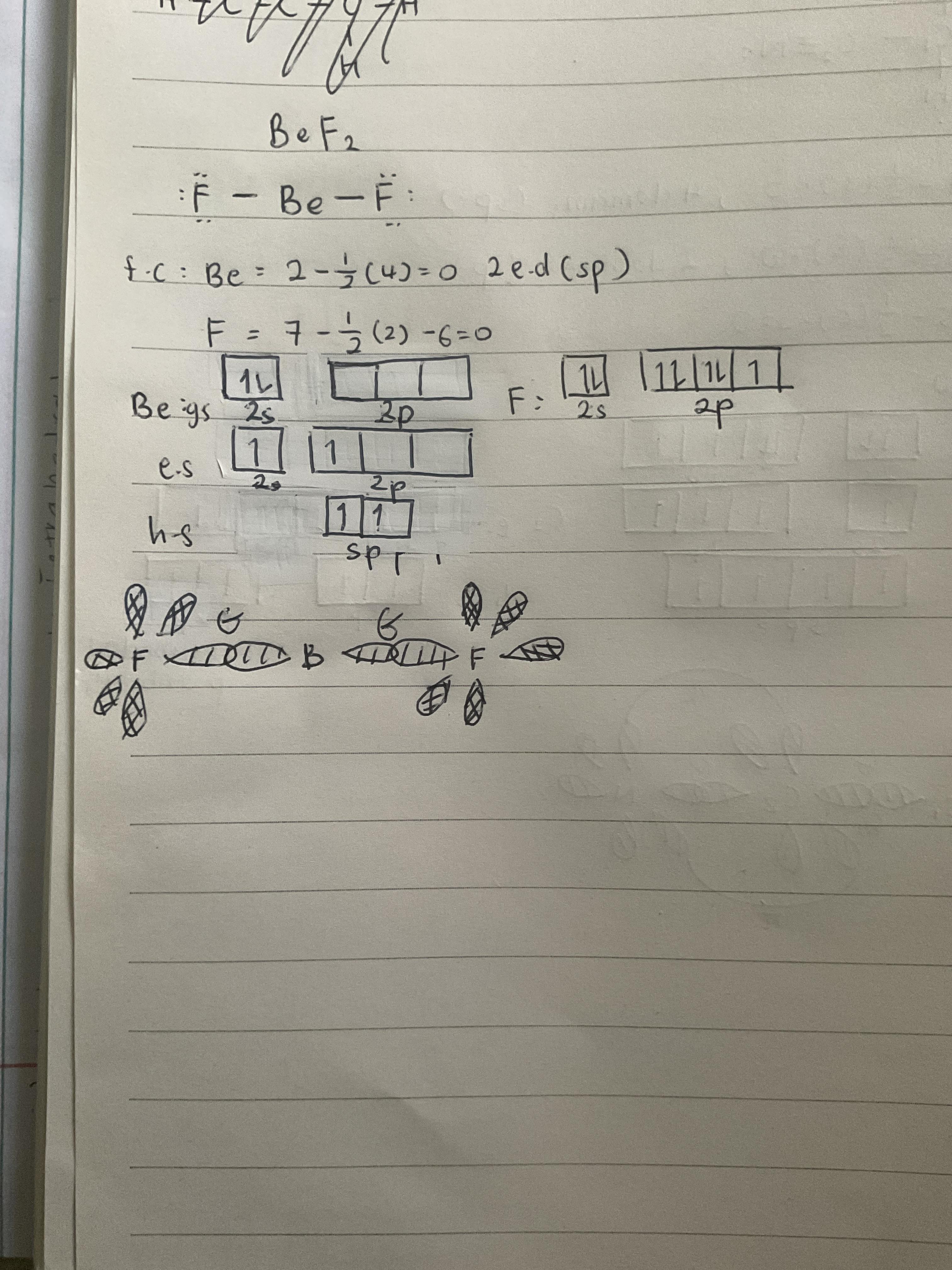
when i check on google, the f is dumbell shape, but isnt it suppose to look like this ? im confused
19
Upvotes
•
u/AutoModerator 8d ago
Hey there! While you await a response, we just wanted to let you know we have a lot of resources for students in our General Chemistry Wiki Here!
I am a bot, and this action was performed automatically. Please contact the moderators of this subreddit if you have any questions or concerns.
3
u/PassiveChemistry 8d ago
What do you mean by "dumbbell shape"? This looks right, but I'd like to clear up any confusion if I can
3
u/7ieben_ Trusted Contributor 8d ago edited 8d ago
Yes, and no.
Gas phase BeF2 is a linear, isolated molecule, as you've shown. Condensed BeF2 can form tetragonal coordination, ultimately yielding the quartz type in the solid state.
3
u/One_Yesterday_1320 8d ago
not exactly. you cannot split up an orbital into two sections like that. it’s one continuous orbital, it can’t detach and when you’re drawing it you need to draw it as such. it’s like an elongated 8. you don’t write it as two separate, disconnected ovals do you? that goes for all p orbitals.
-4
u/Romantickalchemist 8d ago
I am not familiar with this particular way to represent it, I will suggest you to make true the Lewis octate , the Be, has 2 electrons to give away , each particle of flourine has already 7 electrons on the last orbital , it's easier for it to stole from the Berilium 1 electron to complete the 8 on the second orbital. You could check as well Periodensystem 2026 on your playstore
0
u/Repulsive-Shallot-89 8d ago
Fluorine is on the outside and only needs 1 bond in it's ground state 2s²2p⁵ it already has 1 unpaired ē sitting in 2p orbital ready to go . It doesn't need to excite or hybridize. It just bonds straight from it's G.s But for Be it has to hold to 2 fluorines so it only needs 2 unpaired ē.
In G.s both ē are paired up so it can't bond yet In E.s It bumps one electron up to 2p so it now has 2 unpaired electrons In H.s Since an s and a p orbital have different shapes, Be blends them into two identical sp orbitals so both Be–F bonds end up equal
Hope this helps .