r/cicd • u/CalligrapherOk9458 • 12m ago
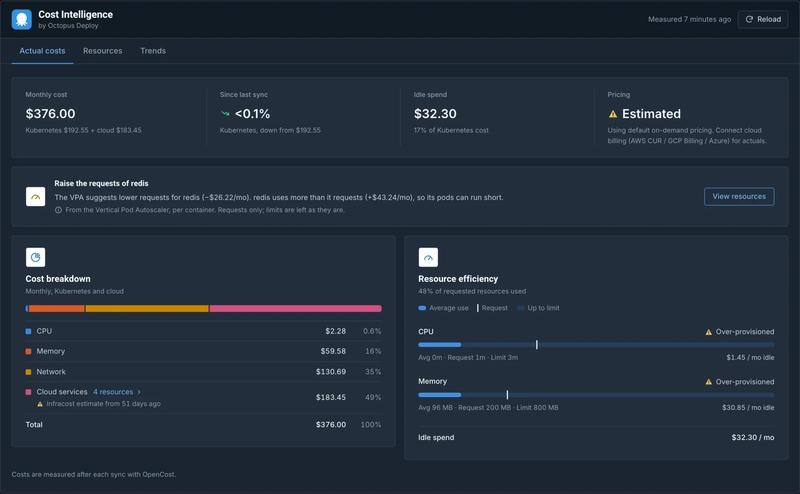
We built an open-source plugin that shows what each Argo CD application costs
1
Upvotes
r/cicd • u/todaywasawesome • Jan 09 '23
Here's to a great 2023 🥂
r/cicd • u/CalligrapherOk9458 • 12m ago
r/cicd • u/Constant-Nerve-503 • 11h ago
A green CI check tells me the job succeeded. I still want to know whether it ran the tests I expected.
I built testfix-ci, an open-source Node.js CLI that compares the jobs, steps, and minimum test counts you declare against records from a specific CI run. It runs offline using the evidence you provide.
The video shows two cases I tested with the published package and its bundled Vitest examples:
0 with zero tests. The contract required at least one, so the CLI flagged missing verification.1**.** The CLI used the recorded process exit and flagged a failure.I’d love a technical review of the contract and evidence model. If you’ve dealt with flaky CI or misleading green checks, what failure mode would you add? I’m especially curious how you’d handle partial evidence from reruns or matrix jobs.
r/cicd • u/Ellie-Gray72 • 9h ago
every monday there's a fresh stack of dependabot PRs, mostly security bumps. they sit until they conflict with each other and someone closes the lot in one go.
the real issue is the pipeline. a green build doesn't mean much for us because test coverage is thin, so nobody wants to merge a transitive bump that might break something three services away. and the PR doesn't say if the vuln even touches our code.
ihave asked to reduce our vulnerability backlog without adding a manual review step. thinking renovate with grouping, automerge for patch versions, and some kind of gate that only lets it through if specific test suites pass. (security has its own thing going with mend and rival on some other repos, but that's their project and i would rather fix our pipeline first.)
what does your CI do before a dependency bump is allowed to automerge? contract tests, canary deploys, something simpler?
Here's a tool I built to help manage the flood of changes being generated by my Claude Code and Codex agents: https://github.com/vocaro/queuekeeper
The agents kept finishing changes and trying to run tests all at the same time, each competing for my Mac, the Xcode simulators, the Android emulators, Unity, and my iPhone. To manage the chaos, I built a local merge queue and build farm. It groups changes into batches, tests the changes together, and pushes them to main only after they pass. It also spreads builds across my Macs so they don’t all pile up on one machine.
It's free and open source. If this sounds like your setup, give it a try and let me know how it goes.
r/cicd • u/Odd_Village5431 • 17h ago

If your AI agent calls HTTP tools (payments, orders, tickets, CRMs), unit tests on happy paths won't catch what happens when a tool API commits a write and drops the response (
502/ timeout).I built
agent-fault-check(afc) in Go to test those failure modes deterministically in CI:Links:
Pro/Team includes a 7-day free trial (and code
FOUNDING50gives 50% off). Feedback welcome!
r/cicd • u/Common_Dream9420 • 22h ago
Made up example: CI is green on a PR, but a retried job could still create two shipment records for the same order.
Say ur repo-level test harness already has a check for that rule.
How do u decide to rerun just that check against the PR or commit, and what part of it do u still end up maintaining urself?
r/cicd • u/mohanedmoh123 • 1d ago
I've been building an open-source operator called Treebind. The first alpha releases are out, and I'd like feedback from people who run stateful apps on Kubernetes before I go further.
The problem: some apps keep their config in files on a volume and get edited from a UI. git-sync pulls in one direction. Argo CD and Flux apply manifests, but they don't sync an app's own files. So changes made in the app never reach Git, and changes made in Git don't reach the app. [One sentence from you: the real case that made you build this.]
What it does: you create a Treebind resource that names a Git repo, an existing PVC and a sync policy. A sync agent pulls Git changes into the volume, commits the edits the app made, and can push them back. Conflicts show up as a condition on the resource.
Where it is: alpha (v0.0.1-alpha.4), tested on kind only, v1alpha1 API with a placeholder group name. Please don't point it at data you can't lose yet. Install is a Helm chart from an OCI registry, or install.yaml. The quickstart checks both directions end to end, and CI runs it on kind.
What I'd like to know:
- Which storage setups do you run (CephFS, NFS, local-path, cloud disks)? I've only tested kind.
- How would you want merge conflicts handled?
- Which app would you want to try this with first?
Repo: https://github.com/mohanedmoh/treebind (Apache-2.0, I'm the author)
r/cicd • u/Aware_Picture1973 • 1d ago
I built BuildDoctor this week for Fly.io Hacksgiving. You enter a public GitHub project, and while you watch, a newsroom of AI agents prints a newspaper about its GitHub Actions pipeline: headlines, articles, press photos that move and, with enough finished runs, a grade.
Behind the jokes it is strict. Code computes the facts from the runs and jobs, a model flags possible problems and must cite those facts, and a council of models tries to refute every finding. Models only vote; code decides. Jev by TypeSafe, an outside fact-checker, rates published findings and picks the front page.
I'd love your feedback:
- Try it on your own public project (it needs a recent successful run on the default branch, started by a push). It takes about a minute.
- Tell me when a finding is wrong. That is the most useful thing you can do.
- Tell me if a headline is funny, or if it falls flat.
It only reads public projects: your project's code is never run, and nothing is written to your repository. Most of the code was written with AI coding agents, and I reviewed and tested it.
Demo: https://builddoctor.app
Film (2 min): https://youtu.be/AMyisqY_Mkk
Code (MIT): https://github.com/pikespeak/builddoctor-agent
r/cicd • u/Liam_Fairbanks5 • 1d ago
one thing I have found surprisingly difficult in container security is figuring out who should actually fix a vulnerable image.
Finding the running pod and its image digest is usually straightforward. The harder part starts when you need to work backward which repository produced it, which commit went into the build, and which team is responsible for maintaining the service today?
We've had cases where the original CI pipeline is barely documented, and even finding the repository doesn't tell us whether the ownership information is still accurate.
I am looking at how tools like Upwind and Rival handle this as part of a broader container security workflow, but I am also interested in what people have built themselves.
do you attach source repository and commit metadata during image builds?? And do you enforce ownership metadata through admission policies, or is that still something teams maintain separately?
Especially interested in how you deal with ownership changes over time. A team label added a year ago is not necessarily a reliable contact today.
r/cicd • u/Baz-Turnover5210 • 18h ago
Writing code is no longer the bottleneck. the new bottleneck is CI/CD. Whoever finds a solution for it can consider themselves a big winner.
Agents now handle everything, and because they have sandboxes with a well-established testing and validation flow, an agent can pretty much take care of merging and deploying much faster.
You might argue that CI/CD is slow not because agents aren't doing it, but because the deterministic things we check in the pipeline take a long time and we cannot actually skip them; for example, a lint rule that takes two minutes to run would still take that long with agents, too. That is a fair argument, and I do not have a solid answer for it (yet)
What do you think? Are there any early solutions you can think of?
r/cicd • u/Fit_Champion1940 • 1d ago
A few weeks ago I asked here why tests pass locally and fail in CI. The replies were great. Most of the fixes started the same way: someone had enough evidence from the failed run to reproduce it.
So the next question. When a run fails in CI, what do you keep?
What's been suggested so far:
Two things I'm unsure about:
What's on your list, and what did you add only after it bit you?
r/cicd • u/g0_g6t_1t • 1d ago
We moved our CI onto a fresh spot VM per job in our own cloud accounts, deleted when the job ends, and open sourced it as backmesh (free). Against GitHub's 4-core runner at the same vCPU count (ours full cores, on AWS's m8a), build steps ran up to 2× faster (Docker 1.9×, Go 2.2× over 8 jobs) and a build cost 7–12× less on spot, before ~$86/month of always-on VMs on AWS.
The boot question first: from queueing to its first step, a job waited a median 43–46 s on spot and 34–36 s on demand, against 4–5 s on GitHub, so queue to done wasn't faster. What helped:
apt-get update against mirrors mid-sync, so the cloud CLIs now install from pinned releases.Feedback welcome, especially on the wait. Code is open source here https://github.com/backmesh/backmesh
r/cicd • u/AfraidofAIworld • 2d ago
One of our builds got really slow so I checked the self hosted runner. It had 70 gb of old docker layers four versions of the same sdk and a credential from a project we finished months ago. Third time I've had to clean this thing.
Now I'm looking at disposable runners on hourly vms from serverspace hetzner cloud and digitalocean. Create one for the pipeline then delete it.
Sounds easier but I'm worried every build will spend half its time setting up the new vm. Has anyone tried this with a small team and was it actually less work?
For more than 14 years, I have worked with C, Java, and other languages, and kept running into the same problem: every language or project seemed to have its own way to run tasks, package software, enforce Git hook rules, generate documentation, and manage changelogs. The tools could work well on their own, but the development process around them felt fragmented.
I tried to solve parts of this problem more than once. Over the years, I built task tools and custom DSLs in JavaScript, C, Python, Perl, and other languages. I would use an idea for a while, then move on to another project. The prototypes ended up scattered across hard drives, and the ideas never came together as one tool I could use across projects.
I started Everyinit as a YAML-based task manager. As I worked on it, I saw that tasks depended on more than commands: I also needed to describe their environment and give common operations a shared home. I added built-in actions, then GitRules, which has since become repository policies. Little by little, a side project I had not even created a repository for began to take the shape of the cohesive tool I had been trying to build.
On August 23, 2026, I made the first commit in Everyinit's repository. After that, I found it hard to stop working on the project. I could see Everyinit fitting the different projects I work on and making my future Linux contributions easier and more consistent. I did not want to let go of that possibility.
Everyinit is still in its canary phase, and its architecture is evolving. I want to share the problem that led me to build it and the design taking shape, not claim that the model is settled.
Give each concern a place
The current design separates four concerns: environment inputs, repository rules, workflow orchestration, and procedural scripts. I chose JSON for environment and policy files so users can extend those contracts and create and share schemas for their own projects. Evin loads and connects the pieces, while built-in actions cover operations that do not need to live in a script.
environment.json ─┐ ├──> Evin loads and validates the workspace policy.json ──────┤ │ workspace.flow ───┘ ├── resolves task inputs and dependencies ├── runs ESH commands and scripts └── invokes built-in actions
The diagram is a map of the boundaries, not a full account of how each piece works. It reflects the direction I am exploring: give each concern a clear home, then let the workflow connect them.
That separation has a cost. Contributors need to learn more than one file and decide where a new behavior belongs. I am still working out whether the boundaries make projects easier to understand, or whether they add too much ceremony.
The question I am testing
Can one project make routine development work more consistent without forcing every repository into the same shape? Everyinit is my attempt to find out. Its canary phase gives me room to test these boundaries and change them when they create more friction than clarity.
If you maintain several projects or build developer tools, I would like to hear where fragmented tooling causes the most friction for you—and whether you would bring any of those tools together.
Everyinit is open source, written in Rust, and still in canary. Feedback and architecture discussions are welcome.
Project: everyinit.dev
Source code: github.com/dukasn/everyinit
r/cicd • u/turtle_par_iter • 2d ago

I've been building Cupel in the open: it runs your own tests, records which lines each test runs, plants small faults and reports which tests notice. From that it guards pull requests, audits suites and gives agents evidence. It has no dependencies, no telemetry and no network calls, and it never changes your code.
0.5.0 adds:
Every number in the docs says what machine it was measured on, and the release notes list what isn't verified yet.
Contributions and bug reports welcome: https://github.com/Vibernt/cupel · Docs: https://vibernt.github.io/cupel/
So I’ve been building tool called Deployground, and the way I describe it is a mini IDP - the Backstage/Port style self-service layer, but instead of another web dashboard, it’s wherever your team already chats/communicates. Right now that’s Slack, but it’s built so the chat/UI layer is extendable, Teams is on the roadmap, and I am happy to consider more
The idea is a dev/QA/product - whoever you decide has access, picks a catalog entry, names their stack, perhaps overrides a version, and clicks submit. That turns into a single PR with everything is traceable (owner, TTL, resolved versions), Argo CD takes it from there and syncs it the normal way, and the thread updates as it goes live or breaks.
The bit relevant to this sub - it’s not another tool with cluster creds. Git is the only interface it has, PR in, Argo CD applies, done. Since that’s the whole mechanism, it rides on whatever cluster/region topology your Argo CD is already managing. Multi-cluster, multi-region estates work without Deployground needing to know or care, since it’s just writing manifests into Git and Argo does the actual placement. Works against either an ApplicationSet or raw Application CRs if your org restricts those, and it can take status either from Argo CD notifications or just poll the API.
Every deploy also has an expiry baked in. You get warned before it dies, there’s extend/destroy buttons in the thread, and a reaper cleans up the PR’s worth of stuff if nobody acts. No DB behind it either, state just comes from Git
Repo + demo gif: https://github.com/rhysmcneill/deployground
Licensed under Apache-2.0. Feel free to try it out, contribute, and 🌟 if you enjoy it.
r/cicd • u/DevOps-AI • 3d ago
You build the app, and it runs locally. Deployment adds servers, build pipelines, containers, certificates, and DNS. This setup can take longer than development. So there are solutions for that provided by many companies like Vercel, Coolify,Railway just to name a few.
However, despite of these mega names, you need Github, still an astute DevOps that will reduce the effort of CI/CD and build docker files. Then there are limitations on Server configurations, the platform that you can use and last but not the least the high pricing which looks as cheap in the initial phase but once your project starts building up, the charges start becoming exorbitant.
Future of DevOps
What is needed is a managed deployment platform. One can select a project folder. Detect the stack, fills in build and start commands, deploys to production, and serves the app on domain with HTTPS.
Simply No DevOps needed and can be used in Monorepo , simple Cloud structure, if desired then a specific core can be allocated or for Saas Deployment which turns out to be cumbersome.
Simply where No Docker, CI/CD, or manual stack detectionis required. Build and start commands are filled in. Optionally connect a private GitHub repo for automatic deploys on push. Monorepos are supported. Can be deployed without effort for a implistic cloud hosting or cumbersome Saas Deployment, can cater for not only one or two platform like next.js but can autodetect various platforms, primarily used in web development and can seamlessly deploy
How it Should Work: Four Steps
Builds can fail on any platform. The response is what matters.
Now where to use AI in the new AI world so that it can reduce the effort , idenitfy errors in the code and then fix it. So an AI assistant can be created which can address these issues. On a build failure, it reads the log, framework, and settings, fixes the configuration, redeploys, and reports the changes. It handles build commands, ports, runtime versions, environment variables, and install issues.
It does not edit application code or generate secrets. If the issue is in your code, it reports the file and line.
Such application is essentail in this fast moving software world where most of the development has already been eaten up by AI.
While this poses a big threat, it also opens opportunities for Vibe Coders who have zero or limited experience of development and their reliance on developers hampers the advancements in technologies and their own ideas

Disclosure: I wrote this (minitart, open source, free).
Some of my development happens in private repos, so every CI minute is billed, and macOS minutes cost 10x Linux ones on GitHub, so the 3,000 GitHub Pro minutes run out very fast. My Mac mini is on all day anyway, so I moved my jobs there.
One consideration is I didn't want projects running straight on my Mac, with access to my files and home network, even if these were trustworthy projects. I looked around and the existing tools were either unmaintained, in early beta, or built for teams at scale, so I wrote something small on top of OpenAI's Tart:
Repo: https://github.com/zurfyx/minitart Demo: https://demo.minitart.rovira.sh
Feedback welcome!
r/cicd • u/Western_College3228 • 3d ago

r/cicd • u/Bethhunt_87 • 3d ago
Between shipping features and the odd redesign, I’m terrible at keeping our site working for AI agents. Docs drift, the pricing page changes, and nobody remembers to check the MCP server we put out.
We already run Lighthouse in CI, but tracking agent readiness in there feels clunky. I’ve tried a one-off checker like Frase and a plain checklist, and I’ve also looked at scanners like Ora and Actuity, since I could just paste a URL after a deploy.
Thing is, I don’t want to burn Friday afternoons rerunning scans and updating tickets. Small teams, what’s your actual setup for keeping this from slipping without it becoming extra homework?
r/cicd • u/BrotherGlad4572 • 3d ago
r/cicd • u/tilostechjourney • 3d ago
