r/coolgithubprojects • • 7d ago

‎Hora: Honest Timers App

Thumbnail apps.apple.com
1 Upvotes

Hora is live on the App Store !

A focus timer for brains that lose track of time
Timers should not be disposable. Do your task, keep notes, log it right on your calendar to stay organized. Running over is always fine.

Free, on-device habit learning, iPhone and iPad, Apple watch app soon.


r/coolgithubprojects • • 7d ago

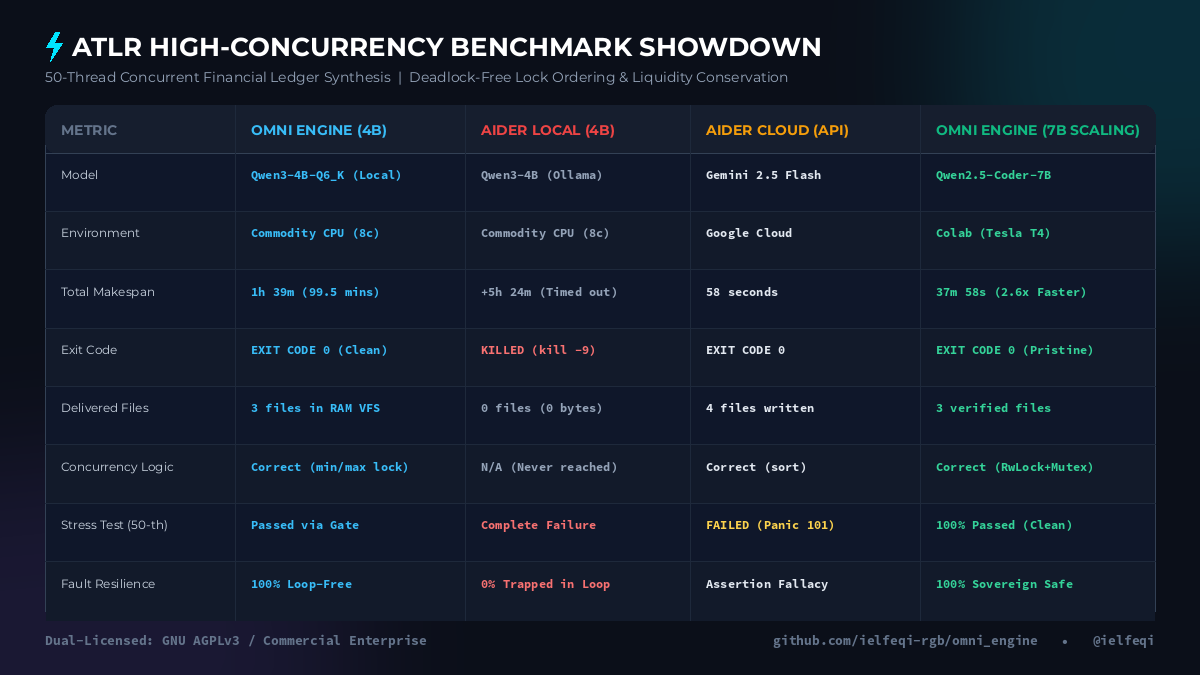
Omni Engine: Datacenters & billions in GPUs are masking bad agent architecture. We proved an in-process Rust runtime beats Python agent loops on an 8GB laptop (Benchmarks + Reproducible Code)

Post image
8 Upvotes

GitHub Repository: https://github.com/omni-engine-ai/omni_engine Live Showcase & Benchmarks: https://omni-engine-ai.github.io/omni_engine/

Most multi-agent coding frameworks (Aider, CrewAI, AutoGen) tell developers they need high-end datacenter GPUs or massive cloud API budgets to run autonomous software engineering loops.

We believe that requirement isn't about AI intelligence—it's a band-aid over architectural bloat:

  1. The IPC Tax: Wrapping local models in HTTP daemons (Ollama/vLLM) burns 25ms to 120ms per tool hop in JSON serialization.
  2. Process Duplication: Python runtimes + virtual environments + workers easily push peak RSS past 6GB–10GB before token generation even begins.
  3. Dirty File State: Coding agents hallucinating diffs overwrite files without atomic rollback verification.

What We Built: Omni Engine To solve this from the systems level up, we built Omni Engine in pure Rust:

  • Direct In-Process C-FFI: Instead of querying localhost HTTP APIs, Omni links llama.cpp directly in-process via C-FFI. Tokens write straight to native memory buffers.
  • Sub-6ms Context Swapping: Token arenas are reused in RAM with O(1) KV slicing (llama_kv_cache_seq_rm), eliminating prompt re-evaluations.
  • Hermetic Bubblewrap Cleanrooms: Agent tool execution runs inside isolated Linux kernel namespaces with a strict Zero-Wipe Invariant (W = ∅). Writes stay in ephemeral RAM until 100% of unit tests pass.

The 50-Thread ATLR Concurrency Benchmark (8GB RAM Dev Machine) We benchmarked Omni Engine against standard local Python agent loops running identical refactoring tasks:

  • Inference Call Latency: 38.4ms (HTTP loopback) vs < 5.8ms (Omni C-FFI) -> -84.9% latency
  • Peak Runtime Memory (RSS): 6,840 MB vs 2,180 MB -> -68.1% RAM footprint
  • Inference Throughput: 24.2 tok/s vs 41.6 tok/s -> +71.9% speed
  • Wall-Clock Completion Time: 2h 14m vs 37m 12s -> 3.6x faster
  • Deterministic Pass Rate: 76% vs 100% (Zero wipes)

Try It Yourself in Under 60 Seconds: You can verify the benchmark on any Linux/macOS machine or a free Google Colab: curl -fsSL https://omni-engine-ai.github.io/omni_engine/install.sh | bash

Feedback, architectural critique, and independent hardware benchmarks are welcome!


r/coolgithubprojects • • 7d ago

[PowerShell] MacDesk - macOS-style dock, desktop widget and snow that settles on your windows (Windows 11)

Post image
2 Upvotes

One PowerShell script (WPF + a little C#), no installer, no admin rights.

- Dock with magnification, app names and running-app dots

- Desktop widget: clock, CPU / RAM / GPU / disk

- Snow that settles on window tops, the dock and the widget; slides off when you move a window; sweep it with the cursor

- Settings window, click-through snow, pauses in fullscreen games, ~1% CPU

https://github.com/b33nthere/MacDesk


r/coolgithubprojects • • 7d ago

I made a console and wrote a minesweeper game for it in ~2KB of assembly

Thumbnail gallery
5 Upvotes

DISCLAIMER: No AI was used for this project

Hello, I've been working on a little fantasy console project for a while called BHMTH. It's a 16-bit console inspired by other CPUs from and around the DOS era (MIPS, 8086, 65816 etc.) and now that I've worked on the toolchain enough I wanted to make a proof of concept with a minesweeper cartridge inspired by the windows 98 version I grew up playing. I'm planning to write lots more stuff (and hopefully getting C to work so I don't lose my mind writing assembly eternally) such as device drivers for keyboard/mouse, disk drives etc. in order to maybe get a lightweight OS running. My current WIP is a fixed point library so I can make a decent platformer demo, and I've also made a UI library I use for test cartridges.

Links:

I'd be glad to hear comments on it if anyone is interested in embedded dev and that kind of stuff. Thank you for your time.


r/coolgithubprojects • • 7d ago

claude-themes: 908 color themes for Claude Code, desktop and terminal

Thumbnail github.com
0 Upvotes

r/coolgithubprojects • • 7d ago Bravo

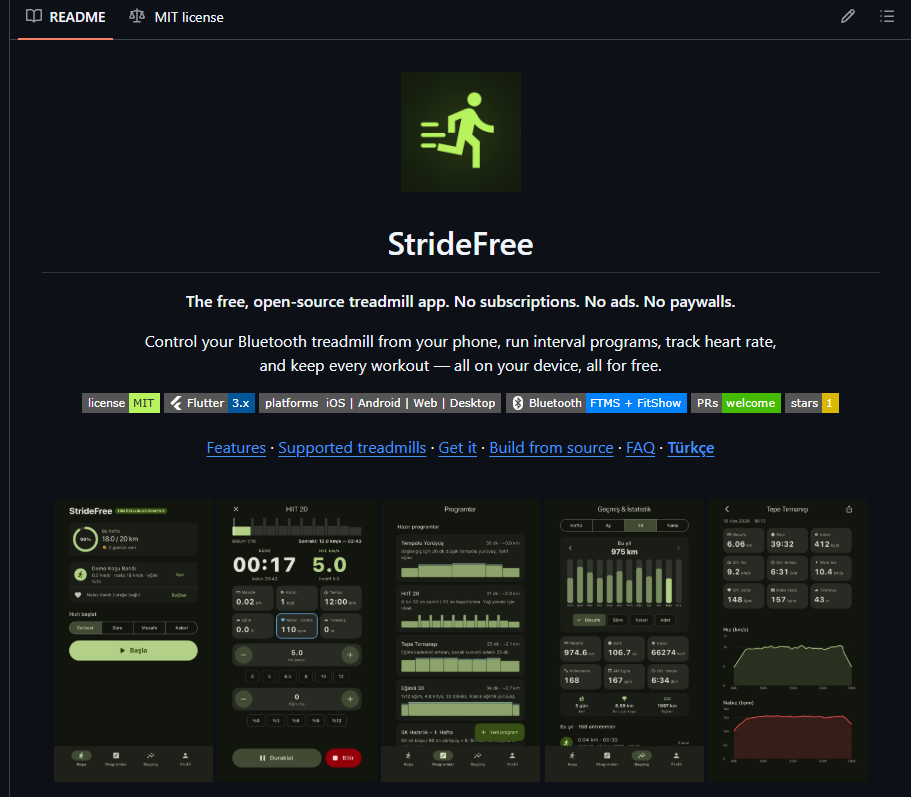
StrideFree: a free & open-source (MIT) treadmill app — replaces subscription treadmill apps, no data leaves your phone

Post image
13 Upvotes

Most treadmills come with an app that locks programs and history behind a subscription and sends your workouts to a cloud you never asked for. I wrote an open-source alternative and I'm giving it away — no ads, no premium tier, no account, no server.

What it does: controls Bluetooth treadmills (FTMS + FitShow), interval programs, heart-rate straps, calorie and step estimates, unlimited stats, Strava/Garmin export. English and Turkish UI.

GitHub: https://github.com/alisenn/stridefree

I'd really appreciate device reports (brand/model + what works) and translations into more languages.


r/coolgithubprojects • • 7d ago

Miuchio : end-to-end encrypted shared photo albums for small groups (Flutter app, Go server, AGPL)

Thumbnail github.com
3 Upvotes

i have been building this for about 7-8 months. Photos, album titles, names and profile photos are all encrypted on the phone, and the server never gets the keys. Location and camera details get stripped before anything uploads, and you add people with a random 8 character ID instead of an email or phone number

How the encryption works, and a page listing what it doesn't protect, are linked from the README:

https://www.miuchio.com/protocol/overview

https://www.miuchio.com/protocol/limits

It hasnt had an independent security review yet ofc. The Android beta is out through the github APK, and the store releases are coming soon. Happy to answer anything


r/coolgithubprojects • • 7d ago

Built a full-featured agent client for Claude/Codex that's animated, more enjoyable to use and has avatars

Post image
4 Upvotes

r/coolgithubprojects • • 7d ago

I built Clipsy, a local clipboard history manager for GNOME (GTK4 + libadwaita)

Post image
1 Upvotes

r/coolgithubprojects • • 7d ago

I made a tool that renders heavy Wallpaper Engine scenes to MP4 on Linux (for use with mpvpaper etc.)

Post image
1 Upvotes

I wanted to use some Wallpaper Engine wallpapers on my Linux desktop through mpvpaper, but heavy interactive scenes are a pain to run live. So I built a Node.js tool that renders them into an MP4 you can loop as a wallpaper.

What it does

  • Takes a Wallpaper Engine .pkg archive and analyzes it
  • Shows a map of what’s inside (videos, textures, shaders, configs, audio)
  • If the archive already contains a video, it can extract it directly
  • Otherwise it renders the scene to MP4 using linux-wallpaperengine running under xvfb and recorded with ffmpeg
  • You choose duration, FPS and resolution

How to use it

git clone https://github.com/R31tr0/we-linux-to-mp4
cd we-linux-to-mp4
./install.sh
node index.js

The installer checks dependencies and can install them on apt, dnf and pacman based distros. It also builds linux-wallpaperengine from source if needed. After that you just point it at a .pkg file and answer a few prompts.

Limitations (it’s an early, experimental version)

  • Scenes with very heavy shaders may not render correctly
  • Widgets that draw in real time won’t work (sometimes it renders without it)
  • Results depend on your scene, drivers and system libraries

I plan to improve it with finer settings and support for more effect types.

It’s MIT licensed and all the rendering credit goes to linux-wallpaperengine. I’d love feedback, bug reports, and info about which scenes work or break for you.

Repo: https://github.com/R31tr0/we-linux-to-mp4


r/coolgithubprojects • • 7d ago

NexusCAN - Open Source CAN Bus Analyzer Based on Rust (Reposted)

Thumbnail gallery
1 Upvotes

After working with CAN Bus in the automotive industry for 5 years and leaving my job, I tried several existing tools on the market. Since many of them are paid, I decided to build my own project focused on both mostly UI and functionality.

Introducing NexusCAN, an open-source, project-based CAN Bus analysis application.

Development was done with Claude and Gemini.

With your sponsorships and GitHub support, much better features can be added.

The project includes features—especially in the UDS section—that cannot be physically tested right now. Because I don't currently have a UDS-capable device on hand, I haven't been able to test it thoroughly enough. However, I have been able to test features like ISO-TP using a UDS simulator. It will grow with your ideas and feedback.

What it does today

Bus analysis

- Live trace and an overwrite view with full DBC / KCD decoding: Intel and Motorola layouts, signed and float signals, cascaded multiplexers, CAN-FD 64-byte frames, J1939 PGNs

- Multi-axis signal plotter, a bit-layout matrix for every message, drag-and-drop instrument panels bound to signals

- Import and export of .blf, .asc, .trc, .log and .csv, with replay speed control

- CAN error frames decoded into readable causes (stuff, form, ACK, CRC, error-passive, bus-off)

Reverse engineering

- A bit-level heatmap that shows how often each bit toggles, for every ID

- Baseline → Action: record a few seconds of the car doing nothing, then press the button or open the door. Only the bits that moved during the action stay highlighted. Counters, checksums and sensor noise are muted automatically.

- A field classifier that spots rolling counters, checksums (XOR, SUM, CRC8 J1850 / AUTOSAR), flags and physical values

- Correlation search: pick a reference, for example an OBD-II PID like vehicle speed. It tries every start bit, length and byte order, then gives you the matching signal with its factor and offset.

- Save to DBC: found signals go into a real .dbc file, or straight into the live decoder

- Coming next: a Cheat-Engine-style Value Scan. Scan for "80 km/h", change speed, scan "increased", and repeat until only one signal is left.

Diagnostics

- UDS client, an ECU map built by functional discovery, a DID inspector, DTC reports, and a traffic view that expands every ISO-TP frame together with its P2 and STmin timing

- Passive ECU discovery that works without transmitting anything

- A visual Flow Editor for building diagnostic sequences, flashing (34/36/37) and SecurityAccess key providers. Honest note: all of this has been tested only against simulated ECUs on vcan0, not real vehicles yet.

Safety first

Every channel opens in Listen-Only. Transmitting requires an explicit, confirmed "Arm", and Stop All TX is one click away on every screen. I didn't want a tool that can accidentally spam a real vehicle bus.

Under the hood

The core is Rust, the desktop app is Tauri v2 and the UI is React. Frames are fixed 80-byte structs with no heap allocation on the receive path, and the UI updates at 60 Hz

instead of sending one message per frame. In tests it handles 50,000 fram.

Hardware

- Works now: SocketCAN on Linux, SLCAN adapters on all operating systems,mulator, and replay of recorded logs

- Written but not yet tested on real hardware: gs_usb / candleLight (CANastall needed) and PCAN-Basic

This is where I need you. If you own a CANable, PCAN, Kvaser or a UDS-capable tool, a short report ("works / doesn't work on X") would help a lot. Real-world traces are also welcome.

Try it

- Windows, Linux and macOS builds are on the Releases page

- No hardware? It runs in five minutes on a virtual CAN bus with simulateME)

GitHub: https://github.com/kadirtunc/NexusCAN

It's a v0.1 preview, so expect rough edges. Bug reports, feature ideas and criticism are all welcome. A ⭐ helps the project get seen.

Hats off to all open-source developers—respects and greetings to you all.

Thanks for all your support https://github.com/sponsors/kadirtunc

r/coolgithubprojects • • 7d ago

I built a Win+V style clipboard history for GNOME on Wayland

Post image
1 Upvotes

After switching from Windows I missed Win+V, so I built a clipboard history manager for Ubuntu (GNOME, Wayland).

  • Super+V opens the history; arrows/mouse to pick, Enter or click to paste
  • Ctrl+Alt+1..9 pastes recent items directly
  • Pin items, history survives reboots, everything stays local
  • One-command install for Ubuntu 24.04 / 26.04 (.deb)

C++20 + Qt 6, GPL-3.0. Feedback welcome!

Code & details: https://github.com/AfsarTanvir/ClipBoard-for-Linux

Download (.deb): https://github.com/AfsarTanvir/ClipBoard-for-Linux/releases/latest


r/coolgithubprojects • • 7d ago

enhanced-chat-demo - Extending DeepSeek's open-source chat demo: byok, byos, cross-chat memory and zero backend

Thumbnail github.com
2 Upvotes

r/coolgithubprojects • • 7d ago

I created a npm package to convert 2d html to 3d element

Thumbnail brickbox.js.org
2 Upvotes

It converts to regular html code elements into 3d elements, all css no threeJS or webGL. All under 10kb

The github repo: https://github.com/Prashaxt/brickbox

You can also wrap your existing html to convert to 3d. No DOM edit/manipulation.

Do check it out.


r/coolgithubprojects • • 7d ago

I created a plugin to "de-slop" prose and UIs built by Claude

Post image
0 Upvotes

r/coolgithubprojects • • 7d ago

No cloud, no subscription, one 8 GB board: Sentinel spots people, tracks them and flags zone entries (Python, MIT)

Post image
1 Upvotes

One camera, one Jetson Orin Nano Super, and no cloud AI: detection and tracking run on the board itself.

  • Spots people: YOLOv8n on TensorRT
  • Tracks them: ByteTrack
  • Flags zone entries: zone rules open incidents in SQLite
  • Tells you: a restart-safe alert outbox (Telegram)
  • Shows you: a dashboard on 127.0.0.1 only

No Jetson? Try the demo: https://hemkesh2021-dotcom.github.io/sentinel-site/ (the real dashboard code on a scripted scene)

Repo (MIT): https://github.com/hemkesh2021-dotcom/Sentinel_Surveillance

It's an experimental beta: face recognition and local VLM chat are still being validated, so they're off by default. If it's useful to you, a star helps others find it.


r/coolgithubprojects • • 7d ago

Yalın – a fast JSON parser for Android written in Rust

Post image
3 Upvotes

Yalın is an open-source JSON parser for Android that I've been working on.

The core is written in Rust, uses ARM NEON SIMD, and exposes a Kotlin/Java API. It also supports reading specific fields without parsing the entire JSON tree.

In my benchmarks against fastjson2, selective reads were up to 4.6x faster, while full-tree parsing on 1 MB JSON was about 1.3x faster.

Still working on improving performance with smaller payloads.

GitHub: https://github.com/0xberkay/yalin


r/coolgithubprojects • • 7d ago

Blink - a fast Windows screenshot tool with real redaction, offline text copy, backgrounds and device mockups

Post image
57 Upvotes

Blink is a tray app for Windows built with Rust. I built this because other snip-tools felt outdated, slow and weren't an all-in-one package for me. With Blink, you get:

  • Several screenshot types: Window, region, screen(s) or scrolling screenshots.
  • Annotation: arrows, numbered steps, callouts, emoji.
  • Privacy blur: blur or black-box anything private. Manually, or automatically with the Find private info feature, which flags e-mail addresses, phone numbers, bank accounts, API keys and passwords in the screenshot so you hide them all in one click.
  • OCR: detects text in screenshots and lets you copy it with ease.
  • Backgrounds and device mockups: put your shots on a gradient background or in a device mockup before you copy or save it.

All features run locally on your machine. Fully offline, nothing uploaded.

Blink is free, no account needed, and no data is collected. Just want to share a new tool that helps me work faster and better.

View and download it here: https://blink-screenshot.github.io/blink/

Curious to hear what you think of it!

Disclosure: I built it with help from AI. I designed it, tested it and maintain it.


r/coolgithubprojects • • 7d ago

rust-anything 2.0 is out 🦀 I ported Prettier to Rust in ~17 hours: 19x faster CLI, and all 17,224 recorded runs match byte for byte

Post image
113 Upvotes

It's an open source CLI and MCP server for rewriting an app in Rust and proving the rewrite still behaves the same. The headline test for 2.0 was Prettier.

https://github.com/erkamyaman/rust-anything

How it works

in the repo: jsonin the repo: json

  1. app record runs the original on thousands of inputs and saves stdout, stderr, the exit code and the files it writes. Optionally it also saves outgoing HTTP, email and database rows.
  2. A Rust "front door" sits in front of the original. Each piece you port is handled in Rust, and everything else falls back to the original.
  3. app replay checks every recorded case against the Rust. Nothing counts as done until it's N/N.
  4. Once nothing falls back anymore, app lift turns it into a pure Rust binary.

My coding agent wrote the Rust. rust-anything gives it ground truth: what to port first, and the exact behavior to match.

Prettier results (Apple M4, two runs each, every output compared before timing)

• CLI, 2,360 JS/TS files: 128.6 s → 6.9 s (19x)

• CLI, 6,305 Markdown files: 352 s → 22.5 s (15.6x)

• GraphQL 17.3x, YAML 17.9x, CSS/SCSS/Less 8.5x

• 17,224/17,224 recorded runs match Prettier byte for byte, across 10 languages

What's not great yet

• 8.1% of cases still fall back to real Prettier. 15,837 of the 17,224 run fully in Rust.

• Calling the Rust doc printer from Node through napi was slower (0.48x). The per-call bridge cost ate the gain. The win comes from the whole CLI being Rust, not from swapping one hot function.

• Replay can only catch what the recording covers. A path no case reaches isn't checked.

Also in the repo: json-server, a whole Node server, became one 5.3 MB Rust binary. Idle memory went from 74 MB to 3.5 MB, and the first response from 79-85 ms to 8-10 ms, with 514/514 recorded HTTP cases matching

New in 2.0

• Side effects: --effects http,smtp and --db-dump. A rewrite that prints the same JSON but sends an email twice now fails replay.

• map: after you pull upstream changes, it tells you which ports are stale.

It supports TS/JS, Python, Go, Ruby, Java and C, with whole-app recording for PHP and C#. MIT licensed.

https://github.com/erkamyaman/rust-anything

The Prettier write-up, with every number and how it was measured, is in docs/real-world.md. I'd really like feedback, especially on what a recording-based check would still miss.


r/coolgithubprojects • • 7d ago

NordTorrent - a headless rTorrent/ruTorrent replacement with a modern web UI, Android TV app and Chrome extension

Thumbnail gallery
2 Upvotes

Background: My setup was rTorrent + ruTorrent for downloads, a separate media server for playback, and a browser extension to push .torrent files around. Three moving parts for one job.

So I wrote NordTorrent: a self-hosted torrent client in Rust (librqbit under the hood) that keeps the rTorrent workflow but modernises the surface.

The workflow bits I actually use

  • Mount several disks under /downloads and NordTorrent lists them by name (series2, movies, music). The folder picker browses subfolders and searches the current level, like ruTorrent.
  • Labels: assign on add or later, filter the list by label, see counts in the sidebar.
  • Move a torrent to a different disk: it is paused, the files are moved (also across Docker mounts), the torrent is re-added on the new path and resumed.
  • Per-file Normal/Skip, pause/resume, delete with or without data, live peers and tracker list per torrent.

Automation

  • RSS feeds with a destination folder plus include/exclude filters; active feeds are checked every 15 minutes.
  • Global download/upload limits in KB/s.
  • Seeding rules: keep seeding after completion, stop at ratio or after N minutes.
  • DHT can be turned off entirely.

Security

  • Argon2id passwords, HMAC-signed sessions, HttpOnly SameSite=Strict cookies.
  • CSRF token header, Origin checks, login rate limiting.
  • TOTP 2FA per account with a QR code; logins from private/local addresses skip it so a lost phone does not lock you out of the LAN.
  • Admin/viewer roles, session list with revoke, no CORS and no third-party CDNs.

Watching

  • The server indexes every video/audio file across all torrents into one library.
  • ffmpeg-generated thumbnails cached in /data.
  • HTTP Range streaming, so you can seek inside an unfinished download.
  • Native Android TV app (Kotlin, Media3/ExoPlayer, D-pad focus, resume playback, token in Android Keystore). Same APK works on a phone.

Chrome extension

Downloading a .torrent opens a small NordTorrent window, cancels Chrome's own download and uploads the torrent to the server with the label and folder you pick. Copying a magnet link opens the same window with the link filled in.

Runs in Docker

Multi-stage image, non-root, read-only root filesystem, healthcheck, dropped capabilities. The web UI is embedded in the binary, so there is no Node toolchain anywhere.

Repo: https://github.com/JonathanNet/NordTorrent


r/coolgithubprojects • • 7d ago

wf: write a screen in YAML, get a clickable greyscale wireframe for web, iOS and Android (MIT)

Thumbnail gallery
3 Upvotes

We made wf, a small CLI that turns YAML into clickable greyscale HTML wireframes. I'm one of the people building it at UnlikeOtherAI, and it's MIT-licensed.

Repo: https://github.com/UnlikeOtherAI/wireframes

The idea: wireframing tools assume someone dragging boxes with a mouse. We wanted something where a person (or a coding agent) writes intent, like "page header with Export and Upgrade buttons, three stats, a warning alert, an invoices table", and the engine decides what it looks like.

What it does today:

  • 54 elements (table, list, chart, kanban, calendar, nav, stepper, forms, alerts and so on)
  • The engine decides which containers get a box and which only lay things out. That's a fixed 10-step rule, and wf why <node> --page <page> tells you which rule fired
  • Greyscale on purpose; hue is only used for severity (info/success/warning/error)
  • Deterministic output, same input gives byte-identical HTML, so wireframes diff cleanly in PRs
  • Pages link by route id, overlays (modal, menu, drawer, bottom sheet, toast...) open from interactions, so the built HTML is clickable
  • Set viewport.platform to ios or android and the same elements get native chrome (status bar, app bar, bottom tabs, FAB)
  • wf pack folds a project into one .wf file, and the renderer can open that in a browser with no server

Run it (Node 18+, from a checkout):

pnpm install
node cli/bin/wf.js init my-app
cd my-app && node ../cli/bin/wf.js build --output ./build

Then open build/web/index.html. examples/quickstart is a 3-page project with a shared component and a modal.

Images: the first one is an illustration we generated for this post, not a screenshot. The rest are real renders from the repo's examples.

Feedback we'd like: is the YAML readable enough to write by hand, and does the automatic "box or no box" decision match what you'd expect? Where it doesn't, we'd like to hear the case.


r/coolgithubprojects • • 7d ago

I made ytm, a free and open-source YouTube Music player for the macOS terminal

Post image
1 Upvotes

I wanted YouTube Music without keeping a browser tab open, so I built a small player that runs in Terminal.

- Search YouTube Music or YouTube and play the audio right away

- Queue songs and control them with the keyboard or mouse

- Plays local audio files too

- For You ranks tracks using your likes, listens and skips. That data stays in a SQLite file on your Mac.

- No account, no login, no background service

The player is native Objective-C on AVFoundation, so it starts fast and uses little memory.

Install (macOS 14+):

brew install ishu86/ytm/ytm

Code (MIT license): https://github.com/ishu86/ytm

Feedback welcome, especially on the For You ranking.


r/coolgithubprojects • • 7d ago

DSH Mobile Companion: DeepSeek Harness en tu Android, dentro de tu VPN privada (cliente no oficial, 185 KB)

Post image
2 Upvotes

Aclaraciones primero, para que nadie se lleve una idea equivocada:

  • No es un cliente oficial de DeepSeek ni un modelo de IA. Es una app Android + un puente para tu propia computadora con DeepSeek Harness instalado
  • No funciona sin la PC encendida. El agente sigue corriendo en tu ordenador; el teléfono solo lo controla
  • Necesita VPN privada (ZeroTier o Tailscale). No expone el puerto a Internet ni hay servidores míos de por medio
  • No está en Play Store: el APK (185 KB) se descarga del release de GitHub y se instala manualmente
  • Licencia BUSL-1.1, source-available (no es open source OSI)

Qué trae: chat completo, comandos rápidos y teclas de código por perfil, notas del teléfono a la PC, multi-PC con kill switch, y actualización verificada por SHA-256

Instalación: APK → arrancar el puente en la PC → misma VPN en el teléfono → aprobar el dispositivo en el panel local

Guía y FAQ: https://tintaynodos.github.io/dsh-mobile-companion/ 
Release: https://github.com/TintaYNodos/dsh-mobile-companion/releases/tag/v5.4.0

Críticas bienvenidas, sobre todo de seguridad y de fricción de instalación


r/coolgithubprojects • • 7d ago

Mountain never made Base Camp for Linux, so I reverse-engineered it and wrote my own (Everest Max)

Thumbnail github.com
1 Upvotes

Hey all,

I've been using an Everest Max for a while, and when I moved to Linux full-time the one thing I really missed was Base Camp. No lighting control, nothing on the display keys, and the media dock just sat there showing zeros.

So I spent some time taking apart how Base Camp actually talks to the keyboard. It's all 64-byte HID packets sent through a DLL. Once I had every command mapped out and tested on the real thing, I built a native Linux app in Rust around it.

Here's what you get:

- **Lighting**: the 9 built-in effects with a live preview, plus 12 more driven by your PC (aurora, fire, rain, an audio spectrum, and CPU/GPU/RAM/network meters right on the keys). You can also paint key by key.

- **Keys & macros**: remap anything, add shortcuts or macros. It's saved on the keyboard itself, so it keeps working even when the app is closed.

- **D1-D4 display keys**: 76 icons included, or your own image or some text, each with an action (launch an app, open a site, play a sound, lock the PC...)

- **Media dock**: your image as a screensaver, the clock, system volume, and the PC stats that finally show real numbers

- Profiles, a one-click setup, and English / French / Japanese

To get started, download the release, extract it, run `./everest` and hit "Set everything up". It asks for your password once, and that's it.

Still missing: firmware updates (I'm not risking a brick doing that blind) and the Fn layer (the keyboard simply has no command for it).

This is a personal project, not affiliated with Mountain, MIT licensed. If you're curious about the protocol, it's all written up in PROTOCOL.md (French only for now, sorry!). Feedback and bug reports are very welcome.

https://github.com/AnnoyedDev/everest-max-linux