r/cosmology • u/Umbrellajack • 5h ago
Question: Current state of cosmological inflation?
youtu.beSorry, I hope cross posting is ok, I this this might be good here too. Thanks! 💕
r/cosmology • u/Umbrellajack • 5h ago
Sorry, I hope cross posting is ok, I this this might be good here too. Thanks! 💕
r/cosmology • u/SubstantialFlan8329 • 1d ago
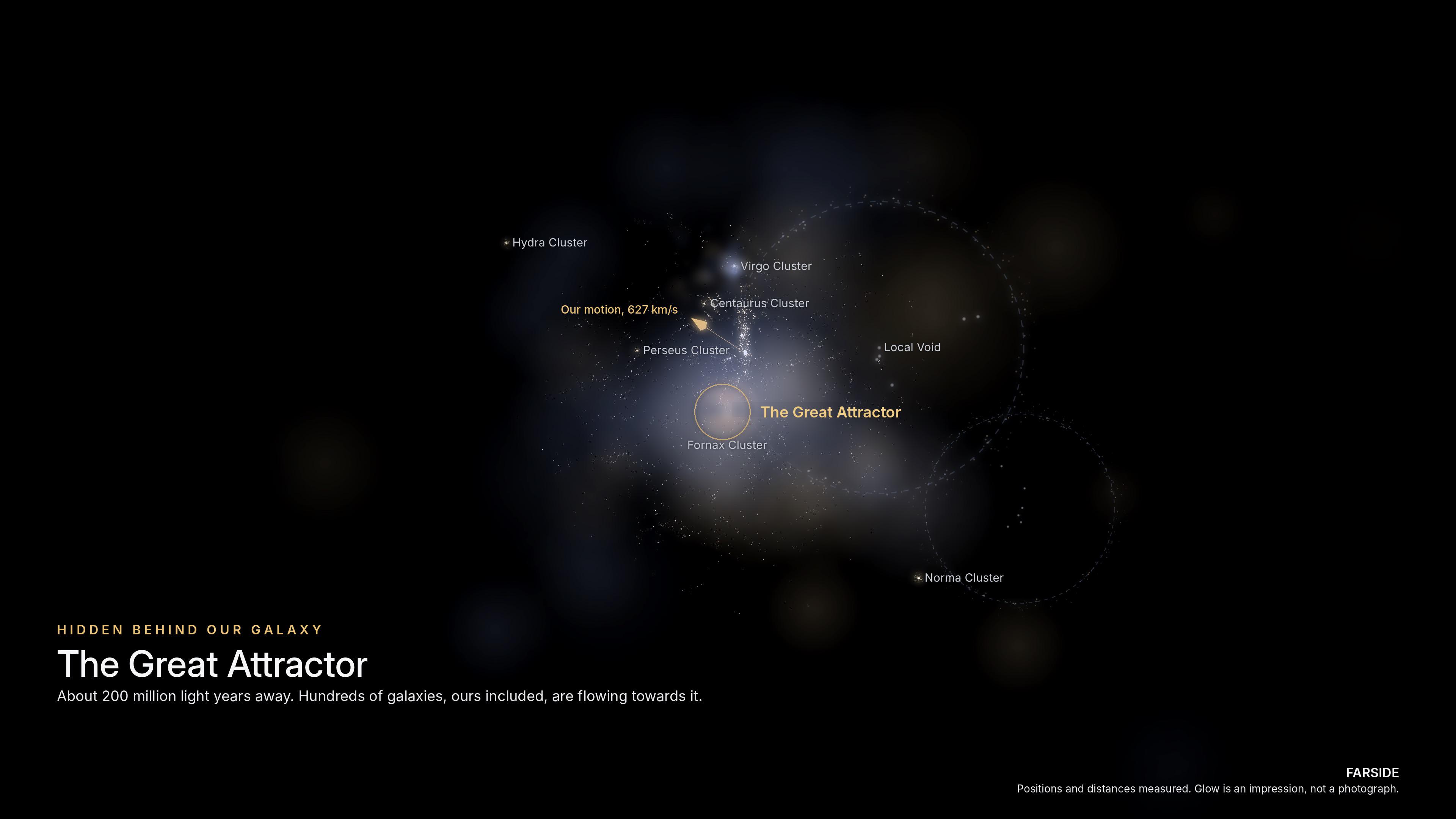
This is a render from a 3D map of the universe I am building. The gold ring is the Great Attractor, about 200 million light years away, behind the dusty disc of the Milky Way (the dark band across the glow). Around it are the Norma, Centaurus, Virgo, Hydra, Perseus and Fornax clusters at their measured distances, plus the Local Void.
How it was made: it runs live in a web browser (WebGL). Each cluster is placed in 3D from its published sky position and distance, and the glow is drawn from what each region is made of. This frame was captured at 4K straight from the map, with only the labels and caption added.
What is real and what is not: positions and distances come from published measurements. The soft glow is an impression of where the mass is, not a photograph.
Question for people who know this better: how much of our 627 km/s is the Great Attractor itself, and how much is the Shapley Supercluster pulling from further out? I have read figures anywhere from about a third to most of it and would love to know what the current view is.
Happy to hear what I got wrong.
r/cosmology • u/Gloomy_Locksmith_362 • 1d ago
You all seem knowledgeable here, so I'd like to ask you what you think this whole thing is, given what we think about the universe, what is your prevailing theory about what we could be inside, why we are here or whatever else?
In my noob view I guess we are inside a greater being, like a bacteria in our gut, given what we know about that microlife, and how micro we seem to be in the seeable universe
r/cosmology • u/SubstantialFlan8329 • 3d ago
I am building an educational visualisation that takes people forward in time to the possible endings of the universe, and I am trying to present the evidence honestly rather than just showing the heat death as settled.
My current understanding, please correct me:
Questions for people who know this better than me:
- Is it fair to show the freeze as the best supported, with the crunch as a serious but unconfirmed possibility?
- How much weight should a 3 sigma result get in something aimed at the public?
- Anything important I am missing, like other endings or caveats about the w0 wa parameterisation?
r/cosmology • u/Galileos_grandson • 3d ago
r/cosmology • u/AutoModerator • 4d ago
Ask your cosmology related questions in this thread.
Please read the sidebar and remember to follow reddiquette.
r/cosmology • u/Windturnscold • 4d ago
r/cosmology • u/anti-life86 • 6d ago
r/cosmology • u/Hammer_Price • 6d ago
Excerpt catalog notes lot 397:
Rare ALS signed one page both sides, 7.75 x 9.75, [postmarked April 26, 1968]. Handwritten letter to his childhood friend Bill Cleghorn at the Central Electrochemical Research Institute, sharing happy personal news on the birth of his son, along with reports of a trip to America and an uneasy professional detente with the astronomer Fred Hoyle.
Stephen Hawking attended St. Albans School from the age of ten, falling in with a close-knit group of bright boys whose shared interests ranged from inventing their own board games and listening to classical music to long bicycle rides in the Hertfordshire countryside. Bill Cleghorn was one of the group, along with Hawking's best friend at that time, John McClenahan; the boys spent nearly every moment together, between completing long hours of school and homework and spending time at one another's houses.
Their friendships endured beyond their school days, after the group found their separate ways to universities, new jobs, and their own families. In 1968, three years after achieving his doctorate, Hawking had applied to work at the Institute of Theoretical Astronomy at Cambridge, founded by the renowned Yorkshire astronomer Fred Hoyle the year before. He was awarded the post, but might yet have been justified in the sense of unease he felt about working under his new director: Hawking had publicly challenged the Hoyle theory of gravity a few years earlier, earning him academic notoriety and acclaim for his brash brilliance.
Diagnosed with early-onset motor neurone disease in 1963, Hawking's physical capabilities deteriorated over time. His shaky hand evinced in this handwritten letter of just five years later, making authentic autographs exceedingly scarce. Confined to a wheelchair by the end of the 1970s, he opted to sign with just a thumbprint later in life. An excessively rare autograph letter from one of the towering figures of science in the 20th century.
r/cosmology • u/scientificamerican • 9d ago
r/cosmology • u/lebron7 • 10d ago
r/cosmology • u/Galileos_grandson • 10d ago
r/cosmology • u/Successful-Bit-2909 • 10d ago
I'm looking for small, independent podcasts on cosmology and the nature of time, especially ones that interview independent researchers and authors, not only professors. Which ones do you listen to and trust? Shows with episodes in the last couple of months would be ideal.
Thanks!
r/cosmology • u/AutoModerator • 11d ago
Ask your cosmology related questions in this thread.
Please read the sidebar and remember to follow reddiquette.
r/cosmology • u/Competitive_Travel16 • 11d ago
r/cosmology • u/MurkyEconomist8179 • 13d ago
Assuming they could be around that long of course
r/cosmology • u/Necessary_Living_617 • 12d ago
Hi everyone, I'd really appreciate some honest advice from people who've been through something similar.
About me: I'm 21M, from India, finishing an MSc in Data Science and Environmental Intelligence in the UK. My student visa ends in January 2027. My undergrad was in Computer Applications. I honestly chose it because I had no interest in studies back then and wanted to escape engineering, since I was scared of physics and chemistry at school.
I came to the UK because I was interested in marine science. My dissertation was on deep learning for underwater image enhancement (diffusion models and rectified flow), and I did a short voluntary placement at a marine research lab. But over time marine science stopped exciting me. New species get discovered every day, and the mystery faded for me.
What surprised me is that during my MSc I got genuinely interested in physics and maths. Podcasts like StarTalk and World Science Festival brought it out. I realised what I love isn't a specific subject. It's the click when I finally understand something, and that chill from the mystery behind it. I now want to do a PhD combining AI and astrophysics. I don't want to throw away my computing skills, and I know generative models are being used in cosmology, so that feels like a bridge. I'm not sure if that's realistically how it works, though.
The job situation: I have no real work experience apart from a part-time fast food job and short placements. I've applied to lots of jobs and got rejections for every single one. Not one interview. I emailed my old lecturers and got no replies. My supervisors are busy with their own work. I even emailed people offering to work for free just to get real experience, and hit a dead end.
So I keep wondering what's going wrong. Is it my nationality? My student visa? Would the Graduate visa actually change anything? I've seen people on it who still couldn't land a job.
My options as I see them:
If you've been in a similar spot, or you're in academia, physics, astro-ML or hiring:
- Which option would you pick in my shoes, and why?
- Is moving from a data science background into an AI + astrophysics PhD realistic?
- What would make a PhD application stand out when I don't have a physics degree?
Thanks for reading this far. Any honest advice helps.
r/cosmology • u/AutoModerator • 18d ago
Ask your cosmology related questions in this thread.
Please read the sidebar and remember to follow reddiquette.
r/cosmology • u/Interesting_Eye6087 • 18d ago
So… about the claim fact that the rate of expansion of the universe is actually increasing. The way I understand it, the redshift of farther galaxies is higher hence by definition, they are moving away faster.
Here’s the part that’s been playing in my (untrained) mind:
While the observed redshift of farther galaxies is greater, the data also represents the state billions of years ago when the light was emitted from the above distant galaxy.
So (this is where you chew me out.) is it possible that billions of years ago, the big bang explosion was still “hot” and expansion speeding up. *Is it possible that the reason farther galaxies appear to be moving away faster is because all galaxies were moving faster earlier in time - we just see the earlier in time light from the farther galaxies now?* But now, in reality the expansion has slowed down and these galaxies are either slowing down or (sacrilege!) headed back in for the Big Crunch - we just can’t see it yet (today’s light will reach us in a few billion years.
It’s my first post ever on such a topic and my first on this sub. Hope it is the right one.
Thanks in advance for a Feynman level explanation that I can grasp.
r/cosmology • u/Philosophy_Cosmology • 18d ago
I was reading a random article and found a reference to an old (1971) paper by A. G. Agnese and A. Wataghin in which the authors introduced a new timescale. According to this new timescale, the initial singularity of classical Friedmann cosmology can be banished to the infinite past:
We can anticipate that under some restrictions (rather general anyway), the new scale t (which we shall call cosmological) has interesting properties. These properties are: a) The origin of time (big bang) in the cosmological scale is shifted to tᵢₙ=-∞. b) One sees that there appears a variation of the light speed c and of the gravitational constant G with the age of the Universe.
...
The natural scale τ is the one which has been used always in practice in all methods of evaluation of the age of the Earth (e.g. the uranium method) or of the age of the Universe (e.g. cosmological red-shift). In this scale it is tacitly admitted that the speed of light has always been what it is today, and the result is of course that the age of the Universe comes to be ≈10¹⁰y. In the alternative cosmological scale t, which we have discussed in this paper, it is admitted that the speed of light may have changed (and also the unit of time may have changed), and it is possible to obtain for the age of the Universe a value which tends to infinity.
I'm not sure I understand their argument very well, but it seems to me the idea is that time asymptotically slows down as the singularity is approached. Consequently, t=0 is never reached. But feel free to correct my interpretation.. I'm not a cosmologist.
Ref: "Scale Factor in Cosmological Homogeneous Models." A. G. AGNESE and A. WATAGHIN.
r/cosmology • u/cyberpsych • 18d ago