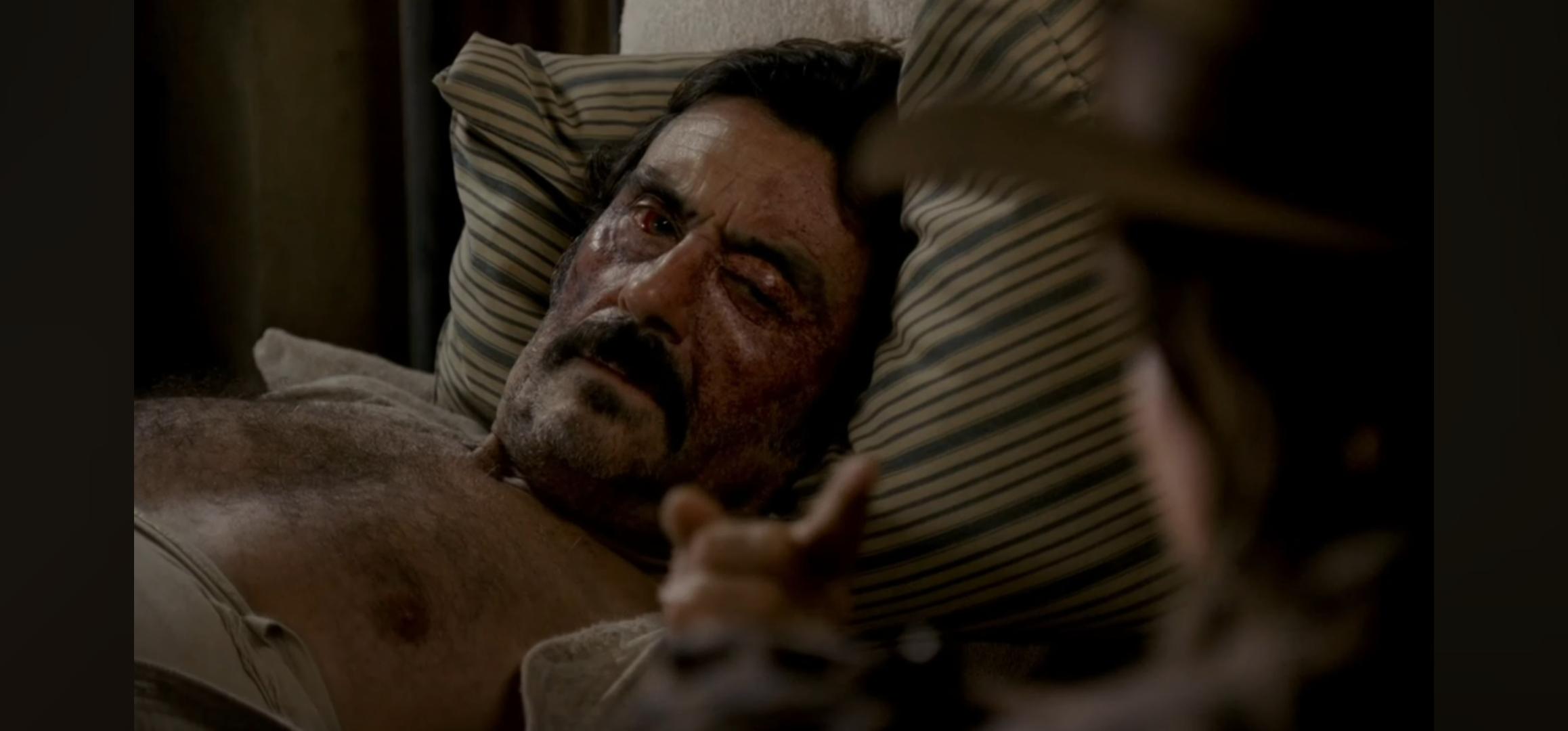
Hey folks,
The character of Odell has provoked much discussion because of his confusing behavior and abrupt death. For the first time, we can trace the full story, as told contemporaneously by Deadwood creator David Milch in conversations recorded during the making of Season 3. The material comes from across a half-dozen cassette tapes found in his papers at Yale University’s Beinecke Rare Book & Manuscript Library. (An extended version of this story appears at https://davidmilch.substack.com/p/deadwoods-odell-explained-by-creator )
How Odell Was Made
Season 3 of Deadwood begins shooting in fall 2005. As usual for a David Milch production, he has general ideas about the direction of the season and a rigorous understanding of his characters’ psychologies, but all scenes are being generated just days or even hours before they are shot.
Actor Forest Whitaker has expressed an interest in appearing on the show, and Mr. Milch is trying to accommodate Whitaker’s schedule. On October 19, Mr. Milch has a phone call with someone named Scott (probably Scott Brazil, producer of The Shield)* to gauge Whitaker’s availability:
We’re trying to get Forest Whitaker to guest star in the show [Deadwood] and I suspect that you’ve had your fill of these inquiries…what I didn’t want to do is go too far down the road without talking to you. I mean, I don’t want to fuck you guys up or even put you in a position where I have to ask if it’s going to screw your schedule up too much.
Mr. Milch seems to be bending over backwards for the actor:
I should think [the role would require] four shooting days in December, not continuous. We would work around you, obviously. And, you know, and if it couldn’t all be in December, so be it. But I just, if his being away in November is putting you guys up against it in any fashion, we can move on.
The phone call ends. Mr. Milch comments to his writing staff:
Milch: He says they’ll make it work…he sounds like they’re getting fucking sick of him [Whitaker] already.
Male voice: So maybe we should do them favor and get him in November.
Milch: Maybe we’ll just jerk him off the way he jerked us off…but they will make it work.
Sometime in the next week the scheduling difficulties prove insurmountable, meaning the mid-season episodes now have a storytelling gap that must be filled. Characteristically, Mr. Milch improvises, as he explained months later to a visitor to the set:
This character, Odell, is the son of Hearst’s cook…when he first came into existence, the only similarity he has to the present character is he was Black. He was a hustler, and he was going to be played by Forest Whitaker, who had asked to be on the show. And so I told him I would try and create a character for him. And then things changed, as they invariably do.
“I don’t really know where the characters are going or where the story is going.”
In the two weeks since the call, Mr. Milch has been writing Odell, amongst all the other calls on his time. He has come up with the character, and has a grasp of the man’s psychology:
You know there’s a lovely thing in Dostoyevsky talking about Raskolnikov, the guy who goes out to kill this old lady pawnbroker and he’s going to make God prove his existence or prove his absence. And the narrator says that Raskolnikov had given himself over to certain incomplete ideas. See, I think this kid [Odell] has given himself over to an incomplete idea. The idea of coming back there to take a run at Hearst. If he really wants to get away with it, he ought to work through his mother, so there’s something unresolved, unclear in his intentions. And Samuel Fields, who’s good at a con, would sense something of that…that there’s something not fully thought out in what the kid is doing.
But this insight has not translated easily into a coherent set of story beats. The character has been cast, with Omar Gooding in the role, and five scenes have already been shot. Odell arrives in Deadwood, then talks with his mother, Aunt Lou (who suspects his reasons for coming), and meets George Hearst for the first time, arranging to dine with him later that day. Terrified her son is in over his head, Aunt Lou then begs Samuel Fields, one of the town’s few other Black characters, to convince Odell to leave town rather than keep the appointment. Fields finds Odell drinking in a saloon, but Odell won’t listen to his entreaties.
And yet Mr. Milch still doesn’t have a sense of where the storyline is going. He begins thinking aloud:
What do you suppose Odell’s plan is? Whatever his plan was is pretty fucked up right now, because of his mother, right, [telling Odell she suspects his reasons for visiting Deadwood] but how would he acknowledge that? I mean…would he be enraged? Is he still looking to run the game on Hearst? So that’s what Odell is winding himself up for a little bit at the Number 10 [drinking at the saloon]… Now I think there remains the credible prospect of working the game in Odell’s mind. And what you want to hear Aunt Lou say is, I’m supposed to make a meal and I know if I do that my boy’s gonna be dead.
Here’s how the pivotal upcoming Odell/Hearst dinner is developing in Milch’s imagination:
One way to look at this, you know, a black woman brings a child into the world, the world she brings into is a nightmare. She’s going to save him from the nightmare. She sent him to Liberia. All she’s done is deferred the nightmare so that when it enacts itself it will enact itself in a compressed and more violent form. This is the nightmare.
And she wants to try and minimize the effects, the damage that occurs. So…probably you would want is to see Odell getting her out of the way and her trying to stay, and Odell architecting an environment where she would have to leave.
You know this is a tough thing to admit, but I’m amongst friends, right? If you wanna understand the best sort of archetypal storylines, watch wrestling matches. And the ways that the referee is disempowered in wrestling matches, which are so absurd. He’s always distracted. The referee is distracted by one guy misbehaving of the tag team while the other guy of that tag team in the ring, meanwhile the other guy is getting fucked.
And another sort of mythic enactment in a wrestling match is ‘shake hands with me’. The villain suddenly has a conversion and he says to the hero, shake hands. And the crowd is saying, no, no, don’t shake hands with him, he’ll fuck you up the ass. Don’t shake hands with him.
So, if Aunt Lou is watching a wrestling match, the one she had hoped to avoid, you know, of her son’s encountered with all the power of the white world. And now she’s trying to be the referee by doing all kinds of obsequious behaviors, trying to placate Hearst. And her own son, seemingly out of naïveté, is saying, let us wrestle, Mom. And you have to portray that process for the real nightmare to begin, when finally the referee is sent from the ring by the seeming hero.
Mr. Milch is also working out a backstory for Odell’s con. It includes the young man’s long-simmering hatred of his mother for sending him away as a child, and the fact that he has not been in Liberia all this time, as his mother has believed:
Can’t you just once leave me alone? It wasn’t enough you fucked me up and sent me over [to Liberia]. Now you’re not even going to let me earn? You know the closest I’ve been to Liberia?
So, probably what happened was, you know, she put the money together, and the ship’s captain, whatever the fuck it was, you know, who was taking him over there, he begged the ship’s captain to let me come back to America, and the ship’s captain said, well, there are certain services you can do me on the voyage back, we might be able to work something out.
[So] he’s been in New York City, or whatever the fuck it is, and he’s tracked her [Aunt Lou] for years, and he’s worked the fucking thing out and he’s got a guy who’s over in Liberia, so he’s got all the right details.
Anyway, and the one fucking thing he didn’t count on was that his mother would be there [in Deadwood]. The last letter he got from her, and imagine what a tortuous fucking path the letters would have, because they’d have to go to Liberia, and the captain would have to collect them and bring them back and find him, and he probably would have to pay 400 bucks a letter. The captain had shaken [him] down: ‘well, I’ve been to considerable trouble. It’s rather an elaborate mail route’. So that probably the last letter [from Aunt Lou] that he got would be a letter which said, ‘Mr. Hearst has plans to go to the Black Hills. He has left me at his diggings in the Comstock. but I pray for you son,’ so what he thinks is his window of opportunity [to come to Deadwood while his mother isn’t there, to con Hearst].
So it’s a hustle, then, and on this basis Mr. Milch settles in to write the dinner scene between Odell and George Hearst. But, as we know, a straightforward piece of conmannery is not what appears on screen. Instead, in real time, as Mr. Milch writes, the action evolves into something more complex. Odell doesn’t try to get money out of Hearst, instead hoping the millionaire will send a professional back to Liberia with him to assess the gold find. Mr. Milch would later explain why the change happened:
[Because Forest Whitaker couldn’t be cast] we made him Aunt Lou’s son. And then he was still going to be a hustler. And then as I was trying to write him as a hustler, he wouldn’t go, he wouldn’t be one. And so all of what were going to be the telltale signs that the sincerity he was invoking was, in fact, a fraud — that he was drinking too much and so on — turned out instead to be proofs of his humanity. But he was telling the truth about the gold that he had. [my emphasis]
The scenes setting up the dinner pointed to Odell being a hustler. But when it came time to write the dinner itself, Odell refused to behave like one, and Mr. Milch wrote it the other way.
Some might call this bad storytelling. Mr. Milch would cite it as an example of letting the materials organize themselves.
Even after Odell’s departure from town has been filmed, Mr. Milch is still working to discover how the storyline should finally resolve:
I think that kid’s gotta die. Odell…It’ll be kind of cool if it isn’t Hearst’s fault but [his mother Aunt Lou] hates him so much and he’s given her every reason to.
During a farewell scene between Aunt Lou and her son, she wants to give him a garnet set in a brooch for good luck, but can’t find it.
What about if all you play in the 8th show is her coming in with the garnet and says, could you send this after him?
What you want to play is that kind of malicious, that petulance that Hearst has when his back is hurting him and he just wants to break your balls. He says, you’re not superstitious in that regard, are you? You know, like that. And actually, it’s stronger if you deprive the audience of Odell. So it’s only the recollection of Odell, because, I mean, what a parent is always afraid of is, jeez, I put him at risk by letting him go. And the way you really play that is by having him not there.
…And I think that, you know, what we really do want to accentuate in that storyline is she was an absent mother for however good reason.
Now the wider sweep of the show intrudes; the main locus of drama is not Odell and Hearst but how other characters have gathered to decide how to deal with the danger Hearst poses to the town. Sheriff Bullock has written a letter of condolence to a miner Hearst has ordered killed, and this indirect appeal to decency will be published in the next morning’s edition of the town newspaper, a move that will surely antagonize the tycoon:
What you want people to believe in the 8th episode is how fucking tense everybody is about that letter, if you’re spending a lot of time with [the Odell storyline], just as a function of time spent…what you want is to start with that feeling of anxiety, you know, about where they’re delivering the newspapers.
With this, the Odell storyline comes to its abrupt termination. Mr. Milch decides that Hearst will come to Aunt Lou and tell her that her son has died, with no explanation of who killed him or why. The larger story has left no more room for the Odell plot.
Epilogue: “I Fucked The Dog”
Production resumes after Christmas. Early episodes of Season 3 are being edited while scenes are generated for the remaining episodes.
On March 21, Mr. Milch expounds on his storytelling philosophy, beginning with one of his favorite anecdotes:
What the chemist Kekulé said, when the structure of the benzene ring, which made a lot of people a lot of money, came to him in a dream. And he said, ‘visions come to prepared spirits’. It came to him in a dream, but he had spent his whole life preparing himself to receive the vision. And so what I try to do, instead of thinking that I need an outline is just trust that all my time on Earth has been spent being prepared to receive that vision. And let it go.
As conversation continues, Mr. Milch addresses what happened with Odell:
Question: How do you know which [idea is right] to trust and follow?
Milch: You don’t.
Question: You just hang in?
Milch: You don’t, but because knowing is a static condition, and knowing the rightness or wrongness of the thing is really just a measure of the energy that continues to emit…So, for example, I kept trying to write the Odell scene, that Odell was running a game on Hearst. And it just wouldn’t go there. Now, my knowing could then at that point have said, well, I fucked the dog. That’s to presuppose that I’m separate from the work [so] I said, well, that isn’t what he did, and using the same scene I just let its new present redefine the meaning of its past. And so that’s another way of saying, stay with the process. Trust the process. You know, when you feel that it hasn’t gone the way you expected or hoped it would go, or that isn’t the money-making way to do it, don’t recoil on yourself. Stay with it. [my emphasis]
There you have it. Was Odell a hustler, looking to run a game on Hearst? Yes, he was, until it came time to write the scene when it emerged in the flow of Mr. Milch’s imagination that he wasn’t. Was the Liberian gold strike real? No, it wasn’t, until that same scene, when it turned out to be true.
Who killed Odell, and why? Maybe Hearst ordered it, maybe not. The tapes suggest a practical answer rather than a dramatic one: the death was a way to close out a storyline that was crowding the bigger drama of the town.
The final question, whether Odell was in the coffin sent to Hearst in the season finale, was never answered on-screen, but the tapes offer a strong hint. In late March, Mr. Milch is attending to the last few practical filming matters before production wraps:
Okay, so then let’s think what else there is. There’s... We could do a thing with Utter opening the coffin of Odell. We would not need Odell [i.e. actor Omar Gooding] for that.
※ ※ ※
Comment: There’s a reason the documentary that followed Mr. Milch’s final days showrunning NYPD Blue was called Without a Net.
Mr. Milch couches his creative approach in metaphysical terms, citing exchanges of energy or, elsewhere, a process of testimony to the interconnectedness of all human beings. But there is something distinctly Milchian that requires him to take constant risks and push the envelope. This holds for the nuts and bolts of television production as much as for his addictions to drugs and gambling and his lifetime of other reckless behavior.
That envelope-pushing has on-screen consequences. From a distance, Deadwood is a world that digs its roots deep, full of characters who have unwittingly ended up in town puzzling out how to live. Examined closely, the contradictions that the limits of personality impose upon their actions are mirrored by the predicament of a storyteller working out, in real time, what these characters will do. Sometimes the result is a story turn that cannot withstand pitiless scrutiny for logical consistency or conventional narrative coherence, and Odell’s story is the ultimate example.
* The easy tone between Mr. Milch and “Scott,” plus mentions of aspects of TV production, suggest this was Scott Brazil, then producing The Shield, on which Whitaker was about to debut. Mr. Milch had worked with Brazil for years on Hill Street Blues. However, a Variety article the following summer claimed Whitaker had yet to start filming The Shield at this time, which casts some doubt over the identification.