r/dltHub • • 1d ago

dlthub is now Pay-as-you-go for small and medium teams

Post image
2 Upvotes

Before, you needed a sales call and a yearly contract to use dltHub. Two kinds of teams asked us to change this:

  • Teams that own their data pipelines but have no data engineer. They wanted to start without a contract and pay only for what runs.
  • Data engineers who want dltHub for their team, but their boss must approve the cost. They wanted to use it longer than a trial and show the value first.

How it works: you pay for the time your pipelines run, and you choose how often they run.

  • A few APIs and a Postgres database, once a day: about $80 a month.
  • A team with about 20 pipelines: about $800 a month.
  • Heavy use: a yearly contract with volume discounts, more workspaces, an SLA, bring your own cloud and audit logs.

Every team starts with a 14-day free trial and $30 in credits. When the trial ends, you choose a plan.

Questions about pricing? Ask here or in the app chat

Start a free trial: https://dlthub.com/pricing
Read the announcement: https://dlthub.com/blog/dlthub-pay-as-you-go


r/dltHub • • 8d ago

Announcement Today, we’re launching datasets and lineage on dltHub

3 Upvotes

Your team can now see how data flows through your workspace, from sources through pipelines to datasets, without asking who built what. The Workspace Explorer draws this map from what your pipelines record as they run, so it stays current and nobody has to maintain it. It’s available today in private preview.

Teams and their agents now build a pipeline in an afternoon. Understanding how it fits with the rest of the workspace takes much longer, and that knowledge usually sits with whoever built it. It matters most in two moments:

  1. A run fails and the SLA clock starts. Your team needs to know where the failure began and what sits downstream before the fix can start.
  2. An auditor asks where a number came from. Your team needs an answer that is already on record.

The Workspace Explorer gives you three views:

  • Data Lineage: trace data from its sources through pipelines to datasets.
  • Job Graph: see which jobs trigger which, and what a failed run affects downstream.
  • Schema graphs: see what’s inside every dataset and how its tables relate.

“How your data flows” becomes knowledge the whole organization can use and trust.

How it all works: https://dlthub.com/blog/introducing-datasets-and-lineage


r/dltHub • • 15d ago

Announcement Try out data pipeline performance optimization

Post image
1 Upvotes

We built performance optimization on dltHub so data teams and their agents can fix slow pipelines themselves.

Fixing a slow or failing pipeline usually goes like this:

  1. Re-run it, ideally with logging turned on.
  2. Scan the logs or the data for the error.
  3. Search the code for the cause and fix it, or ask an engineer to.
  4. Re-run. If it works, the problem may be solved for now. If not, go back to step 2.

Asking the agent to fix a slow pipeline is the obvious next step, but the agent needs to know where to look and what to change, so we built a toolkit that gives your agent a repeatable process for tuning a dltHub pipeline:

  1. Profile the pipeline to find the bottleneck.
  2. Let the agent tune the code with our performance tuning skill.
  3. Size the machine to match the workload.

The result is a pipeline that runs faster and uses less memory.

To try it on your own pipelines, paste this into your coding agent:

Run uvx dlthub-start, then /optimize-performance to find out why the pipelines in this workspace are slow or running out of memory, and fix them.

How it all works: https://dlthub.com/blog/introducing-performance-optimization


r/dltHub • • 22d ago

Announcement Today, we’re launching pipeline observability on dltHub.

Post image
3 Upvotes

For data engineers, it’s important to deliver fresh and verifiable data to your stakeholders. Have your agent build and schedule a pipeline, and the job is done, right?

Normal monitoring only catches failed runs, not data anomalies. Your pipelines ran, but the dashboards are failing, and you only know because someone already complained.

That’s why data observability is crucial for your pipelines - in dltHub’s UI, you can catch data anomalies at a glance. Additionally, the job-inspector background agent can speed up recovery from a failure by looking at the job run metadata and proposing a fix before anyone knows it was broken.

Spot missing rows before your business does.

We wrote a blog covering this if you want more detail.

https://dlthub.com/blog/introducing-pipeline-observability


r/dltHub • • Oct 20 '26

dltHub Townhall: Q&A, presenting self healing data pipelines

3 Upvotes

​Join Violetta, Lis, Dave, and Marcin for the dltHub Townhall on October 21.

​Since we shipped the dltHub AI harness, a single engineer builds three times as many pipelines as before. Maintaining these pipelines still involves a lot of attention from engineers. dltHub is building autonomous data infrastructure to reduce the effort to operate pipelines. With background agents, we are helping data engineers to automate the diagnosis when a pipeline fails.

​During the townhall, we will dive deeper into our vision of autonomous data infrastructure and show a live demo of dltHub's verified pipeline health agent . Lis (Director of Engineering), Dave (Staff Software Engineer), and Marcin (CTO) will answer your questions about the agents, the roadmap, and the dltHub platform.

You can join via YouTube Live or LinkedIn Live. See you tomorrow!

https://luma.com/dltHub-townhall-oct


r/dltHub • • Oct 07 '26

Background agents live on dltHub

3 Upvotes

*To try: Paste this prompt into Claude, Codex, or Cursor: "*Run uvx dlthub-start@latest to build my first pipeline and run it on dltHub" and add your agent key

As data engineers, we want to own our code and outcomes, while minimizing the costs associated with building and maintenance.

Today we launch Background Agents on dltHub, a first step towards automating the maintenance further than programming alone would allow it.

Our background maintenance agent comes alive on pipeline failure and follows a predictable troubleshooting pattern. Its permissions that tell it how far it may go in resolving an issue are tiered based on the feasibility of autonomous remediation.

How it works

failures follow a healing chain

- it wakes up when a job fails, not when someone prompts it.
- It reads the run record, the logs, the job definition and the code.
- It classifies the failure (config, credentials, upstream data, code, resources, transient or unknown), quotes its evidence verbatim with the file or log line, and names a fix.
- It doesn’t currently apply the fix: secured with no shell, no write access, no warehouse access, and a token budget per run.

How it looks: a load fails overnight, the alert links to the agent's run, and the diagnosis is already there, with the log lines that prove it and the change to make. Someone reads it over coffee and decides what to do.

In practice

dlt power user Martin Seifert, a data engineering lead at a Swiss nonprofit, built the hand-made version of this to run on dltHub. Every morning his agent checks that his >70 production dlt pipelines ran green and drafts fixes he approves on the train to work. What he wanted next was for that check to start on its own when something breaks.

Why it works as a first agent: the worst case is a wrong diagnosis that a person reads and ignores. Nobody wakes up to a dropped table.

What it doesn't catch: runs that finish green with missing rows. A failure trigger never sees those, so they need a separate check that runs on success.

Interested?

Just try: Paste this prompt into Claude, Codex, or Cursor. The agent does the rest.

"Run uvx dlthub-start@latest to build my first pipeline and run it on dltHub" and set up your agent or book a demo

hbu?

What are you being asked to make agentic, and where are you drawing the line?


r/dltHub • • Aug 06 '26

dltHub: Make agents safe enough to run for your whole team.

Thumbnail
dlthub.com
5 Upvotes

"Hey team, I just wanted to reiterate how damned cool dltHub continues to be, along with the agentic workflows. We have an absolute mountain of Klaviyo data and due to API rate limits it's very slow and was prone to failure on extraction. The agent devised a tiered chunking strategy which does 7 days, then if it times out drops to 1 day, then 1 hour, and has managed to get through some highly problematic data patterns without missing a beat. Super impressive, you guys are amazing!"

- (Jim, Pinter, running his company's data with what he calls a team of agents)


r/dltHub • • Jul 31 '26

Composable canonicals, an ai-native solution to the centralized team knowledge loss problem

Thumbnail
dlthub.com
3 Upvotes

decentralised teams exist because operational needs cannot easily convey the domain knowledge back and forth to the central team.

By using canonical models, the data architecture becomes self documenting knolwedge graphs the LLMs can understand natively.

in this article I describe how that can be used to capture domain knowledge at the source and call on it when we want to answer central reporting business questions or operational needs alike, without adding headcount at the decentralised layer.


r/dltHub • • Jul 29 '26

One engineer. 25 production pipelines into Snowflake. An agent in OpenCode running the whole loop.

Post image
5 Upvotes

A dltHub power user showed us his exact dltHub setup - live.

elvis kahoro hosted a feedback call with dltHub power user Martin Seifert, who walked us through his agentic dltHub setup for Snowflake.

dltHub is the agentic data and managed-infra layer on top of any warehouse - in Martin's case, Snowflake. dlthub runs his ingestion and orchestration. The two things Martin actually called out are the agentic layers of dlthub, and they map straight onto the typical dltHub setup:

→ Skills = the dltHub AI harness. The agentic primitives his agent uses to build, run and fix pipelines. In Martin's words: "one of the more hidden benefits is the skills - the agent skills maintained by dltHub work very well, particularly for deploying a pipeline, building one from scratch."

→ Observability = the AI-native dltHub context catalog. Lineage, schema, data quality, run state. "Everywhere else I've run dlt, I had to build observability myself just to see if pipelines ran."

Inside OpenCode, Martin splits the work across four specialized subagents:
• Data Engineer → ingestion
• Data Modeler → the semantic layer
• Dashboard Developer → data apps
• Platform Admin → infra, ops, and the build-run-fix fallback - "it tries to fix it, presents the fix to me before deploying anything"

He drives all of it from OpenCode, grounded in his actual dltHub workspace - run history, schemas, pipeline state - not just the docs.

The managed-infra side is what Martin means when he calls dltHub "a managed service on top of a couple of VMs": his Platform Admin agent manages the runtimes - dltHub, Snowflake containers, an on-prem VM - on one framework, since dlt runs wherever Python runs.

The scale this handles: 155 million rows across 25 pipelines in 7 days. A load that would normally need full-time monitoring. Instead, his agent watches the runs and prepares the fixes for him to approve - while he rides the train to work.

Get the video: https://www.linkedin.com/feed/update/urn:li:activity:7485368657171124225/
Get the setup: https://dlthub.com/blueprints/agentic-data-stack


r/dltHub • • Jul 22 '26

I migrated a Fivetran pipeline to dltHub for $0.65

Post image
3 Upvotes

Fivetran charged monthly active rows for this MySQL connector. I replaced it with a dltHub job in about an hour for $0.65 in MiniMax M3 tokens. The existing job moved Drupal CMS tables through an SSH tunnel into ❄️ Snowflake every day. My first profile found 346 tables and 6.2 million rows... technically fun, operationally wrong. I created a dedicated SSH key, pinned the server host key, matched Fivetran's exact table scope, checked the plan, and added a downstream Cortex Search refresh task. dlt's SQL source does not open SSH tunnels, so I built a small Paramiko TCP forwarder and passed its ephemeral local port to SQLAlchemy. The deployed job completed in 39 seconds. This is what I consider reasonable to be billed for 😎 Twenty-five focused tests cover the host-key handling, source scope, composite keys, incremental state, cleanup, and downstream SQL. I still made data and security decisions myself. OpenCode handled a lot of typing, fixtures, and plumbing for $0.65. Pretty good trade 😜

Read more: https://www.linkedin.com/pulse/i-migrated-fivetran-pipeline-dlthub-065-martin-seifert-8hhxe/


r/dltHub • • Jul 22 '26

dlt vs dltHub: the five ecosystem layers dltHub adds

Post image
5 Upvotes

dlt handles ingestion.

dltHub adds the five ecosystem layers you'd otherwise build yourself: AI harness, context catalog, transformation, orchestration, managed infra.

Read more: https://dlthub.com/blog/from-dlt-to-dlthub


r/dltHub • • Jul 21 '26

Migrating off of Airbyte - how it works, why do it

Post image
3 Upvotes

Maintenance is the main reason we see users move to dlthub - who should do it, how fast, how often.

users move for the reliability, ease of use by anyone on the team, and low cost of ownership.

Read more: https://dlthub.com/blog/migrate-from-airbyte-to-dlthub


r/dltHub • • Jul 17 '26

Migrating off Fivetran: what happens to your bill, and how easily the move works

Post image
2 Upvotes

You already pay for compute everywhere else in your stack — Snowflake, Databricks, AWS. Ingestion is the one place you still pay royalties per row. Switch that to compute and the bill typically drops 10–100x.

We benchmarked what one hour of dltHub (~$1) moves, by source type.

On the move itself: senior engineers report ~1 connector/day in-house. Or bring us your stack — when we have capacity, we move 30 pipelines in two weeks.

📖 Read the full post here


r/dltHub • • Jul 17 '26

Your Python ETL scripts were the right call — here's what it takes to make them production-grade

Post image
4 Upvotes

Writing your own integrations was smart: you kept control of the most foundational part of your stack instead of handing it to a vendor. But the difference between hobbyist and professional pipelines isn't the happy path — it's the failure modes:

  • Schema changes break your back — data loads untyped, or typing shifts from run to run
  • Incremental state is missing — or it's a max() over a big table on every run
  • Transient errors kill the run — rate limits and network blips become failures
  • Recovery is ugly — broken idempotency means duplicates and partial loads, cleaned up by hand
  • Bus factor of one — the author can fix it, the rest of the team can't. Author on vacation + broken pipeline = ugh

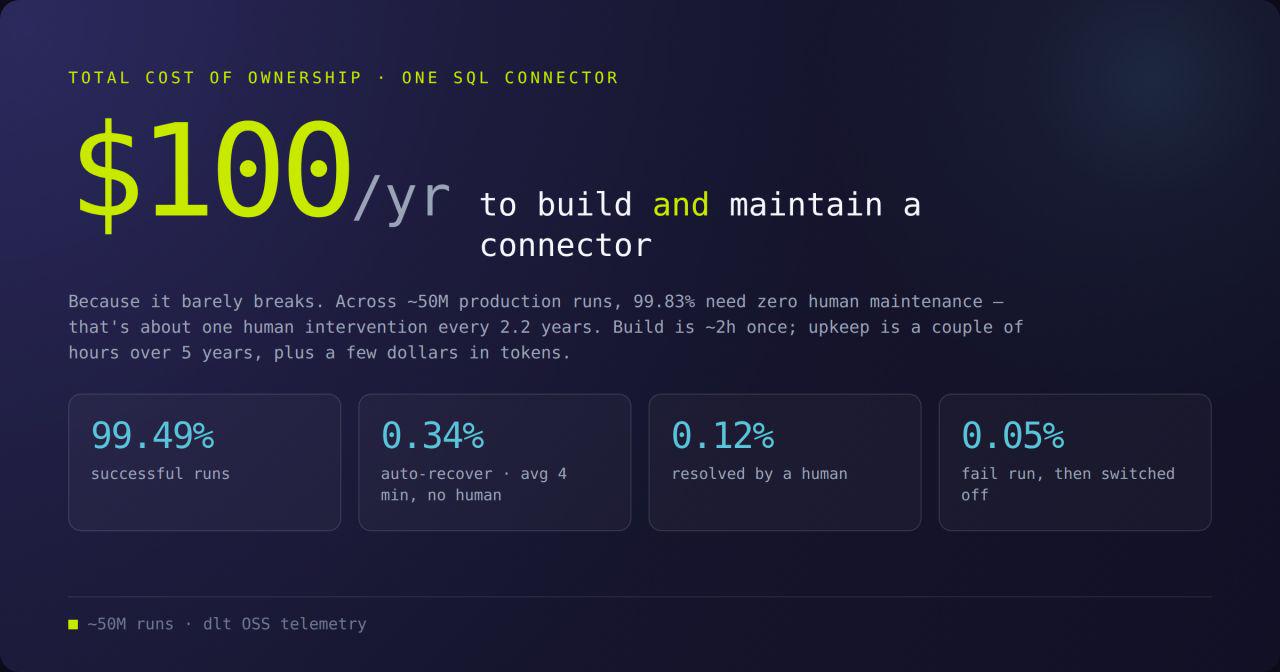
The new post covers how dlt closes each of these — schema evolution, incremental state, retries, parallelism at the flip of a switch — and what running pipelines costs after: 99.83% observed reliability in the wild, which pencils out to roughly $100/connector/year in maintenance.

It also walks through what dltHub adds on top: agentic deployment and maintenance, so reading logs and tracking down breakages stops being specialist work under pressure.

📖 Read the full post here


r/dltHub • • Jul 08 '26

dltHub Blueprint: Break down agent spend by model, person, and customer

Post image
4 Upvotes

r/dltHub • • Jul 08 '26

Launching dltHub Blueprints - an opinionated assembled stack built by domain experts

Post image
4 Upvotes

A few weeks ago we launched dltHub Pro: our first commercial product, and the first LLM-native code tool.

Advanced individual engineers picked it up and built serious things fast. Some effectively assembled their own flavor of a dltHub stack using the dlthub components.

But most of the inbound requests didn't ask for parts. They clustered around specific use cases: Get us off a vendor. Make our agent costs measurable.

Our original idea had been to soon launch Scale, the team version. But the inbound asked for their problem solved end to end, not which plan they fit in. So we're removing the user-oriented Pro/Scale/Enterprise separation.

Instead we assemble the product around the use case: Blueprints.

A Blueprint is an opinionated, partner-built recipe of dltHub that solves one problem end to end — the sources you already use, the transformations that answer your question, a dashboard for the team that asked. The composability stays, you just don't have to do it alone.

If you're on Pro: nothing changes, your subscription continues as is.

We published the launch FAQ today: why agent spend is the first Blueprint outcome, why agent traces break the Fivetran-plus-dbt model, and how the three parts fit together.

https://dlthub.com/blog/agent-cost-distillation
blueprints: https://dlthub.com/blueprints


r/dltHub • • Jul 07 '26

Turning agent traces into queryable dashboards

Thumbnail
youtube.com
3 Upvotes

How do you eval your agents?

Agent traces are a good place to start.

If you're building with AI coding agents, chances are you already have a bunch of traces sitting locally or coming in from external services. In this workshop with DataTalks.Club, Alena Astrakhantseva shows how to turn that messy trace data into something structured, queryable, and actually useful for debugging and reporting.

It covers local traces (Claude Code, Codex, Copilot), REST APIs, and building dashboards on top of them.


r/dltHub • • Jul 02 '26

The total cost of ownership of a DIY connector in agentic age is $100/year

3 Upvotes

I wrote earlier about reliability nrs, that's because i was calculating maintenance rates.

Turns out people running dlt in production only need to do a maintenance event every 2.2 years. Since maintenance is crazy fast and simple, that's maybe 1h per yer of dev time ($100 value) and $1-2 of tokens.
https://dlthub.com/blog/tco#the-real-cost-of-a-connector-today-is-closer-to-100-y


r/dltHub • • Jul 02 '26

99.83% OSS dlt production pipeline runs do not need a human intervention

Post image
3 Upvotes

I looked at the last 50m runs of pipelines of companies using dlt in production and the reliability was shocking. There were 3x more transient errors (network, source, destination availability) than hard issues like access loss or api deprecation.

More: https://dlthub.com/blog/tco


r/dltHub • • Jun 24 '26

Blog Post You're the agent, unless you use a continuous context

8 Upvotes

Human in the loop doesn't mean you do the errands.

Human JUDGMENT in the loop. Not human copy pasting context because the agent is doing cursed things without it - that's busy work.

The agent should have all the context access it needs.

Video is from this morning in our office: A Rube Goldberg machine that works like an agent without context.

read more about how our context layer works: https://dlthub.com/blog/context


r/dltHub • • Jun 22 '26

Maintain a deployed pipeline from cursor chat with dltHub Pro

4 Upvotes

I just recorded this video to show the capability. For myself as a data engineer, this is like a dream come true.

Total cost of ownership is looking amazing.

Asking for a fix costs under $1 in tokens and takes under 10 minutes (video speeds up waiting times for your convenience but look at the clock top right)


r/dltHub • • Jun 19 '26

Memes Cut your ingestion SaaS bill to 1%, before your manager does

3 Upvotes

Cut your ingestion SaaS bill to 1%.

SaaS vendors charge 100–1000x over cost for moving data. You can own those pipelines instead.

How? Tell your Cursor/Claude/Codex to run uvx dlthub-start@latest, build your expensive pipelines there, and deploy them to dltHub.

Worried about token cost? It's about $3 to generate a pipeline, and less for a fix.

The best part? You get control, visibility, and team enablement to self-serve.

Just tell your coding agent to run:

uvx dlthub-start@latest

start a free trial — $30 in credits, no card required, 14 days, check what your pipelines really cost to run. All doable from chatting with your LLM.

Try it before your manager does!


r/dltHub • • Jun 02 '26

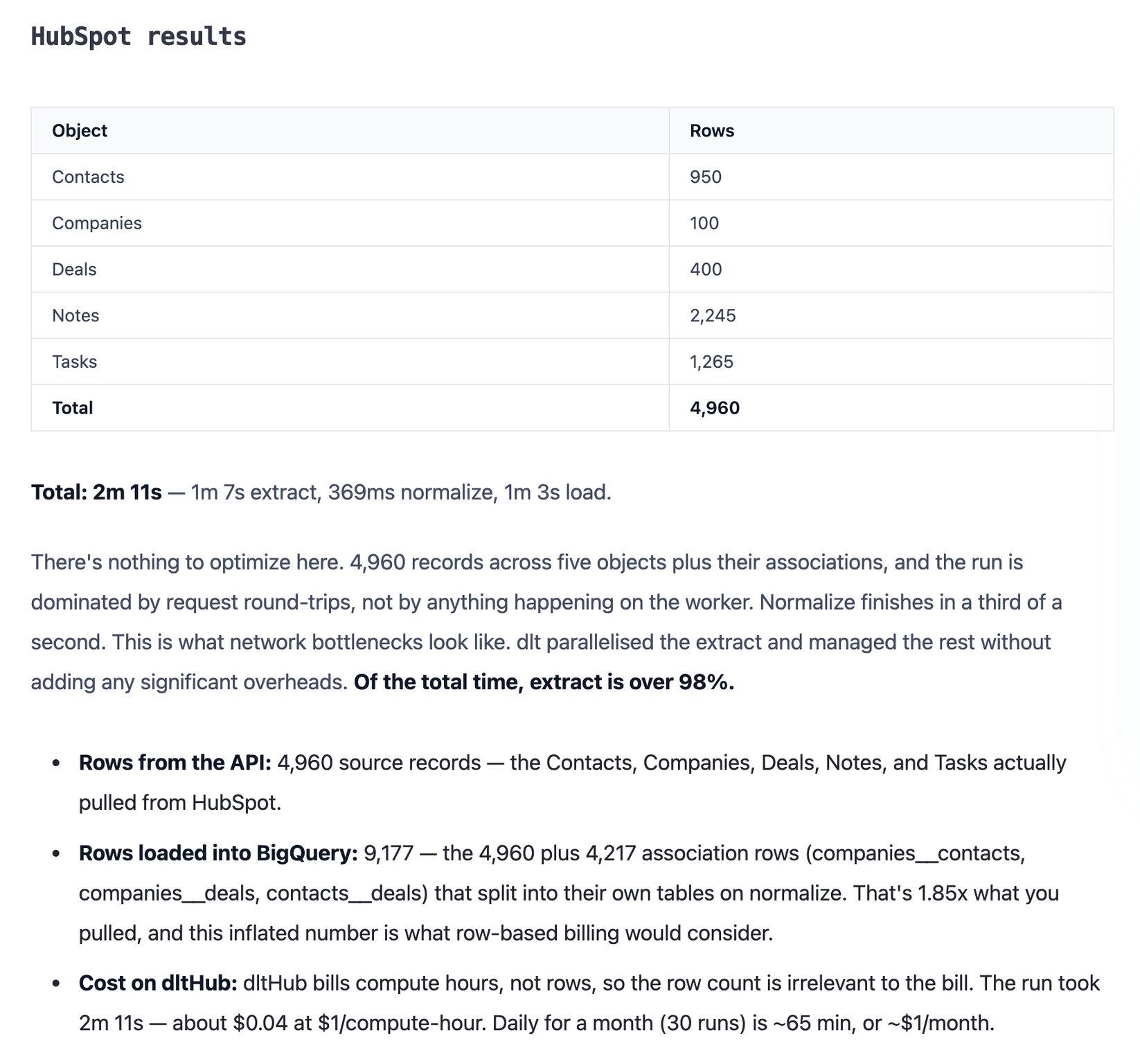
Blog Post dlthub benchmark: Rest APIs (network bottleneck): dlthub adds only 2% overhead

Post image
3 Upvotes

Continuing our benchmark series: REST APIs!

Last week we saw that 1h of dlthub runtime can transact 65gb/350m SQL rows

But how does it perform on APIs? It waits, effectively!

dlt's normalisation only takes 2% of the total time while the rest is waiting for network (which is also accelerated by dlt with parallelism)

Looking at inserted rows (hubspot, github, post unnesting), we see a rate of about 225-275k rows per hour.

https://dlthub.com/blog/benchmark-dlthub#case-2-rest-apis


r/dltHub • • Jun 02 '26

Blog Post Data quality: Agents testing business rules thanks to continuous context

Post image
6 Upvotes

You almost never get the source's business rules. The app that produced the data enforced them, but none of that travels downstream. So you make assumptions and write code against them.

Full blog post: https://dlthub.com/blog/dq-toolkit-preview

The breakage isn't usually a schema change (when using dltHub at least).

The quiet killer is semantic drift: the assumption was right when you wrote it, then the source changed its logic and nothing told you. A new status value appears. A field that was always populated starts coming through 30% null.

The pipeline keeps running. The numbers keep being wrong.

This is also why "just point an agent at the table and add data quality" produces noise. An agent that doesn't know what the data is supposed to mean will test everything and surface nothing, a thousand generic assertions, zero signal.

Useless, with a compute bill attached.

The signal comes from knowing the assumptions end to end. dlt's schema already carries some of them (primary keys, non-null, uniqueness) because the loader uses them.

The dltHub AI Workbench data quality toolkit reads those, then has you state the semantic ones in plain language, samples the column to confirm the real value set before any rule is offered, and writes the approved checks in as decorators that run on every load.

Because the LLM context is continuous end to end, the LLM knows where to apply checks on your pipelines. The rest is plumbing.