When extreme wealth concentrates at the top of society, it creates a vacuum of underdevelopment, broken education, and chronic scarcity at the bottom. Out of this engineered deprivation, the predatory detachment of the elite gets absorbed by the poor. In sociology, this is known as internalized oppression and cultural hegemony—where the ruling class makes its own ruthless worldview feel like "common sense." Rather than uniting to challenge the system keeping them down, marginalized people absorb the elite's mindset, turning those who share their exact struggles into disposable objects to be exploited, degraded, and discarded.
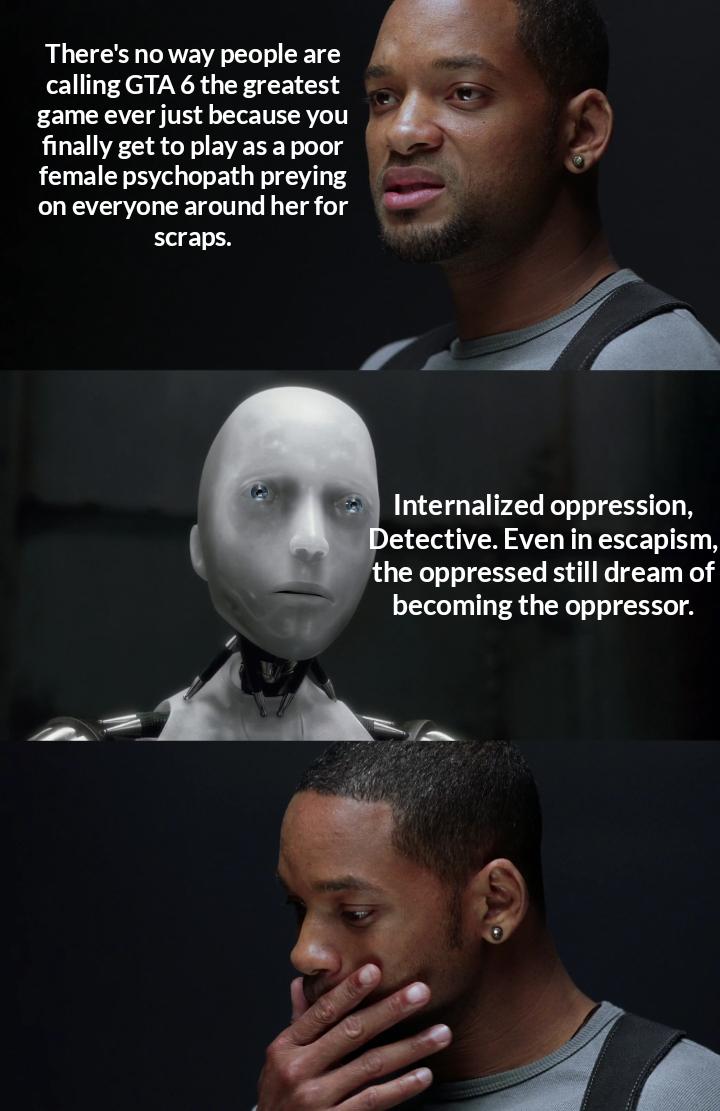
As the Brazilian educator Paulo Freire famously warned, when education isn't liberating, "the dream of the oppressed is to become the oppressor." We see this exact pathology celebrated in modern pop culture—most notably in the breathless hype crowning Grand Theft Auto VI as the "greatest game ever made" simply because players now get to inhabit an impoverished female psychopath carving out survival through ruthless criminality. Instead of imagining the end of the predatory system that creates poverty, mass culture mistakes equal-opportunity cruelty for empowerment. Playing as a poor protagonist who preys on her own socio-economic peers for scraps gets packaged as "progressive representation," proving that under a colonized mindset, liberation is reduced to getting your turn as the exploiter.
In the real world, this transferred psychopathy manifests across several destructive personalities within impoverished communities:
The Sexual Personality (Patriarchal Commodification): In spaces of unchecked wealth, powerful men treat impoverished women seeking financial escape as temporary, disposable luxuries. Stripped of economic agency, men in underdeveloped communities internalize this exact worldview, aspiring to treat women with the same disposable, sex-slave mentality. As feminist theorists like bell hooks have pointed out, when men are denied real institutional power, dominating women's bodies becomes a brutal proxy for control—normalizing hyper-objectification, sexual violence, and gang rape culture.
The Racial and Tribal Personality (Horizontal Violence): Undereducation and economic scarcity breed intense competition for crumbs. Theorists like Frantz Fanon called this horizontal violence—where oppressed people take out their anger on each other instead of the system above them. Adopting the divide-and-conquer tactics of elites, impoverished groups weaponize race, ethnicity, or nationality against equally marginalized neighbors through xenophobia, colorism, and tribalism.
The Religious Personality (Monetized Desperation): In underdeveloped regions where institutional support is missing, spiritual desperation gets ruthlessly monetized. Adopting the extractive mindset of corporate monopolies, predatory religious leaders and fanatical peers weaponize faith to exploit the vulnerable—framing poverty as a moral failing or curse, extracting the last meager savings from desperate believers, and condemning out-groups as evil.
The Familial Personality (Alienated Kinship): Extreme deprivation corrupts the most intimate human bonds, turning households into sites of ruthless extraction. Family members and close friends stop viewing one another as sources of mutual care and instead calculate each other's worth strictly by how much labor, money, or utility can be squeezed out. At its most depraved extreme, mirroring historical slaveholders, desperate relatives treat their own blood kin as literal chattel—selling children or siblings into forced labor, debt bondage, or sexual slavery as final assets to liquidate for survival.
The Economic Personality (Street-Level Predation): Within financially devastated neighborhoods, the "profit-over-people" ethos of corporate monopolies mutates into predatory street-level hustle culture. Small-scale contractors withhold wages from desperate day laborers, local loan sharks and scammers ruin their own neighbors, and everyday citizens mock unhoused people or welfare recipients as "parasites"—mirroring the rhetoric of detached billionaires to feel a false sense of superiority over those at the very bottom.
Breaking the Cycle: A Spectrum of Social Solutions
Because these psychopathic personalities—and the pop-culture fantasies that glorify them—are born from engineered scarcity and miseducation rather than human nature, they can be dismantled across a spectrum of action, from the revolutionary to the moderate:
The Revolutionary (Abolishing Scarcity): True liberation means dismantling the extreme wealth concentration that manufactures the psychopathy in the first place. Through mass working-class solidarity, wealth redistribution, and guaranteeing basic survival—housing, healthcare, food, and education—as human rights rather than scarce commodities, the desperate need to exploit neighbors, women, and kin collapses.
The Structural (Critical Education and Protection): Drawing on Freire’s idea of critical consciousness, schools and community programs must teach people to recognize the systemic roots of their poverty—and see through media fantasies that repackage their own exploitation as "empowerment." Pairing critical education with trauma-informed mental health care, strong legal protections for women and children, and crackdowns on predatory lending and trafficking starves these destructive personalities of the environments they need to grow.
The Community-Led (Mutual Aid and Solidarity): At the grassroots level, neighborhoods can reject transactional relationships by building local mutual aid networks, worker cooperatives, and community land trusts. By pooling resources to care for the unhoused, protect vulnerable families, and resolve conflicts through restorative justice, communities replace the elite's "every person for themselves" ethos with collective resilience.
The Moderate and Personal (Conscious Refusal): Even within broken systems, individuals can begin decolonizing their own minds through daily accountability. Calling out lateral violence, refusing to participate in the objectification of women or the scapegoating of marginalized neighbors, questioning the media we consume, and fostering genuine, non-transactional care within our own families acts as quiet, everyday resistance against the cruelty of the ruling class.
Ultimately, the most insidious triumph of extreme inequality is the colonization of the mind—convincing the oppressed to mirror the psychopathy of their exploiters both on the streets and in their digital fantasies. Yet the moment the poor recognize their shared humanity and refuse to copy the cruelty of those above them, the machinery of exploitation loses its strongest weapon, opening the door to true collective liberation.