r/economy • u/FlappyBored • 14h ago
G7 real GDP growth Q3 2026

0
Upvotes
r/economy • u/HarpoMarks • 9h ago
r/economy • u/Standard-Software-41 • 19h ago
This sounds extreme, but only because people confuse price with value.
Imagine you have an apple and your neighbor has an orange. If you trade with each other, you haven't created any new fruit. You only changed who owns what. Markets do not create value; they only swap one thing for another. The ratio of that swap, one apple for one orange, is what we call price.
Actual value is created in only two ways in the real world:
A) Making something useful or gathering it from nature.
This can be wheat because it feeds you, or a warm coat because it protects you from the cold. A song also has value because it brings joy, gold because it never rusts, and oil because it powers cars and heats homes. You can do something with these things.
B) Making a binding promise (an obligation).
Suppose you buy a $100 chip at a casino, or put $100 into a gift card. That plastic chip or card isn't useful on its own; you can't eat it or wear it. Its value comes from a strict legal obligation: the casino or store must give you $100 worth of cash or goods when you hand it back. Stocks and bonds work the same way; the company is legally obligated to share profits or pay you back.
Money like euros and dollars works this way. When a bank lends someone money to buy a house, a debt is created. The bank is obligated to accept those euros or dollars back from you to wipe out your debt and take the mortgage off your house. That legal duty to cancel debt is what gives bank money value.
Now look at Bitcoin.
When Bitcoin's creator, Satoshi Nakamoto, wrote a computer program that updates a shared list of numbers (a database), he did not create anything from the first category; you cannot eat it, wear it, or build with it.
And he did not create anything from the second category either. Those numbers in the computer list do not obligate Satoshi, the issuer, to do anything for you. Just as a casino must redeem its own chips and a bank must accept its own dollars to cancel the mortgage on your house, an obligation only exists with the issuer. With Bitcoin, you cannot bring that record back to Satoshi and have him pay you out like a casino, or release a debt like a bank. His records carry zero obligation from him.
Those records are completely non-binding, just like a page torn out of an old newspaper, a paper bill from a Monopoly board game, or a square of toilet paper with a number written on it in pen.
Here is the key difference: a square of toilet paper belongs to the first category because it actually has a practical, everyday use. Satoshi’s computer record cannot even do that. That is why a single sheet of toilet paper has more real value than every Bitcoin in existence.
So where does Bitcoin's high price come from?
Price only shows up when people start trading. Suppose someone gives away a bank record of 300,000 USD, which has massive real value because it can wipe out a family's entire house mortgage, in exchange for a Bitcoin record saying 5 BTC.
That trade does not magically inject value into Bitcoin. Just like swapping the apple and the orange, nothing useful was created. It only shows someone making a foolish trade: giving away a powerful legal record that clears real-world debt in exchange for an empty record that obligates nobody to do anything. The "price" of Bitcoin, 300,000 dollars for 5 coins, is simply a scoreboard measuring that foolishness.
Why so many people join in on this, and even burn massive amounts of electricity just to keep updating Satoshi’s non-binding list, is a mass delusion that psychologists, sociologists, and economists will be studying for generations.
r/economy • u/DecembersDragons • 14h ago
I had a dream. I went to see Uncle Sam at his little shop. I walked up to the counter and told him I wanted to buy a T bond. Well do you he says. Well do I got plenty to sell you he says. So I toss down a hundred bucks and tell him to give me a two year. He takes the hundred and gives me a two year bond.
So what you going to use that hundred for I ask him. Weapons? Healthcare? NASA? Paying administrators? You know - just making small talk. He smiles a weird quirky smile and tells me to just watch. Then he takes a lighter out of his pocket and burns the hundred I just gave him to ashes.
What. Why. What. I stare at him. Oh I didn't sell you that bond to finance my projects he tells me. I sold you that bond to reduce inflation he says with a smug grin. Now that naughty hundred dollars you just gave me no longer exists. Less money. Less inflation.
Isn't this all a little weird though I point out to Uncle Sam. But he just nods and says haven't you heard?
Debt and Finance got divorced.
Two years later I visit Uncle Sam's corner store again. It's time to cash in my T bond. I slap it down on the counter and say where's my money. Where's my 110 dollars big guy? Pony up old man. But he's busy doodling on a piece of paper. Come on I haven't got all day.
Just a sec I'm almost done he says. Then he rips a couple straps of paper off and gives them to me. It's a drawing of a hundred dollar bill. And a drawing of a ten dollar bill. Here you go he says.
Did you seriously just create that money right now I ask him. Well I do have my talents he says. There are those who would call them ... unnatural. He raises an eyebrow. Yes I did just create that money out of thin air he admits. But you see I don't need to dip into my finances to pay my debts because
Debt and Finance got divorced.
As I told you when you bought the bond two years ago Uncle Sam concludes.
So let me get this straight I say. When you sell me a bond you destroy the money I give you. When you pay off my bond you create the money you pay me. Not one penny from any of this is ever entering or leaving your budget. So why are you doing any of this?
Because he says to me as if talking to a dullard - there's all these bonds already out there. If I just pay them off with money creation without selling new bonds ... massive inflation. Huge inflation. Civilization ending inflation. So I got to keep the wheel spinning you see. Keep selling new bonds to reduce the money supply I increase when I pay off old bonds. Then everything is perfectly fine and normal.
I get it. But something occurs to me. How Uncle Sam are you financing yourself now that debt divorced finance. You can't borrow anymore to pay your bills. Uncle Sam gets wistful and says well I got to keep my budget now. Which by the way is a whole lot easier now that I'm not paying the entire defense budget on interest payments every year. If I want to spend more I have to tax more. If a real big emergency comes up I got to hammer the rich with a one time wealth tax. Usually not a great idea but if WW3 breaks out you got to do what you got to do.
Uncle Sam gets a far away look in his eyes. I remember back before debt divorced finance he says. Man I could defecit spend with the best of them back then. But the debt got bigger and bigger and one day interest on it started rising and no matter what I did I couldn't stop it from rising. It worked until it didn't you see. Debt death spiral. Nothing but calamitous choices. Having to listen to idiots tell me to just reduce spending and increase revenue. Like I hadn't passed that point of no return fifty mile markers ago. Like the voters would ever put up with what that entails. Death. Default on it! Death. Inflate it away! Death. Outgrow it! Nice fantasy. Death. See nothing but death choices. That's when debt had to divorce finance. I had to change debt itself.
r/economy • u/FantasticQuartet • 23h ago

r/economy • u/yogthos • 14h ago

r/economy • u/Dry_Maintenance7538 • 23h ago
Let's say the president wants to get the economy back to how it was in say 2019, and its the best president ever, is this even possible nowadays, I don't see it being possible because regardless of everything because of the job market and the greedy companies right now etc, talking about America specifically
r/economy • u/martinmartinez123 • 2h ago

r/economy • u/RelativeBuyer2800 • 8h ago
r/economy • u/moneyfromscratchau • 9h ago

On 12 May 2026 the Australian Government handed down its federal budget, forecasting an underlying cash deficit of $31.5 billion for 2026-27 and gross debt passing $1.1 trillion during 2027-28. Is that alarming, or normal? In this episode we look at what the federal budget is, a household example (with illustrative numbers) showing the difference between a deficit and debt, where the money comes from, where it goes, how the budget reaches your wallet, what different economists say, and the limits of a budget made of forecasts.
r/economy • u/invisiblemanrrs • 17h ago
Looking at the nine macro conditions that preceded the late-2018 bear market—fading Year-1 tax cut stimulus, escalating tariffs, a high-stakes U.S.-China summit, a Chinese semiconductor espionage scandal, rising Treasury yields, an impending Fed rate hike, and private credit stress—almost every single one has lined up again in November 2026. If you treat those nine catalysts as independent, random events (like rolling nine separate dice at once), the statistical odds of them colliding in the exact same quarter twice within eight years is roughly 1 in 8 billion. In standard probability, a number that small forces you to reject the idea that this happened by random chance.
Once you drop the assumption of pure randomness and look at who controls the levers, that "impossible coincidence" erodes into a coordinated timeline. The fiscal and tariff clocks are locked to the same Year-2 post-inauguration calendar as 2018; the Iran war energy shock and new tariffs mechanically force the inflation, higher Treasury yields, Fed rate hike reversal, and private credit strain; and the Shenzhen summit-to-tariff whiplash was an active diplomatic choice. Even the final "wildcard"—the Nvidia Chinese espionage reveal—loses its randomness when you consider that intelligence stakeholders knew about the leak for over a year and controlled when to surface it, turning what looks like a freak statistical storm into synchronized execution.
This not random. It’s orchestrated. For what purpose.
r/economy • u/No_Carpet_5165 • 18h ago
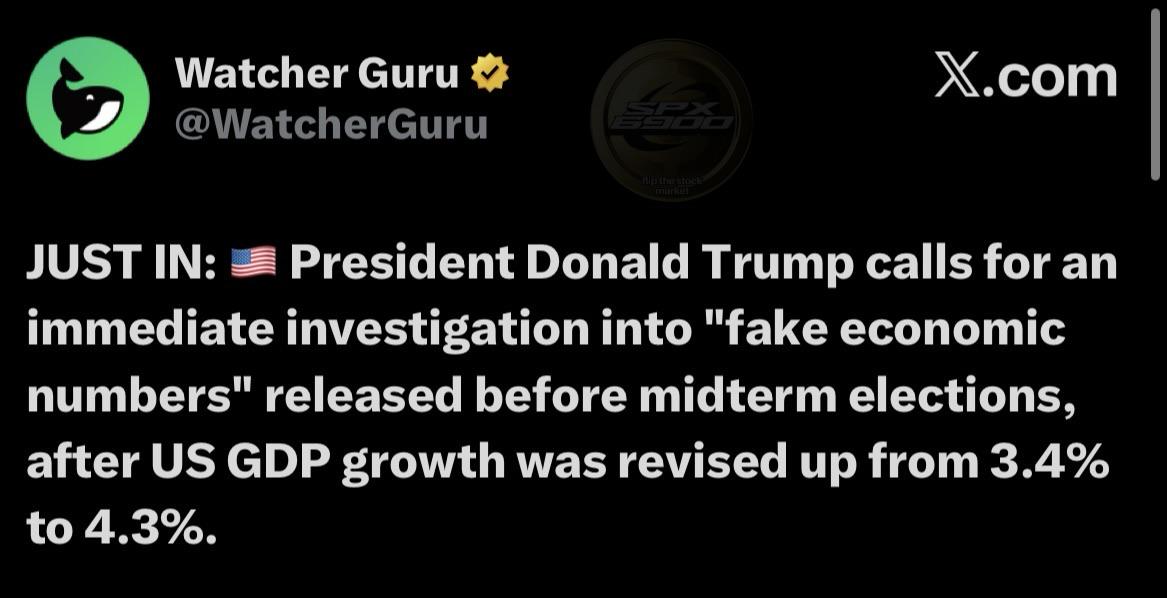
I'm having a hard time reconciling the latest 4.3% GDP growth figure with some of the broader economic conditions:
- Blanket tariffs increasing consumer and industrial costs.
- Stagnant real wage growth and a weakening labor market.
- War-related energy, transportation and supply chain disruptions.
- Relatively subdued GDP growth in preceding quarters.
I get how aggressive AI capex, inventory accumulation and government spending are contributing to GDP, but what's driving the growth in real consumer spending?
One variable I keep coming back to is how we're measuring inflation. September YoY import and export prices were up 8.1% and 11.6%, respectively, with nonfuel imports up 6% before accounting for tariffs. Meanwhile, Q3 annualized PCE inflation was 2.1% and the GDP deflator was roughly 1.8%.
I realize these aren't apples-to-apples comparisons, but it's an interesting discrepancy, especially considering the September PCE methodology changes that retroactively lowered reported inflation.
I'd like to look beyond the headline numbers. What's actually enabling consumers to spend more in this environment? What other data are economists looking at that would support the notion of a growing economy outside of the AI investment boom?
Curious where my logic might be flawed or what I'm overlooking.
r/economy • u/NiceCardiologist5189 • 18h ago
I'm a PhD candidate in international political economy. I've finished all my coursework and comprehensive exams, and in my line of work I have to follow both world politics and the economy very closely. What always bugged me is that most sources treat them separately, when a strait closing, a new tariff or a sanctions package shows up in prices within days. So I built the tool I wished I had.
What's on it right now:
- a short markets brief every weekday morning and an after-close analysis in the evening, with the sources listed
- world markets explained in plain words: stocks, rates, oil, gold, currencies
- 5 minute lessons with a quiz on things like tariffs, sanctions, trade deficits, central banks and reserve currencies
- country profiles you can compare side by side (growth, debt, inflation, trade)
- a live map of world tensions, so you can see where the risks are
- a predictions game where you call real events like central bank decisions and see how you did
- book suggestions and a monthly book club
It's free. The first lessons are open to everyone, the rest only need a free account. Nothing on it is investment advice, the goal is just to understand what's moving and why.
https://geopoliticsforeveryone.com/go/rd
Honest feedback welcome. What would make something like this actually useful to you, and which economic topic do you feel is badly explained almost everywhere?
r/economy • u/-WestKite- • 23h ago
r/economy • u/lurker_bee • 11h ago

r/economy • u/Snapdragon_4U • 12h ago

r/economy • u/Guateaeon • 19h ago
r/economy • u/Conscious-Quarter423 • 17h ago
r/economy • u/Editor_91 • 18h ago

r/economy • u/DumbMoneyMedia • 16h ago

r/economy • u/jaredd_ • 3h ago

