r/egyptology • u/Djedra • 15h ago
Photo The Sun forms a Hieroglyph
The sun forming the hieroglyph for ‘horizon’ between Khufu’s and Khafre’s pyramids.
r/egyptology • u/Djedra • 15h ago
The sun forming the hieroglyph for ‘horizon’ between Khufu’s and Khafre’s pyramids.
r/egyptology • u/Responsible_Ideal879 • 10m ago
r/egyptology • u/Handicapped-007 • 9h ago
Shabti
PLACE CREATED Egypt, Africa
CULTURE Egyptian
PERIOD Middle Kingdom - early New Kingdom
DATE 1837-1479 BCE
MEDIUM Calcite
CREDIT LINE Gift of the Georges Ricard Foundation
DIMENSIONS 5 3/8 x 1 3/4 x 1 5/8 in., 450 g (13.7 x 4.4 x 4.2 cm, 15 7/8 oz.)
OBJECT NUMBER 2018.010.613
Label Text
Shabtis first appear at the end of the Middle Kingdom. They were crafted from various materials and deposited in burials or given as votive figurines. The decoration of shabtis at this time was varied. Some shabtis bore offering formulas typically found on stelae, coffins, and other funerary objects.
This small calcite figure wears a large lappet wig and rectangular beard. The wig, ears, eyes, and nose are carefully modeled. There are faint traces of a mouth. Two hands in low relief protrude from the wrappings of his mummiform body, with one grasping an ankh. The other implement is lost or was never completed. It is possible that an inscription was once painted on the shabti.
Exhibition History
Life and the Afterlife: Ancient Egyptian Art from the Senusret Collection, Michael C. Carlos Museum, February 4 - August 6, 2023
Published References
Hotel des Ventes, Marseille, Archeologie (25 Avril 1974), lot 93.
Melinda K. Hartwig, ed., Life and The Afterlife: Ancient Egyptian Art from the Senusret Collection (Atlanta: Michael C. Carlos Museum, 2023), catalogue entry 84.
TERMS ushabti
PROVENANCE
Purchased by Georges Ricard (1921-2012) from Hotel des Ventes, Marseille, France, April 25, 1974, lot 93. Ex coll. Musée de l'Égypte et le Monde Antique, Collection Sanousrit, Monaco, 1975-1982. Ex coll. Georges Ricard Foundation, Santa Barbara, California.
STATUS Not on view
COLLECTIONS
Ancient Egyptian, Nubian, and Near Eastern Art
Title
Shabti 1837-1479 BCE Middle Kingdom - Early New Kingdom Findspot unknown Egypt Calcite The Michael C. Carlos Museum at Emory University
https://collections.carlos.emory.edu/objects/38335/shabti
The Michael C. Carlos Museum at Emory University
r/egyptology • u/ismaeil-de-paynes • 9h ago
In the previous Article we spoke about the first of the founding fathers of Ancient Egypt, King Menes Narmer, and his counterpart in Arabian history, King Manqaus ibn Shaddad.
This is the link for anyone who wants to read:
https://www.reddit.com/r/ancientegypt/comments/1y30osc/comment/19t4ovz80itwi/
-----------------------------------
Today we will speak about King Khaslim, or Khasekhemwy, the second unifier of the Two Lands.
Ancient Egyptian tradition, as reflected in the inscriptions of the First and Second Dynasties, attributes to King Khasekhemwy the role of the second unifier of Egypt after Narmer, and he was the last king of the Second Dynasty.
He reunified the Two Lands after a period of division and disturbance, led military campaigns against rebellious northerners, and left huge architectural structures in Nekhen, Abydos, and Saqqara, among the most prominent of which is Shunet El Zebib.
Khasekhemwy was unique in Egyptian history in placing the symbols of Horus and Set together above his serekh, in an indication of reconciling the two conflicting powers and stabilizing unity.
The military campaigns in his reign reached an extent that a famous inscription mentions the counting of the northern dead by the thousands, which makes him, in ancient Egyptian consciousness, one who achieved order, that is Maat, at the expense of the forces of chaos, that is Isfet, represented by the northern rebellion.
As for the Arabic name Khaslim, it appears in a number of medieval Arabic sources, and these sources vary in the details of his biography, but most agree on attributing him to the period before the biblical Flood, which historically corresponds to the early dynasties of ancient Egypt, and on attributing a group of major works to him, the most prominent of which is that he was the first to make a gauge for the Nile (Nilometer) and to care for waterworks.
The accounts mention that he bred from donkeys and cows riding animals of great strength, and that he performed wonders, and that he fell passionately in love with a slave girl belonging to his sister, so estrangement occurred between him and his sister, and she turned to the east of the Nile and built a city and a temple for Venus.
Other sources add that he was the seventh of the kings of Egypt before the Flood, and that he was a wise priest-king, combining wisdom, priesthood, long life, and architecture, which are the model qualities of the founding king in medieval Arabic literature.
The first basis for comparison between the two figures is the phonetic similarity between the two names. Khasekhemwy appears in Greek transcription in a form close to Khasekhem, while Khaslim consists of the consonantal roots kh-s-l-m. It is noted that the two roots are similar in the first two letters: the khā’ and the sīn or ṣād, and they differ in that Khaslim adds a lām after the ṣād, while the Egyptian original adds a khā’ after the sīn.
This difference can be explained by the fact that the lām is an intrusive element in the Arabic transmission, either added to facilitate pronunciation, or as a result of alteration by copyists, or as a phonetic substitution from another sound.
It is noted that the Arabic sources did not preserve the form of Khasekhemwy in its ancient Egyptian shape, which indicates that the Arabic transmission was not direct from ancient Egyptian inscriptions, but from oral accounts or from late Demotic or Coptic texts, and then the name was altered into Khaslim through multiple linguistic intermediaries.
Al-Suyuti (1445–1505 CE) says in his book Husn al-Muhadara fi Akhbar Misr wa al-Qahira (The Agreeable Discussion of the History of Egypt and Cairo):
“And after him was Khaslim, and he was the first to make a gauge for the rise of the Nile; that is, he gathered the people of science and engineering, and they made for him a house of marble on the bank of the Nile, and in its middle he placed a small basin of brass, in which was measured water, and on the edge of the basin were two brass eagles: male and female. When it was the first of the month in which the Nile rises, the house was opened and the priests were gathered before him, and the chief priests spoke words of theirs until one of the two eagles whistled. If the male whistled, the water was complete and good; if the female whistled, the water was deficient and drought would follow, and they would calculate accordingly.”
The male and female eagle in the account of the Nilometer may be a transformed echo of the Horus–Seth duality. In Khasekhemwy’s serekh, the two gods appear together as a symbol of reconciliation and the consolidation of unity, but the Arabic transmission did not preserve their names or their original image, and so reduced the duality to a pair of birds on the two sides of the Nilometer.
Here appears the subject of the two eagles, male and female, a subject that reveals much about how the Arabs viewed females as a source of misfortune.
In the ancient Egyptian sense, the pairing of male with female in statues and symbols was an expression of cosmic balance, and of the completeness of the order that is based on the pair, not on one side alone.
But the Arabs who transmitted the report of the gauge carried an inferior social view of the female, with roots in the pre-Islamic era, when they hated females and buried daughters alive out of fear of shame and poverty. The effect of this view remained strong in historical narrative after Islam, though it lessened because of Islamic legislation.
Therefore, the mention of the female eagle alongside the male eagle was not read by them as a symbol of sacred balance, but as a strange or odd matter, or as a kind of magic and hidden wisdom.
This affected their view of the king himself, so instead of remaining a sacred king who achieves cosmic order, he became in their view a wise king with wonders, strange tales about him, and his choice of the female in his statue was mentioned as a matter of astonishment, not a matter of sanctification.
Indeed, their insertion of the story of his passionate love for his sister’s slave girl, and the estrangement between him and his sister, makes the female presence in his biography a source of disturbance and temptation, not a source of balance, and that is a direct reflection of the hatred of females and of the view of her as an object of suspicion and torment.
Among the other aspects of similarity is that both were linked to controlling the waters of the Nile. Khasekhemwy, according to some studies, added to his constructions what relates to controlling the flood and securing the area around the capital, while Khaslim is explicitly attributed with establishing the first organized gauge for measuring the rise and fall of the Nile, which recalls what Herodotus attributed to Menes Narmer of diverting the course of the Nile to build Memphis.
As for personal qualities, the Arabic sources do not give Khaslim the attributes of the divine king, but describe him as wise and a priest, who gathered scientists and engineers to make the gauge, and he has wonders and accounts in love and family conflict.
This shift from the divine king to the wise king reflects a shift in religious vision: the Arab Muslims were not ready to accept the idea of the divine king (because the mere idea of this is forbidden in Islam), so they transformed the founding fathers of Egypt, into a wise priest-kings, which is an image that is consistent with the Islamic tradition that knows figures such as Luqman the wise, al-Khidr, and David and Solomon the two prophet-Kings.
------------------------------
In the next episode we will speak about King Djoser and his counterpart King Disara, and it will be more exciting and more informative than the previous two episodes, with my sincere greetings.
r/egyptology • u/Handicapped-007 • 13h ago
Shabti of Tamehyt
CULTURE Egyptian
PERIOD New Kingdom, Dynasty 19
DATE 1292-1191 BCE
MEDIUM Wood, paint
CREDIT LINE Gift of the Georges Ricard Foundation
DIMENSIONS 8 11/16 x 2 1/16 x 1 7/16 in. (22 x 5.2 x 3.7 cm)
OBJECT NUMBER 2018.010.607
Label Text
The wooden shabti of Tamehyt has a simple lappet wig with ears protruding. A broad collar and garland encircle the neck, both painted black. The hands protrude from the mummy wrappings with a single column of text painted golden yellow. The inscription reads, “The illuminated one, the Osiris, Tamehyt […], true of voice.” The name Tamehyt is common in the New Kingdom.
While it is unusual for the lower torso of funerary figurines to be colored black with yellow text, similar shabtis exist from Dynasty 19. The black and yellow painted decoration is comparable to anthropoid coffins from the same period.
Exhibition History
Life and the Afterlife: Ancient Egyptian Art from the Senusret Collection, Michael C. Carlos Museum, February 4 - August 6, 2023
MCCM Permanent Collection Galleries, March 11, 2024 - Present
Published References
Melinda K. Hartwig, ed., Life and The Afterlife: Ancient Egyptian Art from the Senusret Collection (Atlanta: Michael C. Carlos Museum, 2023), catalogue entry 87.
TERMS ushabtipainting (image-making)
PROVENANCE
Ex coll. Georges Ricard Foundation, Santa Barbara, California, possibly purchased from Jean-François Mignon, Aix-en Provence, France.
STATUS On view
COLLECTIONS
Ancient Egyptian, Nubian, and Near Eastern Art
Title
Shabti of Tamehyt ,1292-1191 BCE New Kingdom Dynasty 19, Findspot unknown Egypt, Wood and paint,The Michael C. Carlos Museum at Emory University
https://collections.carlos.emory.edu/objects/38224/shabti-of-tamehyt
The Michael C. Carlos Museum at Emory University
r/egyptology • u/Connect-Vast-8744 • 1h ago
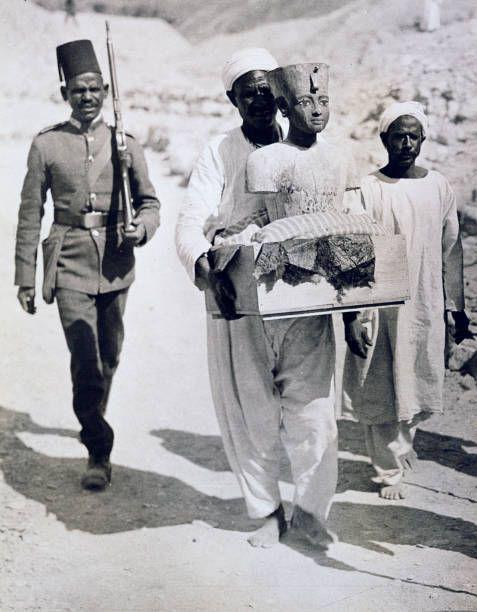
Luxor, 1922. Workers carrying a statue of Tutankhamun out of KV62.
After 3,000 years underground, he wasn't carried out by machines or by Carter's team alone - he was carried by hand, by Egyptian workers from Luxor.
Their names are almost never recorded, but they did all the heavy lifting in the Valley of the Kings.
r/egyptology • u/Handicapped-007 • 17h ago
Shabti of Neferibresaneith
PLACE CREATED Egypt, Africa
CULTURE Egyptian
PERIOD Late Period, Dynasty 26
DATE 664-525 BCE
MEDIUM Faience
CREDIT LINE Gift of the Connoisseurs by exchange
DIMENSIONS 7 1/4 x 1 5/8 x 7/8 in. (18.4 x 4.1 x 2.3 cm)
OBJECT NUMBER 1998.011
Label Text
This tall, slender figurine belonged to a man named Neferibresaneith, son of Shepenbaster. Fashioned from pale blue faience, the shabti is typical of the Late Period and the Ptolemaic Period. The facial features are well-modeled, with almond-shaped eyes, and delicately incised details. The mummiform figure stands in the traditional pose, with arms crossed, grasping a pick in the left hand and a hoe and the cord of a basket in the right.
The text, a standard Late Period version of the shabti spell, reads as follows: The Illuminated One, the Osiris Neferibresaneith, born of Shepenbastet, justified of voice, he says: O, these shabtis, if one counts off the Osiris Neferibresaneith, born of Shepenbastet, justified of voice, in order to do any work which is done therein in the necropolis; indeed, (one) implants an obstacle there as a man at his duty; "here I am," you (pl.) shall say; count yourselves off at the time, daily, to be served therein the necropolis, to make arable a field, to irrigate the riparian land, to transport by boat the sand of the west to the east and vice versa; "here I am," you (pl.) shall say.
Exhibition History
MCCM Permanent Collection Galleries, October 1998 - February 2000
MCCM Permanent Collection Reinstallation, October 6, 2001 - June 2006
MCCM Permanent Collection Gallery, 2009 - Present
Published References
Peter Lacovara, "The New Galleries of Egyptian and Near Eastern Art at the Michael C. Carlos Museum," Minerva 12 (2001): 9-16.
Peter Lacovara and Betsy Teasley Trope, The Realm of Osiris (Atlanta: Michael C. Carlos Museum, 2001), 30.
Sara E. Cole, Judith Barr, and Roselyn Campbell, "'A Man in His Duty': An Ushabti of Neferibresaneith and a Case Study in the Dispersal of Egyptian Antiquities," Getty Research Journal 10 (2018): 191-206.
Rune Nyord, Seeing Perfection: Ancient Egyptian Images beyond Representation (Cambridge: Cambridge University Press, 2020), 69, Figure 23.
TERMS ushabti
PROVENANCE
Acquired by MCCM from Merrin Gallery, New York, New York.
STATUS On view
COLLECTIONS
Ancient Egyptian, Nubian, and Near Eastern Art
Title
Shabti of Neferibresaneith, 664-525 BCE Late Period Dynasty 26, Findspot unknown Egypt,
Faience, The Michael C. Carlos Museum at Emory University
https://collections.carlos.emory.edu/objects/19348/shabti-of-neferibresaneith
The Michael C. Carlos Museum at Emory University
r/egyptology • u/Connect-Vast-8744 • 1d ago
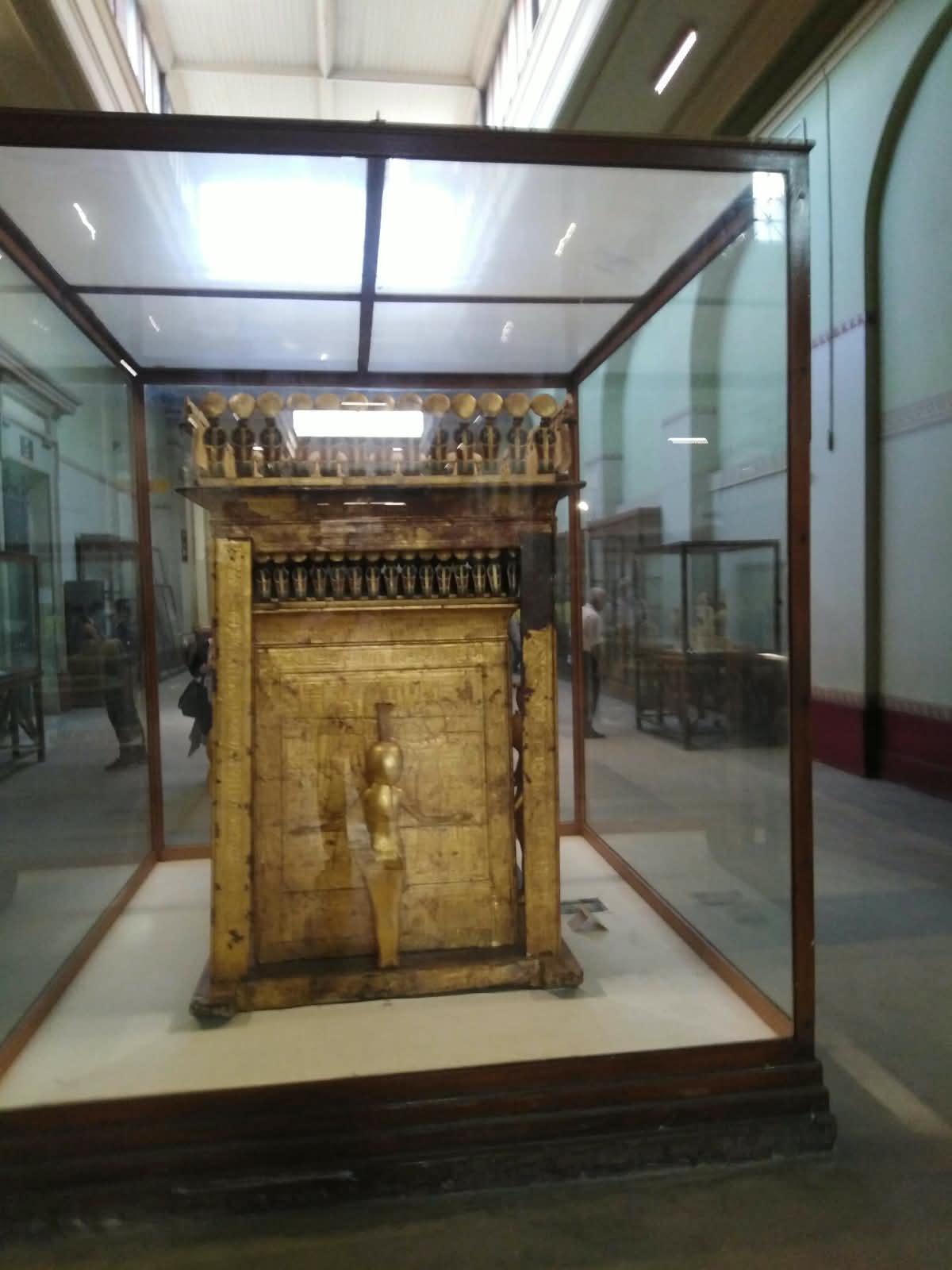
Took this today in the Egyptian Museum. The gold is still shining after 3,300 years. You can see Serket with her arms stretched out protecting the shrine.
Has anyone seen this in person? It's way bigger than it looks in photos.
r/egyptology • u/Responsible_Ideal879 • 22h ago
r/egyptology • u/Connect-Vast-8744 • 1d ago
I took this from the upper floor. You look down and you see statues, sarcophagi, and entire tombs just sitting there like it's normal.
The scale is impossible to feel in photos. Has anyone here visited? What was the one piece that stopped you in your tracks?
r/egyptology • u/Connect-Vast-8744 • 1d ago
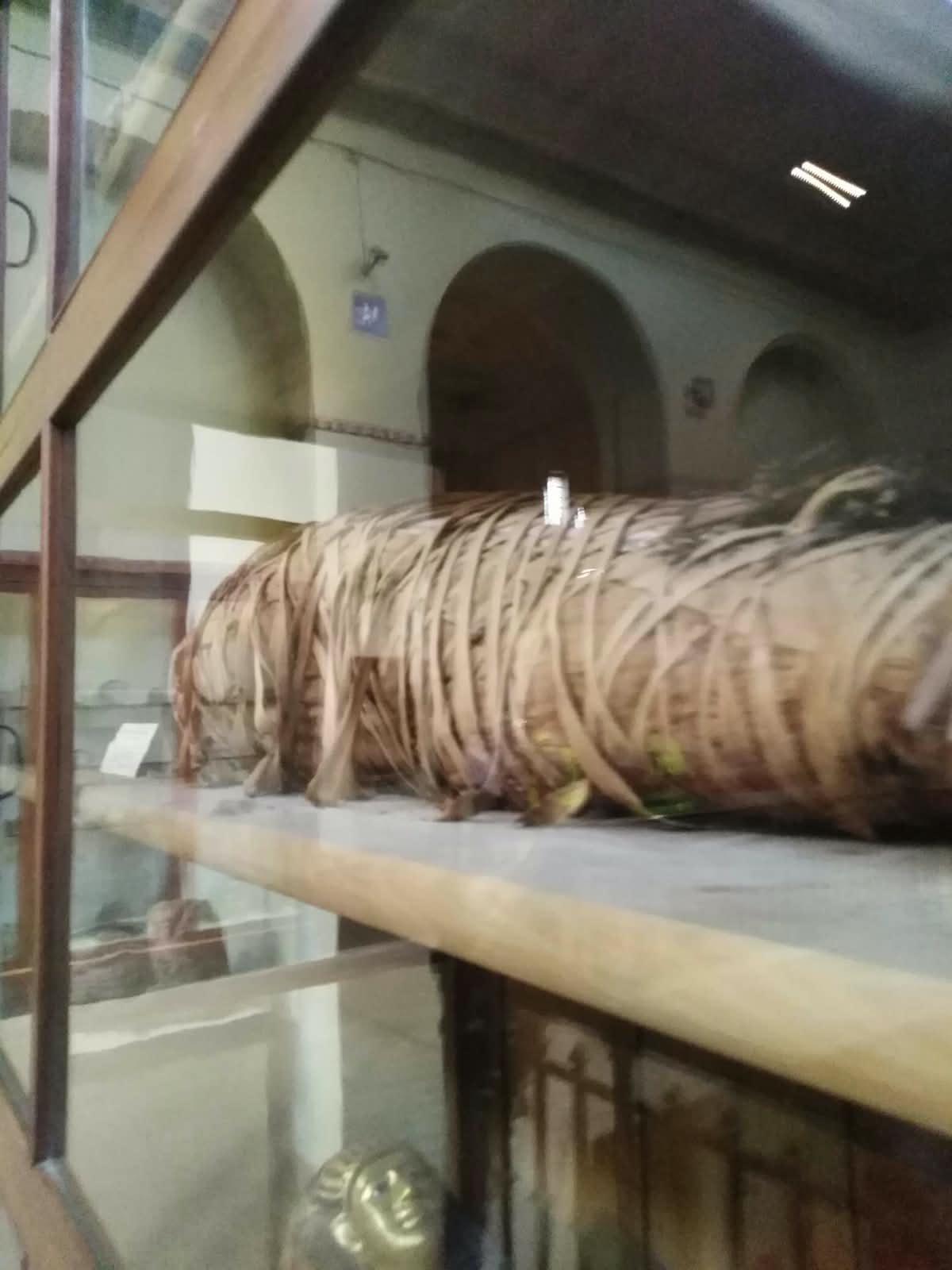
Took this in the Egyptian Museum. You can still see the original linen wrapping and how carefully it was done.
It's strange to think this person was alive thousands of years ago and we are still looking at them today.
r/egyptology • u/Connect-Vast-8744 • 1d ago
This hallway felt endless. Glass cases on both sides full of 3,000+ year old artifacts, and almost no crowd. Best museum experience I have ever had.
If you visit Cairo, don't skip the old Egyptian Museum in Tahrir. It's different from the new Grand Museum.
r/egyptology • u/Handicapped-007 • 1d ago
Shabti of the Vizier Paser
POSSIBLE ORIGIN Thebes, Egypt, Africa
CULTURE Egyptian
PERIOD New Kingdom, Dynasty 19
DATE 1292-1191 BCE
MEDIUM Faience
CREDIT LINE Gift of the Georges Ricard Foundation
DIMENSIONS 6 x 1 15/16 x 1 5/16 in., 168 g (15.2 x 4.9 x 3.3 cm, 5 15/16 oz.)
OBJECT NUMBER 2018.010.346
Label Text
This bright blue faience mummiform shabti wears a striped lappet wig and a large broad collar. The crossed arms protrude from the wrappings, a distinctive feature of Dynasty 19 shabtis. On his wrists he wears bracelets. On his back is a yoke with two water pots and a small seed bag strung over one shoulder.
The shabti inscription, picked out in black, gives Paser’s name and titles as the “Overseer of the city of Thebes” and “Southern vizier,” the latter being one of the highest titles in ancient Egypt. He was appointed vizier by Sety I and remained in that role until at least the twenty-first year of Ramesses II. Several of his shabtis were found at the Serapeum in Saqqara, donated to the sacred Apis bulls. This shabti likely came from Paser’s tomb at Sheikh Abd el-Qurna in western Thebes (TT106).
Exhibition History
Michael C. Carlos Museum, Veneralia 2019 Senuseret Collection Preview, May 18, 2019
Life and the Afterlife: Ancient Egyptian Art from the Senusret Collection, Michael C. Carlos Museum, February 4 - August 6, 2023
MCCM Permanent Collection Galleries, March 11, 2024 - Present
Published References
Hotel des Ventes, Avignon, Meubles Objets d'Art (22 Mai 1977), lot 43.
Melinda K. Hartwig, ed., Life and The Afterlife: Ancient Egyptian Art from the Senusret Collection (Atlanta: Michael C. Carlos Museum, 2023), catalogue entry 86.
TERMS Ushabti
PROVENANCE
Purchased by S.A.M. Sanousrit from Hotel des Ventes, Avignon, France, May 22, 1977, lot 43. Ex coll. Musée de l'Égypte et le Monde Antique, Collection Sanousrit, Monaco, 1977-1982. Ex coll. Georges Ricard Foundation, Santa Barbara, California.
STATUS On view
COLLECTIONS
Ancient Egyptian, Nubian, and Near Eastern Art
Title
Shabti of the Vizier Paser, 1292-1191 BCE New Kingdom Dynasty 19, Findspot Sheikh Abd el-Qurna in western Thebes (TT106), Faience, The Michael C. Carlos Museum at Emory University
https://collections.carlos.emory.edu/objects/37726/shabti-of-the-vizier-paser
The Michael C. Carlos Museum at Emory University
r/egyptology • u/Connect-Vast-8744 • 2d ago
r/egyptology • u/Handicapped-007 • 1d ago
Shabti for Khaemwaset
PLACE CREATED Egypt, Africa
CULTURE Egyptian
PERIOD New Kingdom, Dynasty 19
DATE 1292-1191 BCE
MEDIUM Faience
CREDIT LINEGift of Joseph A. Lewis II and Sofi Lewis
DIMENSIONS 6 x 1 3/4 x 1 in. (15.2 x 4.4 x 2.5 cm)
OBJECT NUMBER 2015.050.001
Published References
Galerie Gunter Puhze, Gallery 25 (2011), number 183.
TERMS Ushabti
PROVENANCE
Said to have been found at the Serapeum, Saqqara, Egypt. Ex coll. Florent Dalcq (1878-1950), Belgium, acquired from the Service des Antiquities, Egyptian Museum, Cairo, Egypt, 1923. Thence by descent to Andre Lagneau, Neuchatel, Switzerland. Ex coll. Joseph Lewis, United States, purchased from Galerie Gunter Puhze, Freiburg, Germany, January 24, 2012.
STATUS Not on view
COLLECTIONS
Ancient Egyptian, Nubian, and Near Eastern Art
Title
Shabti for Khaemwaset,1292-1191 BCE New Kingdom Dynasty 19, Findspot Said to have been found at the Serapeum, Saqqara, Faience, The Michael C. Carlos Museum at Emory University
https://collections.carlos.emory.edu/objects/35049/shabti-for-khaemwaset
The Michael C. Carlos Museum at Emory University
r/egyptology • u/ancientegypt1 • 1d ago
r/egyptology • u/Connect-Vast-8744 • 1d ago
r/egyptology • u/Handicapped-007 • 2d ago
Stele of Kesi
18th Dynasty, time of Thutmosis IV-Amenophis III., ca. 1419-1372 BC.
Time:
18th Dynasty, time of Thutmosis IV-Amenophis III., ca. 1419-1372 BC.
Object Name
Stele
Culture
Egyptian
Location of discovery:
Abydos (presumably)
Material/technology:
Painted limestone
Dimensions:
H 50.3 cm, B 34.3 cm, T 9 cm.
copyright
Art Historical Museum, Egyptian - Oriental Collection
Invs.
Egyptian collection, INV 141.
Provenance
1821 purchase by E. A. Burghart in Egypt
Title
Stele of Kesi, 18th Dynasty, Time of Thutmosis IV-Amenophis III ca. 1419-1372 BC., Findspot Abydos (presumably), Painted limestone, Kunsthistorisches Museum (Art History Museum, Vienna)
https://www.khm.at/en/artworks/stele-des-kesi-317240
Kunsthistorisches Museum (Art History Museum, Vienna)
r/egyptology • u/Connect-Vast-8744 • 2d ago
r/egyptology • u/Handicapped-007 • 2d ago
Amulet from a Child's Burial in the Shape of a Baboon
Accession number
AS 3339
Current Location
Magazines
About the object
Numerous amulets were placed with the deceased children, which were meant to protect the children from various misfortunes during their lives, but especially in the afterlife. Among the typical amulets from the child burials of the Third Intermediate Period in Matmar are the protective gods Bes (ÄS 3153, ÄS 3161) and Isis lactans (ÄS 3315) as well as the protective udjat eye (ÄS 3333). Children who were buried without coffins had a higher proportion of Bes and udjat amulets, which probably compensated for the missing protective coffin cover. In addition, among the child burials in Matmar, among other things, the Sau (ÄS 3349) as a symbol of the heavenly goddess Nut, the Ba birds (ÄS 3122), which stand for a aspect of the human soul, as well as the gods Horus (ÄS 3152), Sachmet (ÄS 3156), Thot (ÄS 3339) and also an aegis with a lion's head (ÄS 3159). (Mélanie Floßmann)
Date
c. 943–723 BC, 22nd–24th Dynasty, Third Intermediate Period, Egypt (Find context)
material
Faience
Dimensions
Height x Width x Depth: 3.9 x 1.7 x 1.4 cm.
Geographic Origin
Find spot: Tomb 1248, Matmar, Middle Egypt, Egypt
Provenance
Since 1970, Institution: State Museum of Egyptian Art, Munich
1949–1970, Institution: Egyptian Collection of the Bavarian State
1945–1949, Institution: Central Collecting Poin
1935–1945, Institution: State Egyptian Collection
1932–1934, Institution: Museum of Ancient Small Art
1929–1931, Excavation: British Museum Expedition, Guy Brunton, Matmar, Egypt
Individuals / Institution
Museum of Ancient Small Art
References
Flossmann-Schütze, Mélanie / Schlüter, Arnulf with the collaboration of Perrot, Anne-Hélène / Kutschka, Markus (editor), Childhood on the Nile. Growing up in Ancient Egypt, Munich 2025, cf. 318-319 with illustrations, Cat. No. 98j [M. Flossmann-Schütze].
Brunton, Guy, Matmar: British Museum Expedition to Middle Egypt 1929-1931, London 1948, cf. Tf. LIX, 43.
Credits
Dataset: SMÄK, last editors (chronologically): Mélanie Flossmann-Schütze, Jan-Michael Dahms; Bibliography: Anne-Hélène Perrot; Data editorial board: Nora Heil.
Last change
02.07.2026, 11:34 AM.
Title
Amulet from a Child's Burial in the Shape of a Baboon, c. 943–723 BC 22nd–24th Dynasty Third Intermediate Period, Egypt (Find context), Findspot: Tomb 1248, Matmar, Middle Egypt, Faience, Staatliches Museum Ägytischer Kunst
Staatliches Museum Ägytischer Kunst
r/egyptology • u/Handicapped-007 • 2d ago
Stelophorous statue of Amenemipet
This ‘stelophorous’ statue is an example of the tomb’s connection with the celestial plane. Statues of this type date back to the New Kingdom and were placed, facing the rising sun, in the niches of the pyramidal superstructures of private tombs. They depict a kneeling person holding a stela in front of them, bearing a representation of the sun god in his boat and a hymn dedicated to the deity.
Inv. no. :
Cat. 3038
Material:
Stone / Limestone
Dimensions:
20 cm x 55 cm x 26 cm
Date:
1539–1292 BCE
Period:
New Kingdom
Dynasty:
Eighteenth Dynasty
Provenance:
Egypt, Luxor / Thebes
Acquisition:
Purchase Bernardino Drovetti, 1824
Museum location:
Museum / Floor 1 / Room 06 DEM / Showcase 10
Selected bibliography:
Fabretti, Ariodante-Rossi, Francesco-Lanzone, Ridolfo Vittorio, Regio Museo di Torino. Antichità Egizie (Cat. gen. dei musei di antichità e degli ogg. d’arte raccolti nelle gallerie e biblioteche del regno 1. Piemonte), vol. I, Torino 1882, pp. 413–414.
Malek, Jaromir, Topographical bibliography of ancient Egyptian hieroglyphic texts, statues, reliefs and paintings VIII: objects of provenance not known. Part 2: private statues (Dynasty XVIII to the Roman Period), statues of deities (Topographical bibliography of Ancient Egyptian hieroglyphic texts, statues, relief and paintings 8/2), Oxford 1999, p. 575.
Orcurti, Pier Camillo, Catalogo illustrato dei monumenti egizi del R. Museo Egizio di Torino, Torino 1855, ii, p. 193.
Tiradritti, Francesco, Il cammino di Harwa: l'uomo di fronte al mistero: l'Egitto [mostra: Brescia, Mus. Diocesano ott. 1999-gen. 2000], Milano 1999, p. 30 e 161, fig. a p. 31.
Vidua, Carlo, “Catalogue de la collect. d'antiq. de mons. le chev. Drovetti, a 1822”, in Ministero della Pubblica Istruzione (a cura di), Documenti inediti per servire alla storia dei Musei d'Italia, vol. 3, Firenze - Roma 1880, p. 288, n. 91.
Title
Stelophorous statue of Amenemipet, 1539– 1292 BCE New Kingdom Eighteenth Dynasty, Findspot Luxor / Thebes, Limestone, Museo Egizio di Torino.
Museo Egizio di Torino
r/egyptology • u/Handicapped-007 • 2d ago
Amulet from a Child's Burial in the Shape of a Baboon
Accession number
AS 3339
Current Location
Magazines
About the object
Numerous amulets were placed with the deceased children, which were meant to protect the children from various misfortunes during their lives, but especially in the afterlife. Among the typical amulets from the child burials of the Third Intermediate Period in Matmar are the protective gods Bes (ÄS 3153, ÄS 3161) and Isis lactans (ÄS 3315) as well as the protective udjat eye (ÄS 3333). Children who were buried without coffins had a higher proportion of Bes and udjat amulets, which probably compensated for the missing protective coffin cover. In addition, among the child burials in Matmar, among other things, the Sau (ÄS 3349) as a symbol of the heavenly goddess Nut, the Ba birds (ÄS 3122), which stand for a aspect of the human soul, as well as the gods Horus (ÄS 3152), Sachmet (ÄS 3156), Thot (ÄS 3339) and also an aegis with a lion's head (ÄS 3159). (Mélanie Floßmann)
Date
c. 943–723 BC, 22nd–24th Dynasty, Third Intermediate Period, Egypt (Find context)
material
Faience
Dimensions
Height x Width x Depth: 3.9 x 1.7 x 1.4 cm.
Geographic Origin
Find spot: Tomb 1248, Matmar, Middle Egypt, Egypt
Provenance
Since 1970, Institution: State Museum of Egyptian Art, Munich
1949–1970, Institution: Egyptian Collection of the Bavarian State
1945–1949, Institution: Central Collecting Poin
1935–1945, Institution: State Egyptian Collection
1932–1934, Institution: Museum of Ancient Small Art
1929–1931, Excavation: British Museum Expedition, Guy Brunton, Matmar, Egypt
Individuals / Institution
Museum of Ancient Small Art
References
Flossmann-Schütze, Mélanie / Schlüter, Arnulf with the collaboration of Perrot, Anne-Hélène / Kutschka, Markus (editor), Childhood on the Nile. Growing up in Ancient Egypt, Munich 2025, cf. 318-319 with illustrations, Cat. No. 98j [M. Flossmann-Schütze].
Brunton, Guy, Matmar: British Museum Expedition to Middle Egypt 1929-1931, London 1948, cf. Tf. LIX, 43.
Credits
Dataset: SMÄK, last editors (chronologically): Mélanie Flossmann-Schütze, Jan-Michael Dahms; Bibliography: Anne-Hélène Perrot; Data editorial board: Nora Heil.
Last change
02.07.2026, 11:34 AM.
Title
Amulet from a Child's Burial in the Shape of a Baboon, c. 943–723 BC 22nd–24th Dynasty Third Intermediate Period, Egypt (Find context), Findspot: Tomb 1248, Matmar, Middle Egypt, Faience, Staatliches Museum Ägytischer Kunst
Staatliches Museum Ägytischer Kunst
r/egyptology • u/Paleo-Arabic • 2d ago
Hi I have been researching and asessing the Canannite language and have collected one of the most extensive collections of cananite languages in my ongoing scholarly book. This is a breakthrough work that I would love to introduce and share some information with you guys about. Thank you.