r/elearning • • 2d ago

Could a topic map spark collaboration across corporate training teams?

My husband and I built Bettyapp (bettyapp.org) to search inside educational videos (MIT OpenCourseWare, Khan Academy and others) and jump to the exact moment something is explained. We originally made it to help one of our kids study for Calculus. We were sailing around the world, homeschooling, and wanted to see how AI could help find video snippets and maybe even limit screen time.

We have shared this tool online. Bettyap is free, no ads, and links back to the original source.

The feature I like most is the map. Search "Napoleon" and dots light up well beyond history, in philosophy, psychology, evolution, thermodynamics, computing and astronomy.

Bettyapp map search for "Napoleon"

So that got me thinking - I wonder whether Bettyapp could help corporate training teams? Yes, the search feature would help find all instances of a topic. But, picture searching your company's own course library for a 2-minute on-brand snippet, and seeing where a topic like "negotiation" shows up across sales, procurement and leadership courses that different teams built separately.

Here is how "negotiation" displays on the Bettyapp search map at in an K-12 and university course context.
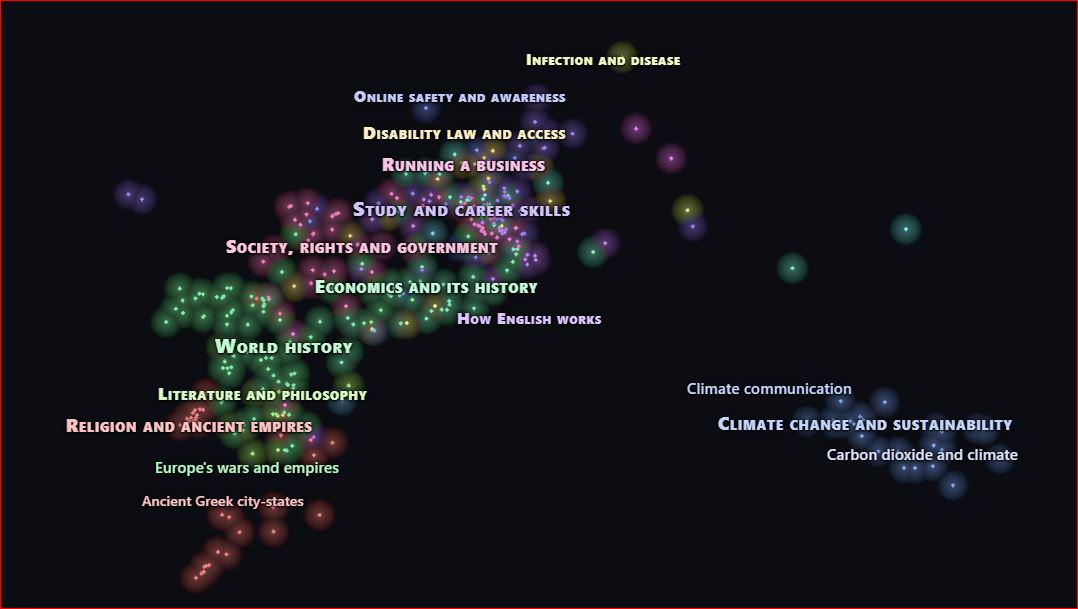
Bettyapp map search for "negotiation"

For those of you curating courseware: would something like this be useful? What would it need to plug into your workflow (LMS, Rise, Storyline)? I'd love to get some feedback. Thanks.

0 Upvotes

8 comments sorted by

2

u/PeepSoWP 2d ago

For a company library, I'd make permissions part of the map itself: a learner shouldn't see a restricted course's title, transcript snippet or topic dot just because the video link eventually denies access. Then a result should deep-link to the original lesson at the relevant timestamp, using the learner's normal sign-in. Could your first pilot cover two teams with different course access and one shared topic? That would test both discovery and the access boundary.

1

u/Escher12345 2d ago

Thanks! We'd be happy to do a pilot. I agree on both points: permissions should be built into the search and the Map themselves, so a learner never sees a restricted course's title, transcript snippet or topic dot, rather than finding it and then hitting "access denied". And each result should take the learner straight to the original lesson at the right timestamp, using their normal sign-in. Two teams with different course access sharing one topic is a great pilot design.

Bettyapp can already run as a separate site that searches only one organization's own videos (we do this already for another site), and a result can open the moment in the organization's own video player instead of Bettyapp's.. What it doesn't do yet is per-team access inside one organization, but that builds on the same mechanism. Each collection is already its own filtered set of lectures, topics and Map, so per-team access means applying that same filter to each team's courses. That's what your pilot would set up.

For your pilot, access would be checked on the server using each learner's groups from your normal sign-in. A restricted course would never appear anywhere: not in results, snippets, result counts, topic pages, suggestions, a dot on the Map or a region's name. Results would link to the lesson in your own player, which checks access as usual.

Your test is a good one: two teams with different course access and one shared topic, with "no leaks" as a written pass/fail check alongside "found the right moment faster". If you'd like to try it with your own library, or with one of your customers', we'd be glad to talk through the details.

2

u/PeepSoWP 1d ago

Thanks for clarifying what's live and what's planned. I was suggesting a test setup; a pilot would need a separate discussion with the team. For the per-team version, I'd also remove a learner from a team while their search session is open, then repeat the same query. That checks whether cached results still respect the changed access, without waiting for a fresh sign-in.

1

u/Escher12345 1d ago

Agreed. A test setup first, and a pilot as a separate conversation. Your suggestion is a valid check and would catch cases where access is checked once at sign-in, or where an old result is still held in a cache. Bettyapp's two-team test setup already keeps each team's results apart. I'm adding your step to it: 1) remove a learner from a team mid-session, 2) repeat the same query without signing in again, and 3) confirm nothing from that team comes back, including counts, snippets, topic pages and the Map. I'll post a link to the test setup when it's live, and you can try both teams yourself.

2

u/Kolleges_Official 1d ago

The search idea sounds useful. For corporate teams I think adoption hinges on two things: respecting the LMS permissions people already have, and letting content owners fix bad tags quickly. Internal libraries are full of outdated versions, so a "last reviewed" date on each result would help a lot. A small pilot measuring how often people find an answer without pinging an SME would make a strong case.

1

u/Escher12345 1d ago

Thank you, this is exactly the kind of detail we need.

You are right on permissions. Inside a company, Bettyapp would show a person only what their LMS already lets them open. It would take that from the LMS and not keep a second set of rules.

Fixing tags is the same. The content owner should be able to correct a bad tag on the spot, and the search should use the correction straight away.

I like the "last reviewed" date very much. Old versions are a real problem in internal libraries. A date on each result, and a way to retire an old version, would let people trust what they find.

Your point about SMEs is important. As you say, on most teams the same few experts answer the same questions again and again. Bettyapp already searches more broadly than the exact words a person types. It searches by meaning, so it finds the moment that explains a topic even when the person does not know the right term for it. It also finds related moments that cover the question from another side. People often go to an SME because they do not know what to search for. This should cut those questions too, and reduce the drain on the SME further.

So the pilot would measure just that. We would count how often people find the answer themselves, and how often they still have to ask an SME. We could also ask the SMEs whether they get fewer repeat questions. Would a team of 20 to 50 people be a fair size for that?

2

u/Kolleges_Official 16h ago

20 to 50 sounds like a good pilot size. Big enough to get real repeat questions, small enough that content owners actually fix tags when they're flagged. I'd also track how often people trust the answer versus double-checking with an SME anyway, since the 'last reviewed' date is what drives that.

1

u/Escher12345 15h ago

That's a good point. Finding the answer isn't enough if people still go and ask the SME just to be sure. Then no time has been saved at all.

So the pilot has to look at trust, not just usage. The usage numbers would tell us how often people search and play a result. But we'd also want to know if they believed/trusted it.

One possibility is to ask a quick question when the clip ends. Something like "Did you trust this enough to act on it?" If they say no, they could tick why from a list of pre-configured options. Free text entry would probably be skipped by most people. Choice might be out of date, didn't fit their situation, too important not to check with a person, etc.. The content owner would see those answers for each recording, without names.

That would show pretty quickly whether the "last reviewed" date is doing its job.

I'm curious what you've seen. How recent does that date need to be before people stop double-checking? Or does it depend on the topic?

If you know a team that would try it, I'd like to hear from them.