r/graphicnovels • • 6d ago

Weekly Reading Thread What have you been reading this week? 22/11/2026

12 Upvotes

A weekly thread for people to share what comics they've been reading. Share your thoughts on the books you've read, what you liked and perhaps disliked about them.


r/graphicnovels • • 27d ago

Monthly Rankings Top 10 of the Year (October 2026 Edition)

40 Upvotes

*The idea:*

List your top 10 graphic novels that you've read so far *this year.*

Each month we will post a new thread where you can note what new book(s) you read that month that entered your top 10 and note what book(s) fell off your top 10 list as well if you'd like.

By the end of the year everyone that takes part should have a nice top 10 list of their 2026 reads.

If you haven't read 10 books yet just rank what you have read.

Feel free to jump in whenever. If you miss a month or start late it's not a big deal.

Do your list, your way. For example- I read *Hellboy* this month, but am going to rank the series as 1 slot, rather than split each individual paperback that I read. If you want to do it the other way go for it.


r/graphicnovels • • 7h ago

General Fiction/Literature My review of Blankets

Post image
64 Upvotes

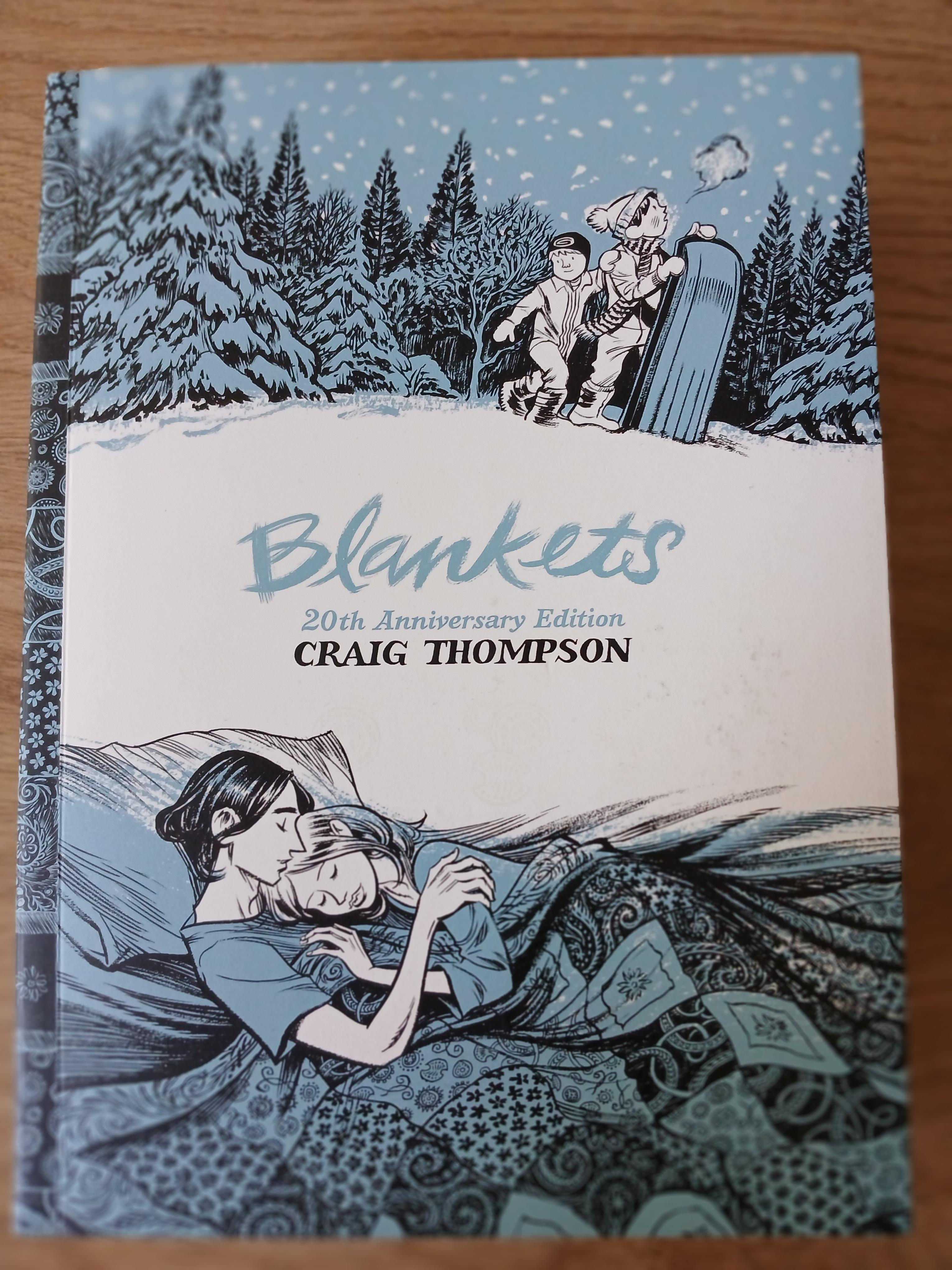
Blankets is a graphic novel memoir by Craig Thompson, which deals with his relationship with his brother when they were kids, his first love when he's a high school senior and his relationship with christianity throughout his life.

I'm having a hard time thinking of what to say about this book, since a lot of its meaning is under the surface. This is intentional, and is a smart play on the title, since blankets refers not only to the bedding item, but also to the blankets of snow that covered everything when Thompson was a kid growing up, which he says makes everything simpler, but as the snow thaws, complexities start appearing. I think I'm still in the process of thawing out my thoughts about this book, but I'll write about that process here in the meantime.

The bulk of the story here deals with a two week visit Craig takes to see a girl he likes, Raina, who he met in a christian camp during christmas break. This visit is shown through a lot of different angles. One face of it shows a young couple falling in love, but as this is going on, it's also the story of Raina's parents' divorce, which in turn is putting pressure on Raina to take care of her two adopted siblings, both of whom have developmental disabilities. As this is going on, Craig is also having trouble making sense of his devotion to christianity with his newfound feelings of love (and lust).

If this sounds complicated, it's because it is, but the way Thimpson built this comic allows him to tell everything with enough space to dig deep into everything, which I appreciated. This book is pretty long, and the panels are nice and spacious, allowing for a storytelling rhythm that is clear and can take detours into bible passages, dreams, fantasies, memories, etc. This makes the book feel really full and substantial, but at the same time, the understated and human ending may leave you with more questions than answers.

I think that's the only word I can think of to describe this story, human. I mean that in the sense that it deals with the ways humans experience things, relationships with parents, siblings, wider society around us, and the internal life and thoughts of a person growing up.

Moving on to the topic of art, Thompson does this neat trick where he uses cartoony figures and thick lines to give everything a "sketchy" look, but if you actually look closer, you'll see that there's not a line out of place. This makes everything look spontaneous and real, which somehow makes the story easier to believe than a realistic style would. He also uses a dry brush technique (at least I think that's what it is) to give textures to his lines, creating a wintery world where you can almost reach in and touch the snow, and where the indoor rooms feel cozy and warm. It's beautiful, and the page count allows Thompson to create a very tangible picture of winter in some of the snowier areas of the US.

I could go on rambling, but I think I've made my point. This graphic novel is beatiful, thoughtful and thought-provoking, and I will probably mull-it over during the next several days. It's a captivating work that I would recommend to anyone interested in great comics, and I will definitely look up more info on the creation of Blankets and pick up Ginseng Roots too, since this was a fascinating read.

(fyi on the recommendation tho, this book includes depictions of child sexual abuse, so keep that in mind of you think that's something that might be too heavy for you).


r/graphicnovels • • 7h ago

Question/Discussion Was on a trip to France and found these graphic novels that looked very interesting. I tried looking to see if any of them had English translations but I had no luck. Was hoping someone here might know where I can find a translated version of at least one of these

Thumbnail
gallery
25 Upvotes

r/graphicnovels • • 4h ago

Recommendations/Requests Tracking Your Collection

7 Upvotes

What app does everyone use to track/catalogue their TPB/Graphic Novel collection? I don't care about tracking values, I just want something simple that ideally uses a barcode scanner, shows the name and cover, and is free.


r/graphicnovels • • 10h ago

Recommendations/Requests Looking for female lead in fantasy action series, but with a romance sideplot

3 Upvotes

Greetings everyone, I've been looking as the title says to an action fantasy series that has a female lead, but with a side of romance.

It feels like whenever a comic I find has romance in it, it is the main focus of the story instead of just a side story (I remember people endlessly complaining about romance side plots in movies and series in the 2010s, I guess they've won this debate) BUT with an asterisk, I'd like to see a straight romance.

Not sure if it's just my bad luck, or if it's the current day meta but whenver there is a fantasy series with a female lead the story either has no romance at all or she is queer. Not to say it's bad, but it's just that I'm missing a good old straight relationship in a fantasy that isn't mainly romance.

Something like Darkly She Goes, but not necessarily dark fantasy, it can be brighter for sure.

If possible something new


r/graphicnovels • • 1d ago

Recommendations/Requests The Eyes Also Eat: 10 Visually Striking Comics (November 2026)

Thumbnail
gallery
258 Upvotes

This is a continuation of my monthly series where on the last Friday of each month I highlight 10 visually striking books that I've read in hopes that some here resonate with a few.

If you have any gorgeous books to recommend yourself, feel free in the comments!


r/graphicnovels • • 22h ago

Horror Just picked this up today "Swamp Thing By Rick Veitch Book 3".the long awaited collection concluding Veitch's run on the book.

Thumbnail
gallery
21 Upvotes

Containing issues 80-87, Annual #5 and the 4 issue Mini series "Swamp Thing 1989," issues 1-4 previously unpublished until this year. Finally after over 37 years since he walked away from the title .


r/graphicnovels • • 1d ago

Collection / Shelfie / Haul Black Friday Delivery from Walt’s

Post image
107 Upvotes

Top three are to read with my daughter!


r/graphicnovels • • 20h ago

Recommendations/Requests Looking for graphic novels about fear

7 Upvotes

Hi, so im an art student and im working on my big final project of the school year, its going to be a horror graphic novel. the main theme is the fear of the dark and how our childhood experiences like trauma can form our fears later in adulthood, another theme is also false memories. For my project i need other works to use as references for specific aspects of my project.

Thats were you folks come in! Im looking for graphic novels/ comics were:

-the protag lives with some sort of phobia/ fear and then also faces it/ overcomes it. preferably this work also features visual metaphors of that trauma and fear

-flashbacks are a recurring throughout out the comic, preferably with the context of fears and past traumas

-were the characters personal growth is shown through some sort of visual metaphor

to clarify im not looking for one graphic novel that features all of these points, im looking for a seperate graphic novels that feature atleast one of the mentionted points.

Any help would be really appreciated!


r/graphicnovels • • 1d ago

Collection / Shelfie / Haul Just got myself both of the DC and Marvel crossover graphic novels in the mail after ordering them from Amazon tonight!

Thumbnail
gallery
20 Upvotes

Not gonna lie, I really love both of the covers on these books! It's really awesome seeing all of our favorite Marvel and DC heroes together in the same picture again in decades, and I think that they're absolutely incredible! I really love how all the heroes like Batman, Spider-Man, Superman, the Hulk, the Flash, Doctor Strange, and the rest are charging into battle as a massive team on the Cosmic Kiss Caper's cover with the shining yellow-ish white background, I think it really makes them all stand out and pop! I also really like the one for The Dead Of Night, with the heroes charging towards the viewer with the darker background, with heroes like Wonder Woman, Spider-Gwen, Jane Foster's Thor, and Steel, too! For me, I kinda like the cover for The Cosmic Kiss Caper more because of it's epic side-view of the heroes charging to the left, as it's kinda like a movie poster, and I prefer that over the one for the second book because of that. It's a real joy to see all the heroes from DC and Marvel together again, and I'm glad I picked both of these up when I had the chance!

What do you guys think?


r/graphicnovels • • 14h ago

Action/Adventure [Update] Recommendation for Lady Mechanika fans: Bass x Machina

0 Upvotes

r/graphicnovels • • 1d ago

Collection / Shelfie / Haul The New Graphic Novel in the Scurryverse Came Today!

Post image
8 Upvotes

It's so tall! I actually leave on vacation tomorrow morning and I would have totally taken this except it's so tall, I'm afraid it'll get bent or something because it doesn't fit in anything. lol I'll be excited to read it when I get back home though!


r/graphicnovels • • 21h ago

Question/Discussion Need help finding an old graphic novel (read it around 2014-2016)

1 Upvotes

Here's what I can remember about the book: It was about a group of kids, who were prisoners (I think?), because I remember them all wearing orange jumpsuits. The main character kid had messy hair.

Their job was to hunt and collect ghosts. (Spoilers ahead, I guess) For the majority of the story it seems like they're the good guys, and they're told they're hunting ghosts for a good cause (either putting them to rest or to stop them from hurting people), but near the end the twist is revealed: the mayor(?) of the city was evil, and was collecting the ghosts to put them in a big sci-fi generator thing where they would provide free power to the whole city. And this hurt the ghosts so the main character turns on her plan and destroys the generator and lets the ghosts free.

Also, I think the kid might've had/gotten ghost powers at some point?

Graphic novels it is NOT:

- Ghostopolis!!! I have this one and love it as well. I'm 100% certain it's NOT this. At no point did the story I'm looking for actually take place in the afterlife.

- Ghost Town

- Desmond Cole Ghost Patrol

- The Science of Ghosts: Cover looks kind of like the outfits the kid characters wore, but art style is totally difference and Ive never read this one at all, I'm sure.

I hope soneone can find this one! It's been nagging me on-and-off in the back of my mind for years now!


r/graphicnovels • • 1d ago

Question/Discussion Speed racer: deluxe or standard tpb?

Thumbnail reddit.com
1 Upvotes

r/graphicnovels • • 1d ago

Question/Discussion Marvel Premiere Collection - Thoughts?

2 Upvotes

Hi all, I have no experience with these editions and my LCS has none in stock so I can't physically handle one.

How do you all like the format? Are they too small? Does the size compromise the art/experience?

I'd like to hear some thoughts before I commit to ordering one. Thanks!


r/graphicnovels • • 2d ago

Recommendations/Requests These are my updated favorite reads. What else do you recommend I check out?

Post image
162 Upvotes
  • Also enjoyed: Mister Miracle, The Vision, Absolute Wonder Woman Vol. 1 - The Last Amazon, Weapon X, Beta Ray Bill (DWJ), Do a Power Bomb, Elektra: Assassin
  • Reads that were okay to me: Absolute Wonder Woman, Vol 2. - As My Mother Made Me (Didn't hit the same way Vol. 1 did), Hulk Grey (Liked the art, story was alright), Absolute Flash Vol. 1 and 2
  • Didn't enjoy: Luther Strode (poor story and felt like straight violent gore for the sake of it), Swamp Thing (sue me)(felt too dense and slow).

I feel like there's an aesthetic I'm drawn to but I can't quite describe yet.

I'm also noticing that for the most part I like "mainstream heroes" but in non main line stories that are self-contained (minus Absolute Batman).

When reading graphic novels I feel like I tend to like fast-paced ones. Though I would say Superman For All Seasons and Absolute Martian Manhunter are slower reads that I really enjoyed.

Recently tried the New Mutants Demon Bear Saga. The art was super cool when Bill Sienkiewicz was doing it, but the writing just took me out of it, so I stopped.

Currently reading: Batman The Cult (not exactly my taste but the art is cool and story is quite interesting)

Probable next pick up: Nightwing Year One (just finished Robin Year One and really enjoyed it).

My previous post to see how my taste has changed: https://www.reddit.com/r/graphicnovels/comments/1vdxhk7/what_should_i_read_next_and_why/


r/graphicnovels • • 2d ago

Recommendations/Requests Any recommendations based on the few comics I've read?

Post image
79 Upvotes

I've liked them all


r/graphicnovels • • 2d ago

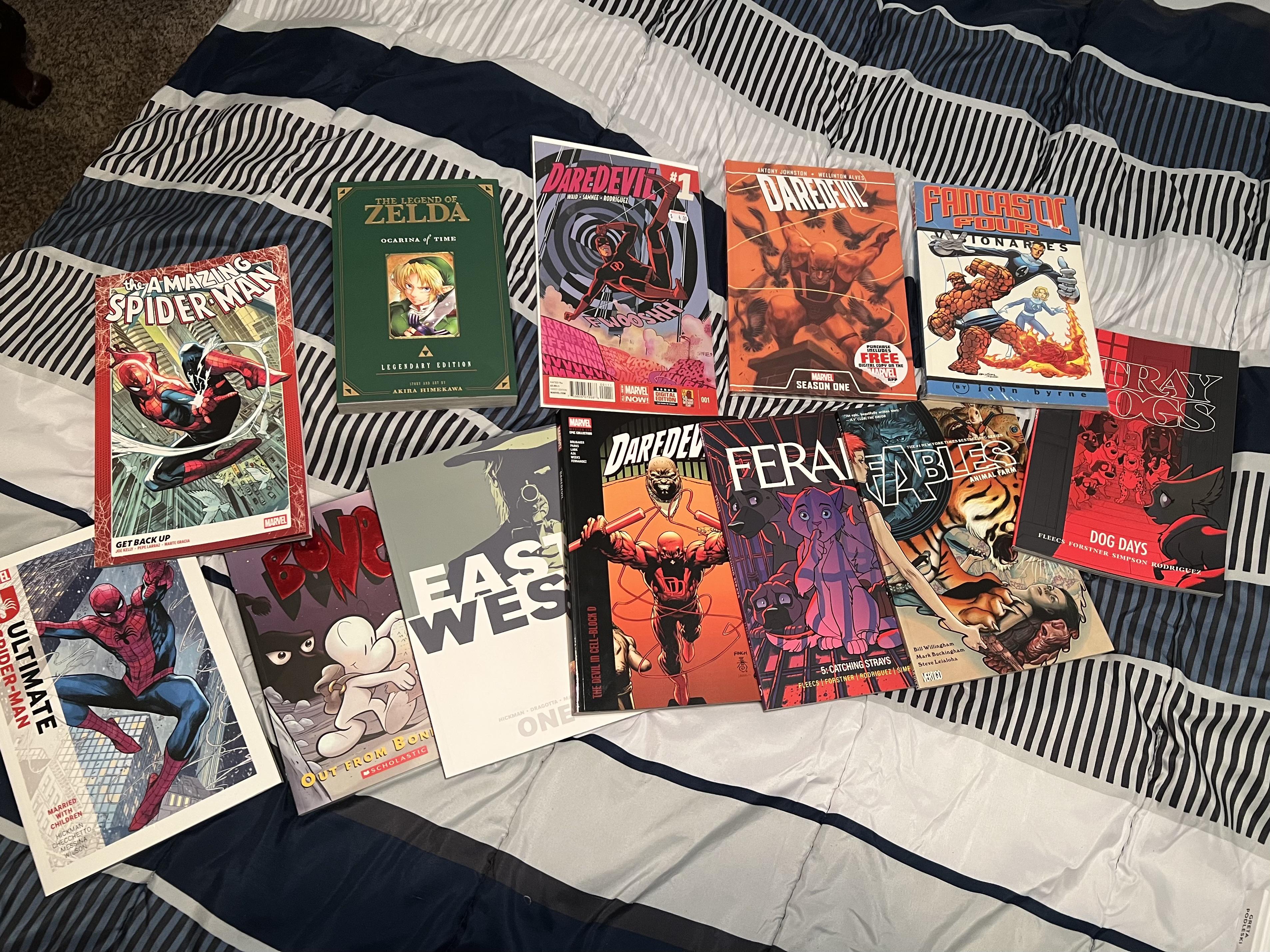
Collection / Shelfie / Haul Thanksgiving haul, lots of Vol 1s and continuations of books I’ve already started

Post image
20 Upvotes

I decided to rethink how I go about collecting/reading comics. For awhile I focused on either omnis or huge compendiums for runs with the idea that I would be getting more bang for my buck. Then I realized I could be paying omni price for something I may not even like and then be wasting money.

So I took a step back and chose to instead focus on trades and then see about upgrading to a bigger format if I like it.

Of all of these, the one I’m least familiar with the Fantastic Four. I’ve only read the 2 Midnight issues that are out right now and really liked them but aside from that I’ve never read an FF comic before. I chose the beginning of John Byrne’s run because I heard it was a good entry point for new readers and I’m personally not a fan of how writing was done in the Silver Ave when they were created


r/graphicnovels • • 2d ago

News TITAN CATALOG UPDATE: Tales from the Clerks hardcover coming August 2027 (collection of Kevin Smith works)

Thumbnail
gallery
7 Upvotes

r/graphicnovels • • 3d ago

Collection / Shelfie / Haul It just arrived. And it's beautiful.

Thumbnail
gallery
77 Upvotes

Tis the season when your kickstarter backings are starting to show up!

I present to you, Cosmopirates by Alejandro Jodorwksy and Pete Woods.


r/graphicnovels • • 3d ago

Superhero This Guy Lists: 200 Favorite Comics - “Marvel Boy” (honorable mention)

Thumbnail
gallery
33 Upvotes

While I continue trying to reconstruct the original list ranking that I impulsively erased during a brief crisis of confidence regarding the value of this project, here is a review of another honorable mention that just narrowly missed the cut, primarily so I can keep myself in the habit of posting these things on a regular basis.

When discussing Grant Morrison’s relatively brief stint at Marvel, most readers naturally gravitate toward their work on the (New) X-Men, and understandably so, since that was the longest and most influential project, and the title that permanently altered the trajectory of Marvel’s mutant line (even if only by a few degrees, since true change remains largely incompatible with the economics of corporate intellectual property). But if there is one comic that most completely encapsulates Morrison’s vision of the Marvel Universe and superheroics in the 21st century, it is probably Marvel Boy, a six-issue collaboration with artist J.G. Jones published in 2000 and almost immediately overshadowed by the projects and real-world events that followed it.

Part of the reason for that neglect is easy to understand. Despite bearing the name of a preexisting Marvel character, Marvel Boy functions less as a revival than a complete reinvention: its cast is composed almost entirely of new faces, its conflicts are largely self-contained, and its ending clearly points toward a second volume that never materialized. Unlike New X-Men, it leaves behind no obvious footprints for future writers to follow, occupying instead the strange position of being simultaneously one of Morrison’s most ambitious comics and one of their least celebrated. Which is unfortunate, because in a lot of ways it is also one of their most revealing.

Re-reading it today, the series feels like both a time capsule from the year 2000 and a surprisingly prescient forecast of the decades that followed. Its premise is deceptively simple: following the destruction of his ship and the murder of his crewmates by the billionaire industrialist Doctor Midas, the young Kree explorer Noh-Varr finds himself stranded on Earth looking for vengeance. What follows initially resembles a familiar superhero scenario, albeit one filtered through Morrison’s usual fascination with pop culture and psychedelic science fiction, with the added impression that they have set themselves the challenge of outdoing Warren Ellis at his own game, though it quickly reveals itself to be interested in something far stranger than the traditional hero-versus-villain dynamic.

Noh-Varr is not merely an alien, but a culture shock given physical form and unleashed upon the Marvel Universe. One of Morrison’s recurring preoccupations throughout the 1990s and early 2000s was the question of what happens when radically new ideas collide with stagnant institutions, and this tension between chaos and order, the future and the present, that animates works as different as The Invisibles and New X-Men, is distilled here into a single protagonist. Noh-Varr arrives from a civilization so technologically and culturally advanced that it might as well be magical. His people practice what he openly describes as “Zen fascism,” possess sentient recreational drugs, engineer themselves genetically for pleasure and self-expression, and have largely dissolved the social, political, and biological boundaries that define human civilization. The result is one of the more unsettling protagonists in mainstream superhero comics: attractive, charismatic, funny, sympathetic, and wounded… yet also abrasive, arrogant, casually violent, culturally supremacist, and utterly convinced that humanity is fundamentally broken. And Morrison repeatedly puts readers in a position in which they are forced to identify with someone they would almost certainly distrust under different circumstances. That tension lies at the heart of the comic.

One of the more perceptive readings of Marvel Boy I’ve encountered in preparation for this review comes from a guy named Travis Hedge Coke on Substack, who argues that the series is fundamentally concerned with ideological contamination. Every major force in the comic represents a competing vision of how reality should be organized: Doctor Midas embodies acquisitive capitalism, Hexus the Living Corporation (whose logo is, amusingly enough, a giant X) pushes the era’s distrust of corporations to its logical conclusion, transforming branding into a self-replicating contagion, and Noh-Varr arrives carrying his own memetic payload in the form of Kree philosophy. In other words, everyone is attempting to colonize reality with ideas. I think Hedge Coke largely nails it, though I’d push that argument even further: Morrison isn’t merely staging a conflict between ideologies - they’re taking the constituent elements of the Marvel Universe itself and treating them as ideological systems too.

The series’ most fascinating achievement may therefore be its relationship with Marvel continuity. Much as Neil Gaiman’s The Sandman transformed obscure corners of DC history into a cohesive mythology, Morrison approaches the Marvel Universe less as a collection of stories than as a bottomless well of reusable concepts and spare parts. Rather than simply updating existing characters, they reverse-engineer their underlying ideas and ask what they should look like at the dawn of the 21st century. The Kree, long depicted as little more than a belligerent alien empire, are transformed into transhumanists whose society combines Zen philosophy, genetic engineering, and fascism. SHIELD ceases to function as a glamorous spy agency and instead resembles a corporatized security apparatus whose purpose is preserving the existing order. Doctor Midas distills decades of Marvel industrialists, military contractors, and armored adventurers into a single figure whose defining superpower is acquisition itself. And the Fantastic Four, traditionally the beating heart of the Marvel Universe, are quietly demoted from protagonists to background sight gags, a fleeting reminder of an older conception of wonder that no longer occupies center stage.

Most ambitious of all is Noh-Varr himself, who is simultaneously Spider-Man, the original Marvel Boy, and every alien outsider archetype that has recurred throughout Marvel’s history since the Sub-Mariner. Morrison’s real innovation is allowing that archetype to embrace its own alienation. Where Peter Parker responded to trauma by accepting responsibility, Noh-Varr responds by declaring war. Where other Marvel heroes traditionally channel their anger into service to the status quo, Noh-Varr channels his into revolutionary violence. In doing so, he taps into the tension that has existed in Marvel stories for decades, one that found its perhaps most famous expression in the X-Men’s oft-cited Martin Luther King Jr./Malcolm X dichotomy, and one that embodies the entire history of Marvel’s moral framework: the ongoing argument with itself about how marginalized people should respond to power, and the struggle between integration and confrontation, responsibility and righteous anger.

This is why I find the oft-repeated characterization of Marvel Boy as a proto-Ultimate comic both correct and somewhat misleading. Like the Ultimate line, Morrison is interested in what Marvel concepts might look like if created for a new century. Unlike most Ultimate books, they have little interest in grounding them in “realism,” choosing instead to essentially radicalize them. By which I mean that every familiar Marvel idea is pushed toward its most extreme logical conclusion: the Kree become transhuman fascists, corporations become memetic viruses, SHIELD becomes a surveillance state, and superheroes become ideological weapons. Continuity itself becomes a fever dream of competing symbols, identities, and brands. In that sense, the series is less a story than a stress test. Morrison takes the conceptual machinery of the Marvel Universe, turns every dial to maximum, and then watches to see what survives. And the remarkable thing is just how much of 21st-century Marvel feels as though it crawled out of that wreckage.

Along similar lines, it’s difficult to understand how distinctive parts of this book looked in 2000. While many contemporaries pursued either exaggerated superhero bombast of the 90s or the increasingly decompressed cinematic (excuse me, “widescreen”) storytelling that would dominate the decade that followed, this series drew from two very different strands of Marvel’s past in order to envision its future: Morrison and J.G. Jones may have approached the book with a kind of Kirbyesque creative zeal, but Jones’s artwork here feels less indebted to Kirby than to Jim Steranko, perhaps the most modern-minded of Marvel’s classic artists. Like Steranko, Jones is interested in design, fashion, and the ways in which images can be manipulated to create psychological effects. His pages possess a tactile realism that grounds Morrison’s more outlandish concepts, yet his use of motion effects and visual distortions, combined with Avalon Studios’ blown-out colors (which I’d normally hate, but which feel appropriate here), imbues the entire series with a slightly otherworldly quality. Strobing figures, light trails, frozen moments, and digital artifacts transform action scenes into something closer to the fragmented, hyperstimulated energy of early-2000s MTV than a conventional superhero fight.

In general, Marvel Boy feels less influenced by film than by the emerging visual grammar of turn-of-the-millennium media culture. Morrison once described Jones’s approach as inspired by “digital editing effects” and “percussive rhythms” rather than traditional cinematic techniques, which sounds like the kind of abstract nonsense Grant would routinely feed interviewers at the time, but also feels exactly right. The series frequently resembles a collision between a fashion magazine spread, a music video, and a superhero comic: advertisements, corporate iconography and logos, news broadcasts, and television screens saturate nearly every page. Rather than merely depicting media saturation, Marvel Boy formally embodies it. Some contemporary reviewers dismissed these flourishes as style for style’s sake, but to me, viewed from a distance of more than two decades, they look incredibly prophetic.

The series’ most fascinating aspect, however, may be its historical timing: it was released in perhaps the narrowest cultural window imaginable, at the turn of the century, but just before September 11 permanently altered the political and cultural landscape. Its protagonist is, quite literally, a terrorist. He antagonizes governments, attacks institutions, destroys landmarks, and responds to personal trauma with ostentatious displays of public violence. But rather than portraying him as a villain, Morrison expects readers to at least partially sympathize with this adolescent insurgent outsider (I suspect that the same comic released just a year later would have been received very differently). This specificity has therefore caused some readers to write off Marvel Boy as dated, but I would argue the opposite. Sure, the particulars are undeniably rooted in the anxieties of the late 1990s and early 2000s: celebrity culture, consumerism, corporate globalization, media saturation, millennial dissatisfaction with established institutions, etc. Yet the underlying concerns feel more relevant than ever: the power of branding, the seduction by charismatic extremists, the struggle between competing realities, the transformation of politics into spectacle, and the increasingly porous boundary between culture and commerce are hardly relics of the year 2000. If anything, they are the defining concerns of the present moment.

The irony is that Marvel Boy ultimately achieved many of its ambitions without receiving much credit for them. Elements of its aesthetic, politics, and worldview gradually seeped into mainstream superhero comics even as the series itself faded into relative obscurity. Looking back from the vantage point of the mid-2020s, it is difficult not to see traces of it everywhere: in Marvel's fascination with transhumanism, in superhero fiction’s treatment of corporations and media as existential threats, and in the increasingly common practice of dismantling and reconstructing superhero mythology for new generations of readers. From Marvel’s Ultimate and Midnight lines to DC’s Earth One and Absolute imprints, contemporary superhero comics repeatedly return to the same basic question Morrison was asking in Marvel Boy: what happens when familiar concepts are stripped for parts and rebuilt to reflect a different cultural moment? The series may never have received the sequels that Morrison originally envisioned, but many of its ideas escaped containment anyway while nobody was looking.

Today, Noh-Varr survives primarily as a supporting player shuffled between superhero teams, stripped of much of the weirdness that originally made him fascinating, but the original miniseries reveals a character that is challenging, provocative, and unapologetically strange, even by today’s standards, much like the comic itself. It may not be Morrison’s most polished work, nor their most emotionally resonant (which, along with its function as the first part of a trilogy that may never be completed, keeps it from inclusion on the list proper), but it might just be their purest statement on youth, power, media, ideology, and the allure of believing you’ve figured out how the world should work. Bummer they never got to expand on it.

r/graphicnovels • • 3d ago

Question/Discussion SMILE by Raina Telgemeier appearance in the latest Mr. Wolf's Class book?

Post image
11 Upvotes

Is it just me, or is Randy reading Smile by Raina Telegmeir in the new Mr Wolf's Class book, The New Student?


r/graphicnovels • • 3d ago

Question/Discussion Find name of comic trilogy

Thumbnail reddit.com
2 Upvotes