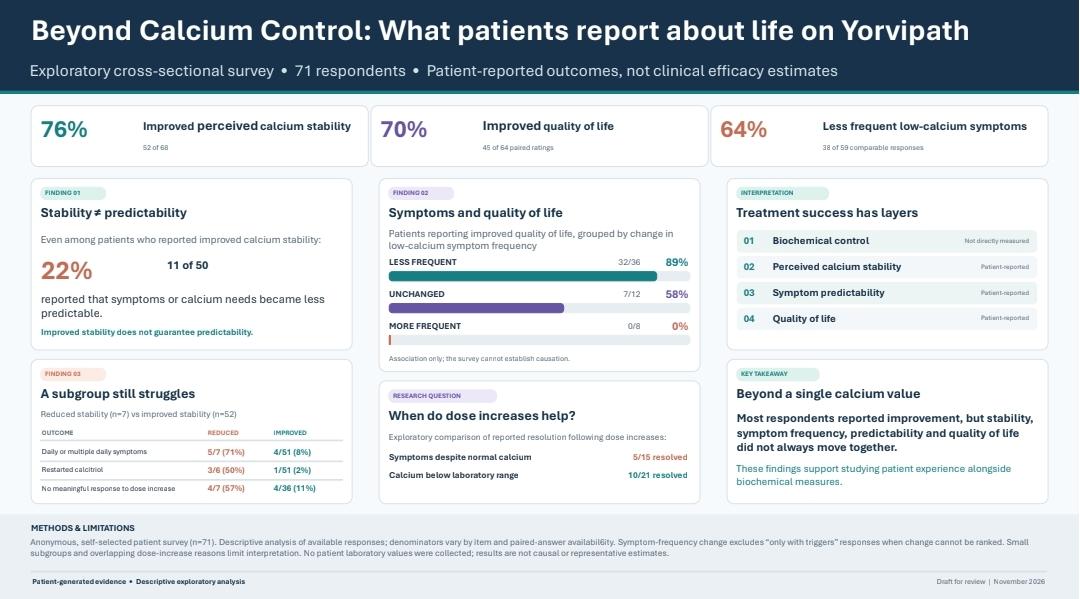
A while ago, I conducted an independent survey of people with hypoparathyroidism about their experiences with Yorvipath. I've recently been taking a closer look at the 71 responses, particularly the relationships between calcium stability, symptoms, dose adjustments, and quality of life.
Some of the findings were encouraging. Others raised questions I hadn't fully considered when I designed the survey.
First, the good news!
Most respondents reported improvements after starting Yorvipath:
76% reported improved calcium stability (52/68).
70% reported improved quality of life (45/64).
64% reported less frequent low-calcium symptoms (38/59 with directly comparable responses).
But what interested me most wasn't simply whether people improved. It was how different aspects of their experience changed and whether those changes always occurred together.
Three findings I found particularly interesting are:
- Improved calcium stability doesn't necessarily mean improved predictability.
Among respondents who reported improved calcium stability, 22% (11/50) nevertheless reported that their symptoms or calcium needs had become less predictable.
That raises an interesting question: What does stability mean if someone still can't anticipate how they're going to feel or what their body will need?
2. Changes in symptom frequency were closely associated with changes in quality of life.
Among respondents with comparable symptom-frequency data and quality-of-life ratings:
32/36 (89%) whose symptoms became less frequent reported improved quality of life.
7/12 (58%) whose symptom frequency stayed the same also reported improved quality of life.
None of the eight whose symptoms became more frequent reported improved quality of life.
I find that middle group particularly interesting. What improved their quality of life if their symptoms weren't occurring any less frequently? Was it severity, duration, recovery time, treatment burden, or something we didn't measure?
3. Dose adjustments didn't resolve difficulties for everyone.
A small subgroup reported worsening calcium stability, persistent symptoms, and limited improvement after dose increases.
We also saw a possible pattern suggesting that dose increases prompted by symptoms despite normal serum calcium may be less likely to resolve the problem than increases prompted by calcium below the laboratory reference range.
The numbers are small, so this is a question worth investigating- not a conclusion about how dose adjustments should be managed.
So what does all of this mean?
One possibility is that we're looking at several related but distinct aspects of treatment success: biochemical control, calcium stability, symptom predictability, symptom burden, and quality of life.
Improvement in one area doesn't necessarily guarantee improvement in another.
These are exploratory findings from a small, self-selected survey, not a clinical trial. The responses are self-reported, and we don't have laboratory data to independently evaluate biochemical control or establish why these patterns occurred.
And this is where I'd really love your input!
I'm interested in hearing from people whose experiences support these patterns, but I'm equally interested in experiences that contradict them.
Did your calcium become more stable while your symptoms became less predictable? Did your quality of life improve even though your symptoms didn't become less frequent? Did a dose increase resolve symptoms even when your calcium was normal?
Or is there another explanation for these patterns that we haven't considered?
I'm not looking to prove a particular hypothesis. I'd like to understand what these responses might be telling us, what we may have missed, and what questions deserve closer examination.
What stands out to you? What would you challenge, or want to understand better?