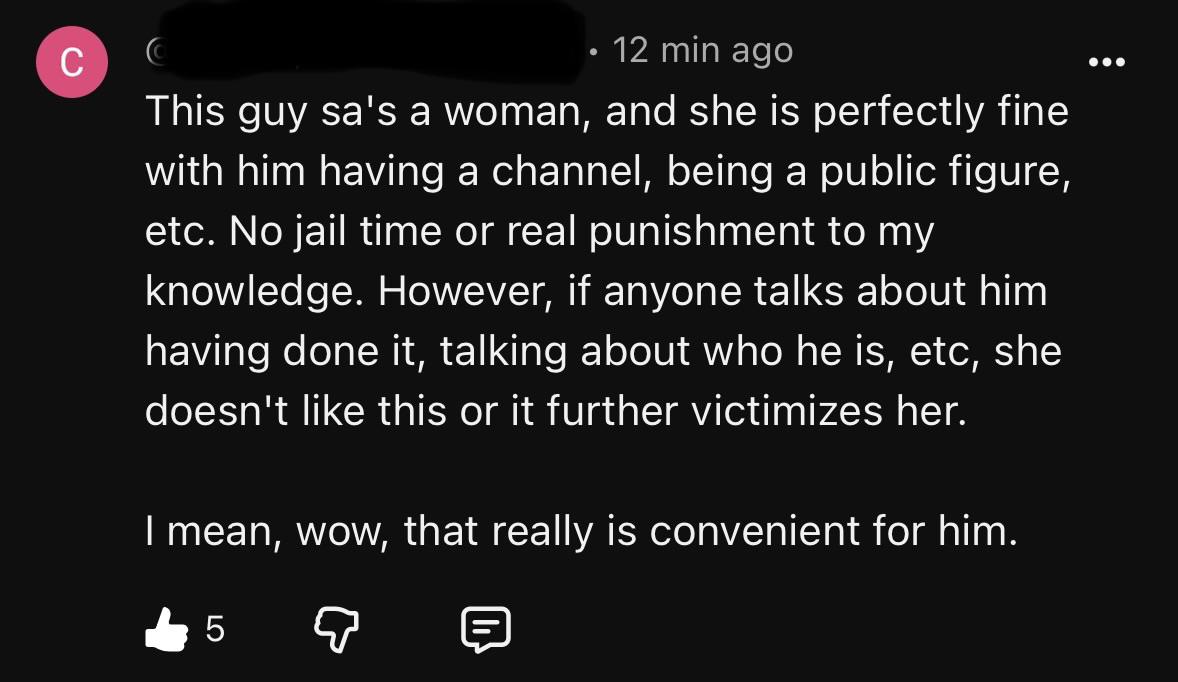
There are currently two main ideas that the conversation surrounding Jacob Geller gravitates towards: his honesty and sincerity; and the possibility of redemption from sexual assault.
---
There's a reason people find trusting his honesty and sincerity difficult. By omitting his history of sexual assault, his essays and manner of self-presentation (intentional or not) as innocent and morally virtuous/conscious become dubious. His actions then can only be viewed as being performative, with the underlying desire to shed responsibility and wash away this past self.
This skepticism naturally extends to his most recent YouTube video, 'A Joint Statement on Moving Forward', with the light setup, the cadence, and the editing making use of the same aesthetics of sincerity that all his other videos took on. But the aesthetic isn't really the core reason people don't trust this video--had it been shoddily recorded, or whether or not it included Jane's statement--trust was fundamentally broken by the omission, and the video is not sufficient cause to trust him again.
---
The natural defense is that he shouldn't be expected to air out a private matter, especially one that might compromise the victim's privacy. Fair enough--but that still leaves the option of disclosing it privately to his collaborators.
Trusting collaborators to keep it private still has an inherent risk. In such a tight knit community of leftist essayists, with every individual this information is given to, the more likely it'll spread. This is without accounting for the very likely possibility and justified act of warning others in the community as a means of deterring collaboration/contact. Silence, in this case was both the easier choice for him and the safer choice for his victim.
Still, and perhaps naively, I believe that he should have disclosed it to his collaborators. Or, at the very least, vetted and restricted himself to working only with people he can fully trust. But this is questioning his methodology of disclosure in a world post-revelation. With all forms of disclosure being a risk and despite silence--which we'll charitably assume was meant to mitigate harm--still ultimately exposing the victim, there's only really one solution: **he shouldn't have started a public career in the first place.**
---
Redemption as a concept will always be heated, and there's never a time a complete consensus on whether a person should be considered redeemed or not exists. And yet we as a society will some day come to a conclusion despite personal apprehension.
Moral judgement has always been this instinct we have--a way of protecting oneself and the community, telling us that '*this person, by their actions, can potentially harm people.*' But because of the variety of lives we've lived, our sense of and understanding of what is dangerous and harmful and what isn't will vary.
In light of what we know, it's perfectly reasonable to not trust him. In fact, it should be encouraged: there is no reason to trust him. However much we caveat that his silence had some reasonable justification, and that it was a complicated and difficult situation (as we did in the prior part), I would still insist that omitting it was irresponsible. It caused many who found comfort in him and trusted him as an individual--especially his collaborators and peers--real harm and discomfort.
---
I believe, still, that he has a right to a platform. Not a right to an audience, mind you; neither to forgiveness, or success, or any of that matter. Only that he has a right to be a public figure. Allowing redemption I believe means that we should be ready to be uncomfortable with someone's presence. This is in the end the core of what I believe is rehabilitation.
If there is a responsibility he should be mindful of and carry now that this has all come to light (a responsibility he's had since the beginning, really), it's that he should be responsible for the audience he curates. To not let the easy art vs. artist separation bring people into an apathetic support of him if he truly believes in what he preaches.
This isn't to say he should forewarn the viewer every video of his past or constantly perform imperfection, only that he cannot let that parasocial bond rebuild into blind trust. I personally don't know if I'll be able to watch his videos because there'll always be an underlying discomfort I have now due to this controversy. But my discomfort is mild, and not the same as how others are now experiencing it.
And, who knows? Maybe he lied about Jane and allat in which case fuck him yeahhhh (But honestly any speculation on this part can be pretty disrespectful to the victim itself so I say it in jest)