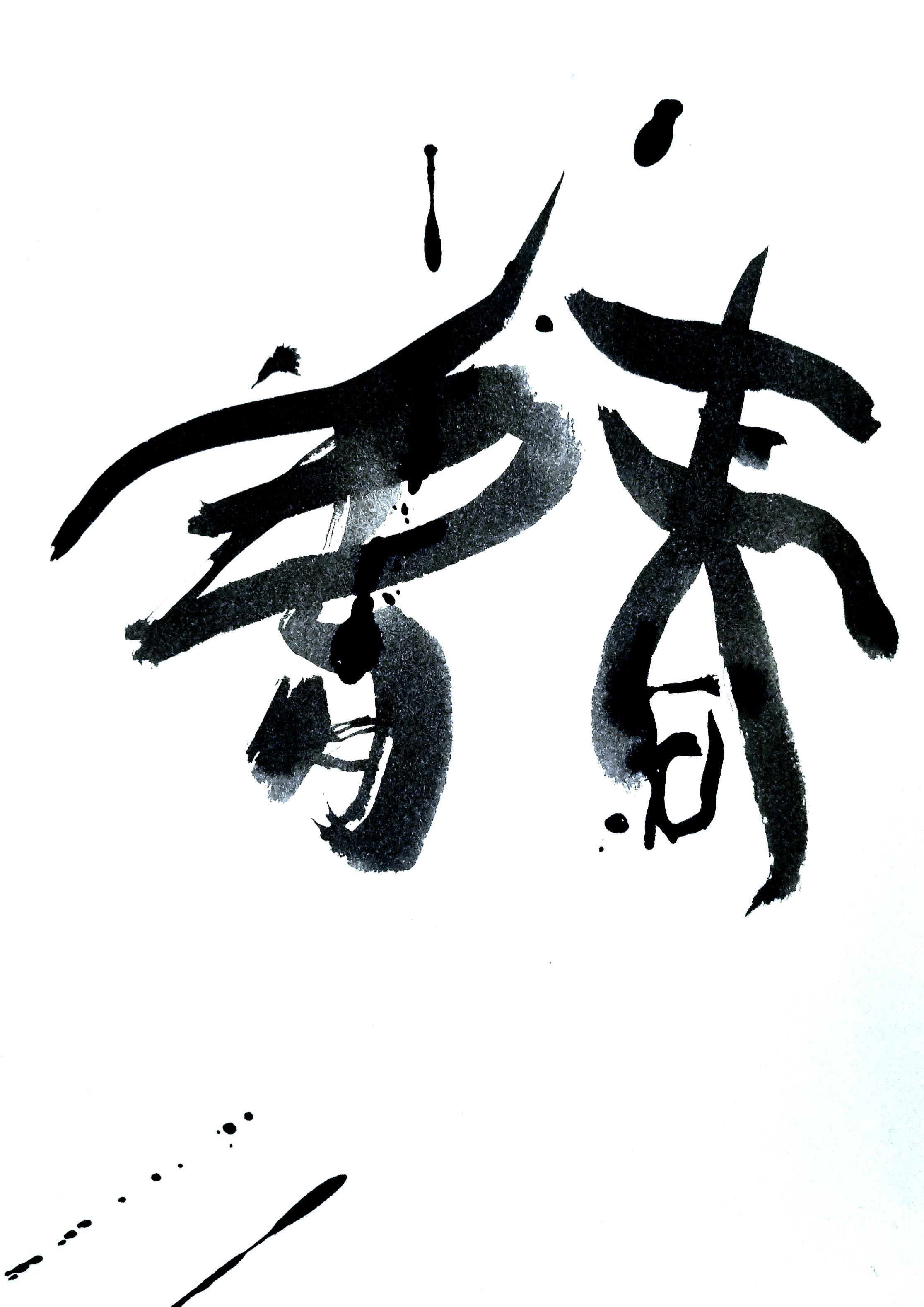
A few months ago I took a calligraphy lesson from a Japanese teacher, and she had some really interesting books that showed how to do different calligraphy font styles. I'm going to ask her about them, but I would like to see if Reddit has some good recommendations for books and references.
korean given names are usually two hanja, picked from a government list of about 9,400 characters allowed in names. a lot of families still take the baby's birth date to a naming house (jakmyeongso), which builds the birth chart (saju) and checks which of the five elements it's short on: wood, fire, earth, metal or water.
the element of a character is mostly read off its radical. naming houses call it jawon ohaeng (字源五行), the element by the character's source. anything with 木 counts as wood, 氵 or 水 as water, 金 as metal, 火 or 灬 as fire, 土 as earth. jade counts as metal too, so 珍, 玟 and 珠 with 王 on the left show up a lot for kids who are low on metal. sometimes you can guess what a person's chart was missing just from the left side of their name.
i'm korean and made a free site that does this for non-korean names, so this last part is self-promo. you put in your first name and birthday and get a korean name with the hanja and a reason for each character. i ran Ethan with a january 25, 2001 birthday as a test. the chart had no wood at all, and it came out 柳玟樹 (Ryu Min-soo): 柳 "willow" and 樹 "tree" both carry 木, and 玟 "veined jade" is in the middle because metal was low too.
no sign-up, and the birthday stays on your device.
if anyone could help me identify the kanji on the right in this image, i would really appreciate it! i'm translating this manga, but the quality of the pdf i was provided with is pretty poor, making it difficult to read some things. i can tell the rest of the phrase says "鍋の," but i can't figure out that last kanji no matter how hard i try. if context helps: the phrase appears on what seem to be some packets at a grocery store on a display in front of cabbages.
What happens if you combine kanji with Roman style serifs? This kind of weirdness. Is it worth making an entire font like this? What's the average reaction likely to be from Japanese people? What might such a font even be called, since its not technically a Mincho font (which at least nominally pays attention to how they might have been drawn with a brush).
seeing how a kanji is put together is what finally made them stick for me, so i built a site around that idea while studying Nihongo.
each kanji page shows the parts it's made of and other kanji that share them. for example 木 (tree) becomes 林 (grove), and then 森 (forest). you can also practise writing it with stroke order and see example words.
Three Hatakosen ramune bottles with different flavours.
The kanji after the flavour, such as 'ichigo' (strawberry), is unfindable. I assume it means 'flavour', however I am unsure. I also don't know how to pronounce the words, seeing as I am unable to find it on multiple kanji sites.
Kindly asking for assistance. It's supposed to be MUSŌ KAKUSEI, Awakening of the Unrivalled. However id like to verify the accuracy of the text as well as get a deeper understanding of the phrase. The philosophy, if you will.
Please someone help with some tricks to memorise pronunciation of kanji. The actual character is much easier to remember but I cannot for the life of me to get most the pronunciation in my head. Helpppp
The top of 家 (ie) is 宀, the roof radical. Japanese calls it うかんむり (ukanmuri), the "u crown", since it looks like katakana ウ (u) sitting on top.
Underneath is 豕 (shi), an old character for pig. You can still spot it in 豚 (buta), pig, where it sits next to 月 (tsuki), the meat radical.
Why there's a pig in the house is less settled than the picture makes it look. The 説文解字 (Shuōwén Jiězì) treats 豕 here as a sound hint, short for 豭 (ka), a boar. Other people point to farm families keeping pigs right under or beside where they lived, and Han dynasty tomb models of farmhouses often come with a little pig pen. Some scholars tie it to pigs offered to ancestors instead.
Japanese uses it everywhere. 家族 (kazoku) is family, 作家 (sakka) a writer, 家計簿 (kakeibo) the notebook where you track household spending, and 大家 (ōya) your landlord.
Has anyone seen an older source that actually settles the pig question?
取 (toru), "to take", is one of the first kanji you learn, and it has a pretty grim picture inside.
The left half is 耳 (mimi), ear. The right half is 又, which looks like "again" (mata) but is really an old drawing of a right hand. So the kanji is literally a hand holding an ear.
Why an ear? The oldest Chinese character dictionary, the 説文解字 (Shuōwén Jiězì, around 100 AD), explains 取 as "to capture" and quotes an even older text on warfare: those who capture take the left ear. Soldiers cut the left ear off enemies they had killed or captured and handed them in, because ears were much easier to carry and count than heads.
There's even a separate character for that trophy ear, 馘 (kaku). It survives in Japanese in 馘首 (kakushu), which literally means cutting off a head and today is a stiff, formal word for firing someone. Same idea as the everyday クビ (kubi), "neck", which is what you say when you get sacked.
The ear has long since dropped out of the meaning, so today 取 is just taking in general:
取る (toru), to take, to grab
取材 (shuzai), gathering material, a reporter's interview
鳥取 (Tottori), the prefecture, literally "bird taking"
And it hides inside other kanji as a sound part, like 趣 (shu) in 趣味 (shumi), hobby, where it mostly tells you the reading.
One more ear for the road. 恥 (haji), shame, is ear plus heart. The popular explanation is that your ears turn red when you're ashamed. It's a nice story, but the old dictionary says 耳 is there for the sound, not the blushing.
so im writing a song, and i want to have some Japanese lyrics in this song. i don't trust Google translate at ALL, but ive used what it's given me as a placeholder
the words i want translated are
"such a bloodletter
bloodletter"
Google translate gave me
"そんな血抜き / Son'na chi nuki (such a bloodletter)
瀉血師 / shaketsu-shi (bloodletter)"
i stuck with them because they rhymed but im not sure if that's correct, because other sites such as deepl have given me different things; is there a more accurate translation for these words? in a way that rhymes/end similarly as well
the word "bloodletter" is repeated throughout the song later as well, is it a different word alone than in a sentence such as above?