r/kubernetes • • 2h ago

kubernites v0.15.1: cluster rw

2 Upvotes

followup on my previous post!

kubernites v0.15.1 is here and now it can read and write (be careful) clusters. i've opensourced the live cluster part of the game so you can see yourself what's happening under the hood (as you can't trust black boxes after all), contributions are welcome!

the game demo on itch: https://waxb.itch.io/kubernites
the repo: https://github.com/waxb/kubernites

production still not recommended! have fun!


r/kubernetes • • 1d ago

how do you clean up forgotten stuff in a cluster like old namespaces and orphan pvcs

39 Upvotes

feels like clusters slowly fill up with junk nobody owns. old test namespaces, pvcs left behind after a statefulset got deleted, configmaps no one references anymore. do you run some cleanup job, use labels with an owner and expiry, or just do a manual sweep every few months? curious what actually sticks long term


r/kubernetes • • 4h ago

Splitting a 10M-user matchmaking service into region-isolated parts: notes on what scales on what

0 Upvotes

A matchmaking service is a nice case study because its parts scale on completely different signals. Lumping them into one deployment is where most of the pain comes from.

Three parts, three scaling signals

  1. Status API ("am I matched yet?"): stateless and read-heavy. With 10M players polling every 3 seconds, that's about 3.3M requests per second. Scale it on request rate, not CPU, because a cheap poll endpoint can be saturated long before CPU looks busy.
  2. Matchmaker workers: these own partitions of the queue (game + region + skill bracket). They scale with the number of active partitions, not with traffic.
  3. Queue state: this is where contention lives. The fix for two workers matching the same player is an atomic, conditional state change plus an idempotency key, not more replicas.

Isolate by region

Run each region as its own cell with its own state. One region's database failing then pauses that region's queue instead of cascading everywhere. Cross-region routing becomes a deliberate, capped fallback rather than an accident.

Hot spots

A popular game in one region turns one partition hot. Because partitions are the unit of scaling, you can split that one further and add workers for it without resizing the whole fleet.

Shed load before you fall over

A readiness check that reflects real saturation, plus a retry-after hint to polling clients, beats letting pods crash-loop under a retry storm.

How are you scaling read-heavy endpoints like this: request-rate metrics, custom metrics, or something else?

(This comes from a workshop Tural Suleymani, a Microsoft MVP, is running on Wednesday, where he evolves an open-source .NET version of this service live. The repo includes Kubernetes deployment docs)


r/kubernetes • • 7h ago

Anyone using an AI agent for EKS upgrades?

Thumbnail reddit.com
0 Upvotes

I'm building an agent that prepares EKS upgrades: checks add-on compatibility and deprecated APIs, then opens Terraform PRs for a human to review. It's read-only and can't merge or apply.

Has anyone built something similar? Curious which MCP servers you used and how you scoped permissions. Open to swapping ideas or collaborating.


r/kubernetes • • 1d ago

Moved my Kubernetes secrets to Bitwarden with External Secrets Operator

87 Upvotes

My homelab cluster runs from a public Git repo through Argo CD, except Secrets. Those were still kubectl create secret from my laptop.

Now they live in Bitwarden Secrets Manager. External Secrets Operator syncs them into normal Kubernetes Secrets.

Git only holds references, no values. The cluster’s access is read-only, and a rebuild needs one token.

Repo: https://github.com/prateekjaindev/homelab

Write-up: https://blog.prateekjain.dev/kubernetes-secrets-on-a-talos-homelab-with-bitwarden-eb5696dfb3be?source=friends_link&sk=0f6495f99946cd6de38c978dc13a4ad7


r/kubernetes • • 15h ago

In the age of agentic AI, is learning technologies deeply still worth it?

0 Upvotes

With AI agents becoming increasingly capable of writing code, troubleshooting issues, generating configurations, building dashboards, and even managing infrastructure, I've started questioning how much time we should still invest in learning technologies deeply.

Take Kubernetes, for example.

If I understand the fundamentals Pods, Deployments, Services, networking, storage, scheduling, troubleshooting, etc. but AI agents can help me write manifests, debug errors, analyse logs, and troubleshoot issues, how deep do I really need to go?

Another example is Grafana. Traditionally, you'd spend time learning how to build dashboards, create panels, configure queries, variables, and fine-tune visualisations. Now, with tools like Grafana MCP, an AI agent can interact with Grafana and help create dashboards in minutes. Things that used to take a lot of manual work can potentially be done through a conversation with an agent.

So, why spend hours manually building dashboards or memorising configuration syntax when AI can do most of the implementation for you?

I'm not saying fundamentals don't matter. Obviously, you still need enough knowledge to understand what's happening, validate the output, recognise bad decisions, and troubleshoot when things go wrong.

But maybe the way we learn technology needs to change.

Should we focus less on memorising commands, syntax, and every feature of a particular tool, and focus more on:

  • Understanding concepts and architecture
  • Understanding how different systems interact
  • Troubleshooting and critical thinking
  • Knowing how to validate AI-generated solutions
  • Making technical decisions rather than doing every implementation manually

I'm genuinely curious how others are thinking about this.

In the age of agentic AI, where do you draw the line between mastering a technology yourself and relying on AI agents to do the heavy lifting?

Would you still spend months mastering Kubernetes, Grafana, Terraform, etc., or learn the fundamentals and let AI agents handle much of the implementation as you encounter real-world problems?


r/kubernetes • • 1d ago

Anyone using milvus helm or milvus operator in prod

Thumbnail reddit.com
3 Upvotes

r/kubernetes • • 2d ago

CVE Patching Across Hundreds of Workloads

61 Upvotes

With all the recent CVEs being announced, what's your approach to quickly patching hundreds of container workloads spread across multiple Kubernetes clusters?What were some of the biggest challenges you've run into, and how did you solve them? Also, how do you make sure patching becomes an ongoing process instead of a fire drill every time a critical CVE drops?


r/kubernetes • • 2d ago

Kargo and multiple freight from one warehouse

Thumbnail reddit.com
3 Upvotes

r/kubernetes • • 2d ago

Kubernetes security tools that fix the vulnerable images instead of just flagging them?

18 Upvotes

our cluster scanner lists around 900 cves across 40ish workloads and most of them sit in images we pull through vendor helm charts, so rebuilding them ourselves isnt really an option. i've been reading about rapidfort and chainguard, and i'm not sure yet which of them fits charts we don't own. which kubernetes security tools fix the vulnerable images instead of just flagging them...


r/kubernetes • • 2d ago

Way forward after KTHW?

6 Upvotes

So I set up 4 nodes on my proxmox and jumped straight into the Kubernetes the Hard Way series of labs. Needless to say I came all the way to the end but I don't feel like I learned that much. I know the basics of pubkey encryption and TLS and it felt like a lot of it was just setting up a safe way for the nodes to talk to each other.

I am searching for a deeper understanding and better mental model of the whole system.

Does anyone have any experiences to share or tips on where to go from here to learn it in an effective hands-on fashion?

Not working with kubernetes currently but preparing for an interview.


r/kubernetes • • 3d ago

do you set cpu limits on everything or just requests

35 Upvotes

requests make sense to me but cpu limits seem to cause throttling even when the node is idle. memory limits at least stop one pod from eating the node. curious if most people skip cpu limits on purpose or just use the defaults from a helm chart


r/kubernetes • • 2d ago

Periodic Weekly: Share your victories thread

4 Upvotes

Got something working? Figure something out? Make progress that you are excited about? Share here!


r/kubernetes • • 3d ago

How do you structure your Flux repo directories?

13 Upvotes

Just getting started with Flux and trying to settle on a folder layout. For example, I'm thinking of something like:

clusters/
└── home/
├── infrastructure/
│ ├── controllers/
│ └── configs/
└── apps/

Do you split by type like this (controllers/configs), or keep everything for one app in its own folder?

Would love to see how others lay theirs out, and links to repos are very welcome. Thanks!


r/kubernetes • • 3d ago

Kubernetes storage in 2026?

43 Upvotes

Hello,

Currently running 3x master and 3x worker nodes in virtual machines, vanilla kubernetes. These virtual machines are running in a vmware environment.

As you all know, Broadcom is Broadcom. We're planning to move away from vmware under 2027, currently we're evaluating Proxmox and HPE VM Essentials.

But, the K8S cluster is running the vSphere CSI plugin for storage, which works great. Once we start migrating i need to have another storage solution in place. Reading about this there is a shit ton of mixed opinions regarding:

  • Rook Ceph
  • Longhorn
  • Piraeus
  • And more

Most discussions are from 2-3 years ago when platforms like Longhorn still had some issues for some people, a lot of people ran Rook Ceph but it was complex and resource intensive. Some ran pure NFS-servers etc.

So I'm just wondering, what are you all using today? Pros and cons of the solution you're using?


r/kubernetes • • 2d ago

Giving a cloud coding agent cluster access without a kubeconfig

0 Upvotes

A cloud agent (Devin here) runs its changed service in its own VM and tests it against the shared cluster through a routed Signadot environment, with one API key and no kubeconfig: https://www.signadot.com/docs/tutorials/devin-signadot-sandboxes

Full transparency, I work for Signadot.


r/kubernetes • • 3d ago

How to backup and restore PVCs with Plakar's Kubernetes Operator

Thumbnail
youtu.be
8 Upvotes

r/kubernetes • • 4d ago

Keeping things updated is... annoying.

25 Upvotes

Yeah, I know, big surprise. But I just started to put together my entire structure and even added GitOps to keep track and sync of what I run. However, in doing so, I realized that I had no "update strategy" - and so I went looking and found... pain.

For reference, I use Flux for my GitOps, it is immediately installed via k0s' k0sctl so that it is available as soon as possible. And that mostly just works. Once Flux is alive, I can apply a GitRepo + Kustomization that points at the root of it all and it just goes. That part is solved and works nice. But of course, things get updated.

I use this structure in my repo:

- docker/...
- opentofu/...
- kubernetes/
  - root.yaml # GitRepo + Kustomization
  - kustomization.yaml # Points at each <component>/flux.yaml
  - <app or component name>/
    - flux.yaml # Tells flux where this component's kustomization.yaml is
    - kustomization.yaml # Actually lists all related files
  - <other thing>/
    - install/... # HelmRepo + HelmRelease
    - config/... # CRD based objects - be that a config or something else
    - flux.yaml # Is a "---" separated YAML for both with dependency tracking

This structure is easy to maintain - although it has an absolute number of repeatance but... its okay. It does bother me but realisticaly, this is just a homelab doing homelab things, I can copy and paste a bit.

The real problem is trying to receive updates. Right now, I bend updatecli in a cronjob to my will using updatecli compose. But this falls apart quickly because the policies for patch, minor and major updates fight each other - a lot. And it falls apart on image tags like Vaultwarden's 1.37.5-alpine; the -alpine tag throws off the comparison and borks the check completely.

So... what can I use to help me here? What do you use to keep track of updates across helm charts and plain container images?

I looked into Kargo but that would instantly explode complexity by a lot - especially since I want a write-back to Git to track what happened when and by whom. (I do use a PAT right now, but I plan on using a GH app in the future for better separation.)

Any recommendations or tips...? Thanks!


r/kubernetes • • 3d ago

Periodic Weekly: This Week I Learned (TWIL?) thread

5 Upvotes

Did you learn something new this week? Share here!


r/kubernetes • • 4d ago

I built a game to learn kubernetes - Night Shift

Thumbnail play.snowops.net
272 Upvotes

I have been working on multiple projects and one thing I felt was the biggest challenge for adoption. Setup time. If something takes up more than 5 minutes, you lose 90% of your potential users.

For this, i created a browser game which helps you learn real world kubernetes incidents within your browser. It's free and no setup required.

All the results are from logs of my another project - Snowops Labs. So, everything you will get is real.

It teaches you how the real engineering team works and gives you real incidents to solve and learn.

I'd genuinely like to hear what experienced engineers think. Especially if you've spent time troubleshooting production incidents.

TL;DR: An attempt to make practical DevOps troubleshooting more interactive and game-like. Give it a try and tell me what you think.


r/kubernetes • • 4d ago

Made a kubectl plugin that finds pods exposed to java4shell

18 Upvotes

java4shell (CVE-2026-114938) only triggers if the node CPU has AVX-512 VBMI, the JDK is affected, and -XX:-UseBASE64Intrinsics isn't set.

For those who don't have security scanners I wrote a small kubectl plugin. It reads the NFD CPU labels and pod specs, optionally execs `java -version` for exact versions and flags, and also warns about pods that could get rescheduled onto a VBMI node.

https://github.com/simonliska/java4shell-k8s-scanner

Any feedback appreciated! (PS: built with help from Claude).


r/kubernetes • • 4d ago

Pod ran out of PIDs, every subsystem failed with a different error, and the liveness probe kept passing

27 Upvotes

Writing this up because the symptoms looked like four unrelated outages and the actual cause was one number.

We run a service in a pod that shells out a lot (az, kubectl, some bash pipelines). One morning it started throwing errors from everywhere at once:

  • DB client: connection reset by peer
  • shell runner: fork/exec /usr/bin/bash: resource temporarily unavailable
  • a fetcher: “config not initialized”
  • a cloud integration marked INVALID with az login failed and 500+ retries behind it

Different errors, different components, same minute. And the liveness probe was green the whole time, so nothing restarted it.

resource temporarily unavailable is EAGAIN. On fork it means the kernel wouldn’t give the container another PID. The pod had hit its pids cgroup limit. Everything that needed to spawn a process was failing, each in its own words. The health endpoint is a plain HTTP handler that never forks, so it answered 200 right through the outage.

What was eating the PIDs: subprocesses that never exited. Some execs had no timeout at all. The one that did have a timeout killed the bash -c wrapper on expiry, but not the az and kubectl it had started, which got reparented and kept running. kubectl in particular was hanging forever on auth for clusters where our service principal was missing a role. A few leaked per scan, a scan every hour, for weeks.

How we confirmed it from inside the pod:

cat /sys/fs/cgroup/pids.current /sys/fs/cgroup/pids.max # cgroup v2

cat /sys/fs/cgroup/pids/pids.current /sys/fs/cgroup/pids/pids.max # cgroup v1

ps -eo pid,etime,cmd | sort -k2 -r | head # oldest processes first

current was at max, and the oldest entries were weeks-old kubectl processes.

What we changed:

  1. Every exec gets a context with a deadline, and cancellation kills the whole process group, not just the direct child (in Go: Setpgid on the child, signal the negative pid). This was the actual bug.
  2. Explicit podPidsLimit on the kubelet (--pod-max-pids), low enough that a leaking pod dies before the node does. We were on the default, which is high enough to take the node down first.
  3. Alert on container_processes from cAdvisor trending up against the limit. It had been climbing in a straight line for weeks and nobody was looking at it.
  4. Considering a liveness probe that actually forks something, since an HTTP 200 told us nothing here.

The lesson I keep coming back to: when several unrelated things break in the same minute, stop reading the individual errors and look for what they share. Here it was the kernel saying no to fork.

Curious what people use for the liveness side. Is “probe that execs something” a thing, or do you just alert on the pids metric and leave liveness alone?


r/kubernetes • • 5d ago

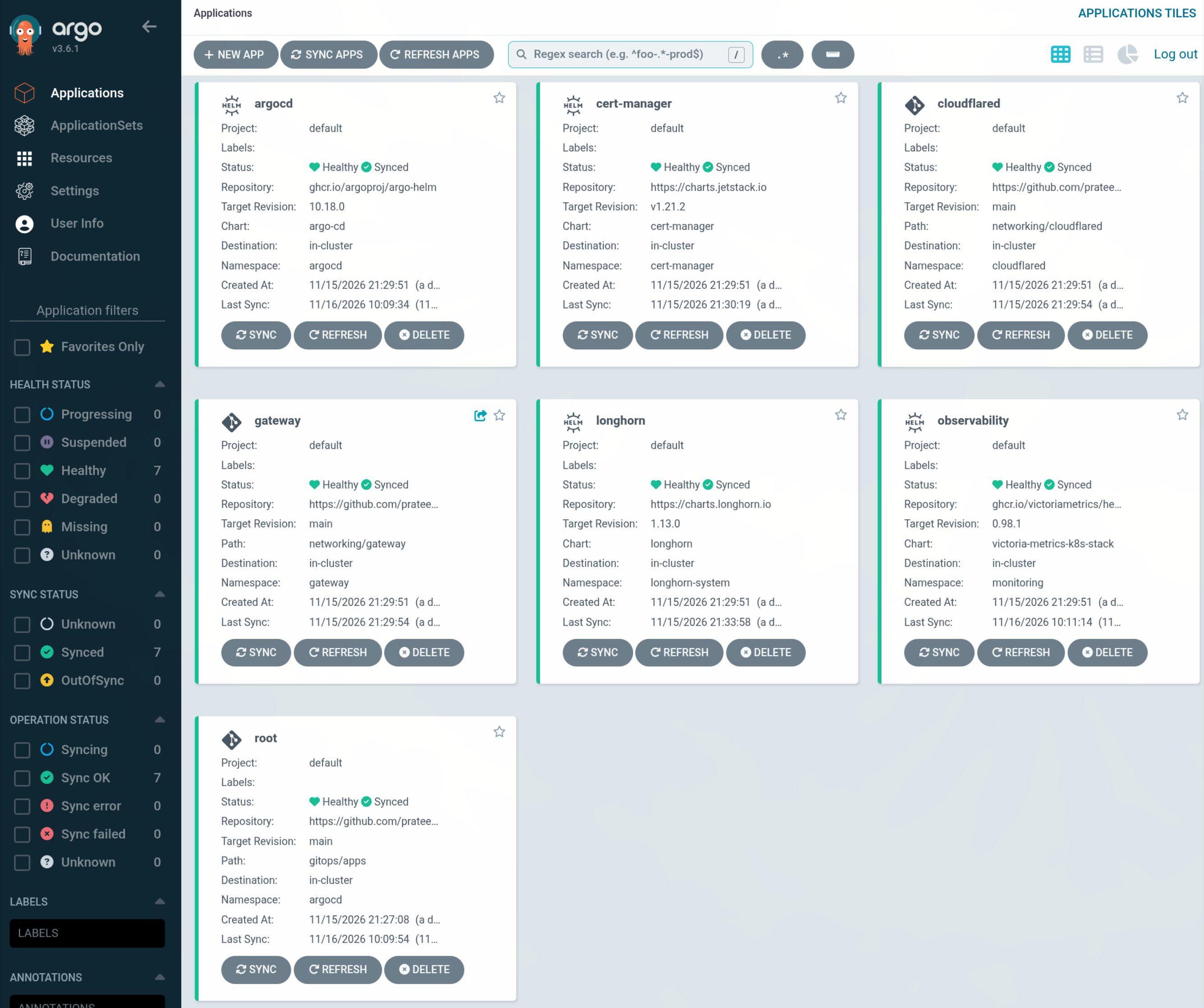
Moved my homelab to Argo CD

Post image
546 Upvotes

My homelab used to run on helm installs from my laptop, and the repo kept drifting from the cluster.

Now Argo CD syncs everything from Git. If you change something directly, it gets reverted. Nothing was reinstalled, it took over what was running.

A few things stay outside on purpose: Cilium, since Argo CD runs on its network, and Secrets, since the repo is public.

Repo: https://github.com/prateekjaindev/homelab

Detailed write-up: https://blog.prateekjain.dev/gitops-for-a-3-node-talos-kubernetes-homelab-with-argo-cd-336c076e93cc?source=friends_link&sk=ebda84ecdc3e2458fead2638374be51e


r/kubernetes • • 4d ago

Periodic Weekly: Show off your new tools and projects thread

2 Upvotes

Share any new Kubernetes tools, UIs, or related projects!