r/machinelearningnews • u/Retell • 3h ago
Tutorial A Beginner's Guide to Local AI with Inkling, Qwen, and Unsloth

6
Upvotes
r/machinelearningnews • u/ai-lover • 3d ago

Attackers now use AI agents to scan, plan and run intrusions at machine speed. That changes what a good response looks like.
1. The trend → CrowdStrike reported 1 AI-agent group targeting more than 200 organizations in 11 days. → Unit 42 found attacks moving about 4 times faster than a year earlier. → Wiz's tracker lists 16 AI platforms that disclosed incidents between October 4 and November 9.
2. The 4-pillar playbook → Detect and contain automatically: kill-switches and automatic token revocation. → Communicate fast, and securely: notify customers and partners in hours, over out-of-band channels. → Eradicate thoroughly: assume backdoors and bring in independent forensics. → Shrink the blast radius: Zero Trust and ephemeral design. Data never stored can't be stolen.
3. What it looks like in practice → Fireworks AI detected its October 24 event the same day and brought in Palo Alto Networks Unit 42. → Klue notified customers the same day it found misuse of OAuth tokens, then revoked access.
4. The shared part → Suppliers, platforms, vendors and customers each control part of the risk. → Deleting a key from a breached platform does not revoke it. Rotate at the source.
My take: no company can promise zero incidents. Every company can promise a fast, honest response.
Full analysis: https://www.marktechpost.com/2026/11/19/ai-security-incident-response-playbook-2026/
Fireworks data retention post: x.com/lqiao/article/2121434466082242896
r/machinelearningnews • u/ai-lover • 3d ago
AI agents look great in demos. Until real users break them.
Plurai built a world where your agent can fail, learn, and get fixed before your users ever see it.
→ Digital twin: Your real agent, its tools, and environment recreated from your code
→ Simulated users & tasks: Realistic users, tasks, and workflows that push your agent into the edge cases that matter
→ Auto evals: Check what your agent actually did, not just what it said
→ Verified fixes: Every failure comes with the run that exposed it and a fix you can verify
→ Replays: Turn any production failure into a simulation and replay it against every new version of your agent
All inside the coding agent you already use: Claude Code, Codex, or GitHub Copilot.
See where your agent breaks before production: simulation.plurai.ai/connect
r/machinelearningnews • u/Retell • 3h ago
r/machinelearningnews • u/ai-lover • 6h ago
NVIDIA released Alpamayo 2 Edge, an open reasoning vision-language-action model sized for onboard compute. It plans 6.4-second trajectories from surround cameras and writes causal explanations only when a scene needs them. Weights are OpenMDW-1.1, code is Apache 2.0.
What it does
<NOMINAL> tokens in routine driving instead of a full CoC traceKey numbers (self-reported by NVIDIA)
Full analysis: https://www.marktechpost.com/2026/11/22/nvidia-alpamayo-2-edge-2b-reasoning-vla-drive-thor/
Model: huggingface.co/nvidia/Alpamayo2-Edge
Repo: github.com/NVlabs/alpamayo2-edge
Technical details: developer.nvidia.com/blog/running-av-reasoning-models-within-onboard-compute-and-latency-limits/
You can check the deployment options and specs here through our GPULeaderboard.com chrome extension.
r/machinelearningnews • u/ai-lover • 1d ago

Thinking Machines released Inkling 2 Mini, a sparse MoE that loops its middle layers instead of adding parameters. It stores 24 layers and runs the middle 12 layers 3 times, for 48 layer passes per token. The checkpoint is ~20GB, Apache 2.0, with text and image input and up to 1M context. All Inkling benchmark numbers below are self-reported.
What it does
Key numbers (self-reported)
Full analysis: https://www.marktechpost.com/2026/11/21/thinking-machines-inkling-2-mini-looped-transformer/
Model: huggingface.co/thinkingmachines/Inkling-2-Mini
Model card: thinkingmachines.ai/model-card/inkling-2-mini
Technical details: thinkingmachines.ai/news/inkling-2-mini
r/machinelearningnews • u/OfficialCerebras • 1d ago
r/machinelearningnews • u/loucaspy • 2d ago
LeanScene is an open-source shot boundary detection model designed to run completely client-side in the browser or on consumer hardware with zero server uploads. At 1.6 MB (0.39M parameters) and 7.2M MACs/frame (115x fewer ops than TransNet V2), it outperforms TransNet V2 across standard shot detection benchmarks.
Uploading multi-gigabyte raw video files to cloud GPUs just to detect scene cuts creates latency and bandwidth bottlenecks for browser-based video editors, media asset managers, and dataset curation pipelines.
| Dataset | TransNet V2 | LeanScene |
|---|---|---|
| BBC Planet Earth | 96.1 | 97.4 |
| RAI | 92.6 | 93.7 |
| ClipShots | 77.7 | 79.1 |
Scaling the 2D encoder up to 4x wider barely changed accuracy. Most of the gains came from mining the model's false alarms on real footage and masking out high-confidence predictions so unannotated transitions weren't penalized as negatives.
r/machinelearningnews • u/ai-lover • 2d ago

RadixArk released DaisyRose-27B, its first open-weight model. It is Qwen3.8-27B post-trained with reinforcement learning only, no SFT or distillation, under Apache 2.0. Training used about 1,200 curated agentic tasks, 144 H200s and 18 days on RadixArk's open-source Miles RL framework.
What it does
Key numbers (self-reported)
Full analysis: https://www.marktechpost.com/2026/11/20/radixark-daisyrose-27b-agentic-model/
Model: huggingface.co/RadixArk/DaisyRose-27B
r/machinelearningnews • u/ai-lover • 2d ago

NVIDIA released Nemotron-Labs-Sigma, a set of 14 open checkpoints at 3B and 8B. Unlike LLaDA, Dream or NVIDIA's own Nemotron-Labs-Diffusion, Sigma does not diffuse over discrete tokens. It adds Gaussian noise to learned 16-D token embeddings and denoises them block by block. The paper argues the smooth trajectories make few-step distillation and steering easier.
What it does
Key numbers (self-reported by NVIDIA)
Full analysis: https://www.marktechpost.com/2026/11/20/nvidia-nemotron-labs-sigma-continuous-diffusion-language-model/
Models: huggingface.co/collections/nvidia/nemotron-labs-sigma
Paper: arxiv.org/abs/2610.02665
r/machinelearningnews • u/evol_daed • 3d ago
https://softperceptron.com/vram-calculator
I built this to answer "will this model run on my card, and how fast?" without downloading 40 GB first.
Pick a model, quantization, context length and GPU. It shows whether it fits, how many cards you need, an estimated tokens/sec, and the longest context that fits. You can also enter any Hugging Face model.
Everything is computed from the model's published architecture (layers, KV heads, head dim) and the card's memory and bandwidth. They are estimates, not benchmarks, and the formulas are written out on the page. The speed estimate is memory-bandwidth-bound decode; I checked it against llama.cpp's published gpt-oss 20B numbers and it lands within about 25%.
No login, no ads. I'd like to hear where the estimates are wrong for your hardware.
r/machinelearningnews • u/OfficialCerebras • 3d ago
r/machinelearningnews • u/ai2_official • 3d ago
r/machinelearningnews • u/ai-lover • 3d ago
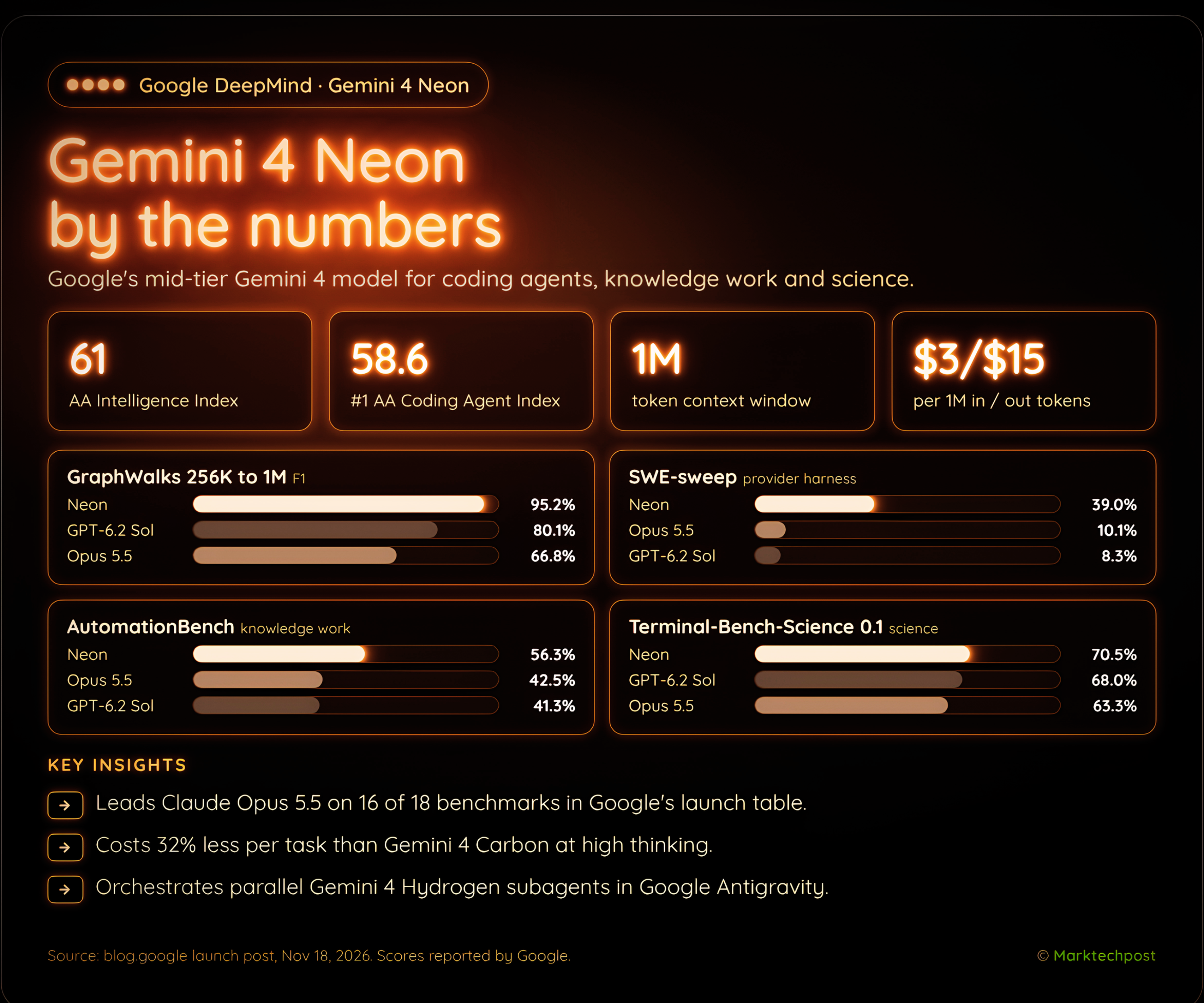
Google DeepMind released Gemini 4 Neon on November 18, 2026. It sits between Gemini 4 Carbon and Gemini 4 Hydrogen and targets coding agents, knowledge work and science workflows. Pricing is $3/$15 per 1M input/output tokens. Weights are closed and the parameter count is not disclosed.
What it does
Key numbers (self-reported by Google)
Full analysis: https://www.marktechpost.com/2026/11/18/google-gemini-4-neon-release/
Technical details blog.google/innovation-and-ai/models-and-research/gemini-models/introducing-gemini-4-neon/
Model card: storage.googleapis.com/deepmind-media/Model-Cards/Gemini-4-Neon-Model-Card.pdf
Try it: aistudio.google.com
r/machinelearningnews • u/ai-lover • 3d ago

Nutrient AI has a Data Extraction API that parses PDFs, scans, images and Office files into spatial JSON or Markdown, and maps fields onto your JSON schema. Each extracted value carries a page, bounding box and match label, plus a composite confidence score when the engine provides one. It ships with Studio (a browser workspace for testing), a hosted MCP server, a coding-agent skill and an SDK.
What it does
Key numbers
Full analysis: https://www.marktechpost.com/2026/11/18/nutrient-data-extraction-api-citations-confidence/
API: nutrient.io/api/data-extraction-api
Studio: dashboard.nutrient.io/data-extraction-api/studio
Benchmark: nutrient.io/benchmarks/parse
r/machinelearningnews • u/FishermanResident349 • 4d ago

r/machinelearningnews • u/ai-lover • 4d ago

Hugging Face's harness-hub team released a rank-32 LoRA adapter for Qwen3.8-27B, trained with reinforcement learning inside the pi coding agent. It is Apache-2.0 and ships with a GGUF adapter. Numbers below are self-reported on the model card.
What it does
Key numbers (pi harness, thinking off, 1 attempt per task)
Full analysis: https://www.marktechpost.com/2026/11/18/hugging-face-qwen3-8-27b-pi-adapted-lora/
Model: huggingface.co/harness-hub/Qwen3.8-27B-pi-adapted
Blog: huggingface.co/blog/harness-hub/harness-adapters
Repo: github.com/huggingface/trl/tree/main/examples/async_grpo_harbor
r/machinelearningnews • u/ai2_official • 4d ago
r/machinelearningnews • u/ScarKey6332 • 4d ago

This recorded evaluation gives AntLing's Ling-3.0-flash-Sante a complete synthetic patient history: 334 visits over 71 years, totaling 130,993 input tokens in one request. The task is to list current medications, allergies and active disorders with dates, scored against an answer key built from the same generated data.
The reported result is 7/7 allergies, 8/10 disorders, 2/7 dental codes and 2/5 medications. The returned active lists keep stopped items out. One recovered medication began in 1954 and was never stopped, with its evidence at line 108 of 2,728. A different medication was restarted in 1966; the key also contains three medications restarted on the final visit date.
The run uses official FP8 across two DGX Spark machines with MTP enabled. Reading the input takes 61 seconds, followed by about 30,865 thinking tokens over roughly eleven minutes.
For a similar evaluation, keep the category denominators and date rules beside the latency readings. This case makes both the retrieved facts and the remaining target entries inspectable.
r/machinelearningnews • u/ai-lover • 5d ago
A lot of teams treat "zero data retention" (ZDR) as a vendor-wide label. It isn't. It belongs to specific endpoints, and it depends on which of 2 standard API designs you use. This explainer walks through the framework Fireworks AI CEO Lin Qiao laid out, with examples from public API docs.
What it does
Key numbers (from vendor docs)
Full analysis: https://www.marktechpost.com/2026/11/17/zero-data-retention-ai-apis-explained/
r/machinelearningnews • u/OfficialCerebras • 5d ago

r/machinelearningnews • u/ALexiosK11 • 5d ago
started this as a personal project to read massive textbooks and web novels, and it turned into a war with hardware limits.
my setup is a windows laptop with 16GB RAM and a 4GB RTX 3050. no cloud, no "just throw more vram at it." the stack is tauri (rust) shell, nodejs orchestrator, and a python sidecar for pytorch models (bge-m3, bge reranker, kokoro tts).

here are the three walls i hit:
unbounded async ingestion spiked node.js memory to 14.6GB on a 16GB machine. i fixed it by implementing a strict sequential await barrier (f65) that streams chunk-by-chunk. peak ram dropped to ~296MB for a 508,000-word book (5.9 min processing).
2. 4gb vram musical chairs
loading bge-m3 in fp32 ate ~3.9GB of vram, leaving zero room for the reranker or tts. switched to fp16 (~1.1GB) and wrote an idle ttl eviction manager (f43) that reclaims ~3.2GB of vram when models sit unused.
3. silent speakers
even after bundling the python sidecar into tauri, webview2 blocked tts audio playback. had to share a single user-gesture-unlocked audiocontext between ui sounds and narration to fix it.
also learned that a clickable citation makes a sentence inspectable, but it doesn't magically prove the llm is right. compression ratios vary (3.6:1 to 5:1 in my samples), so the human still has to be the judge.
it's open source (agpl-3.0) with a windows installer. works with ollama, lm studio, or byok endpoints to keep everything local.
code and builds here if anyone wants to dig into the architecture or roast it:
https://github.com/ayumu-ml/Omnitome
happy to answer questions about the retrieval setup or squeezing multiple models onto a 4gb gpu.
r/machinelearningnews • u/phenex_agi • 5d ago

I measured what happens to GPU energy when AI agents' KV caches are evicted during tool calls: one H200 NVL, vLLM and SGLang, Qwen3-32B / 30B-A3B / 8B, synthetic agent sessions, recorded SWE-agent trajectories, a replay of Kimi's production tool-agent trace (Mooncake) and BFCL v4. Every prediction was pre-registered before its run.
Findings:
- Hits don't degrade gradually. Past ~1.2-2.2x working set over cache they collapse, and energy per turn ends up within 0.01-1.6% of running with no cache. Qwen3-32B, ~27k-token sessions: 8 sessions kept 88% of prompt tokens cached, 16 kept ~0%.
- Restoring a prompt's KV from host memory costs ~1/110-1/220 of the above-idle GPU energy of recomputing it.
- On the overloaded production replay, a 160 GB host tier took finished requests from 85-86% to 100%, with 16-18% more prompt tokens for about the same energy. At a lighter load it saved under 1%.
- BFCL: accuracy with and without the cache differed by 3 of 400 tasks; the cache doubled correct answers per kWh.
Limits: one GPU type, GPU board energy only (NVML), single node.
Feedback on the method is very welcome.
r/machinelearningnews • u/ai-lover • 5d ago

NVIDIA released 2 Apache 2.0 projects in public preview. NVKE is a management plane that lets a GPU cloud run a managed Kubernetes service on its own hardware. NVKR builds and signs the node images, container images and Helm charts those clusters use. NVKE has no runtime dependency on NVKR.
What it does
Key numbers (self-reported by NVIDIA)
Full analysis: https://www.marktechpost.com/2026/11/17/nvidia-nvke-nvkr-managed-kubernetes-gpu/
NVKE: github.com/dsx-ai-factory/nvke
NVKR: github.com/dsx-ai-factory/nvkr
Docs: docs.nvidia.com/nvke
r/machinelearningnews • u/ai-lover • 5d ago

Liquid AI released d1.2 and d1.2-ultra on November 16, 2026. They are decision models: instead of generating text, they return a probability for every option in 1 call, so only input tokens are billed. The new versions accept text, images and audio and add 5 typed answer formats.
What it does
Key numbers
Full analysis: https://marktechpost.com/2026/11/17/liquid-ai-d1-2-omnimodal-decision-models/
Blog: http://liquid.ai/blog/d1-2
Docs: http://docs.liquid.ai/lfm/models/d1
Index: http://artificialanalysis.ai/evaluations/artificial-analysis-decision-index