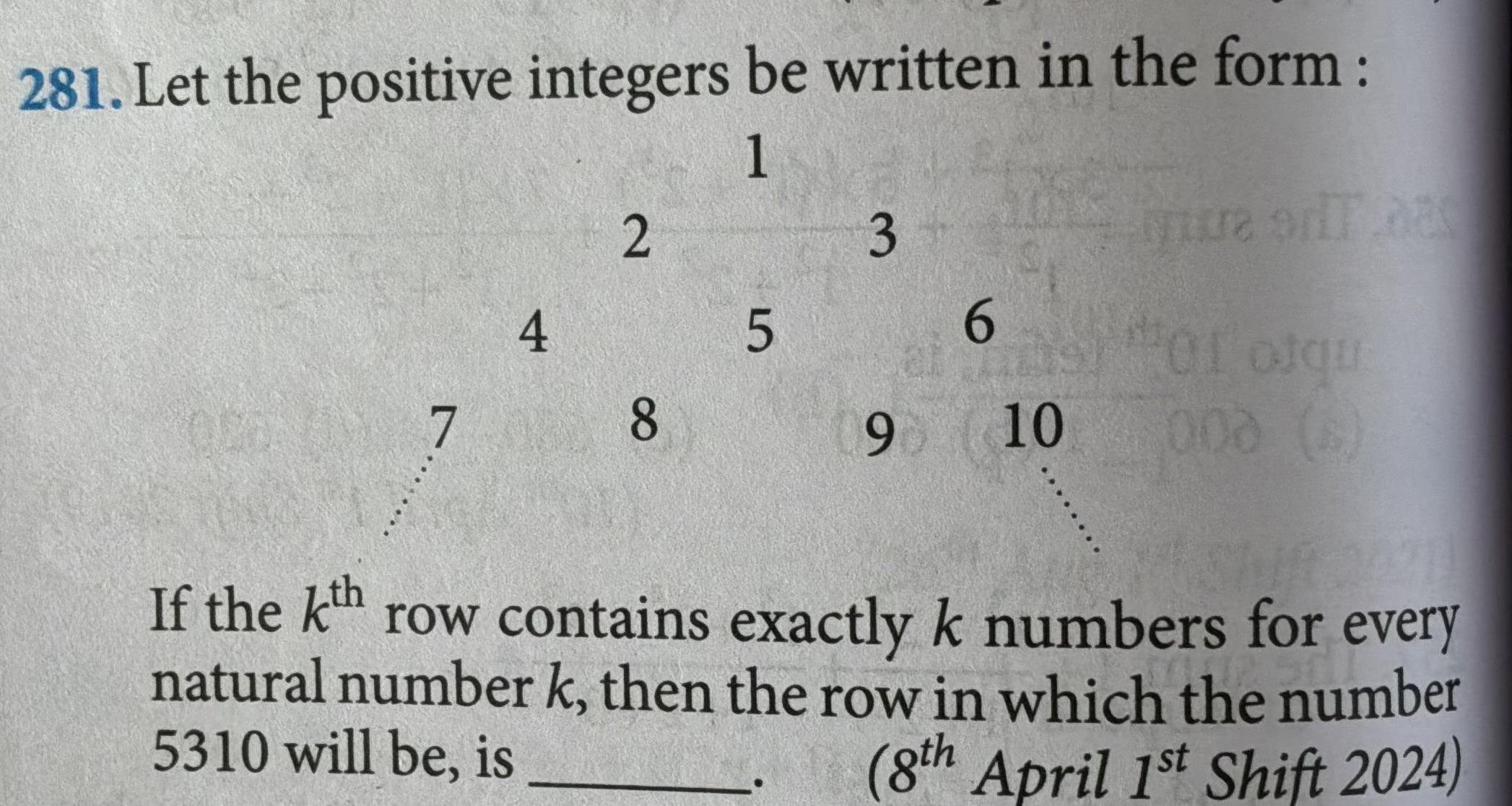
Try making lower limit and upper limit for each row as a function of its row number. Approximate the function as just n² and find n. Now, check for the nearby values for the correct answer.
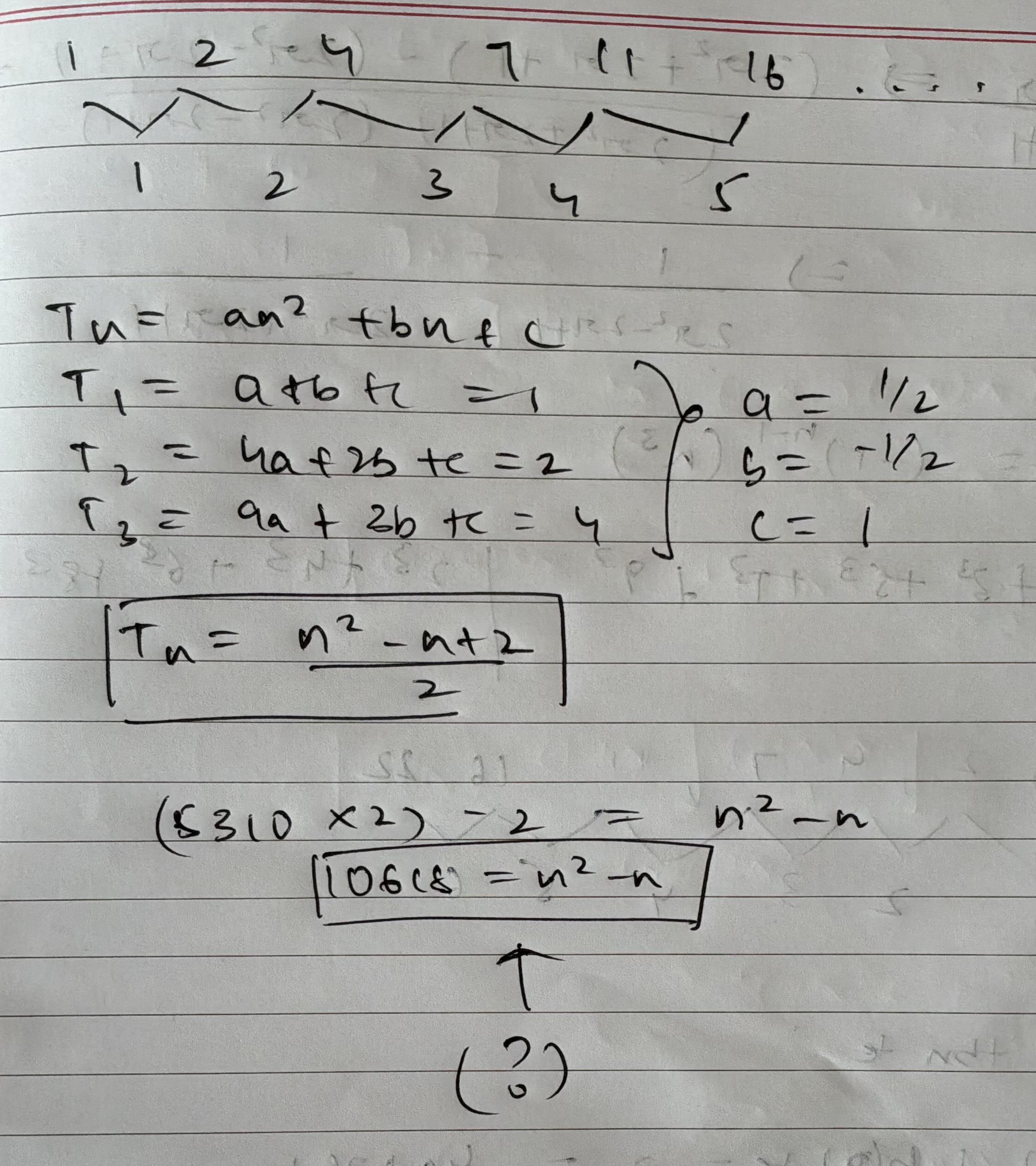
make 2 agp series i.e. of 1,2,4,7 etc. and 1,3,6,10 etc. and find it’s common term and then you will find that of the series no. 103 5310 lies between both
Realizing the pattern of last digits in every row gives n × (n + 1)/2, where n is the respective row number.
If the element lies at the start of any row (Hint : If after solving the quadratic equation, the value of n comes out to be a decimal, then the number surely doesn't lie at the last position of any row), then solve n × (n + 1)/2 = that number, and whatever is the positive value of n, add a 1 to its integer part that will be the row number for that element.
Example for 7 lying in the first position of row 4, just solve
1
u/Anonymous1415926 21d ago
Try making lower limit and upper limit for each row as a function of its row number. Approximate the function as just n² and find n. Now, check for the nearby values for the correct answer.
Can't think of any other shortcut
1
u/Anshmungra_58 9d ago
make 2 agp series i.e. of 1,2,4,7 etc. and 1,3,6,10 etc. and find it’s common term and then you will find that of the series no. 103 5310 lies between both
0
u/Pretty_Section_5835 21d ago edited 21d ago
Easiest method :
Realizing the pattern of last digits in every row gives n × (n + 1)/2, where n is the respective row number.
If the element lies at the start of any row (Hint : If after solving the quadratic equation, the value of n comes out to be a decimal, then the number surely doesn't lie at the last position of any row), then solve n × (n + 1)/2 = that number, and whatever is the positive value of n, add a 1 to its integer part that will be the row number for that element.
Example for 7 lying in the first position of row 4, just solve
n × (n + 1)/2 = 7
So, n² + n - 14 = 0
Solving this gives,
n = 3.27 (positive value)
Then row number
= Integer part of 3.27 + 1
= 3 + 1
= 4
Then,
n × (n + 1)/2 = 5310
n² + n - 10620 = 0
Solving this gives the positive value of n to be,
n = 102.55
Therefore,
Row number of 5310
= Integer part of 102.55 + 1
= 102 + 1
= 103 ✌️👍😊