This sounds like a joke but we will have to develop new tools to check vulnerabilities in the software that we use to verify proofs. If we're gonna work with mathematical proofs that are too big for humans to handle, we're gonna need to be able to tell whether something got actually proved or whether the AI found a crack in the software.
we should never consider something is 100% epistemologically authoritative, new tools will follow, but if we get stuck on current LLMs and current version of lean, and disregard skeptical investigation, those tools will never arrive, and not only we as humans will be conditioned to not learn, also we will stagnate on tools that are not correct.
250 k being too long to read shouldnt be a reason for us to abandon human investigation
250k today, 4M tomorrow. the fact is that LLMs will produce proofs faster than we can humanly verify them. Maybe it'll be in 4month or 10 years but we will have to accept eventually that mathematics are getting too complicated for the human brain to catch up. the amount of work it would take to manually verify those will only grow.
The problem is at that point automatons will stagnate as well, they will find all the possuble optimizations allowed by the symbol set we have provided during their inception at their best, at the best case scenerio.
Like technically there are 10000000 m pages of correct statements out there that means something.
Like agents can provide a lean compilible statement of lenght 10000000 m lines if it fits in the ram, page files.
You can argue you may even solve non existent frontier problems because now you have a hyper accelerated way of generating statements
At one point it throughly becomes motion without any intent
And like since we are so removed from everthing then, we cant even recognize emergent bugs.
We will absolutely use AI to form new hypothesis and discover new frontier problems. I don't see a future where we keep understanding the evolution of mathematics. Software is getting perfomant enough to develop the field further than we can. The only "proof" we will have that Math 2.0 makes any kind of sense is if it is used in practical applications.
My understanding is that the proof theoretic power of Lean is equal to ZFC + axioms of the form “there are n inaccessible cardinals” for each n, and the “my axioms” functionality can’t fundamentally remove hidden reliance on that proof power in the kernel. This is only based on what I’ve heard so am open to being corrected based on a misunderstanding.
But there is a theoretical point that moght seem trivial but really goes to the heart of what a lot of the debate is if you ask me:
No theory can prove that the existence of a proof of a statement in that theory means the conclusion is true. This is Löb’s theorem. The theory itself must always examine the proof on an individual basis to be persuaded.
It is not an exaggeration, I don’t think, to say that by the same token we must examine the proof ourselves to be satisfied as to the individual proof, because “a proof of the claim exists,” “the claim is true” and “[this expressly given thing containing real extractible computational content] is a proof” are three different claims that are not logically equivalent. This literally goes to heart if the difference between knowing that something is true, having evidence it is true, and understanding why it is true.
Maybe this is a silly question but forgive me, I don't understand LEAN or computer science. Are we proving the Riehman Hypothesis or are we proving that a proof of the Riehman Hypothesis has to exist?
From what I’ve heard, Claude has proved the Riemann hypothesis, and it’s proof has been verified to have the correct inputs, the correct outputs, and no obviously wrong math in it. It could have possibly abused a bug in the lean kernel, but otherwise, the proof is solid. Now the task is to go through the lines of code to 1) verify it did not abuse bugs, and more importantly 2) understand how it proved the Riemann hypothesis.
Yeah but they have used multiple kernels independent of each other to check if the proof compiles or not. So it's very unlikely that the lean code exploits vulnerabilities of all these different kernels
Or there could be a common bug/logical misstep within the system. I think it's unlikely, but at millions of lines there's a lot of chances for failure.
At least one of the kernels itself has been formally verified to be correct.
The systems that check it would have had to have bugs, allowed a bug through, and then AI discovered the bug the first bug let through and been able to exploit it for this proof
I was actually arguing with my friend who works in infosec the other day, that it should be possible to make exploit free code. He was telling me it's impossible. If it can be formally verified as such that's pretty interesting.
Making exploit free code is a much harder problem than making correct code.
For instance, anyone can write a program that verifies if two strings are equal, to see for instance if a passed string is equal to a secret string. With learning a bit of theory, it is very easy to than write a proof that the program is correct, that it only returns true if the 2 strings are equal, and false otherwise. A little more theory, and you can prove that the program also terminates for all inputs. That's good and all. But then you find out that your provably correct program is actually exploitable. See, if you return false as soon as you find a letter that doesn't match, you are vulnerable to a timing side channel attack.
You could then create a new version of it that is immune to that too. But that's the thing with exploits, we don't actually have a formal definition of what an exploit free code in general even is.
Does the fact (assuming that is the case) that it compiles mean that there is anything mathematically interesting in the proof or does that just mean that the proof is "grammatically" correct?
There is something called curry howard isomorphism that basically translates a proof as a computer program. Think of theorems as functions in a typical programing language. If you code a theorem , you also generate a fix type of output which can only be the proof of the theorem as a data structure. When I say it compiles, it means it gives the correct type of output which is the type of proof of the theorem.
If your TI-82 is a "calculator for numbers" as in it computes "1 + 1" should result in an output of "2"....
...then Lean is a "calculator of truth statements". If you are given statements "A is true" and "if A is true, then B is true", then it is always the case that "B is true" because there are deterministic logic rules to essentially "calculate" a correct conclusion from your starting facts.
Mathematicians do these calculations manually when checking the validity of proofs, but Lean automates it as a non-AI deterministic software.
What Claude did is essentially generate a bunch of button presses on the Lean "calculator" corresponding to a proof for the Riemann Hypothesis and the calculator spat verified that the button presses forms a valid logical argument, thereby certifying that the proof is correct and RH is true.
The only way for Lean to be wrong here is if the humans who built Lean made a mistake somewhere in its implementation, so it does the equivalent of "2 + 2 = 5" for logical statements. This has already happened recently, but you can't really guarantee it won't happen again because humans (and LLMs honestly) obviously make mistakes from time to time. For now, we don't know of any bugs and it seems Lean's certification is trustworthy.
Something I saw (and maybe I simply misunderstood it) seemed to hint that what Claude has done was to calculate Chebyshev's binomial coefficient or calculate something better than that. Which is what you would expect from a big, fast computer. It was able to complete a proof that humans were incapable of completing because we can't do those kinds of calculations or do enough of in order to find the necessary result.
logical protestability is, imho, basis of all mathematical knowledge, when you black boxify it by essentially including in your proof 'i plugged it in X amount of machines and the result was the same' it is no longer formal proof that can be protested by logic alone, it now becomes an experiment in living world.
this cannot be a formal proof. The math folk got comfortable with autoformalization for a couple or two years now, and should start questioning what the hell is going on.
you're technically right but by that standard no formal proof of anything is accessible to you at all, it's always some empirical experiment.
it's desirable to convert those LLM proofs to real human understanding. it's a very legitimate concern that even once that is done, the result will be lesser than what the naturally developed human theory would've given us in due course. but trying to pretend that it's not even a correct formal proof is almost pure unadulterated cope.
and by the way, don't be so quick to assume that the proof won't be converted to a formulation that's fully comprehensible to experts in the near future.(though I can't predict that with confidence and must disclaim some technical subject matter ignorance)
im rather ok with empirical experiments, if skepticism allowed im not okay with trying to convince each other we have hit the end of the road
in case of lean its not a formal proof because we are not relying on a formal theory, we are literally relying on a language that is based on that theory implemented on some compiler on some hardware
this is why it should never be considered a formal proof, a very convincing argument, not a formal proof
"absolute epistemic authority" doesn’t exist in reality (unless you’re religious, I guess). Just like Lean could theorotically have unknown kernel bug that make it erroenously claim that Riemann hypothesis has been solved by Claude slop output, it’s equally true that every (of relatively very few people) who read and understood and verified Andrew Wiles Fermat's Last Theorem proof could have made same error when verifying it abd that’s it’s actually false.
Both are absolutely possible but we don’t get 100% certainty in anything in reality so we have to play odds. So far I’d put 97% chance that Claude slop has actually proven Riemann hypothesis, as strange and depressing as it is. Obviously full 99.9% confirmation will take some years to arrive.
then why are we arguing here 'no other epistemic agent is needed it compiled so its done'
>who read and understood and verified Andrew Wiles Fermat's Last Theorem proof could have made same error when verifying it abd that’s it’s actually false.
like I said that's technically correct in the same sense that you could say categorically that no formal proof can exist in reality at all because it's some abstract idealisation that cannot be perfectly implemented in reality and certainly can't be implemented in such a way that we have perfect knowledge of its infallibility.
there is in fact no more reliable way to ever implement a long formal proof in reality than on a computer. it can still fail to be reliable (what if someone hacked your computer? what if you're having a hallucination and what you think you're seeing on the computer screen isn't even what you're really seeing? what if you're wrong about the fundamental physics that underlies the operation of the hardware in a way that's now become relevant for the first time?)
there's an argument to be had about how strong the guarantee provided is / how reasonable these failure scenarios are, and how that compares to traditional proofs (which don't pertain to be nowhere nearly as formal, and are accepted on the basis of a psychological felt sense of understanding by the fallible human reviewers)
personally, what I care about most in math is the psychological felt sense of understanding anyway. most of the time you're outsourcing it to another person for most of the corpus of human math, which is why I care about exposition of even human results. but if you're claiming such proofs are in principle not valid and can't transcend traditional proofs in the strength of the guarantee they provide, you're just coping.
The most problematic part of your argument is the assertion that running a proof through Lean is essentially an empirical experiment repeated across multiple machines.
Lean doesn’t simply evaluate whether a mathematical statement appears to be true: it constructs an explicit proof object within a foundational logical system (dependent type theory).
You seem to demand that mathematical knowledge be contestable through logic alone. But a Lean proof satisfies precisely that requirement: one can challenge its axioms, definitions, inference rules, formalization or individual derivation steps.
Also, your logic can be turned against traditional maths, and it holds. Under your reasoning, we should object that:
Human brains are physical systems susceptible to malfunction.
Human reasoning is susceptible to cognitive biases as reading mathematical symbols relies on sensory perception.
Multiple mathematicians agreeing doesn’t guarantee that they are correct.
Errors could exist in previously established theorems on which the proof relies.
It is about trust. I trust experts. I do not trust LLM's, for I have seen and experienced their bullshit. It is also hard to trust 17 million lines of proof have been verified in less than a day by others. Furthermore, 17 million lines of anything reeks of bullshit.
If this is all good and true I have no issues. But if people claim it is true with this much certainty it is correct and it turns out is not. Oof, I am not sure the trust in these experts will really be recoverable.
For now I will trust it, because the math experts are all telling me this is legit. I will do so in the future as well. They can use LLM'S, but it is going to be the experts I trust.
I am just saying that if this turns out to be not true. It is going to take a whole lot to earn that trust back due to the certainty projected here.
True but the difference is a human readable proof is mostly feasibly accesible to any human, which allows protest and discussion, there is now an epistemic gap.
Like the answer to every question exists in nature in its most correct form, this has no use to us mostly because if epistemic gap between us and nature.
Our relation with automated systems start to resemble our relation with nature, which begs the question: is this knowledge.
go read anything that is beyond a second year's purview in undergrad and youll realise that most people cant even read a single page of it
higher studies in any field requires a shit ton of pre reqs that most people take for granted because it has become as mundane as the alphabet for them
Yeah but if lean was proven (in a human readable way) to only compile with correct proofs, why would it not be enough?
If you prove that something correctly identifies if a shape is a triangle then you can say about any shape identified by that object as a triangle that it is indeed a triangle. Your human readable proof for the riemann hypothesis is that: “There is something you can write into lean (with using just standard axioms) for it to accept it as proven.” That feels human readable to me.
Bcoz you are not using an abstract automata hanging in ideal space thats why there are 20+ kernels
AND type theory basis of lean is out of date as of lean 4, which means "it compiles at lean" cant be accepted as a formal argument anymore(even if it was not out of date rerurn back to previous point, you are ultimately heuristicaly accepting the broof through multiple kernels, not formaly)
" the oracle accepts the sequence of symbols therefore true" presents 0 knowledge about the matter.
I think the problem is that the reason why we were looking for a proof of the Riemann Hypothesis was because of the mathematical techniques that would be needed to be invented.
The AI probably did invent those techniques, but we as humans can't use them
I’m replying to u/Dyspchordia ‘s “lean verification cannot ever be a formal reason to accept proof” otherwise yes I agree with you. Although I wouldn’t say “we as humans can’t use them” the proof is out for less than a week, it’s still too early to say that mathematicians won’t be able to extract a lot of valuable information and extract those techniques from it.
I DONT GET IT. Has the proof not been verified by lean? i’m definitely using terms wrong but hasn’t the riemann hypothesis been formalized in lean a while back (a formalization with essentially unanimous agreement), so we know a) the proof is logically sound, and b) is actually answering the question. So the only room for it being fake is a bug in multiple kernels of lean being exploited by claude? I really hate it and wish it couldn’t solve riemann hypothesis but it seems to quite obviously have done so
The entire hypothesis has been basically guaranteed to be true for the last 150 years. The point of a proof is to eliminate all doubt. To rigorously define something as being true.
There is no such thing as "probably proved it". Or "almost guaranteed to be proved". Something being proved is binary, it has or has not be proved.
Ehhhh. I don't know by heart every proof of every theorem in existence. Some theorems have indeed been proved even if I personally don't have the knowledge to understand or personally verify the proof. I just have to trust the mathematicians who have the requisite knowledge are *probably* correct that the proof is valid.
Proofs don't eliminate doubt for everyone; they eliminate doubt for those who can understand and follow them. No one is yet in a position to entirely understand or follow this proof. But that doesn't mean it's not a valid proof.
There's a difference between being told to trust something that someone else knows. You could learn it too, but don't spend the time because the sum of human knowledge is too great to know everything.
Vs. Being asked to trust something that nobody understands or can read.
I mean, I think we're kind of in uncharted territory so I understand where the skepticism is coming from.
Lean has never been this load bearing for something so important. And it's hard to prove something doesn't have exploits/errors so I think that's why people are being cautious with it, especially because AI proofs have exploited it before
I'm sure more people than ever are going to be stress testing it now though
Notably — after the first incident was identified, researchers used AI and tasked it to prove (different flavors of)“False” in lean. You can’t prove False; obviously, so if you do, it’s a bug. Not counting the incident that brought it to their attention, The researchers WANTED the AI to find the bugs and cheat, SPECIFICALLY so the Lean community/researchers could patch them.
So the AIs went and found a few bugs in Lean, iirc there was some counter overflow somewhere and a library vulnerability somewhere else. Maybe a few more that I’m not remembering
No, you have to prove there are no bugs in the trusted core. Lean has a fairly large core compared to other, better systems, and it's kind of annoying that mathematicans happened to adopt Lean rather than one of the systems with a tiny trusted core, but sooner or later someone is going to implement a Lean checker in CakeML or some similar good system.
The proof compiles against four different lean kernels written in different programming languages, one of which was verified in lean. It is basically the same kind of reaction as assuming that AI proved that ZFC is inconsistent
You forgot proving that ZFC with Grothendieck Universes as stated in textbooks is inconsistent, since that's about as difficult as proving Lean inconsistent
The skepticism is warratned but it's been tested against multiple lean implementations now. I'm not going to say it's impossible that there's some issue in all kernels, but it seems increasingly likely that this proof is legitimate.
I'm sure everyone is trying to break it with everything they have right now
I would say the actual question is "if an AI as capable as the one in question is used, is it more likely to solve the riemann hypothesis or find an exploit in lean if it's tasked to solve the riemann hypothesis?"
Proving False is a contradiction, but proving something that isn't actually provable wouldn't necessarily lead to a contradiction. Researchers can apply normal techniques to find bugs in the implementation of Lean, but it might need a completely different approach to find subtle flaws or inconsistencies in the ontology.
Sure, proving False as the stated or incited goal is not guaranteed to be the most efficient or comprehensive way to identify bugs in the implementation. I'm just retelling the story of how certain bugs that were identified were found, because I thought it was interesting that AI agents were tasked with proving something unprovable using Lean. It's a little bit ironic, but I find it an elegant way to improve a system meant to strictly evaluate proof assembly.
But there's a bit of a sleight of hand when talking about those examples. People make it seem like AIs were prompted to solve a math problem, found a vulnerability, and then actively exploited it. What actually happened was that humans told AI to try to find exploits and, well, exploited them. And I don't think anyone realistically thinks Alpoge did that.
The less sensational but still accurate different stories were when AI left "sorry" statements in the middle of the code, so the proofs were unfinished.
Now, could AI actively try to find exploits by itself for the purpose of solving GRH? Maybe. But we don't have good evidence this happened in the past, so we shouldn't suspect this as a high probability suspicion in my eyes.
Weren't we told that AI independently chose to break out of its sandbox and hack into another company just to try and do better at a benchmark? Doesn't seem remotely out of the realm of possibility for an AI working on a famously tough problem for an unfathomable length of time to throw an exploit into the middle of its incomprehensibly long proof
For one, you should read the incident report on the hugging face event. The models they were testing had their safeguards toned down or removed and their task was essentially "hack stuff in your sandbox to answer these questions". The unnerving part was that the ais saw evidence that they were on the real hugging face and rationalised it away.
You're now talking about a completely different instance where there were like 1200 agents, whose problem framing was again to persistently find exploits and software vulnerabilities and had their cybersecurity guardrails and refusal classifies turned off. Granted, the people in charge didn't actively say "break out of the sandbox", but again the whole approach and no guardrails was nothing like what we'd expect a mathematician to run.
And saying "another model/agent did it so we've already some evidence even if the scenario is completely different" is as vacuous a statement as saying "Ted Bundy exists, so maybe my mother could be a serial rapist and murderer of 30 young women". I mean yes, the statement is technically true, but adds nothing in terms of evidence that would move the needle of probability for this being the case above very close to 0%.
I mean I imagine generating this proof almost certainly required orders of magnitude more agents and computational power than solving some random benchmark. It's true that it wasn't explicitly told to find vulnerabilities here but if an agent was told to 'find a proof for this that compiles in lean' then 'find a novel bug in Lean and exploit it in order to generate a proof' would be a valid approach (and may well be a lot easier than solving GRH, given that GRH has never previously been solved while bugs have been found in Lean). Reward hacking along those lines is something AI frequently engages in.
since basically layered agent swarm uses LEAN as oracle, regular proof generation very likely cant find a bug, because lean is 100% authoritative tool for agents
latent spaces of LLMs themselves are not really that much math aware, the agent and tool use revolution opened the pandorax box, both for coding and maths, we are dealing with the same ai that runs bot influencer accounts in instagram.
you need to run some other agent to bombard it with inputs with known outputs to find bugs
That's literally how formal logic works. You start from the minimal set of assumed axioms that define the rules and then only use those rules to prove everything else.
The proof has been checked in multiple independent kernels (proof checkers) including the paranoid kernel, which is meant to be extremely small and strongly audited.
Any bug in Lean can be relatively confidently ruled out.
Wasn't there a whole todo like a year ago about Lean being flawed and allowing certain untrue things to be proved? I know they fixed those specific errors, but I'm not confident there aren't others.
yeahhhh i think this is true, especially with a human proof of this sheer magnitude. Like if they couldn’t explain it I atleast would be doubtful of its validity
My doubt primarily lied in a suspicion that it would be easier for a generative model to trick LEAN at the source code level to have it state that it was correct and complete. If LEAN inputs/outputs have been verified by humans then I will hold the proof in the same skepticism I hold any other human/non-human verified proof. Namely- I will hesitantly accept the outcome of the proof with the knowledge that it may be shown to have an error later
I am not here to argue that it hasn’t been solved, but just statistically speaking “AI exploits a bug in verification language specification” is much more likely than “solves 200 year old problem”
I think the proof is likely correct, but I also think we don’t do ourselves any favors by pretending that it is somehow incontrovertible.
You can’t just say ‘statistically speaking’ and then say your opinion as if somehow the word ‘statistically’ makes it objective, lmao. How exactly are you able to quantify the statistical frequency of the abilities of a frontier AI model?
How many bugs have been found in software by AI versus how many hundred year old mathematical problems. You’re right that I don’t have the exact numbers at hand, but I mean ballpark, let’s say tens to hundreds of thousands vs. less than ten?
That’s not how probability works. You’re p-hacking to pretend that your opinion is objective. It’s entirely arbitrary to decide that it has to be hundred year old math problems only versus every type of software bug found by AI ever. I can do the exact same thing. How many times has AI solved a Millenium Challenge problem versus how many times has AI released a fake proof of the Riemann hypothesis? One versus zero as far as I can tell. So actually, statistically, it’s more likely that AI solved another Millennium Challenge. Whether or not AI proved the Riemann hypothesis is not some coin flip. It’s a single, discrete, testable outcome, and every relevant authority or person who actually understands what happened and what was released is saying that’s what happened. Making up some statistical argument provides zero information here.
Why are you so pressed over this? I said right up front that I believed it was probably a valid solution. But assuming that an AI isn’t capable of reward hacking is straight up stupid.
I’m actually wondering the same thing, whether you all understand AI so incorrectly that you believe the chances of some exploit are zero because it solved some other problem correctly.
Phrase the “statistically speaking” part however you want, I’ll be glad to delete it even, but if you don’t understand that it’s fundamentally true that these programs are fully capable of exploiting a bug rather than solving “the spirit of the problem”- and that in fact they do that every single day, then I guess go collect some statistics of your own to try to understand.
I made it very transparent that I was not citing actual numbers, if you wanna throw a hissy fit over the use of the word “statistical” being used without citation, that’s your prerogative
Only person pressed by this is you goofball, resorting to personal attacks because you actually have zero good arguments and your statistical premise just isn't there.
It’s not that there is a problem with Lean validating a proof, and this is not a critique of Lean, which works exactly as intended as long as it is not abused or misused. Formal verification establishes correctness relative to a formal system; it does not by itself establish that the formal system captures the mathematical truth we intended to investigate.
Kernel (lean) verification can establish with extraordinary confidence that we have correctly proven what we formally specified. That's it. A kernel isn't trying to establish mathematical truth independently of its axioms. It's checking whether we've followed the formal rules and assumptions we've established. And that is key. We establish those formal rules and assumptions.
You could in theory produce something presented as a disproof of the Riemann Hypothesis that could be validated by Lean 4, provided it satisfies the formalization requirements established for the kernel. You could do this through incorrect formalizations or manipulated foundations. You could deliberately submit something that has nothing to do with the actual mathematical claim and still get it kernel-verified, if your primary goal is simply to obtain a Lean stamp of approval for something misleading or meaningless.
That's the extreme case, and nobody should assume malicious intent. But there are any number of other ways things can go wrong when people become overconfident about what kernel verification does and does not establish, because again, WE establish those formal rules and assumptions. In other words, the human component here is the weak link. Not RH, not Kernel Validation, not the AI Proof.
I would love to see RH proven, but I don't think most people appreciate what exactly RH is, the depth of the mathematics surrounding it, or why it has been such an extraordinarily difficult problem to solve in the first place.
The maths underlying LEAN is generally not taught in any undergraduate or masters program, moreover phds who have used LEAN aren’t aware of the underlying math aswell (not all)
Not saying that I have said knowledge of the underlying math but as a programmer I’m more equipped to address the LEAN as a program.
As time goes on, the LEAN kernel will have less and less simple bugs and more complicated bugs. Generally these bugs get more complicated with time and in theory surpass the complexity of the classes of statements we care about. Yes, I do mean catching bugs in lean could potentially be harder than proving Riemann.
This puts us in the middle of good news and bad news. The bad news is proving a LEAN proof is sound for a specific proof maybe intractable, but at an epistemic level we can also hope that the AI provers will attempt the easiest solution which is to actually prove the theorem rather than leverage a bug (assuming bugs are more complex than the proofs themselves)
When you compare the reception of the proof between the LEAN creators and the general maths community you’ll see a stark difference. The lean creators are not skeptical while the general maths community is skeptical. I think this is a epistemic dilemma between how the LEAN creators approach this proof and the general maths community.
On July 25 [2026], Ramana Kumar published a repository containing a sorry-free "disproof" of the Collatz conjecture [which was verified by Lean], produced with AI assistance. It is not a valid proof because it exploits a bug in the kernel's handling of nested inductive types...
The original Collatz repository also passed a week-old version of nanoda, the main external checker. nanoda is an independent kernel (aka proof/type checker) for Lean implemented in Rust by Chris Bailey. The surprising part is that there are two unrelated bugs involved. The official kernel had a missing check in the nested inductive type support, as explained above. nanoda did check that spot, but did not verify the type name in a projection node.
Two different bugs, two different kernels. Software has bugs and vulnerabilities. Software used in the field of mathematical study is not, in the slightest bit, immune.
I would think it to be more vulnerable because people assume no one wants to exploit bugs in this type of software, so they don't look for them. And that may be true of human users, but AI doesn't exploit vulnerabilities maliciously, it does it as means to an end without any regard for correctness or factuality.
In addition to what’s already been said, we need to review the code to make sure that it actually does what we believe it does. Does the code prove the GRH? Or does it prove a subtle variation of the problem?
It’s exactly the same as what a software dev might do after a coding agent contributes code. Sure, the code compiles. But does it actually do what I asked it to do?
The sheer amount of plain misinformation being parroted over and over on this topic is absolutely infuriating.
The RH formalization that was proven was written years ago and is widely accepted to be correct. But I, and the thousand other comments, seem to write this for a wall apparently, because for sure someone else comes out of their hole in 30 seconds writing the next “hurr durr code not checked” comment. It’s truly fighting against windmills at this point.
Exactly that already has been independently by dozens of mathematicians now, and the Lean/Mathlib organization put out a statement confirming it and congratulating Alpoge
there is a formal definition in Lean so it likely corresponds to proof statement, however the definition might even be incorrect in some ways, if i am not mistaken one function outputed junk value as 0 and once upon a time it was messing up LLMs a lot on RH, i think it was patched.
its extremely hard to prove an automata works as the way you think it works
Most working mathematicians were unfortunately hostile to proof assistants or formal logic & type theory way before AI became a thing. If you talked about proof assistants they used to view it as a labour-intensive crime against their white papers and ignore you.
That means that a lot of them can't even read Lean code at all and have a strong resistance to learning the basics needed to understand what is being talked about here.
Ah yes, anyone who ever criticizes or questions AI is an anti. Do you ever wonder why everyone hates you AI bros? You’re insufferable and arrogant. And no, before you jump to conclusions I’m not anti-AI. I’m just an intelligent fucking person with nuanced thoughts and opinions who doesn’t worship AI, doesn’t pretend I’m an AI or math expert, and doesn’t think this Levent guy is some fucking genius
Levant is a PhD mathematician who was a genius before this. And the reason I say it’s just antis whining is because the mathematics community has accepted it. There’s no reason for a normal person to be doubtful at this point.
It’s easier because the proof is right in front of you. You just need to check whether all the statements are correct. This is much easier than thinking up all the statements from scratch, which the proof writer would need to themselves verify regardless.
Like the other guy said, verifying a sudoku solution is much easier than solving one. The same logic applies to proofs.
No, you just need to verify every statement in the proof is true. This is way easier than coming up with a proof from scratch.
You don’t need to reprove a mathematical proof to simply verify all the statements that make up an existing proof are true, you just need to check each individual statement for correctness. Honestly you don’t even need to understand the proof to verify it as long as you at least understand the component parts and verify each component is true.
you definitely cant use LEAN to prove LEAN on input I, thats why you need human understanding, because what you cant formally prove can be heuristically tolerated.
You can prove the validity of the kernel though, that's what lean4lean is for. And you can use the kernel to run the proof and show that it proves the proposition in the type theory
Whether Lean itself is consistent is equivalent to whether ZFC plus inaccessible cardinals is consistent so that would be a foundations question, the two are equiconsistent.
lean4lean is not a formal verification of lean, which logically cant be because lean4lean is an input on lean compiler
its a typechecker and limited soundness checker
so it cant formally prove there is no bugs on input I but it can eliminate some bugs on input I
>Whether Lean itself is consistent is equivalent to whether ZFC plus inaccessible cardinals is consistent so that would be a foundations question, the two are equiconsistent.
consistency is not the only thing you worry about.
Formally verifying a program for arbitrary inputs is in fact perfectly possible and not that difficult if you are allowed to add in runtime assertions. Your implications ("which logically", "so") are incorrect and do not follow
>Formally verifying a program for arbitrary inputs is in fact perfectly possible and not that difficult if you are allowed to add in runtime assertions.
no? there is no guarantee your runtime assertion will act the same given different inputs, there is no formal proof here, in fact the runtime assertion itself is another program all by itself too
You make the program exit early with an error message if the preconditions are not satisfied. This was standard already for formal verification approaches in the 80s that used Hoare logic.
Once you have preconditions established, you can use variables and quantifiers to write proofs that can take in any inputs. You may have encountered these concepts if you took any course that covered first order logic
1st its for partial correctness, and good luck theoretically encapsulating your statement in hoare logic including everything at implementation level, before checking the state
2nd static checking is entirely different thing than runtime assertions, static checking actually allows you to argue for any input, runtime checking only gives you the information about that particular execution
unless of course you can demonstrate finite inputs / states which you can test, through which you can make formal proofs through runtime assertions.
Which we dont have at hand here, we dont even have a limited size of input here ( at least logically) there are infinite states. There can be infinite amount definitions that can be wrong.
Runtime assertions are frequently use to check preconditions/do input validation. You still do statically deduce more facts from those preconditions. Lots of projects use that approach, compcert does for example
rocq is static checking still, stronger than base requirements of hoare but its still not runtime, it also doing and supporting runtime assertions doesnt matter here because it does in fact do static checks, for compcert at least,
also like we are digressing extremely far here, any c to c verificator as an example works by being of smaller symbolic input output scope than its parent compiler, instruction, automata; more restrictive requirements allow two sets of new accepted inputs and not accepted inputs.
they dont, as an example span the entire set of instructions ( compilers in this case) that qualifies the requirement, but what they accept is included in that set.
also like compcerts own correctness does not extend to its executables, because compcert is built on rocq
say you cant compile compcert on compcert accepted compiler
this returns back to our initial problem, can a lean written lean compiler check the correctness specifications of lean, as of today we dont have any formal proof it can, because still lean 4s proof work is incomplete, and likely we cant without adding some sacrifices
this is 'verified bootstrapping' , and CakeML is the work done on it, but it still stands on some trust assumptions, but much much stronger than compcert or lean.
the very fact that you can demonstrably have a stronger correctness trust exists, aside from what you have leads to you can be wrong in more ways compared to other
The proof is done when the parent organisation, Anthropic, requires you to drum up market enthusiasm a day before they float their stock.
Honestly, this is as far as any analysis of the proof needs to go.
So what if the proof is wrong, or nonsense? It will take a long time to figure this out and by then the stock has been sold and the money has already been made.
Isn't AI solution checked by other AI familiar to religion? "God send me to tell you do this and dont do that. Believe me, God told me this". Asking for a friend
Can someone who actually knows shit help me understand something?
My understanding is that mathematicians at anthropic used machine learning to narrow the bounds for the problem, resulting in verifiable proof in lean code.
Anthropic then prompted their chatbot to explain it and it generated 250,000 pages of what may or may not have anything to do with the actual lean proof.
Anthropic is now trying to attribute the accomplishment to a machine learning model trained to sound convincingly human, which is what they're actually selling.
>My understanding is that mathematicians at anthropic used machine learning to narrow the bounds for the problem, resulting in verifiable proof in lean code.
this is not exactly true, they took Lean as the authoritative oracle, by this years developed Agent capabilities, they unleashed an orchestrated hierarchy of Agents at the problem with Lean output as the inference time pseudo reward, this outputs go into context window of subagents, and whats refined from them goes up the chain, something compiled which means its consistent with accepted GRH definition in Lean. There may be some supervision involved but we can only guess, where how etc. it can be a trade secret, to intentional blurring for marketing narrative, none of those things are transparent
>Anthropic then prompted their chatbot to explain it and it generated 250,000 pages of what may or may not have anything to do with the actual lean proof.
since it can boil over context windows so easily, they seemingly almost line by line translated the code into math-english.
>Anthropic is now trying to attribute the accomplishment to a machine learning model trained to sound convincingly human, which is what they're actually selling.
which is insanely non-sqtr on their part but they sell what they can sell.
Ok I understood that better than before. My next question is kind of the last bit again. Is it not just a blatant lie to call that whole process a LLM? I've been fascinated by machine learning since the early YouTube videos explaining it like evolution, and think it has amazing uses just like this and in medicine and image recognition, but I've been pretty vocal about being against using LLMs as a source of information, and people are using stuff like this as a rebuttal of those criticisms. Am I missing something or is it just another case of people conflating different uses of the term "AI"?
Agents are driven through natural language most of the time, even between their orchestrated hierarchy so LLMs they are still, but the main purpose has already became being agents or agent drivers
its probably more efficient to run those agents some other way, but current transformer structure probably is not even efficient for LLMs anway too, at one point whatever you are trained adapted to whatever new task, becomes more cost efficient than figuring out or training the optimum
AI breakthrough mostly happened through scalability, not optimization, and unless they hit a giant wall this will continue.
>I've been fascinated by machine learning since the early YouTube videos explaining it like evolution, and think it has amazing uses just like this and in medicine and image recognition
everything before transformers were a lot different, the best genAIs you got was CNN based image generators such as SD, language generators and parsers mostly relied on sequentially, with a lot of tricks hacking it
the main use of AI was pattern recognition, which is, still the core of Statistical Learning when you go deep enough, anyway, but that use was pretty transparent at the use cases; face recognition, pathology assistance tools, document categorization etc.
>Am I missing something or is it just another case of people conflating different uses of the term "AI"
not in its core, its still the same 'statistical learning' and 'pattern recognition engine' by the actual architecture
but its no longer easy to compare those things by architecture alone anymore
a LLM is a system of resources backed by huge amount of money and labor, at one point theoretical similarity gets eclipsed by this fact, especially since the main power of statistical learning is scalability, it fundamentally alters everything that matters.
Lean cannot be a stand alone proof of anything doest matter how many kernels and compilers crosscheck it
Whether from practicality perspective or from actual logical perspective, we dont have a blackbox oracle of mathmetical truth, 1s its actually proven to be impossible centuries ago 2nd we dont even have a solid proof of type logic of mathlib, and its still a programming language with its own set of approxs and junk values smoothed over years, which means there is no proof of type logic of lean did not translate to actual compiler either, and can very well same logical mistake might have propogated through all compilers of the because of some common logical bias then you have libraries like GMP you depend on which may very well have its own mistakes.
Its extremely hard to prove logical properties of modern programming languages becausr of heavy amount of tricks you use to approximate and translate things in discrete, or even base memory tricks involve actual logical change in the language itself, most of the time we dont even consider, because languages need to be good enough, not oracles
Lean is not an oracle by any means, its a bit more logically easy to trust because of type logic thats it, that why mathlib exists on it, its a general purpose language.
It is a tool to say " hey this proof seems consistent its worth checking it out"
humans make similar mistakes all the time, and have made such mistakes far more times
if lean is not enough, why should human verification be enough ? it could just be that everybody got one specific thing wrong because the proof is SOO complex that it couldnt possibly be understood by humans because our executive functions are limited
You should get an award for the most confident but dumbest redditor of the last 10 years.
You have zero actual credentials yet try to lecture everyone else with your incorrect facts and illiterate opinions, a feature found only among the dumbest basement redditors.
•
u/AutoModerator 5d ago
Check out our new Discord server! https://discord.gg/e7EKRZq3dG
I am a bot, and this action was performed automatically. Please contact the moderators of this subreddit if you have any questions or concerns.
500
u/citybadger 5d ago
Now take the limit as the number of proving of proofs goes to infinity.
65
u/Mitsor 5d ago
This sounds like a joke but we will have to develop new tools to check vulnerabilities in the software that we use to verify proofs. If we're gonna work with mathematical proofs that are too big for humans to handle, we're gonna need to be able to tell whether something got actually proved or whether the AI found a crack in the software.
24
u/AmusingVegetable 5d ago
You want a 2 million page proof? Because that’s how you get a 2 million page proof.
312
u/Living-Ready 5d ago
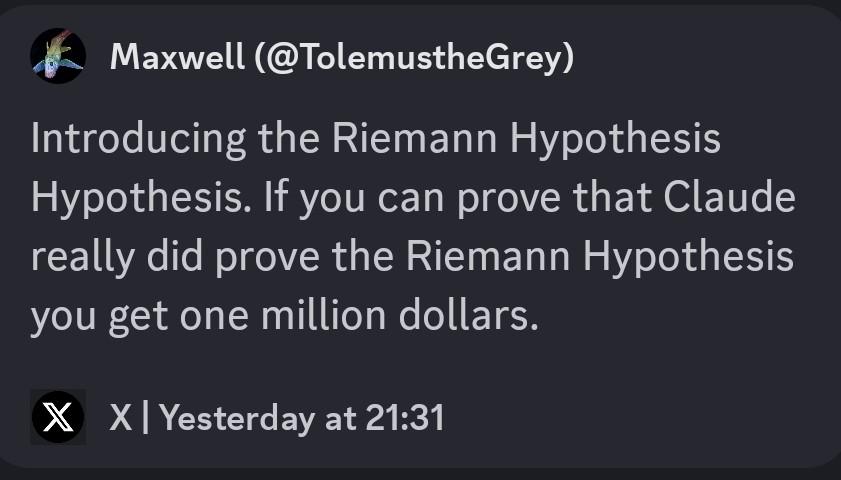
The Lean folks seem pretty confident that they have solved the Riemann Hypothesis hypothesis
119
u/NuclearRunner 5d ago •
I DONT GET IT. Has the proof not been verified by lean? i’m definitely using terms wrong but hasn’t the riemann hypothesis been formalized in lean a while back (a formalization with essentially unanimous agreement), so we know a) the proof is logically sound, and b) is actually answering the question. So the only room for it being fake is a bug in multiple kernels of lean being exploited by claude? I really hate it and wish it couldn’t solve riemann hypothesis but it seems to quite obviously have done so
33
u/Mr_kalas22 Real Algebraic 5d ago
Good luck with that
2
u/acakaacaka 5d ago
You mean using LEAMN to prove LEAN proof?
Then how would you proof that? Using LEAN to prove LEAN prove that proved another LEAN proof.
19
u/Hungry_Technician360 5d ago
ChatGPT told me it's correct with the proof.
9
u/Hour-Grocery2093 5d ago
How do you even know when the proof is done? Just when Claude told you it's done
4
u/Safe-Bookkeeper-7774 5d ago
we got riemann hypothesis2 before gta7
4
u/Bellanzz 5d ago
Riemann Theorem Hypothesis*
2
u/shunyaananda Irrational 5d ago
It's not a proof if you can't fit it on a narrow margin
2
u/ashley99z 4d ago
Where is the standard for the proof?
3
u/CapableCheesecake152 5d ago
„Riemann Theorem Hypothesis“ - right?
1
u/Efficient_Sky5173 5d ago
Gemini 4 Carbon from Google: Here, hold my beer.
1
u/Admirable_Rabbit_808 5d ago
Easy money for the Lean FPO, who just did exactly that
1
u/postprandialrepose 4d ago
It's just proofs all the way down.
1
u/Lord_Olchu 4d ago
Isn't AI solution checked by other AI familiar to religion? "God send me to tell you do this and dont do that. Believe me, God told me this". Asking for a friend
1
u/kloklon 4d ago
This X post is smart/dumb/smart.
middle guy is screaming "LEAN"
1
u/ParsaProgrammer 4d ago
Why doesn’t alpöge ask claude to disprove GRH? If claude succeeds then either:
0
u/TalarFractures 4d ago
Can someone who actually knows shit help me understand something?
My understanding is that mathematicians at anthropic used machine learning to narrow the bounds for the problem, resulting in verifiable proof in lean code.
Anthropic then prompted their chatbot to explain it and it generated 250,000 pages of what may or may not have anything to do with the actual lean proof.
Anthropic is now trying to attribute the accomplishment to a machine learning model trained to sound convincingly human, which is what they're actually selling.
0
u/FernandoMM1220 5d ago
if you can prove which data it used to prove rh
-14
u/Zealot_TKO 5d ago
Anti AIs are unironically like "yea that seems fair"
-1
u/justsomerabbit 5d ago
That would be the Riemann Theorem Hypothesis