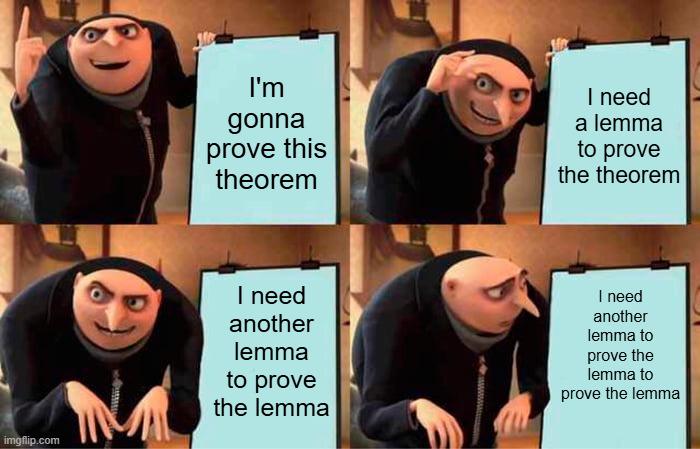
Inspired by: my attempted proof of the associativity of multiplication, which led to me attempting to prove the distributivity of multiplication, which led to me attempting to prove (x + y) + (z + w) = (x + z) + (y + w), which led to me trying to prove ∀x∀y∀z (x + (y + z)) = (y + (x + z)), which led to me trying to prove x = z ↔ x + y = z + y, which led to me trying to prove ∀x [x = y + x ↔ y = 0]. Is there a better way to do this? Probably, but these theorems are nice to have in my back pocket for future stuff, so I'll prove them anyway.
•
u/AutoModerator 2h ago
Check out our new Discord server! https://discord.gg/e7EKRZq3dG
I am a bot, and this action was performed automatically. Please contact the moderators of this subreddit if you have any questions or concerns.
4
u/Scientific_Zealot 2h ago
Inspired by: my attempted proof of the associativity of multiplication, which led to me attempting to prove the distributivity of multiplication, which led to me attempting to prove (x + y) + (z + w) = (x + z) + (y + w), which led to me trying to prove ∀x∀y∀z (x + (y + z)) = (y + (x + z)), which led to me trying to prove x = z ↔ x + y = z + y, which led to me trying to prove ∀x [x = y + x ↔ y = 0]. Is there a better way to do this? Probably, but these theorems are nice to have in my back pocket for future stuff, so I'll prove them anyway.
3
u/Independent-Fan-4227 1h ago
I need to prove the theorem to prove the lemma that proves the lemmas that prove the theorem.
16
u/PM_ME_MELTIE_TEARS Irrational 2h ago
You need a corollary-bypass.
5
u/PM_ME_MELTIE_TEARS Irrational 2h ago
What a dilemma!
4
u/Rude_Anywhere_ Imaginary 2h ago edited 1h ago
Me: A proof within a proof. Two levels?
My prof: Three levels.
Me: It's not possible.
My prof: No, it's necessary.
Me: At that depth, we will require a strong caffeine shot (as opposed to strong sedative)
My prof: yes. Or some coke.
*dramatic score by Hans Zimmer begins
2
u/kanonnakagawa 1h ago
And that lemma is equivalent to the theorem
2
u/Opposite-Ebb1327 1h ago
Honestly the real nightmare is when the lemma you need turns out to be false and you have to go back to the first panel and start over.