If this is your first time on Reddit, you may want to familiarize yourself with Reddit's rules and policies. To make sure you have not been afoul of the rules, please see
A Reddit community is called a subreddit, also known as a sub. The subreddits start with r/.
Followers are not important on Reddit. Your followers are not important either. Only your posts and comments are important. Unlike other social media, hashtags are not useful on Reddit. The Reddit account username cannot be changed after signing up. To change it, you will need to create a new account, which will reset your karma.
Karma is an arbitrary measure of how much you contributed. The more upvotes you get, the higher your Karma. Some subreddits require you to have a certain amount of Karma before you can post. Do not spam irrelevant posts to other subreddits or be rude, insulting, or abusive, as you can be downvoted. This will cause you to lose Karma. Try to avoid getting your total Karma in the negative value.
Also make sure to follow our rules, which are prominently displayed in the sidebar to the right.
Make sure your posts are on-topic and related to Myanmar. Spam may go well with anything but it has no place in this sub. Please do not spam us with unrelated content.
Please keep discussions civil. Tolling and racism will not be tolerated. Our situation here is not for your "lulz". Also, keep swearing to a minimum. Although we will tolerate swearing if it is part of the narrative/discussion, personal insults, over-the-top vulgarity, etc., will not be tolerated.
Adding a flair to your posts will enable others to easily find similar posts. Flairs are used to categorize posts to easily be found. Click here for more details.
Keep reposting to a minimum. Please check to make sure you don't repost news and pictures that have already been posted. r/MAGIC_EYE_BOT and u/DuplicateDestroyer are trialed to help remove duplicate images. Please reply to the bot or send us a message if the bot got it wrong.
Does the content you're posting here fit more than one community? As per Reddiquette, consider posting to other subs such as the ones listed here if the contents fit more communities.
For example, are you posting news? Then you can post into r/news, r/inthenews, r/worldnews, r/USnews (US news only), r/asia, r/asian, r/asean, r/theworldnews. This list is not exhaustive but please use common sense and make sure the content fits the target sub. That means news only goes to news-related subreddits and pictures go onto picture-related subreddits. Make sure to follow the rules of those subs as well, since each sub has its own set of rules.
Yk most subs make a pinned megathread when theres a big topic that is flooding out the sub otherwise... also while we're at it the rules and pins are so outdated lmao.
rather not have the sub flooded out, i dont open r/myanmar purely to talk about genocide and argue with racists
We call this emoji in English “Heart” for the organ too, should it be the same and call for it “နှလုံး” instead of “အသည်း” which means liver? Or did the people who created this word thought that the emoji was a liver?
The recent news have somehow caused a whole lot of right wingers to float on to the surface and comments under news are disgraced by them. People should stop blaming anyone. Here are claims they make:
Rohingyas are not compatible with Bama yin kyay mhu. Okay, why is that so? Why do we practice yin kyay mhu and when do we recognise when its not applicable. Surely, thousands of people being killed in our name should be the time to consider that, no?
"You should keep them in your house". No, we dont want to. For the same reason they dont want to keep burmese people in your house. No, they would rather wind their window down at the intersection and call the Burmese driver who cut you off "Ma Aye Loe" while disregarding fellow road users' lives. But im willing to come up with a solution together if we all can sit down together. Are they?
"They started first". No one started it first. Misunderstandings happen. How would you react to "Woman, 38, 🍇ed on main street" vs "Woman, 38, 🍇ed on main street by a Muslim man"? Quite different, isnt it? If the nation has a bias against Islam, so do reporters and gossip. We have to take that into consideration.
"We are already struggling ourselves". Yes, then what? Let's ask the UN to not do the very thing they were designed to do and supposed to do 9 years ago? The UN does this because a certain German man with a funny moustache did a funny little something against a certain group of people too.
Aside from these claims, do right wingers have actually any supported claims, backed by evidence and theory? If so, im willing to have a chat with you. Let's not let anger rule us. What would change your mind and what could change mine? Let me know.
I'm 19m and I live in North Oakkalapa. I have no expertise per se but I can understand English pretty well. So what is the best way to make sum bread? I'm studying for GED but I feel like I'm wasting my life.And going broke on top of that becuz my family is struggling financially. So please suggest some ways to make money as a teenager with zero employability. Please suggest things I need to learn in order to make money too.
Interesting country, I find myself getting lost as I travel about. Today I arrived in mandalay and I had a hostel saved to my phone, only to arrive and there was nothing there(guess Google Maps was outdated). Wasn’t a big deal as I just walked around and found a hotel to spend the night but now I’m not meeting any random travellers.
Anyways, I’ll be in mandalay for tonight and tomorrow, bagan 25th, 26th, and maybe 27th and then back to Yangon until the 30th if anyone would like to meet up? :)
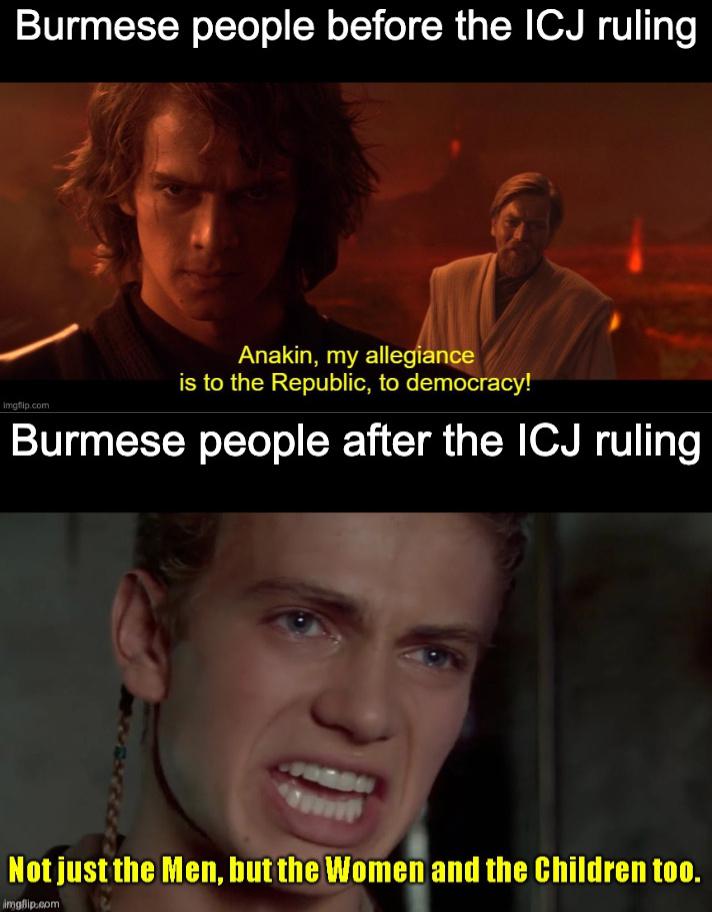
The discussions on this sub following the ICJ ruling have got me thinking about the basis on which individuals are deemed eligible for citizenship in any country.
I am part of the Myanmar diaspora, like millions of others who are now living or seeking refuge in other countries. Given our circumstances, I imagine many of us would prefer our host countries to have accessible and reasonably straightforward pathways to residency and citizenship.
Consider the alternative. What if our host countries argued that Myanmar people simply do not belong there, and that citizenship should be reserved for people whose ancestors have lived in those countries for generations? Our ability to settle, work and build lives in those countries would be severely restricted.
We already see some of this in practice. The US, for instance, imposed a full suspension of entry for Myanmar nationals in June 2025, subject to certain exceptions. Many Myanmar nationals have also faced immigration enforcement and deportation in various countries.
There has been considerable outrage within the Myanmar community when host countries deport Myanmar nationals, particularly those fleeing conflict or persecution. These actions are often criticised as being inhumane or insufficiently sympathetic to the circumstances of a displaced population.
I was therefore rather surprised to find that when the discussion turns to citizenship and the right to reside in Myanmar itself, some people seem to advocate extremely stringent requirements.
In particular, there is a persistent accusation that certain communities entered Myanmar illegally and should therefore be expelled.
I have several questions about this position.
What does it mean to have entered Myanmar illegally when the modern nation-state and its borders did not exist in their present form?
Some of these communities have lived in the territory for generations, even centuries.
For example, Burma was administered as part of British India until 1937. People moved throughout the British Empire, and the distinction between migration within an imperial territory and immigration between independent sovereign states was very different from what we understand today.
It seems rather arbitrary to apply today's understanding of immigration and border controls retrospectively to people whose ancestors arrived under entirely different political and administrative arrangements.
Surely, having lived in a place for generations should count for something?
2. Why are we selective about which migrant communities we consider part of Myanmar?
Consider the Chinese community.
There were established Chinese communities in Burma long before independence. There was also substantial migration during the colonial period, as well as an influx of Yunnanese Chinese refugees following the Chinese Civil War and the Communist victory in 1949.
Today, these communities are generally recognised as part of Myanmar's diverse population, even though not all of them belong to the officially recognised 135 national races.
There has certainly been anti-Chinese sentiment and discrimination in Myanmar's history. I am not suggesting otherwise.
But why do we accept that successive generations of some migrant communities can become part of Myanmar, while insisting that other communities must forever remain foreigners?
What exactly is the principle that distinguishes them?
3. Why should ancestry be the decisive requirement for citizenship?
Myanmar's 1982 Citizenship Law places considerable emphasis on membership of recognised national races and ancestral connections to the territory before 1823.
I understand the argument for recognising indigenous communities and protecting their cultural and political interests. These are legitimate concerns, particularly in a country with such a complicated history of ethnic conflict and cultural suppression.
But why should ancestry be the overriding consideration when determining whether someone can belong to a country?
Many countries provide pathways to citizenship based on factors such as length of residence, family connections, integration, language proficiency, willingness to abide by the law and commitment to the country.
Why shouldn't Myanmar have similarly accessible pathways?
I am not arguing that anyone who arrives in Myanmar should automatically receive citizenship. Countries have legitimate interests in regulating immigration and determining their citizenship requirements.
But surely there should be a meaningful pathway for people who have lived in Myanmar for generations, were born there, have families there and consider it their home?
4. Are we comfortable applying the same principles to ourselves?
I find this particularly interesting when looking at Malaysia.
Malaysia has its Bumiputera policies, which provide preferential treatment and privileges to designated indigenous communities, including ethnic Malays.
The term Bumiputera literally means 'sons of the soil'.
Many Myanmar people I know have criticised these policies as unfair, arguing that citizenship and opportunities should not be determined by ethnicity or ancestry.
Yet I sometimes see very similar arguments being made about Myanmar itself: that certain ethnic groups are inherently more entitled to the country because their ancestors were there first.
Why is one principle acceptable when applied to Myanmar but objectionable when applied to Malaysia?
I find the idea that one ethnic group can claim a superior entitlement to a country simply by virtue of ancestral presence quite troubling.
There is an important distinction between recognising the historical rights of indigenous communities and declaring that everyone else is permanently less entitled to belong.
An individual's character, contribution to society and respect for the law are not determined by their ethnicity. Every ethnic group has good people, bad people and criminals.
I don't think we should create a system in which someone's ancestry automatically makes them more deserving of citizenship than someone who has spent their entire life in the country.
If we believe that Myanmar people should be given a fair opportunity to settle and eventually become citizens of other countries, why should we deny the same possibility to people who have made Myanmar their home?
I am not suggesting that every immigration dispute has the same circumstances, or that citizenship should be granted without conditions.
But I do think we should examine whether our ideas about who belongs in Myanmar are consistent with the principles we expect other countries to apply to us.
Perhaps it is time to reconsider whether citizenship should be based so heavily on the identities of our ancestors, rather than the lives we actually build together.