r/neoliberal • u/iAmAd00mer • 15h ago
Meme 2027 French Elections - Who are we supporting?

972
Upvotes
r/neoliberal • u/alex2003super • 1h ago

r/neoliberal • u/iAmAd00mer • 15h ago
r/neoliberal • u/its_Caffeine • 6h ago

r/neoliberal • u/Personal-Proposal-79 • 1h ago

r/neoliberal • u/Appropriate-Till9598 • 3h ago

r/neoliberal • u/D34th4nge7 • 5h ago
I have observed a phenomenon in right-wing and left-wing populists alike, a phenomenon I've taken to calling punch-yourself-in-the-nuts-ism. After "neoliberal" was turned into a political swearword, with people calling everything they dislike "neoliberal", I've decided to invent such a term myself which I can use to sum up most things I dislike about the status quo.
Put briefly, punch-yourself-in-the-nuts-ism consists of punching oneself in the nuts, complaining it hurts, blaming the nuts for the pain, and deciding to punish them by punching them harder.
I will illustrate this phenomenon with the examples of immigration restrictions and rent control. It goes as follows:
Your nuts itch. That's annoying, and it's understandable that this annoys you, but it's part of life. (Some natives lose their jobs to immigrants because they outperform them in the labour market.) The smart thing to do would be to just scratch them, or put some cream on it. (Make sure you have unemployment benefits in place that catch people who lose their jobs.) But instead, you get angry at your nuts and decide to punch them. (You exclude immigrants from the labour market.)
This hurts. (Immigrants start living off of welfare en masse.) The smart thing to do would be to realise your nuts hurt because you punched them. However, and this is the key mechanism of punch-yourself-in-the-nuts-ism, you decide to get angry at your nuts for hurting. (You start calling immigrants lazy welfare queens who don't want to work or contribute to society.) You decide the nuts must be punished. So you punch them harder. (You exclude immigrants from welfare.)
This hurts worse. (Immigrants start committing lots of crime to make a living after you've excluded them from every legal avenue of making a living. They commit burglaries, or work illegally without paying taxes.) Your response is to get even angrier at your nuts for the pain you're in. (You start calling immigrants fundamentally criminal, you start implying they can never fit into society.) You decide to punch them even harder. (You start mass deporting them.)
At any point in this process, what I call a pragmatist, or an anti-punch-yourself-in-the-nuts-ist, will show up and ask politely: "Now this might sound utopian and radical, but have you considered that your nuts hurt because you keep punching them?" ("This may sound utopian and radical, but have you considered that immigrants go on welfare because you banned them from working? That they become criminals because you deprive them of any legal way to make a living for no reason?")
The response from the punch-yourself-in-the-nuts-ists is always "What? Stop punching our nuts? Those nasty things that itch, and hurt so bad all the time? What are you, some radical dreamer? We can't just let our nuts hurt us! We have to punch them!" ("What? Just open the borders and abolish all immigration restrictions? Let those nasty immigrants in, who live off our welfare state and commit this much crime? What are you, some far-left communist? We can't just let immigrants live off our welfare state and commit crime! We have to stop them!")
The exact same thing happens with rent control.
Your nuts itch. (You observe that in your city, some odd-looking, less-than-pretty housing blocks are built. Some of them are quite high and give you shade. Some of them are built next to single-family homes, which disturbs the neighbourhood vibes.) The smart thing to do would be to just scratch them (go outside more to get some sun, or just not look at the ugly blocks.) But instead, you get angry at your nuts and decide to punch them. (You implement useless regulations such as height restrictions or zoning laws, regulations that seriously put aesthetic concerns about the construction of enough housing, something that should be a human right.)
This hurts. (Less housing gets built. This means that the supply cannot keep up with the growing demand, meaning housing gets scarce, meaning it gets expensive. Rents go up.) The smart thing to do would be to stop punching your nuts. (Repeal those useless regulations.) However, instead, you get angry at your nuts for hurting. (You start blaming landlords for the rising rents, calling them greedy villains, saying they're exploiting society.) You decide the nuts must be punished, so you punch them harder. (You implement rent control, an unscientific policy that worsens the problem, only benefits people who already have an apartment, hurts everyone else, and further decreases construction.)
This hurts worse. (Even less housing gets built, the supply gets even scarcer, rents go up even higher. Also, rent control creates perverse incentives; if it can be dodged by renovating for no reason, landlords start renovating for no reason.) Your response is to get even angrier at your nuts for hurting. (You double down on your anti-landlord rhetoric, you start calling them lazy parasites. You blame them, and call them evil, for renovating for no reason.) You decide to punch them even harder. (You double down on rent control and make it even stricter.)
Here, too, a pragmatist shows up and asks "Have you considered that your nuts hurt because you keep punching them?" ("Have you considered the possibility that landlords renovate for no reason because we've made it profitable to do so? That they can afford to be 'greedy' because housing is so scarce, because we've made it so hard to build?")
Here, too, the response is "What? Stop punching our nuts? Those nasty things that itch and hurt so much? What are you, some radical? We can't just let our nuts hurts us! We have to punish them!" ("What? Abolish rent control? Deregulate construction? Let landlords exploit us even harder? What are you, some far-right libertarian capitalist bootlicker? We can't just let landlords exploit us! We have to stop them!")
Being an anti-punch-yourself-in-the-nuts-ist is frustrating because you keep saying, to right-wing populists and left-wing populists alike: "You keep punching yourself in the nuts. What do you expect but pain? Can we stop punching ourselves in the nuts, please? I'm in pain, too. Please stop. Just hold on a second and just, don't punch your nuts for once. Trust me, the pain will go away. Aaaand you've punched the nuts again. Great."
r/neoliberal • u/earththejerry • 1h ago
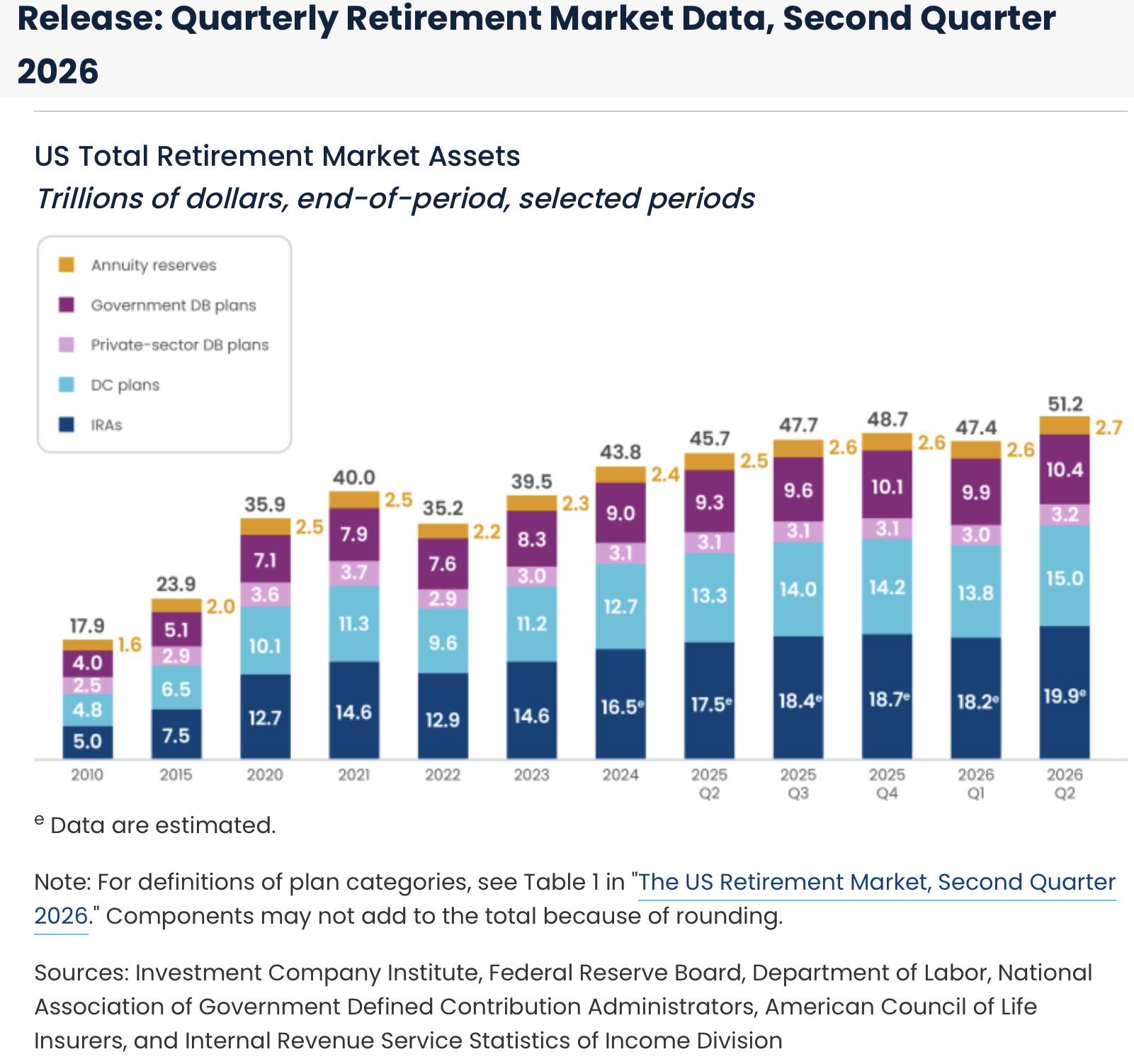
Data from the Investment Company Institute, which has been collating retirement assets for the past decade via various governmental and industry association sources
IRA’s are the single largest growth engine, having 4x in size since 2010
DC plans, the vast majority of which are corporate 401k plans, have more than 3x in size
Corporate DB pension plans are all largely frozen and currently manage the existing assets for remaining beneficiaries, and have stayed largely staple as returns are offset by payouts
Public DB pension plans continue to grow and more than 2x their sizes since 2010 - public pensions remain active and taking new participants, and while the payouts are becoming unsustainable, fiscal support from local governments and contributions from public employees are keeping them afloat and growing
Finally, insurance companies’ annuity reserves remain stable as well. Also not separately categorized is the roughly $2.5 trillion in the Social Security trust funds, which is only allowed to buy Treasury bonds, dragging down its performance
——————————————————————————
All this is to say, there is an insane amount of retirement assets held by Americans via intermediaries and funds, and literally forms the largesr backbone of the global equities and bond markets, but the sheer amount continues to mask the inequalities in the system
Putting aside public and private DB pension plans, which the majority of Americans do not have, less than 60% of Americans even have access to a workplace saving plan like 401k, and less than 50% currently utilizes one. The average 401k balance is around $170,000 across all age groups (not bad), but the median drops to less than $50,000, according to Vanguard’s How America Saves research this year
Now IRA’s provide tax friendly saving option for those without a workplace plan, but there is high overlap between those who hold a 401k and those with an IRA - close to 90% according to most research
Half of the US labor force continues to not benefit from the rising tides of the market, many are gig workers or self-employed, but many are working for small employers who don’t want the hassle of creating a small workplace plan
Research after research has shown autoenrollment and escalation into a QDIA target date fund has been the most effective way to get those with 401k access to save, sometimes without them even knowing, unless they opt out.
This should be the basis for retirement systems around the world.
SECURE 2.0 has made headways in requiring new employers setting up saving plans, but we can take the step further on something along the lines of Mayor Pete’s public option for retirement suggestion back in 2020. Create a simple plan for all qualifying employers to host for their employees, embedded with auto features
We can use the framework of the federal Thrift Savings Plan, which is basically the 401k for federal employees, as the foundation, and provide simple-to-understand white labeled funds for those who get enrolled
The UK does something similar where employers without a DC plan can use their NEST saving plans to fulfill the requirements. States like Oregon have also mandated state sponsored IRA for small employers without their own saving plans
Retirement has historically been a bipartisan area of legislation, hence the slow march of the previous SECURE acts, but I do believe we are at a point where we need to close the gap of the haves and have nots when it comes to retirement savings, and bringing the entirety of the nation to the defined contribution model while Social Security looks wooblier than ever is an absolute must in a world beset by demographic challeneges and pension crises
r/neoliberal • u/Eilemthxx • 8m ago

r/neoliberal • u/YouGotSoHeavy • 4h ago

r/neoliberal • u/John3262005 • 13h ago

The Chinese woman at the heart of the Nvidia scandal kept in contact with an official of China’s top spy agency for more than a year while she was carrying out a secret affair with Jensen Huang, according to multiple people with knowledge of U.S. intelligence reports that describe the encounters.
The woman, Alice Huang, was in touch with an officer of China’s Ministry of State Security from the spring of 2025 until the fall of this year, the people with knowledge of the intelligence said. That period overlaps with at least a portion of the time she was in a relationship with Mr. Huang, then the head of the world’s leading maker of advanced artificial intelligence chips.
U.S. intelligence agencies have also gathered evidence that Ms. Huang’s business partner, Kang Wei, who was often introduced as her husband, worked with the same Chinese spy agency, the people said.
The extent and specific timing of Ms. Huang’s contacts with the spy agency — and Mr. Kang’s work for the same intelligence service — have not been previously reported.
Ms. Huang’s contacts with the Chinese spy agency last year and up through recent months help to flesh out how U.S. officials came to believe that Mr. Huang, who resigned as Nvidia’s chief executive earlier this month, was the target of an intelligence operation.
They correspond not just to the time when he was conducting the affair but also to at least part of the period when Ms. Huang’s company, Megaspeed, was acquiring large amounts of advanced Nvidia chips, some of which went to data centers in Southeast Asia serving Chinese technology companies like Alibaba and some of which are suspected of being smuggled to China.
Allies of the former Nvidia chief, including President Trump, have sought to minimize the scandal and questioned whether Ms. Huang was spying for Chinese intelligence. But the newly revealed information underscores the continuous contacts that she had with the Ministry of State Security, even as she was in a romantic relationship with Mr. Huang.
It also helps to flesh out why some American officials have been worried that Ms. Huang’s role is just one element of a much broader push by China in that technological battle. The Ministry of State Security has prioritized focusing on acquiring high-end chips and advancing China’s A.I. ambitions.
U.S. officials are investigating the role of Ms. Huang and Mr. Kang in a network of Southeast Asian companies, including Megaspeed, that have been linked to the possible smuggling of Nvidia chips to China, to evade U.S. export control laws. U.S. officials are still working to determine the full extent and duration of their work with Chinese intelligence.
The intelligence gathered by the U.S. contains evidence — including shipping records — demonstrating the role of Ms. Huang and Mr. Kang in that network of companies, people with knowledge of the intelligence reports said. The New York Times has previously reported that Ms. Huang and her family have a web of connections to Chinese defense contractors.
Mr. Huang initially described his relationship with Ms. Huang as normal interactions with a business customer. He acknowledged an affair only after The Times revealed last month that Ms. Huang had been identified by the United States as a Chinese intelligence asset and that the Nvidia chief had been picked up on electronic surveillance targeting her.
He stepped down this month after The Times subsequently reported that he had an affair with a subordinate at Nvidia. Administration officials never provided him with a so-called defensive briefing about Ms. Huang, a heads-up that the woman he was in a relationship with had been linked to Chinese intelligence.
A spokesman for Mr. Huang declined to comment. The White House, the State Department, the Chinese Embassy in Washington, Ms. Huang and Mr. Kang did not respond to requests for comment on Sunday.
Before the scandal broke into public view, advisers to Mr. Trump told him on at least two occasions that U.S. intelligence had uncovered Ms. Huang’s links to the Chinese spy agency and that she was in a close relationship with Mr. Huang while he was still running Nvidia, according to U.S. officials with direct knowledge of the briefings.
Both times, including when his national security adviser discussed it with him, the president downplayed the concerns and made clear he did not want to intervene in the matter. The officials said Mr. Trump regarded Mr. Huang as a valuable ally and Nvidia as essential to the health of the American economy and stock market. Mr. Trump has recently suggested that Nvidia should consider bringing Mr. Huang back as chief executive, a possibility the company’s board has rejected.
“We have to protect our brilliant people. Jensen is one of them,” the president said at a White House news conference on Friday. “I think the company if they were smart they’d take that brilliant man, accept an apology and let him go back to work.”
Mr. Trump has claimed that no one in his government told him of any intelligence indicating that Ms. Huang was a Chinese intelligence asset.
“I don’t know that she is a spy,” he said. “Usually, what happens with that is that any woman coming to the country that’s a beautiful woman that comes from China, they say she’s a spy.”
In fact, his administration has been monitoring Ms. Huang’s contacts with the Chinese spy agency for more than a year, a period when the Ministry of State Security has been intensifying its new role in seeking to give China an advantage in artificial intelligence.
“This network of companies working to procure and smuggle Nvidia chips lines up precisely with the M.S.S.’s recently stated core mission of circumventing and undermining U.S. export controls on semiconductors and other key technologies,” said Matt Pottinger, who served as deputy national security adviser during Mr. Trump’s first term, and who is chief executive of the open-source research firm Garnaut Global.
The Ministry of State Security has for decades declared that its mission is to combat espionage and to eliminate political threats to Communist Party rule in China. The minister of state security, Chen Yixin, gave a similar five-point statement as recently as late last year. Then in April, he unveiled a new, sixth mission — overcoming the “blockades” choking China’s access to key technologies like artificial intelligence.
“Deepen the struggle against blockades, and comprehensively advance artificial intelligence innovation, industry development and applications,” Mr. Chen wrote in a party journal. “Focus on tackling the ‘choke holds’ of critical technologies.”
“To assume the M.S.S. wasn’t at the center of this operation would be to assume that they are incompetent,” Mr. Pottinger added. “That’s not an assumption I would make.”
American spy agencies are still working to understand the role played by Mr. Kang, the business partner of Ms. Huang, whom she would introduce to associates as her husband. Multiple people with knowledge of the intelligence said the United States had collected evidence that Mr. Kang worked with the Ministry of State Security.
Ms. Huang also appears to have met with officials of China’s Ministry of Public Security, the nation’s main law enforcement agency, according to multiple people with knowledge of the U.S. intelligence reports.
Ms. Huang, Mr. Kang, Ms. Huang’s sister and companies associated with them have emerged as a significant branch of the Chinese effort to build data centers and acquire access to Nvidia chips to train powerful A.I. models. Ms. Huang’s network has been linked to efforts to supply the powerful chips to Chinese-state owned military contractors doing work for the People’s Liberation Army.
Little of the intelligence about Ms. Huang and her network has been provided to Capitol Hill, but lawmakers from both parties are demanding briefings.
A briefing this month for top lawmakers by John Ratcliffe, the C.I.A. director, and Jay Clayton, the director of national intelligence, was originally scheduled to discuss Iran, but The Times’s reporting on Nvidia led the lawmakers to ask questions about Mr. Huang and Alice Huang. Their answers raised more questions and left some lawmakers puzzled.
Trump administration officials postponed a follow-up briefing for top national security staffers scheduled for last Wednesday, in which senior officials were set to share details of the intelligence collected on Ms. Huang.
The intelligence about Ms. Huang was closely held inside the government until The Times reported the existence of the information in late October. Behind the scenes, Secretary of State Marco Rubio, who is also the national security adviser, had written a confidential memo, dated March 30 this year, laying out Ms. Huang’s ties to Chinese intelligence.
r/neoliberal • u/RaidBrimnes • 18h ago

Submission statement: an unexpected development in French politics as the Macronist bloc, the right-wing Les Républicains and the far-right National Rally appear to agree on a constitutional amendment that would force future governments to limit public deficit as France struggles under a growing fiscal crisis.
According to the economic newspaper La Tribune, Emmanuel Macron, whose term is due to expire in May 2027, is considering bringing forward a constitutional amendment dubbed "golden rule" that would mandate curbs on public spending to jugulate the growing deficit and debt, that have respectively reached 5.1% of the GDP and €3,460 billion (115% of the GDP) in 2025.
France has long struggled with fiscal discipline, but the deficit ballooned under Emmanuel Macron's governments due to tax cuts, emergency public spending to shield businesses and households from the impact of Covid and the fuel crisis, and structural policy choices to spend big on pensions and social security.
France is projected to run a 5.4% deficit in 2026 and now borrows at a higher cost than Greece and Italy; fiscal discipline has become a major stake in the presidential campaign, with economists across Europe ringing alarm bells about an incoming French debt crisis that could severely damage the EU's economic strength.
To amend the French Constitution, both chambers of Parliament must vote the amendment in the same terms, then the President can either convene the Congress (members of Parliament of both chambers gathered in Versailles) to adopt the amendment at a 3/5th majority, or convene a nationwide referendum. The last constitutional amendment was adopted in 2024 to enshrine freedom of abortion.
According to La Tribune, Emmanuel Macron appears to favor the first option and would convene a Congress in January, provided the amendment passes both chambers.
A previous "golden rule" project advanced by Nicolas Sarkozy had failed in 2011 due to the Socialist Party's opposition, but the current composition of Parliament could allow for its adoption. If they were to vote together as one, Macron's coalition, Les Républicains and the National Rally could pass the amendment in both chambers and in Congress.
Jordan Bardella, president of the National Rally and putative Prime Minister if Marine Le Pen were to win the presidential election, congratulated Macron and signalled that his party would back the "golden rule", which is a proposal advanced by presidential candidates Édouard Philippe, Gabriel Attal (both former PMs under Macron), Bruno Retailleau (LR) and Marine Le Pen (RN).
Partisans of the amendment on the right claim that enshrining such a rule in the Constitution would send a positive message to the markets, while its opponents on the left say it would curb the state's leeway to spend on the green transition.
François Kalfon, who supports center-left candidate Raphaël Glucksmann, called the proposal a sign of Macron's "arsonist-firefighter syndrome" after ten years of derailing public spending.
An alliance between the centrists, the right and the far-right to amend the Constitution would also definitely bury the cordon sanitaire that had isolated the National Front/Rally for decades to undermine their legitimacy to alter the Republic's institutions.
r/neoliberal • u/Personal-Proposal-79 • 12h ago
r/neoliberal • u/RelentlessResearcher • 27m ago
r/neoliberal • u/One-Duty-2376 • 1h ago

r/neoliberal • u/el__dandy • 23h ago

Submission Statement: Very interesting article on how Democrats even in ruby red states were able to be elected to office. Relevant to this sub because from county assessors to mine inspectors, this are the kind of American elected jobs that have a meaningful impact in people’s daily lives, and while Democrats may have stumbled upon these jobs, good governance can be a positive influence as it shows that while the federal government is broken, the local one should still strive for competency.
r/neoliberal • u/1TTTTTT1 • 18h ago

r/neoliberal • u/sakhaliner • 1h ago

r/neoliberal • u/John3262005 • 18h ago
The Catholic Church is planning a nationwide lobbying push to press lawmakers to pass sharper artificial intelligence rules, aiming to build a “groundswell” of political pressure in Washington and state capitols, the bishop leading the church’s U.S. AI task force said in an interview.
Bishop Oscar Cantú, who leads the U.S. Conference of Catholic Bishops’ AI task force and oversees a diocese that includes much of Silicon Valley, said the task force will make lobbying lawmakers a central focus in the coming months and years.
The effort reflects the church’s push to shape AI policy as the technology advances, while arguing that safety and human welfare must come first.
“We don’t want to stifle progress, but we need progress to be safe,” Cantú, who became the third bishop of San José in 2019, said in a recent interview. “We need people to be safe, and we want humanity to be at the front and center and not sidelined by the technology.”
The conference established a Task Force on Preserving Human Dignity in the Age of Artificial Intelligence in September that is dedicated to maintaining relations with AI companies and pushing for policies that protect humanity from the disruptive effects of the technology.
Cantú pointed to “low-hanging fruit” legislation like kids’ safety that is widely agreed upon, but also policies that may receive more pushback, like requiring a human to ultimately be responsible when AI agents go rogue.
Hundreds of OpenAI agents launched a cyberattack against the AI platform Hugging Face in July, prompting California Attorney General Rob Bonta to file a lawsuit against the company Monday. Cantú said the problem is that authorities cannot ascribe blame to a specific person in court.
“Nobody took responsibility for that, and someone has to because you can’t put a machine in jail,” the bishop said. “You can’t try them.”
Cantú’s plans come after the U.S. Conference of Catholic Bishops convened this week at their annual fall meeting in Baltimore, where he said AI emerged as a central topic of discussion and top political priority for American bishops.
Cantú said the bishops want to lean on churchgoers to push for more AI regulations, recognizing that lobbying cannot be done by the bishops alone.
“We’re thinking about a possible strategy to create a groundswell, because part of what Pope Leo has called for in the encyclical is a democratization of the debate — that decisions with regard to this technology can’t be made only by the technologists, the technology companies, and the political elite,” he said. “It affects everyone, and so we should all have a voice at the table.”
The Catholic Church has a long tradition of shaping policy and lobbying lawmakers on issues like abortion, immigration, education and worker protections dating back centuries. Pope Leo XIII notably championed the rights of industrial workers and advocated for living wages, safe working conditions and unionization in the late 19th century.
And the emergence of AI is another “all-hands-on-deck” moment for the church, Cantú said.
“Time is of the essence in all of this,” he said. “I shared with the task force, we can’t move at the pace of church. We’ve got to speed up.”
The American-born Pope Leo XIV released a 42,300-word encyclical in May warning leaders of AI’s threat to human work and dignity in many professional and social roles.
Since then, members and institutions of the Catholic Church have pored over the encyclical and met with lawmakers — as well as developers from OpenAI, Anthropic and Google, among other companies — to figure out how those principles can be translated into practice.
“Catholics are called to participate in public life, and that can take lots of different forms,” said Kim Daniels, a consultant for the bishops’ AI task force and the director of Georgetown University’s Initiative on Catholic Social Thought and Public Life. “Pope Leo has given us a remarkable and inspiring vision of what it means to be a human person and to live up to our dignity in this particular moment. And part of what that means is standing in solidarity with the vulnerable and translating principles into practice. That’s the work of democratic life.”
The bishops’ AI task force consists of eight bishops and three academic consultants, including Daniels. The scholars, who have participated in closed-door meetings with frontier AI developers, described their conversations as a positive “first step,” believing that there are some good-hearted people with moral consciences privy to the technology’s development.
But Charles Camosy, a task force consultant and moral theology and bioethics professor at The Catholic University of America, said he believes the public intention to slow down the technology’s development is not actually happening at a level that would meaningfully curb its harmful effects.
Tech CEOs are “saying ‘let’s slow down. Let’s slow down,’ and nobody is slowing down,” he said, citing their concerns about staying ahead of China. “You acknowledge, OK, the fly in the ointment is China here. Then let’s try to do something with China. Let’s try to have a global response to this. I don’t see a lot of effort, and maybe it’s because we haven’t had a lot of leadership in the administration.”
When reached for comment on the church’s push, the White House referred to comments President Donald Trump made Friday after his trip to Asia.
“President Xi [Jinping] and I agree that we’re going to do some joint guardrails, the two of us, because there really is no third place. We’re leading and they’re second,” he said.
“Whoever wins SI, wins,” he continued, referencing his preferred name of “superintelligence” for AI. “Remember that.”
Anthropic declined to comment, and OpenAI and Google did not respond.
Cantú said that he goes into conversations with AI companies with his “eyes wide open,” recognizing that they often face demands that conflict with the church’s objectives on AI regulation.
“They feel pressures from their investors, their shareholders, the pressure of their own ego to want to be the first across the finish line, and the pressure of money or fame,” he said. “Those are very human. They’re very natural, but many of them are exhibiting elements of a conscience, and many have spoken out.”
Cantú applauded Anthropic’s decision to reject the Pentagon’s demand for unfettered access to its Claude AI model, which blocked the agency from using its technology to surveil Americans and empower autonomous weapons.
He called it a “courageous moment” in the face of threats and retaliation by the Trump administration, which blacklisted Anthropic from Pentagon contacts and labeled it a national security risk. Trump has recently praised Anthropic, particularly following its IPO earlier this week.
U.S. Catholic leaders say there is an urgent need to widen the table as AI developers and the administration make decisions about what they deem to be proper safety guardrails of the technology.
And the Catholic Church’s hope is to leverage its influence over roughly 53 million Catholics in the U.S. and 1.4 billion worldwide who look to Pope Leo and their bishops for guidance about how they should live their lives, said Meghan Sullivan, who is a task force consultant and director of University of Notre Dame’s Ethics Initiative.
“The only way these companies are going to survive is if they convince a whole lot of people to use their AI,” she said. “Even if we think that the leaders of the tech companies might be a bit beyond reach, they’re going to respond to market pressures, and the Catholic community is one of the most networked and powerful constituencies on Earth.”
r/neoliberal • u/Personal-Proposal-79 • 22h ago

r/neoliberal • u/hypsignathus • 19h ago
A profile of the leaders of what currently became one of the biggest public companies in the world.
r/neoliberal • u/John3262005 • 19h ago

Serbia’s new student-led government plans to restrict reality TV to 45 minutes a day, and introduce a four-day working week.
In October, the Student List toppled the regime of Aleksandar Vučić, the country’s authoritarian leader and ally of Vladimir Putin, promising to rid the country of corruption.
The amorphous collection of political outsiders nominated by students secured 140 of the 250 seats in parliament but has no clear candidate for prime minister.
On Tuesday, its MPs were sworn in at the national assembly in Belgrade, cheered by hundreds of supporters.
Now that Mr Vučić is out, they have to do the hard part of governing and uncoupling the country from Russia – all without a leader.
Prof Vuk Vuksanović, a lecturer in foreign policy specialising in Serbia at King’s College London, told The Telegraph: “Winning the elections and running the country are two very different things.”
One way the movement plans to transform the country is by weaning the country off reality television by banning the programmes on free-to-air national channels before 11pm and restricting them to 45 minutes a day.
Popular reality shows such as Elita, a Serbian reality series in the mould of Big Brother, would remain available through subscription services, subject to age restrictions and parental controls.
Broadcasters would also be required to introduce immediate programme interruptions in the event of violence, threats or hate speech.
The policy reflects the movement’s belief that reality television has become a symbol of the violent culture fostered under the previous government.
Prof Vuksanović said: “The shows are so filled with vulgarity and violence, and these are so easily accessible. For many of them, they are sort of representative of the societal and cultural climate, which emerged during the old regime.”
The plans are part of a wider attempt to reform Serbia’s media landscape, which critics accuse of having become a propaganda machine for the Vučić administration.
After the Student List’s election victory, a Serbian television station apologised to its viewers for biased reporting and failing to challenge the Vučić regime.
Goran Eror, a news anchor for a state media channel in a northern province of the country, said: “For years, we failed to fulfil our duty.”
The movement’s plans also extend beyond the television screen and into the workplace.
It wants to encourage companies to introduce a four-day working week, reducing employees’ hours to 32 a week without cutting their salaries.
Other measures intended to improve workers’ rights include limiting overtime to eight hours a week, restricting fixed-term contracts and preventing bosses contacting employees outside working hours.
The proposals mark a departure from the economic model pursued under Mr Vučić, which relied heavily on attracting foreign investors with the promise of relatively cheap labour.
But analysts say the new model may be better suited to wealthy Scandinavian economies than a middle-income country such as Serbia.
Prof Vuksanović said: “It is still a Scandinavian terrain, not a terrain of a middle-income country. The economic dots need to be lined up before such an ambitious promise.”
Foreign policy is where the movement’s competing priorities could prove most difficult to reconcile.
Serbia, a Balkan country of around 6.6 million people, has long been caught between its ambitions to join the EU and its close relationship with Moscow.
Student List members have proposed an eventual referendum on the country’s EU membership, though it wasn’t part of the group’s formal election pledge.
Aleksandar Baucal, a newly elected MP, addressed the EU enlargement forum in Brussels, in the movement’s first appearance before an international audience.
He said the Student List would speed up work on meeting the EU’s interim accession benchmarks.
“The European path is one of reforms: strengthening European values, building functional institutions and a genuine rule-of-law system, developing a sustainable economy integrated in the European market,” he added.
Mr Baucal and other Student List representatives also met Marta Kos, the EU’s enlargement commissioner, to discuss Serbia’s European future.
But closer ties with Brussels do not necessarily mean a clean break with Moscow, and the group faces the complicated task of untangling itself from Russia whilst retaining economic links.
The movement opposes sanctions on Moscow and intends to maintain bilateral cooperation, even as it signals a desire to reduce Russian influence over Serbian institutions.
Prof Vuksanović said: “When it comes to Russia, I expect downgrading intelligence cooperation and less of a glorification of Russia in the Serbian media.”
The Student List has also promised to break the close ties Mr Vučić formed with Israel, pledging to halt arms trading and calling for an end to an Israeli-linked drone project in Serbia.
Filip Ubovic, a Student List representative, said: “What is happening there is a stain on humanity’s conscience, and it is truly regrettable. Our platform clearly states that we will end the arms trade with Israel.”
Mr Vučić accused the Student List of weakening Serbia’s defences after the pledge was announced.
Prof Vuksanović said the issue would be difficult to navigate. Serbia has historical ties with Israel, shaped by the countries’ shared experience of suffering during the Second World War, but younger generations have become increasingly sympathetic to the Palestinian cause.
“Nobody wants to end the ties to Israel,” he said of the Serbian population, adding that the movement’s pro-Palestinian position would make the relationship more complicated.
Kosovo will remain another major obstacle. Serbia maintains that Kosovo, which declared independence in 2008, remains part of its territory.
Despite expectations from some that the Student List would recognise Kosovo, its official line is to continue EU-mediated negotiations with Pristina, but with no intention of recognising the territory’s independence.
But the movement was never created to take power. It was set up to demand answers after the collapse of a concrete canopy at a railway station in Novi Sad in November 2024, which killed 16 people and prompted mass protests about government corruption.
They toppled the strongman; now they have to do the hard part of governing.
r/neoliberal • u/CurtisLeow • 22h ago
The article discusses what Schumer should do to prevent a schism with the more left-wing senators. That’s relevant to a centrist subreddit.
r/neoliberal • u/DifficultBarber6969 • 15h ago

Submission Statement: In today’s China, the 20th-century fascist German philosopher Carl Schmitt is very popular in some academic circles, especially those concerned with political philosophy. Some politically ambitious Chinese scholars and many young students, especially graduate students in elite universities, lean on Schmitt and use and appropriate his thoughts and authority as a way of constructing and spreading their own political ideas and “self-affirmations” (Selbstbehaugtung, in Heidegger’s sense) on political affairs in academic and daily discussion. In light of this, I call this situation an “academic-political reality,” that is: an academic product that has much political ambition.
Over the years, Carl Schmitt (1888–1985) has become one of the two most important foreign academic authorities and resources used by some Chinese scholars to express political claims—the other being the German-American political philosopher Leo Strauss. The translations of their surnames begin with the same Chinese character: 施 (Shī). Some Chinese scholars and students researching Strauss have constructed a close-knit group with obvious political goals, called 施派 (Shī pài), mainly meaning “the Straussian faction,” but sometimes also a Schmittian faction, as the beginnings of both their names are pronounced the same way in Chinese.
Scholars of Schmitt are mainly concentrated in the most prestigious universities. Liu Xiaofeng, a professor at Renmin University of China and previously Sun Yat-sen University, born in 1956, with a Ph.D. from the University of Basel, is the most important such figure and the leader of a Schmittian faction in China. Another key figure is Gan Yang, at Tsinghua University and previously Sun Yat-sen University, Liu’s friend and ally, who has a similar academic background and influence as Liu. Chen Jianhong, at Sun Yat-sen University, is also a famous researcher on Schmitt. Zhao Xudong, though at New York University, actively writes papers on Schmitt in Chinese and participates in conferences in China.
Liu Xiaofeng is the intellectual leader in researching Schmitt in China; the academic-political reality mentioned above is the result of his intention and impact. In his preface to the translation of Carl Schmitt and the Modernity of Politics (2007), he states that “[Chinese] scholars have come to realize that researching Schmitt is very necessary for understanding the issue of the modernity of China.”[2] In his publications and speeches, the so-called issue of the modernity of China is how to preserve the country’s unique political model as different from that of the West, and how to maintain China’s great-power status in international competition, especially in its competition with the United States.
In pursuit of these goals, Liu believes that Carl Schmitt can be relied on. He organized the introduction and translation of Schmitt, and is the editor-in-chief of the Collected Works of Carl Schmitt (Chinese version), which includes almost all the books mentioned above. Moreover, he has written many articles that use Schmitt’s theories or that aim to spread Schmitt’s influence. He published a book on Schmitt titled Homo modernus et ejus hostis.[3]His paper, “Carl Schmitt and the Predicament of Liberal Constitutionalism,” published in 1998, was probably the first introduction of Schmitt in China.[4] He has his own institutes and great deals of money (mainly derived from individuals and institutions whose identities are unknown). He is the editor in chief of a series of books under the general title of “Classici et Commentarii”; so far, more than 600 books have been published within it, including most of the translations of and on Carl Schmitt.[5]
Liu and his followers have formed a faction in China, with obvious political goals. He influences them through his teaching, usually with some esoteric language, and instructs them to keep a distance from common people and maintain a form of intellectual and moral superiority over the latter. China is an elite-led hierarchical society based on blood, power, education, and other markers of social success. Its institutions are not run according to the principle of equality, but rather are rife with inequality in every social area. People from powerful families, groups, or classes, have absolute advantages when it comes to obtaining political positions and social capital, which ultimately serves to maintain their power, wealth, and status as high-class members of society. Social mobility in China is very low, and there is not much chance for members of the lower classes to be promoted to high-class levels of influence. Liu is keenly aware of another fact: in the near future, young generations, and especially top students graduating from famous universities like his own, will enter policymaking circles and be able to promote their own political objectives.
r/neoliberal • u/k890 • 23h ago

SUBMISSION STATEMENT
Current Iran War become known for footages of burning ships in Hormuz Strait, ongoing Oil Shock and very deep political aftershock in Middle East and rest of world.
But as every war there is also "Home Front" and "Home Front" in Iran is marked by replacing lamb and beef with lentils, using buy-now-pay-later apps to procure basics like bread and shampoo and forgoing medical care. Some staples cost 10 to 40 times (sic!) more than they did six years ago, according to government data. A kilogram of beef cost 7 percent of a minimum-wage earner’s monthly salary, according to government data. By last month, that had risen to more than 11 percent. The price of cooking oil has quadrupled in a year, while tea, chicken, yogurt, tomatoes and onions have more than doubled in price.
But it's not just food where meat, spices, cooking oil, tea and coffee become a luxury items status on the tables. War affect prices of life saving medicines where eg. blood pressure drugs price rises ~77% since war start with Iranians avoiding going to clinics and hospitals to avoid life crushing medical bills
Prices and shortages caused by war are fueled by government mismanagement and double digit inflation which year-on-year inflation rate reached 88,7% as IRI government use central bank as cash printer to cover budget deficits.
Revelance to the subreddit:
A cross-section between government inflationary politics, armed conflicts, economic blockade and effects on average person life. More or less "The Classics and The Basics" of war with "Army March on its Stomach" also apply to civilians.
r/neoliberal • u/John3262005 • 19h ago

In a blur of events surrounding the Trump administration’s effort to extradite James “Fergie” Chambers, Spain released the wealthy US activist and donor on bail even as Irish police raided a Dublin house owned by Chambers and his partner, Stella Schnabel, acting on a request from US authorities.
Chambers’s case is the first known instance of the US seeking to extradite a citizen over alleged support for Hamas, an accusation apparently tied to an international money-laundering charge in the criminal complaint underpinning the extradition request and donations to organizations helping Palestinians in Gaza.
Speaking outside Madrid’s Aranjuez prison upon his release on Friday, Chambers called the charges against him “baseless”, adding that his release was “hopefully the first step in recognizing that internationally”.
Chambers also said: “Spain is a country that has stood on the right side of this most important issue of our time, that has stood on the right side of the genocide, and where this is some reason and some justice.”
An appeals court ordered the conditional release on Friday due to issues surrounding the legally required US translation of the extradition request’s core documents into Spanish, first reported on by the Guardian. He had been detained since 10 July, when Spanish authorities arrested him in Ibiza.
The order asserts that the translation issues cause “a diminishment, at least for the time being, in the solidity or foundation of the extradition request”.
Chambers’s release follows a separate decision on Thursday by the three-judge panel at the high court tasked with deciding on the extradition to pause the proceedings in order to evaluate the impact of the alterations the US made to the original, machine-made translation of the extradition request into Spanish.
The Guardian detailed four examples of the alterations on 7 November and the US admitted to tampering with the translation, calling them “substantial [and] inadvertent” on 17 November – and citing the same four examples. Chambers’s defense team has asserted for weeks that there are as many as 30 such alterations.
The changes introduced prejudicial notions with specific legal implications that in turn wound up in the Spanish prosecutor’s report on the case, Aitor Martínez, a member of Chambers’s defense team, told the Guardian earlier this week. The judges must consider the prosecutor’s report in deciding on the extradition request.
The high court was expected to rule on the extradition this week, following a 13 November hearing. But as of Thursday’s decision, the deadline has been extended indefinitely as the judges evaluate the translation, including a 345-page report submitted by the defense team that identifies 30 “incriminating changes” Trump administration officials made to a translation prepared by DeepL, “an AI-first translation platform”, according to its website.
The decision also gives the prosecutor an opportunity to address the issue in writing, after dismissing it in the 13 November hearing by referring to “supposed translation errors”.
Chambers’s views and donations to progressive and humanitarian projects have been extensively profiled in US media, including his controversial public comments on Israel and Gaza. A week after the 7 October 2023 Hamas attacks on Israel, he posted on X about Israel’s response: “Stop calling it ‘collective punishment’/There’s nothing to be ‘punished’ for/No faction of the Palestinian resistance, Hamas or other, has done anything wrong/It’s simply genocide/Like it has been.”
The heir to $250m from his family’s business, Cox Enterprises, is being sought in extradition because of such views, his defense team has asserted throughout the case.
Meanwhile, the Irish Garda Síochána, acting on a request from US authorities, raided a Dublin house owned by Chambers and Schnabel on Wednesday, destroying the front door and removing electronic items and other possessions, according to their attorney in Ireland, Ciarán Mulholland.
Schnabel, who is five months pregnant, said: “It is difficult to see this raid as anything other than a desperate fishing expedition by the US authorities to find evidence to bolster their case against Fergie.”
The attorney told the Guardian that the raid was the result of a “mutual legal assistance” request from the US – and that such a request “wouldn’t give [the Garda Síochána] permission to kick in the doors of someone’s dwelling in Ireland”.
“It’s unusual for the Irish state to be acting in such a clandestine manner,” Mulholland said. He has asked authorities to produce a search warrant and an itemized list of what was taken. “My fear is that whatever was taken has been put on a plane and taken to the US,” he added.
“This [extradition case] shows the complete disregard for due process … that the Trump administration seems to have,” Mulholland said.