r/opensourcez • • 19d ago

We wanted an AI agent that remembers us without having unrestricted access to our machines. So we built one.

Thumbnail github.com
3 Upvotes

Hey everyone!

We’ve spent the past year working on something we wanted for ourselves: an AI agent that actually remembers things across sessions, respects your permissions, and keeps working even when you close the terminal.

We kept running into the same problems with existing agents. Context gets lost, memory becomes a pile of files, and giving an LLM access to your machine raises some obvious security concerns.
So we built Mercury Agent, an open-source, MIT-licensed agent runtime that runs on your own machine.

A few things we focused on:
Permissions first: File and command access is controlled by explicit scopes, with human approval for actions that need it. The model doesn’t get unrestricted access by default.

A Second Brain: Instead of repeatedly feeding entire conversation histories to an LLM, Mercury stores structured memories in SQLite and retrieves what’s relevant. Preferences, decisions, projects, and other useful context can persist across sessions.
Always-on execution: Mercury runs as a background service. You can schedule tasks, run persistent bots, and come back to work that’s still in progress.
Token efficiency: Daily token budgets and a token-saving mode help keep usage under control.
Your machine, your choice: Use your own API provider or local models, and interact through the terminal, Telegram, Discord, Slack, or the local web dashboard.
We wanted to build something that feels less like a temporary chatbot session and more like an agent you can actually keep around and control.
It’s open source, and we’d genuinely appreciate feedback from people who care about agent architecture, local-first software, memory systems, and security.

GitHub: https://github.com/cosmicstack-labs/mercury-agent

If you get a chance to try it, we’d love to hear what works, what doesn’t, and what you’d change.
And if you find the project useful or like the direction we’re taking, consider starring it on GitHub. It helps more developers discover the project.
One question for everyone building or running AI agents: What would it take for you to trust an agent running continuously on your own machine?


r/opensourcez • • 27d ago

Welcome to r/opensourcez! Open Source for Everyone

34 Upvotes

Open source belongs to everyone. And we believe its communities should reflect that.

Recently, r/opensource introduced a series of restrictions that have sparked considerable discussion across the developer community.

Under its announced rules:

- AI-related projects are excluded, including software built with AI, using AI, or intended for AI.

- Projects must be at least one year old and actively maintained before being showcased.

- Projects generally need three or more contributors, leaving many solo-maintained projects ineligible.

- Projects must already have an established community, making it harder for new developers to get discovered.

- Requests for contributors or maintainers are no longer accepted.

- Common student and capstone-style projects are excluded from project showcases.

- Users generally need Reddit accounts at least one year old, with significant participation, to promote projects.

- People who don't speak English were told to find another community, with concerns about AI-assisted translation cited as the reason.

Some exceptions exist, but these restrictions raise an important question:

How can new open-source projects grow if developers need an established project, multiple contributors, and an existing community before they can share their work?

We understand the need to address spam, low-effort AI-generated submissions, and misleading projects. Quality matters.

But we believe quality should be judged by the work itself, not by how old a repository is, how many people contribute to it, or which tools helped build it.

That's why we're building r/opensourcez.

A community where:

- Solo developers are welcome. Every great project starts somewhere.

- New projects are welcome. Whether your repository is one day old or ten years old.

- AI-assisted and AI-focused open-source projects are welcome. What matters is transparency, quality, and accountability.

- Beginners and students are welcome. Learning is part of open source.

- Developers can find contributors, maintainers, collaborators, and feedback.

- Language is not a barrier. Developers worldwide are welcome, including those using translation tools.

- Everyone gets an opportunity to share, regardless of their project's popularity or contributor count.

A global community, without language barriers

Open source is a global movement, and no developer should be excluded because of the language they speak.

English will be our primary language for communication, helping developers from different parts of the world understand and participate in discussions.

However, English proficiency is not a requirement to be part of this community. Developers are welcome to use translation tools, communicate in other languages, and participate regardless of their linguistic background.

We encourage English translations where practical to help discussions reach more people, but they are not mandatory.

Your code, contributions, and ideas matter more than the language you speak.

What we stand for

We're not against moderation. We're against unnecessary barriers.

We want meaningful discussions, real projects, constructive feedback, and a community that helps developers improve.

Spam, deceptive claims, repetitive promotions, and low-effort submissions won't be encouraged.

But no legitimate open-source developer should feel that their project is too new, too small, or too unpopular to deserve a place in the conversation.

Let's build something better, together.

Whether you're maintaining a widely used library, experimenting with your first repository, building AI tools, or simply exploring open-source software, you're welcome here.

Let's start with a question:

What open-source project are you currently building, maintaining, or contributing to?

Share your repository in the comments. We'd love to discover what you're working on.

Welcome to r/opensourcez.

Open source for everyone. No unnecessary gatekeeping.

Source: Original r/opensource Moderator Announcement: Your tokens aren't valuable: No more AI.


r/opensourcez • • 5h ago

Termstead - SSH, RDP, VNC, Telnet and SFTP client for MacOS

Post image
1 Upvotes

I'm a DevOps engineer and spend most of my day in SSH sessions. On Windows, MobaXterm kept everything in one place. On macOS, I ended up juggling terminal tabs and separate remote desktop apps.

So I built Termstead - a native macOS SSH client, free and open source (GPL-3.0).

What it does:

  • Session management - Groups, favorites, search, and one-click import from ~/.ssh/config.
  • Jump hosts - Multi-hop bastion chains, with separate credentials for each hop.
  • Port forwarding - Local, remote, and SOCKS tunnels through jump hosts. Run them without opening a terminal, see actual connection errors, and control each tunnel independently.
  • Tabs and split panes - SSH, local terminal, Telnet, RDP, and VNC in one window. Up to four panes with broadcast input.
  • SFTP - File browser alongside the terminal, reusing the existing SSH connection. Standalone SFTP too.
  • Everyday tools - Auto-reconnect, command snippets, timestamped session logs, and live server stats.
  • Security - Uses macOS OpenSSH and Keychain. No accounts, analytics, or telemetry.

RDP and VNC also work through SSH jump hosts.

GitHub (source + DMG): https://github.com/pkhorenyan/termstead

Website + screenshots: https://khorenyan.com/termstead/

I'd appreciate feedback, especially from anyone who used MobaXterm on Windows and switched to macOS.


r/opensourcez • • 5h ago

safe-anything: an open source security scanner in Rust, with 10 good first issues open (each one is a small, real bug or check)

Post image
1 Upvotes

safe-anything finds the holes in a project before someone else does: SQL injection, XSS, leaked secrets, risky config, vulnerable dependencies, and AI agent setups that give an agent too much power. 74 rules, one Rust binary, works offline.

https://github.com/erkamyaman/safe-anything

npx safe-anything .

If you want to contribute, there are good first issues open right now, each with the exact file, what's wrong, and how to check your fix:

- detect Hugging Face, SendGrid, PyPI, Shopify, DigitalOcean and Slack webhook tokens (one rule each, a regex and a test)

- read Pipfile.lock

- a .gitignore with only .envrc wrongly hides the .env warning

- base64 secrets ending in == are missed in .env files

Ten PRs from new contributors were merged today, usually within the hour, with a thank-you.

Issues: https://github.com/erkamyaman/safe-anything/labels/good%20first%20issue

https://github.com/erkamyaman/safe-anything


r/opensourcez • • 9h ago

We have beaten Redis on large workloads

Post image
2 Upvotes

We've beaten Redis in our benchmarks on large workloads. ThunderDB is still in alpha, and we're actively working on improving performance, stability, and reliability. We'd love for you to try it out, share your thoughts, and help us make it better.

https://thunder-db.si/


r/opensourcez • • 9h ago

I got tired of describing UI edits to my agents, so I built a free UI visual editor that writes straight into my SvelteKit codebase

Thumbnail
reddit.com
1 Upvotes

r/opensourcez • • 11h ago

GentleMail, an MIT-licensed webmail, can now be translated and comes with a proper Lexical-based Mail Composer. English and French are in, others are one file

Post image
1 Upvotes

r/opensourcez • • 12h ago

I built a lightweight native C#/.NET editor for Linux using GTK4, Roslyn and .NET

Thumbnail
reddit.com
0 Upvotes

r/opensourcez • • 18h ago

Title: I built a lightweight Python tool to download YouTube videos and playlists as MP4 or MP3

1 Upvotes

r/opensourcez • • 1d ago

Ianua: an open source (AGPL-3.0) identity provider, zero-trust gateway and workflow engine in one product, written in Rust

Thumbnail gallery
2 Upvotes

r/opensourcez • • 1d ago

Open source desktop SQL client for Postgres, MySQL, SQL Server, SQLite, DuckDB and more, in Rust + Tauri - PlatypusDB

Post image
1 Upvotes

Hi, I'm one of the three people building this. It's a desktop SQL client we started because the tools we used at work were either slow or paid for some databases.

It's AGPL-3.0, no account, no telemetry. Windows, macOS and Linux, about a 20 MB installer.

Some things it does:

  • one editor and grid for Postgres, MySQL/MariaDB, SQL Server, Oracle, SQLite, DuckDB, ClickHouse, MongoDB, Redis and more
  • big results stream in, so a million rows scroll without freezing
  • production connections are colored and start in manual commit, risky statements ask first, and edits leave an undo script
  • it can run as an MCP server, so coding agents can query your saved connections (read-only by default)

Repo: https://github.com/platypus-labs/platypus-db

We'd really like feedback, and contributions are welcome (issues, drivers, translations). Happy to answer questions here.


r/opensourcez • • 1d ago

Yengi – Open-source Windows AI IDE built with .NET 10 WPF, featuring a fine-tuned local AI router (1.5B), live Blender & Unity copilots, self-healing agent loops, and multi-tool execution.

Thumbnail
github.com
1 Upvotes

I built Yengi — a free, open-source Windows AI IDE built from scratch on .NET 10 + WPF (AGPL-3.0, 200+ unit/integration tests).

Instead of being just another LLM chat wrapper, it’s designed around deterministic execution loops, local tool routing, and live external environment control.

Architecture & Agent Capabilities:

* Fine-Tuned 1.5B Local Router: Runs a dedicated, fine-tuned 1.5B parameter model locally to handle intent classification and dynamic tool routing—deciding which tools/contexts to invoke before hitting the main reasoning model.

* Autonomous Self-Healing Loops: Executes full `Plan → Edit Files → Run Builds/Tests → Verify Logs → Auto-Fix` cycles without manual copy-pasting.

* Live Blender & Unity Bridges: Connects directly to active Blender and Unity instances to generate, modify, and debug 3D scenes/scripts in real time. The agent even supports visual viewport feedback in Blender to inspect its own spatial changes.

* End-to-End Web & App Generation + Live Preview: Scaffolds full-stack web apps from scratch (including generated visual assets) and renders them inside a built-in live preview pane to inspect changes in real time.

* Prompt Engineering Pipeline: Includes an automated prompt-refinement layer that restructures raw user inputs into detailed, technical prompts before dispatching them to image or 3D generation models.

* Hybrid Model Support & Research Mode: Works completely offline via Ollama or connects to any cloud API, plus a standalone Research Mode for pure exploration without workspace mutations.

Links:

* GitHub Repo:https://github.com/mdaiWorks/yengi

* Windows Installer (.exe):https://github.com/mdaiWorks/yengi/releases/download/v2.0.3/Yengi_Setup_v2.0.3.exe

* Demo Videos:

* https://www.youtube.com/watch?v=l0tdhvCmwNI

* https://youtu.be/8ddIYghp5DI


r/opensourcez • • 1d ago

hls-downloader

Post image
2 Upvotes

r/opensourcez • • 2d ago

I built a free, self-hosted alternative to MyFitnessPal & MacroFactor: openCalory

Post image
1 Upvotes

I built this for myself because I wanted a fast nutrition tracker without subscriptions, account lock-in, or sluggish network requests every time I log a meal. Figured I'd clean it up, MIT-license it, and share it here in case anyone else wants to self-host it or contribute.

How it's built:

• ⁠Offline-first: Reads and writes hit browser IndexedDB (Dexie.js) locally so logging feels instant, even with zero connection.
• ⁠Optional self-hosted sync: Runs on SQLite locally (docker compose up -d) or Turso libSQL if deployed serverlessly, using 90-day tombstones for conflict-safe deletes across devices.
• ⁠BYOK AI (optional): Hooks into any OpenAI-compatible vision endpoint (OpenRouter, Gemini, OpenAI, or local Ollama) for meal photo estimation and nutrition label OCR, with sliders to adjust gram weights before saving.
• ⁠Adaptive TDEE & no-nonsense UI: Calculates weight trend smoothing and estimated adaptive TDEE without turning everything angry red when you go slightly over your calories.
• ⁠Bundled food data: Includes ~2,500 offline whole-food staples alongside live USDA/Open Food Facts search, browser barcode scanning, and full JSON/CSV export.

Repo: https://github.com/NathanP278/openCalory

It's still evolving, so if you self-host it and run into edge cases or want to help improve the sync engine, regional food datasets, or UI, issues and PRs are super welcome!


r/opensourcez • • 2d ago

GlassCast - the podcast app Android was missing

Post image
5 Upvotes

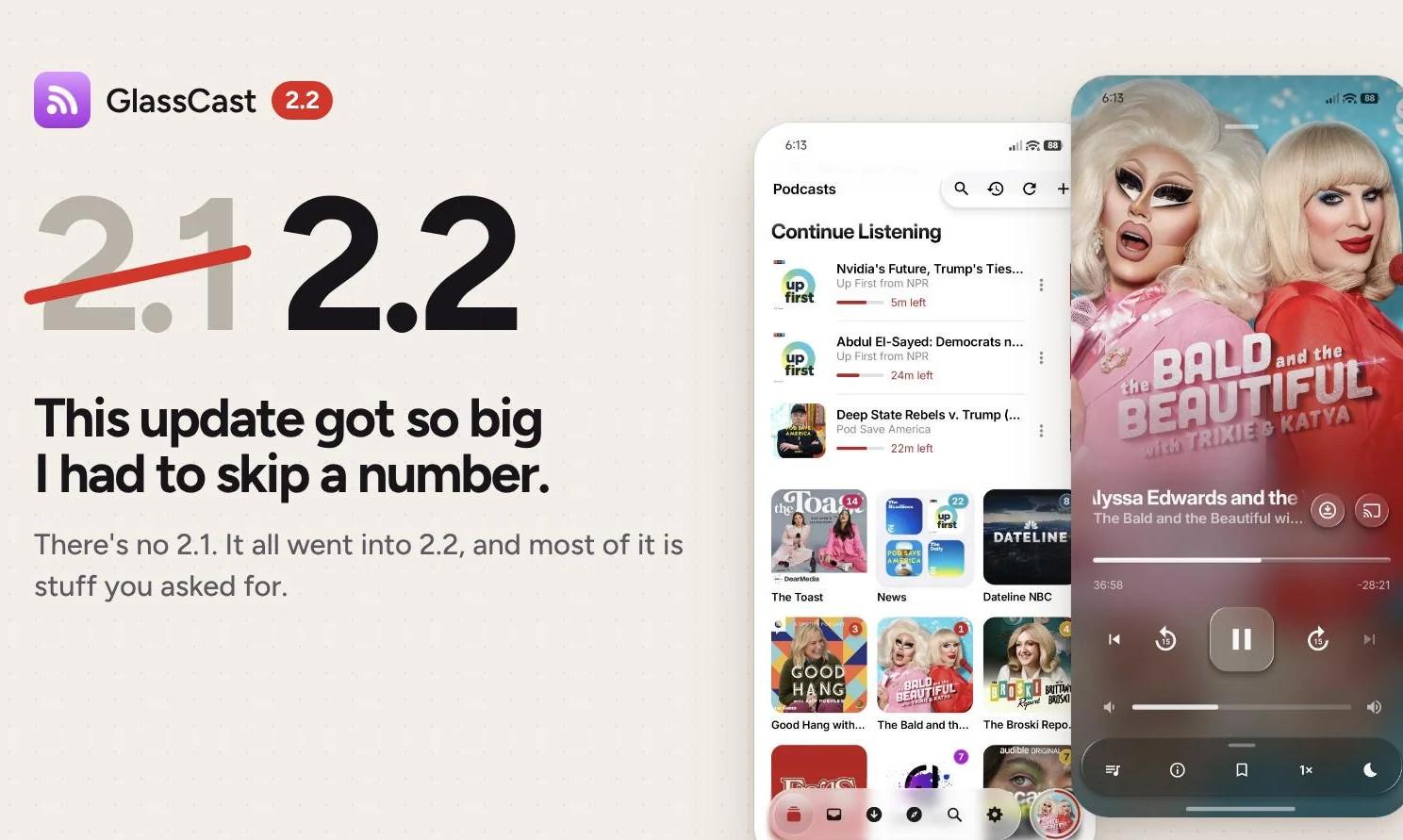
I've been building GlassCast, a podcast app for Android, on my own since September. I started it after switching from an iPhone, because I couldn't find a podcast app on Android I liked using. People kept asking for things, and 2.2 got so big I skipped a version number.

The headline feature is Skip ads, and it was the most requested thing by far. Most shows stitch ads into each download at different times, so I couldn't rely on anyone else's timestamps. Instead GlassCast fingerprints your downloaded episodes on your phone, and audio that turns up in more than one episode or show gets treated as an ad and skipped. No Al and no server, and there's an Undo when it guesses wrong.

Also in 2.2: folders with your own covers, new-episode counts in each cover's color, and a weekly listening card in History.

It's free, with no ads and no account, and open source. Get it here: https://anixitea.github.io/glasscast/

It's just me working on it, so tell me what feels off.


r/opensourcez • • 2d ago

GOKe - a zero-allocation ECS for Go that I’ve been using in real projects for months

1 Upvotes

Hi r/opensourcez,

Earlier this year I wrote GOKe, an Entity Component System for Go. Since then it has been the core of several of my own projects, including https://github.com/kjkrol/gram It has held up well, so I’m sharing it in case it’s useful to you too.

What it offers:

  • archetype-based storage, so iteration is cache-friendly
  • chunk-based SoA layout with direct pointer arithmetic - no GC pressure during iteration or component access
  • fully generic - no reflection, no interface boxing, no runtime type assertions

    go get github.com/kjkrol/goke

Repo: https://github.com/kjkrol/goke
Wiki: https://github.com/kjkrol/goke/wiki

I’d love to hear feedback, especially from anyone who has used other Go ECS libraries.


r/opensourcez • • 2d ago

Cadenza, for the piano players out there

Post image
1 Upvotes

Hello everyone!

I'm a student that plays the piano and made Cadenza. I recently stumbled to an app for learning jazz chords for the piano but I realized it needed a midi input, I however, do not own a digital keyboard. I went searching for an app that could be capable of this and only found some that converted audio to a midi file after having recorded a session. That's why I've created the following app.

Cadenza

The app uses your microphone and streams a live midi channel to apps that are midi-capable. The midi stream is close to real time, now having a sub 1 second consistent delay. Note recognition is done using a modification of Transkun, huge thanks to Yujia Yan for their transcription system. Cadenza is currently completely free, donation is of course well appreciated. The app will in future generations also generate sheet music and chord schemes, the current sheet music implementation is a work in progress which I've almost got ready. Jazz chord learning is also on the roadmap, with other genres receiving implementations in the future as well.

The app promises detection of at least 95% of notes played and recognizing those with 98% accuracy after testing. The latest version as of 21 november 12:52 includes a UI overhaul and incredibly accurate detection of the length of notes played which the app lacked before. Starring the repository is much appreciated and testing the application for yourself is just as important. Thank you for reading this and I hope this may come in handy for the target audience 😄

Link to the repo: github.com/deandromi/Cadenza


r/opensourcez • • 2d ago

PleasePrintit: a self-hosted queue for 3D print requests from friends and family (Docker, runs on a Raspberry Pi too)

Post image
1 Upvotes

“Could you print this for me?” – if you own a 3D printer you know how it goes: links buried in group chats, questions between photos and voice messages, and nobody remembers what's already been printed. So I built PleasePrintit.

What it does

- Friends submit a request by link (Printables, MakerWorld, Thingiverse) or by uploading an STL/3MF/STEP file, with filament, colour and quantity.

- You get a sorted queue with a 3D preview in the browser, a print-bed check, weight and material cost.

- “Open in slicer”: one click opens the file in OrcaSlicer, Bambu Studio or Creality Print, no helper app needed.

- Questions on the request instead of in the chat, an internal note, e-mails for new requests and status changes (can be paused).

- Friends see their queue position, later a photo of the finished print, and can print again with one click.

- New in 1.4: optional pay in advance, switchable per friend, either as a “paid” tick per request or as a credit account. Money changes hands outside the app (cash, PayPal); the app only calculates and blocks “planned” until it's paid. It came from a friend's feedback: his kids would otherwise wish for endless prints.

- Plus archive with search, statistics, a new progress bar and a UI in German, English and French.

Tech: Flask + SQLite, one Docker container, about 50 MB RAM idle, prebuilt image for x86 and ARM64 (so Raspberry Pi 4/5 works). Invite links instead of open sign-up, no tracking, no external scripts. MIT licence.

How it came about: I started it as a small private tool for my circle of friends. A test week with them followed, and since then it has grown in small steps from real feedback: 1.1 languages and slicer buttons, 1.2 archive, statistics and STEP files, 1.3 questions, photo and queue position, now 1.4 with pay in advance. I built it with AI assistance (Claude Code). I make the decisions, test it and run it myself on my NAS, and it has tests and CI.

To be fair: There are similar projects, such as PrettyPleasePrint (https://github.com/danileau/prettypleaseprint) (office, SSO) and STL Quest (https://github.com/richardsolomou/stl.quest) (several printers, print farm). PleasePrintit is deliberately smaller and meant for circles of friends. The README has a comparison based only on their own READMEs. If I misrepresent anything, please tell me.

GitHub: https://github.com/neodk2004/pleaseprintit

I'd love feedback, ideas and honest criticism, especially on installation and the pay-in-advance feature. All screenshots in the README show demo data only.


r/opensourcez • • 3d ago

After years of Plex and Jellyfin struggling on my homelab, I built my own lightweight media server - Noxa

Post image
4 Upvotes

Hi everyone,

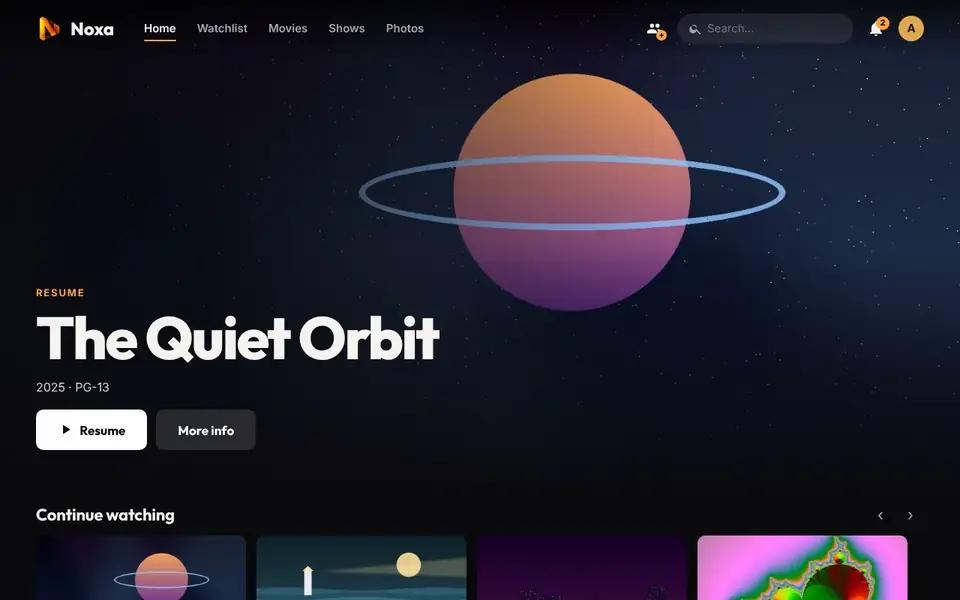
I’ve been running Plex and Jellyfin at home for years. Plex locked the features I wanted behind a paywall, and on my homelab Jellyfin kept pushing my CPU and RAM up on simple tasks like a library scan (about 10 TB of movies and shows here). I wanted something free, open and light, so I started building my own: Noxa, a self-hosted media server for movies, shows, photos and audiobooks.

It’s under the MIT license, with no account, no telemetry and no paid tier. Everything the project has is in the repo.

A few choices I made to keep it easy to run and to contribute to:

  • The server is Python with only the standard library, plus ffmpeg. No database server, no dependency to install.
  • The web interface is plain JavaScript modules, with no build step: you can read and edit it directly.
  • Apps for Android TV, Android and desktop are in the same repo, built by GitHub Actions on every change.
  • There are 200+ automated tests, and two security reviews are documented in the repo.

To be transparent: I’m not a developer by trade, and a large part of the code was written with an AI coding assistant. I review the changes and test everything on my own server, which I’ve been using every day for about a month.

Where help would be really welcome:

  • Translations: the interface is in English and French for now.
  • Testing on different hardware and setups (Unraid, Synology, Raspberry Pi…).
  • Ideas for what to build next. There’s a public roadmap in the Discussions.

GitHub: https://github.com/xenix13/Noxa

Thanks for reading, and any feedback is welcome!


r/opensourcez • • 3d ago

[Looking For Testers/Contributors] Dio - Interpreted Programming Language (Free, Open-Source, BSD-3)

1 Upvotes

Hello everyone. I've been building my project Dio (not as the anime character from JJBA but as Diogenes from Sinope) for a while now. It's small interpreted programming language, with static typing (more info about it in the repo), that's close for a new version release (0.2.0, feature wise it's done but it'slikely buggy), I would like for people to test it and report any bugs or issues (and possibly contribute with code, I'm open to that too, but testing is more than enough), I would prefer people opening new issues on github in the repository (with tags of which OS/platform you used and architecture).

Currently fully supported OS which should work:

- Linux (built on Linux should work the most)

- Windows

- Android (termux)

Should work:

- Mac

- FreeBSD

- (partially) OpenBSD

- iOS (I could run it eith some issues in the compile script) - Not Recommended

Thank you for anyone that'll check the project out, test it or even contribute with code or anything else, it'll be great help to me.

Note: please don't use any gen AI (like Claud, GPT, geminy etc.) while testing it or contributing to it, thank you for respecting it.

Repo: https://github.com/Treechcer/DIO

Live WebApp Demo: https://treechcer.github.io/DIO/


r/opensourcez • • 4d ago

Keyboard-driven terminal UI for libvirt/virsh, with vim keys and live graphs

Post image
14 Upvotes

virsh-tui shows every virtual machine on a libvirt connection with live CPU, memory, disk and network graphs, and lets you start, stop, snapshot, reconfigure and create them from the keyboard. Every action is a virsh (or virt-install) command, and virsh-tui shows you that command before and after it runs, so nothing happens behind your back and you can reuse it in a script.

It works with qemu:///system, qemu:///session and remote hosts over qemu+ssh://, with the same permissions virsh has.

https://github.com/SyscallBrain/virsh-tui


r/opensourcez • • 3d ago

Lumen 0.5: a FOSS gallery with on-device photo search, face grouping and text recognition (Apache-2.0, no Google Play services)

Thumbnail gallery
3 Upvotes

r/opensourcez • • 3d ago

Giving my coding agents a paper trail

1 Upvotes

I’ve been working on Riff, a workflow for keeping track of the decisions behind AI-generated code.

The idea is pretty simple: when you come back to a task tomorrow, or open it in another agent, you should be able to see what was decided, why, what was tested, and what’s still unfinished.

Riff saves that information in your repo. It guides the agent through investigating a change, writing a plan, implementing it, and reviewing the result. It can also flag when changes have made an earlier review stale.

It works with Codex, Cursor, Claude Code, and VS Code Copilot through a skill and a small Python CLI. You use your existing agent and models.

It’s still early, and I’m particularly interested in whether the saved context is useful enough to justify the extra process. A small fix shouldn’t need a mountain of paperwork.

Github : https://github.com/imaanmzr/Riff