r/philipkDickheads • • 1d ago

Jane and Philip

Post image
101 Upvotes

What if absence is not merely a psychological condition, but a clue that reality itself is incomplete?


r/philipkDickheads • • 1d ago

[FULL SPOILERS] I finished Ubik, and I can't stop thinking about that ending Spoiler

41 Upvotes

Major spoilers for the entire novel, including the ending. Please don't read any further unless you've finished Ubik.

I finally finished Ubik, and I'm still trying to process what I just experienced.

I was listening to the audiobook on my usual bus ride home from work. I was so caught up in the story that I couldn't resist leaving the ending for another commute: I got home and kept listening until I finished it. I haven't had a book leave me this surprised, genuinely open-mouthed, in quite a long time.

This is my third Philip K. Dick novel, after The Man in the High Castle and Do Androids Dream of Electric Sheep?, and I think Ubik might be the most disorienting of the three.

There are several scenes and ideas that have really stayed with me.

First, the half-life itself.

What disturbed me initially wasn't simply the idea of preserving someone's consciousness after death. It was how ordinary the whole thing was made to seem. The moratorium, the cold-pac arrangements, the procedures for communicating with the dead... something that should be existentially horrifying is treated almost like an administrative service. There's a bureaucracy around death, and people seem to have grown accustomed to it.

I found that deeply unsettling.

Then there's Pat and her demonstration of her ability to reverse time. That scene genuinely made me wonder whether my audiobook had somehow jumped backwards. The way Dick structures the sequence, with events simply being undone and then narrated again, left me completely disoriented.

And that brings me to the staircase scene.

Joe is deteriorating, physically struggling to climb those stairs, fighting against something that seems almost impossible to overcome. Pat is there, watching him, apparently enjoying his suffering rather than helping him. It's a disturbing, almost sadistic scene. When Joe finally makes it, I felt almost as exhausted as he must have been.

But where did that strength come from? Was it simply Joe's determination, or was Ella somehow helping him? I've wondered about that ever since finishing the book.

Joe Chip, money, and the world he lives in.

One scene that I particularly loved was Joe in the café in Zurich.

Throughout the novel, money is everywhere. You have to pay to open doors, pay for basic services, even pay for something as ordinary as taking a shower. Joe is constantly short of money, struggling with bills and trying to get by. There's something almost comical about it, until you realize how completely this society has turned everyday life into a sequence of transactions.

Then comes that wonderful moment with the coffee machine. When it's effectively threatening to call the police because Joe hasn't paid, he launches into a furious speech about the tyranny of homeostatic machines, dreaming of a world where value, compassion and simple human warmth matter more than whether someone has enough money to buy a cup of coffee.

For a moment, it felt as though Joe had stepped outside the novel and was talking directly about our own world.

I loved that scene. It made Joe feel so human to me. He's not a conventional hero. He's broke, irritable, sometimes ridiculous, and constantly trying to survive. But there's something deeply relatable about him.

Then there's Al Hammond, who essentially treats him like someone who's lost his mind.

I loved that contrast.

And I think that becomes even more important as the story progresses.

Jory, Ella, and the final struggle.

The revelation about Jory was horrifying. The idea that he needs to consume other half-lifers to sustain his own existence, and that Joe has been trapped inside a world shaped by this creature, made me feel almost suffocated.

Joe's encounter with Jory, and later the discovery that Jory is the pharmacist, are among the most disturbing moments in the book.

I also loved the sequence involving Ella, the certificate for a free supply of Ubik, and the pharmacy. Joe seems to be given a way forward, almost a mission involving Runciter, but then everything becomes uncertain again. Ubik has regressed into an older form, Jory is there, and Joe seems to be running out of options.

I genuinely thought he might not make it.

Then comes the mysterious woman who gives him another dose of Ubik. Joe recovers, she suggests that he might be able to summon her again, and he responds by inviting her to dinner at the Matador.

After everything that has happened, that little exchange almost feels absurdly ordinary. And somehow, I loved it.

But, of course, Dick wasn't finished with us.

That ending. And my theory about a third level of reality.

I can think of at least three possible interpretations of the final scene with Runciter and the coins.

1. Runciter has entered half-life himself. Perhaps he died at some point after the events we have followed, and the final scene shows him discovering that his own reality is not what he thought it was.

2. The boundary between the different levels of reality is no longer stable. The worlds are bleeding into one another, and identities, memories and events are crossing boundaries that should keep them separate.

3. There is another level of reality that we haven't identified at all.

My favourite is the third one.

We've spent the novel discovering that what we initially believed to be the primary reality wasn't necessarily the primary reality at all. But what guarantees that Runciter's world is the ultimate level? What if it isn't?

There are two details that keep bringing me back to this possibility.

The first is Sammy Mundo. Runciter explains that Sammy is in a coma, with no cortical activity, and isn't being kept in a cold-pac. Yet Joe considers him as a possible source of the strange, contradictory events they're experiencing, imagining an immature, chaotic and rather cruel personality behind them.

But Mundo was in the group that was in half-life with Joe. For me this is the clue Dick drops and dares you to notice: if Mundo is alive, why was he there with the dead?

I keep wondering why Dick introduces this detail in the first place. Is Sammy just another misleading clue, or is he pointing towards something we haven't understood?

The second detail is even more intriguing.

When Joe notices the cars and the period details in Jory's world, he realizes that Jory seems to know an extraordinary amount about 1939. An era in which none of the people around him had lived... except Glen Runciter.

Why 1939? Why is Runciter the exception?

Could the world we've been attributing to Jory actually be constructed, at least in part, from Runciter's memories? Is it Jory's world, Runciter's world, or something that belongs to a level of reality between the two?

And if Runciter himself is already dead, could his apparent reality be just another layer of the same structure?

I don't have an answer. But I find this possibility much more interesting than simply accepting that we've reached the final revelation about who is alive and who is dead.

Ubik, money, and God.

There's another aspect of the novel I can't stop thinking about: those advertisements at the beginning of every chapter.

At first, they're funny. Ubik is apparently everything: a household product, a food product, a medicine, a solution to practically every imaginable problem. The advertisements are wonderfully absurd, and they fit perfectly into the commercial society Dick has created.

But then comes the final chapter, where Ubik speaks in the first person.

Suddenly, the language is no longer that of a conventional advertisement. It sounds like scripture. Like a creation myth. Almost like God speaking:

"I am Ubik. Before the universe was, I am."

I won't quote the whole passage, but the change in tone is extraordinary.

And this brings me back to Joe's speech in the Zurich café. We have spent the entire novel in a society where everything has a price, where even the most basic human needs are commercialized. Joe explicitly rebels against that system, asking for a world based on compassion and human warmth.

And then the thing that seems capable of saving people, of protecting them against an otherwise overwhelming force, presents itself as a commercial product.

Is Dick suggesting that even the divine has been commodified? That we have reached a point where even salvation comes in a can, with an advertising slogan and a printed label?

I find that interpretation fascinating. Ubik might be a technology, a protective force, something genuinely metaphysical, or perhaps all of those things at once. But the decision to give it the language and appearance of a product seems far too deliberate to ignore.

There's also something I haven't quite worked out about Ella. Could she be the force behind Joe's unexpected strength on those stairs? Is there something almost divine in the way help reaches him when he seems unable to save himself?

And finally, that coin.

I laughed when I read the last scene. Not because it was funny, exactly, but because I genuinely didn't know how else to react.

Runciter discovers Joe Chip's face on a coin. Earlier, we had seen Runciter's face appearing on money in Joe's world. Now the situation seems to have been reversed.

What does that mean? Has Joe somehow become a presence on the other side, just as Runciter was for him? Has Joe become a force capable of influencing Runciter's reality?

And then Dick gives us those final words: "This was only the beginning."

What the fuck?!

I really like the idea that the ending doesn't simply reveal another twist, but forces us to reconsider whether there is ever a definitive level of reality in this novel. Perhaps every world we discover is just another layer, with something else waiting beyond it.

A final thought about Joe.

Of the three Dick novels I've read so far, Joe is probably the character I've felt closest to. It's actually strange, because I find him surprisingly difficult to visualize physically. I can picture the world around him much more easily than I can picture Joe himself.

But emotionally, I found him incredibly human. His relationship with money, his frustration, his vulnerability, his determination to keep going even when everything is falling apart... I cared about what happened to him.

I still don't know whether Ubik is my favourite of the three. The Man in the High Castle might still hold that position. But Ubik has certainly been the most mind-bending and, perhaps, the most purely novelistic experience of the three.

I'd really like to hear what you think, especially about a few things:

- Does my third-level-of-reality theory make any sense? Am I onto something with Sammy Mundo and the 1939 detail, or am I overthinking it?

- What do you make of Ubik itself? A divine presence, a technological safeguard, a metaphor for faith, or some combination of these?

- What do you think the final appearance of Joe's face on Runciter's coins actually means?

- And what was Pat's role in all of this? I still find her behaviour, especially during the staircase scene, deeply disturbing.

Sorry for the very long post. Apparently, finishing Ubik has left me with more questions than I can keep to myself.

I'd love to hear your interpretations!


r/philipkDickheads • • 6d ago

This is a strange one

15 Upvotes

Okay. I need to start out this post by telling you that I am not a smoker. I have never smoked regularly, only recreationally. This is in an important detail so as to fully convey the Dickian synchronicity that I am about to convey to you. Keep in mind that I will smoke, if I'm at a bar and someone has a spare, and my girlfriend smokes very infrequently. That is the first thing to keep in mind. Now comes the set up. It's an intricate one but it pays off, so please bear with me.

I work as a writer in Manhattan. I am contributing writer to a number of publications, including County Highway, which you might know as a literary publication with an Americana bent, published six times a year in the format of an old timey Civil War era broadsheet. A number of different well known authors and oddballs contribute stories on American culture and subculture. Will Self contributed a long essay, Krist Novoselic has written things, Tama Janaowitz wrote about her horse farm. Walter Kirn, the novelist is involved, so is David Samuels, long form journalist and editor, and Don Rosenfeld, publisher and movie producer. Samuels also runs a press, Panamerica press, a new imprint. It had acquired special buzz because Samuels had managed to entice the great Gary Fisketjon out of retirement to be Panamerica's new editor. Fisketjon, if you don't know, edited Bret Easton Ellis, Jay McInerney, Raymond Carver, Cormac McCarthy's 'Blood Meridian' trilogy, and Donna Tartt, among many others. A true giant, in other words. Perhaps the best literary editor of the last fifty years.

Well, about twelve days ago, Gary tragically died of a sudden stroke in his home at the age of 77. He had lived hard and unapologetically. Everyone was in an uproar of shock and grief. We still are. Gary had planned a literary luncheon for all of his friends at a Manhattan hotel restaurant. Now he was no longer with us, and the lunch turned into a wake.Samuels, who was a close friend, decided that everyone required a proper gift bag as a send off. He sent one of his friends to purchase thirty small bottles of rye, Gary's preferred tipple. He also thought that every person should have a pack of Gary's favorite cigarette, unfiltered Camels. Problem is, unfiltered Camels are hard to find. As I live in the Lower East Side and give off the impression of someone who might be able to acquire hard to acquire things, I was tasked with buying them.

Sure enough, I called three different East Village tobacconists, haggled and wheeedled over the phone and in person, and secured thirty packs of unfiltered Camels. It took three hours, a lot of legwork, and was eye wateringly expensive. But no expense was to be spared for the memory of Gary. So the luncheon was held, I was hailed as a minor hero, Gary was commemorated by his illustrious friends. Then I recieved my bag with my bottle of rye and my pack of Camels.

This is where Dick comes in. I've always been a fan, have always dipped in and out of his writing. I'd been writing about a video artist who uses alternate histories and meta histories, commemorations of pasts and futures that have not happened. To refresh my thinking about alternate, lateral and compressed realities, I reread 'Flow My Tears, The Policeman Said'. It was better than I remembered. Then I finished my piece and was hungry for more. There's a natural lull that a writer experiences after writing an intense piece that can be filled with revelry, binge watching, or reading. Why not finally read Ubik?

So I start reading Ubik. I really get into the outlandishness of it, especially the outfits, thinking that it should most definitely be a film directed by Spike Jonz in the style of 'Being John Malkovich'- just unapologetically off kilter and bizarre- and probably starring Joaquin Phoenix as Joe Chip. A little obvious, I know, but still.

As you know, Joe Chip is a psi agent who becomes trapped in a reality that appears to be regressing in time, most likely due to the influence of a malevolent young psionic who can regress time. Most of the novel is Chip struggling against accelerating entropy. He returns to his apartment only to find that his appliances have all regressed forty years. His money is out of date and he can't purchase anything. Vehicles revert back to older models. And he can't smoke a decent cigarette.

Every time he goes to smoke a cigarette, it is already so ancient it crumbles in his fingers as he watches helplessly. It's an incredibly frustrating detail in a novel that is already profoundly frustrating and disorienting. I even start to experience that disquieting reality slippage that Dick readers experience. Joe Chip is a beleaguered employee in a city dealing with higher ups and strange co workers and alluring and dangerous women. I am a writer in Manhattan experiencing very many of the same things. I also live alone in an apartment, slightly alienated and marooned in the early 21st century.

I even consult Grok about the phenomena. "Do readers or critics ever maintain that Dick's novels have, beyond the power of mere prose, some odd influence on the fabric of reality?" Grok says "Well, many people have reported strange coincidences while reading his novels, sure, but they stop short of saying he's 'magic'." Fair enough.

SPOLER ALERT: THIS IS WHERE I REVEAL MY STRANGE EVENT AND IT INVOLVES A KEY PLOT POINT

So I'm increasingly worried for Joe Chip. As you know, the members of his psionic team are all experiencing the collective effects of time regression and entropic decay, and no one knows why. He toys with the idea that all of them were already killed in a bomb blast on Luna by a rival psionic agency, and they are all wandering in a half life, an artificially induced purgatory. As Chip attempts to survive his decaying world, however, he gets cryptic encouraging messages from his boss Runciter, who he believes to be dead. Runciter, however, appears to be trying to message him directly, through television broadcasts, notes scrawled on pharmacy receipts, and in graffiti verses on bathroom walls. Runciter tells him to get ahold of a can of a spray called UBIK that will halt the regression process. Everytime he finds some, however, it has already regressed into some unusable patent medicine or powder form. And he still can't find a decent cigarette.

So I'm reading this, getting anxious and thinking "I should smoke, in honor of Joe Chip (and Gary Fisketjon)". But I can't stop reading, I'm so nervous. Its obvious that Pat Conley, the evil time regressive PSI, is toying with him. Several agents turn up dead, regressed into leathery mummies of skin and bone, and its obvious that the jig is up for Joe. Joe keeps trying, but time keeps regressing. Soon he will be a flat leathery mummy too.

Finally, Joe is terribly tired and wants to lie down. Readers at this point know that this is where you think he's had it. He's exhausted, can barely climb the stairs to his hotel room, and just wants to lie down. Pat, seemingly solicitous but obviously sadistically evil, helps him to his room. I consider grabbing a cigarette at this point out of sheer nerves, but I can't stop reading.

Finally, Joe barely manages to get his metal key into the door of his room, and shuffles in.... to find his boss Runciter, sitting in a chair. Runciter has a can of UBIK spray, quickly sprays him, and reverses Joe Chip's inexorable decay.

"Finally" I say to myself. Because honestly, the novel was starting to be a bummer. "This calls for an celebratory unfiltered Camel" I say to myself. I get up, grab one, and sit back down to read the next chapter. I light it. Then I read the following:

“DO YOU HAVE a cigarette?” Joe said.

His voice shook, but not from weariness. Nor from cold. Both had gone. I’m tense, he said to himself. But I’m not dying. That process has been stopped by the Ubik spray. As Runciter said it would, he remembered, in his taped TV commercial. If I could find it I would be all right; Runciter promised that. But, he thought somberly, it took a long time. And I almost didn’t get to it.

“No filter tips,” Runciter said. “They don’t have filtration devices on their cigarettes in this backward, no-good time period.”

He held a pack of Camels toward Joe. “I’ll light it for you.” He struck a match and extended it.

“It’s fresh,” Joe said.

I STARTED SMOKING AN UNFILITERED CAMEL, MY FIRST IN HOWEVER MANY YEARS, AT THE EXACT SAME POINT THAT JOE CHIP MANAGES TO SMOKE AN UNFILITERED CAMEL IN THE FUCKING NOVEL. I was reading about Joe Chip finally smoking an unfiltered Camel at the exact time that I had, through series of unrelated and unlikely circumstances (including the death of a great literary editor), decided to smoke an unfiltered Camel.

PHILLIP K. DICK THIS SHIT ISN'T FUNNY.


r/philipkDickheads • • 7d ago

A new Dickian here: My journey so far, and where should I go next?

17 Upvotes

Hey everyone!

I'm quite new to Philip K. Dick, and I thought I'd share how I ended up discovering his work.

Interestingly enough, I didn't approach Dick through science fiction. My starting point was actually the TV series The Man in the High Castle.

I've always been fascinated by World War II history, so the premise immediately caught my attention: what if Nazi Germany and Imperial Japan had won the war? Alternate history, and particularly the idea of a victorious Nazi regime, was more than enough to make me curious. Eventually, that curiosity led me to the original novel, and that's where my journey into PKD's work really began.

I decided to listen to the Italian audiobook, and what an experience that turned out to be!

I have to say that Italy has recently seen the release of quite a few of Dick's novels in audiobook format, and I've been taking full advantage of it. The narrators are genuinely excellent, and their performances have made the experience even more enjoyable. Angela Brusa's narration of The Man in the High Castle, in particular, was wonderful.

As for the book itself... well, I honestly wasn't always sure what I was listening to. I remember repeatedly thinking something along the lines of: "What the fuck am I listening to, and why am I so fascinated by it?"

There was something about the frantic inner dialogues, the strange atmosphere and the way Dick approached his characters and their reality that kept pulling me in. I finished the book fascinated, but also somewhat bewildered. I wouldn't say I fully understood everything, but I certainly wanted more.

So I moved on to Do Androids Dream of Electric Sheep?, again in audiobook format.

I enjoyed this one very much too. It was another fascinating experience, although quite different from The Man in the High Castle. By then I was starting to get a little more familiar with Dick's storytelling, and I found myself increasingly drawn into his fictional worlds and the questions he raises.

Something else that has really surprised me, and perhaps what I find most fascinating about Dick so far, is that his books are about so much more than science fiction.

I went in expecting alternate histories, dystopian worlds, strange technologies and mind-bending plots. And while all of those things are certainly there, I wasn't expecting to find so many deeper questions beneath the surface.

Religion and spirituality, the relationship between what is real and what is fake, empathy, identity, and what it actually means to be human. These are themes I honestly wouldn't have expected to encounter in this way when I first picked up his books.

I find it fascinating how Dick uses science fiction not simply to imagine different worlds, but to question the one we live in, and even the very foundations of our understanding of reality and humanity.

That's something I hadn't anticipated, and it's probably one of the main reasons I've become so interested in his work.

And now I'm listening to Ubik.

I'm not finished yet, so absolutely no spoilers, please! But I can tell you that I'm having a hard time keeping up with what's going on. I feel almost as bewildered and confused as Joe himself.

That familiar question has come back: "What the fuck am I listening to?"

And yet, I keep listening. I want to know more. I want to understand what's happening. I want to find out where all of this is going.

That's probably the most surprising thing about discovering Dick for me. I'm coming from a rather different reading background. I've read Orwell's 1984, Animal Farm, Zamyatin's We, but mostly because of their political and historical significance. Science fiction has never really been my main literary interest.

And yet here I am, listening to one Dick audiobook after another, constantly feeling that irresistible urge to hit play again.

So, here's my question to the community: what should I listen to next?

I'd love to hear your recommendations. Which Dick novel would you suggest to someone who is still discovering his work?

I'm deliberately not making a reading list of my own just yet. I'd rather hear from people who know his bibliography much better than I do.

Looking forward to continuing this journey!


r/philipkDickheads • • 7d ago

PKD inspired new music / video

Thumbnail
youtu.be
3 Upvotes

God knows if this will be accepted here but what the hell. I think I might be operating from a similar mental space as Philip. Too many similarities to ignore. Even my name is a sign...
👍


r/philipkDickheads • • 8d ago

Kinda thrown off by the way he describes Rachael

17 Upvotes

I'm reading "Do androids dream of electric sheep?" And I'm really enjoying it but omg, Philip (well, Deckard) constantly describing Rachael as having the appearance of a child, stating that she's 18, but then having Deckard sleep with her while once again talking about how she looks like a child, made me really uncomfortable. Specially since when they're in the hotel room he says things like "her body looked like a child, but she had the eyes of a woman, so she looked like a tennager" (that's not the exact quote, but you get what I mean) for s second a wondered if it was the translation (im not from the US so the copy I bought is in Portuguese) but there's no way that this could be the translator's fault.


r/philipkDickheads • • 10d ago

Do Androids Dream Of Dick

Post image
418 Upvotes

r/philipkDickheads • • 9d ago

The Depreciation of Universes; Entropy, Over-Patching, and the Degraded Timeline

17 Upvotes

Been going down a rabbit hole watching Philip K. Dick lectures and reading up on quantum computing lately, and this is where my head ended up. Curious what you guys think:

Has anyone else ever fixed something until it was broken? You can improve flow on a solder joint, until you melt the trace. You can follow the trace through the board, and then short it to another. You can use a jump wire at too high of a resistance, and burn out a mofset. You can replace the mofset, with a near identical one, but then forget to replace the jump wire with a lower ohm. You can replace the button cell battery, because it was corroded, and lose all backup data.

You can fix something over and over, until you have something inherently broken, and completely different from what you started with.

Is that not a possibility to explain the depreciation of universes?

The second law of thermodynamics states that entropy in a closed system never goes down; it always builds or flatlines as it drifts toward total thermodynamic equilibrium. What if there is no equilibrium anymore, not because it never existed, but because it was lost?

Look at the world we live in. Some cultures think it is bad to kill animals, while others think it is fine. Some think it is bad to kill certain animals while others are acceptable; some are food, and some are pests. Everything originally had its own role, but with humans overhunting and driving species to extinction, we have shifted the balance. If every human dropped dead today, countless animal populations would die right after us. Deer populations would die off quickly because their natural predators have been pushed back; they would overpopulate, eat everything, and get sick. There used to be an equilibrium, and now it is gone. We fixed and managed the environment until it became unrecognizable and completely dependent on our interference.

For forever, the excuse in physics was that if you go small enough, the rules of reality simply change. That explanation was enough to shut most people up, until we built quantum computers. A classical computer bit can be made with two resistors, where one is on and one is off; it is strictly a one or a zero. In reality, something fundamentally cannot be two things at the same time. Yet in a quantum computer, we freeze silicon down to absolute zero to eliminate resistance, trap subatomic particles like electrons or photons, and force qubits to be a one and a zero simultaneously. Three hundred entangled qubits can hold more simultaneous states than there are atoms in the observable universe. We are no longer just observing the quantum rules; we are manipulating them on the micro level. By learning to control superposition, we have essentially built mini gods.

Even at the bottom floor of reality, there are components that refuse to be used as switches. Quarks, the elementary particles that form protons and neutrons, cannot be isolated or observed alone; pulling two quarks apart takes so much energy that the force snaps and spawns new quarks out of the vacuum before you can ever see one by itself. The Higgs boson is the only elementary particle with zero spin. Because it has no spin, it has no up or down, and no one or zero to flip. It decays in a septillionth of a second. You cannot use a Higgs boson as a qubit because it is not a switch on the board; it is the underlying mechanism that gives matter its mass.

When the CERN supercollider slams particles together in a seventeen-mile ring to force the Higgs boson into view, or when we use quantum computers to force matter into two states at once, we are running a jumper wire across the fundamental rules of the system. Philip K. Dick spoke about God as a programmer who constantly patches and rewrites variables along a timeline, and Max Loughan claimed that after building his free-power device, CERN's collider shifted us all over one universe. What if we cannot scientifically measure the shift with our instruments, because our instruments get rewritten with the board, but we can still remember the previous state? We seem to remember small residual things like the Fruit of the Loom cornucopia, the Berenstain Bears, and Shazaam, Mandela dying in prison. Now we watch bizarre anomalies like an alleged pterodactyl bleed through in real time.

If you connect quantum mechanics, string theory, and general relativity full circle, this may sound like a harebrained theory based on connecting dots rather than math, after everything is already stacked on the table. However, if we are manipulating the quantum realm with mini gods and striking the baseline mass of the universe in colliders, we are observing the changes in real time. The equilibrium is gone, the backup data is wiped, and we are watching the board depreciate one patch at a time.


r/philipkDickheads • • 10d ago

Minority Repost

Post image
345 Upvotes

r/philipkDickheads • • 8d ago

Doppelgangers

Thumbnail
gallery
0 Upvotes

not sure where to post this, but I figured this sub might be more receptive.

so I reckon Thomas hardy, looks similar to William Wyman - 2nd picture.

3rd pic is Charles Morse, who looks similar to Einstein.

4th is George W. Creamer, who looks similar to a younger Charles Morse - 5th picture.


r/philipkDickheads • • 11d ago

Birthday Present for my Husband (OC)

Post image
44 Upvotes

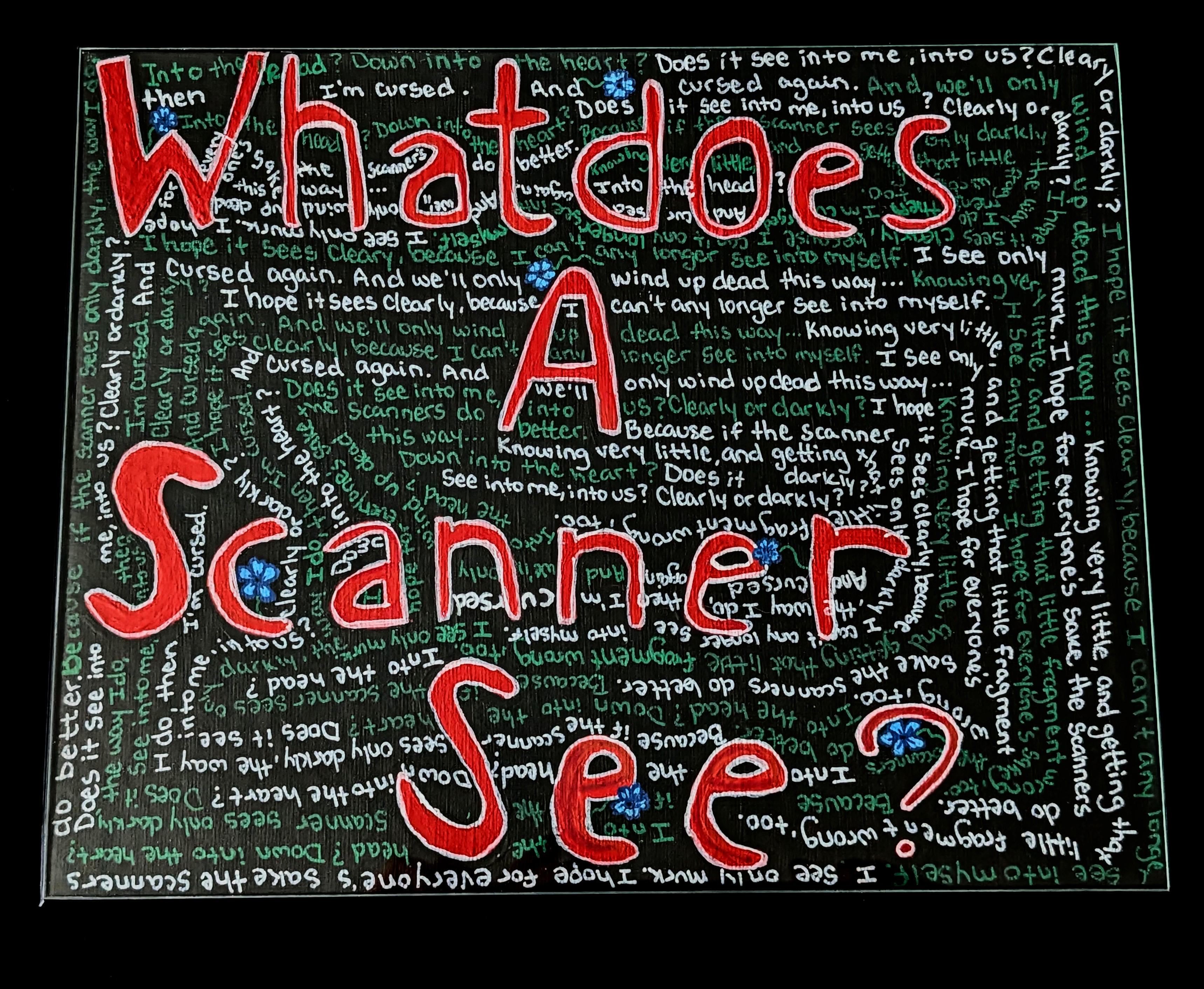
I made this art piece, using acrylic paint and acrylic paint pens, for my husband as a birthday gift. A Scanner Darkly is our favorite book & movie by PKD. It's a little wonky, but we both really like how it turned out and he encouraged me to post it here. Hope you like it! :)


r/philipkDickheads • • 11d ago

I noticed a striking synchronization recently when discussing data centers and it immediately made me think of the story of AUTOFAC. Will data centers consume all resources? Are they a form of population control and is our planet being terraformed?

14 Upvotes

r/philipkDickheads • • 13d ago

Finished my 9th pkd book, Vulcans hammer

Post image
125 Upvotes

I've actually read the whole of second variety short story collection up until the last story before this, but couldn't quite get it done before holiday -second variety was a little big for my bag, so Vulcans hammer became the 9th pkd consumed! I enjoyed this one a lot, the bureaucratic nightmare u folding, the distrust and paranoia of the unity system and the war between Vulcan machines were all a great deal of fun. It's interesting to compare to his later work I have read like maze of death, the writing style and structure is certainly quite all over the place, but personally I found it to be a smoother read than solar lottery. Dr futurity and time out of joint left before I venture into the 60s stuff. I'm going to read a couple of ae van vogt novels next though, a dick break (after I finish up second variety)✌️


r/philipkDickheads • • 13d ago

Looking for a short story about maintenance engineers

4 Upvotes

A long time ago I read one his short stories which was about a world - maybe a colony on the moon? - where everything was automated so no-one worked except maintenance engineers. But I can't remember the title - can anyone help?


r/philipkDickheads • • 14d ago

The Owls Are Not What They Seem: On “Do Androids Dream of Electric Sheep?”

Thumbnail
gnosticpulp.substack.com
16 Upvotes

On “Do Androids Dream of Electric Sheep?” and Don DeLillo’s “Underworld”, etc.


r/philipkDickheads • • 15d ago

A map of Philip K. Dick's books and the 22 films that come from them, from Blade Runner to The Matrix

Thumbnail
films-of-philip-k-dick.mapnil.page
165 Upvotes

r/philipkDickheads • • 15d ago

New Publisher of books about PKD

3 Upvotes

Relatively new book publisher, Wide Books, is publishing books, primarily reference type. Has anyone gotten books from them? Any that should be more widely known?


r/philipkDickheads • • 16d ago

Holiday pkd🏝️🏖️🌴

Thumbnail
gallery
37 Upvotes

Yes, I did consider the title of this post to be "holiday dick" but I decided we are better than that!

I'm on holiday and I grabbed these for my reads. I read 50 pages of Vulcans hammer on the plane and absolutely loved it. Doesn't seem to be one of his highest praised novels from what I can tell but I'm very much enjoying it so far! Will be my 9th pkd, I've nearly finished the 50s stuff now. I'm interjecting a few AE van vogt books into the mix as I'd like to get into his work too, monsters will be my first of his. I've read plenty of Herbert over the years. Do let me know if you guys know of a good AE van vogt thread. I absolutely feel like I'm at one of the resorts mentioned in "the man who japed" - still, just because the paradise is false, doesn't mean you can't enjoy it!


r/philipkDickheads • • 17d ago

The Mainstream That Through the Ghetto Flows | An Interview with Philip K Dick (1974)

Thumbnail 1999pkdweb.philipdick.com
27 Upvotes

The whole interview is quite good and worth reading. But one thing I particularly found interesting and wanted to highlight was Dick's opinion of some of his fellow science fiction writers. He was particularly harsh on Silverberg, Le Guin and Delany. The ones for whom he had nice words to say are Malzberg, Disch and Sladek. I am sharing those parts below with a bit of snipping:

Interviewer: Who do you think is any good?

Dick: In the field? Well, most of the people I think are any good are apparently dropping out of the field. So if I say they're any good, they'll probably deny that they ever were science-fiction writers. Tom Disch, Barry Malzberg, Phil Farmer....

Interviewer: Silverberg?

Dick: I never read anything by Silverberg I liked. I don't like Harlan Ellison's stuff either. I like Norman Spinrad and Catherine Kurtz, who writes fantasy, I guess. She's also very pretty.

Interviewer: Le Guin?

Dick: Well, as Jesus said to Pontius Pilate, "You said it, not me." ''Du sagst." That's Luther's translation. "Bist du Konig?" says Pilate, and then Jesus answers, ''Du sagst"\--"You said it, not me. If that's what you say, Pontius, that's up to you. You're the imperator." I can't answer about Ursula's stuff, because I really don't understand it. Her whole body of writing seems to me like a kind of political sermonette all gussied up with literary style. But when you strip the style away, it's all from the poli-sci department at the University of California at Berkeley.

On Barry Malzberg:

And there's Barry Malzberg, who published the most marvelously crazy statement in the universe. In all the history of science fiction, nobody has ever bum-tripped science fiction as much as Barry Malzberg did. And I think he's a great writer. But you don't break up a marriage that way and you don't leave science fiction that way, by saying, "Everybody in it is rotten and everything that has ever been written is rotten, except what I wrote." Which is what Malzberg said. But he's going on to bigger and greater things.

On Kurt Vonnegut:

And then Vonnegut. Vonnegut has always never written science fiction. Or so he discovered when he looked back over his career and discovered that he'd made a lot of money at some point. And at that point, retroactively he became like the Pope, who gets to say, "Everything I say is true, and I never was writing science fiction, even if you read Player Piano and thought it was science fiction. You were wrong. And Cat's Cradle likewise. And Sirens of Titan. They're not science fiction because I say they're not science fiction. Come to me and I will tell you." That's what Harlan always says, too.

On Robert Silverberg:

He's rich. I don't know how come he is; I can't figure it out because none of the rest of us are. I've always asked him that same question over and over again, and he just smiles that superior, enigmatic smile of his which means, "I know something you don't know, and that's why I'm rich and you're not." He didn't make it from science fiction, because if he did, he sure does know something I don't know. I think he reinvested his royalties in a Pizza Hut or something.

On Samuel Delany's Dhalgren:

I read part of it, and Harlan Ellison and I agree that it's a terrible book. It should have been marketed as trash. I just started reading it, and I said to myself, "This is the worst trash I've ever read," and I threw it away. And Harlan did the same thing, sitting up there in Sherman Oaks where he lives on that steep hill.

On Thomas Disch's Camp Concentration:

One of the greatest science fiction novels ever written. Everybody turns brilliant from getting syphilis, and I always meant to ask Tom where he got the idea that getting syphilis made you brilliant. He told me, peripherally, that Thomas Mann had syphilis--in fact, tertiary syphilis and the more his brain burned out, the more brilliant he got. So Camp Concentration posits that syphilis will speed up your mentational process. Like hell, it does! In any case, I think my book is sadder than Camp Concentration, in a way. (the book he was talking about here is A Scanner Darkly).

On John Sladek:

Sladek did a parody of my writing which is much better than anything I've ever done. I was walking on cloud nine after I read that parody. I wrote Ed Ferber, who's editor of F & SF, and I said, "I have talent. Sladek has genius." And Ed Ferber wrote back and said, "Fine, I'm going to buy a lot of stuff from Sladek now." And he did; he commissioned eight more parodies, all of which are marvelous. Sladek's book is called The Steam-Driven Boy and Other Strangers. His parody of me is called "Solar Shoe Salesman," in which somebody consults these tiles which tell him, "Many small greatnesses denied, no saying. It does not further to discover gifts only. The wise king avoids fried foods." I'm looking at this parody and I'm saying, "If I could write as well as Sladek...."

On Richard Lupoff:

Interviewer: A month ago, I interviewed Richard Lupoff, a good writer, probably best known for Again Dark Visions. . .

Dick: . . . His wife's very pretty, too. I tried to pick her up in a bar once. Didn't know it was his wife. The most amazing thing happened: I found myself in the parking lot stretched out flat. Lupoff sure has a short fuse.


r/philipkDickheads • • 18d ago

Mercerism

44 Upvotes

I just saw a trailer for a new Bladerunner 2099 series, and it looks like Mercerism will finally be depicted in a Dick adaptation. I saw an advertisement for Mercer in one shot, and later what looked like moment he is knocked into the pit of corpses? How do y'all think they'll do it? Are folks interested in this adaptation/sequel?


r/philipkDickheads • • 21d ago

Thought you people might enjoy this

Post image
209 Upvotes

It's a sample from a print shop.


r/philipkDickheads • • 21d ago

Podcast about the PKD short story "Stability."

12 Upvotes

If anyone is going to appreciate this podcast episode, it would be this group. A lengthy discussion about one of the earliest-written and last-published of PKD's works.

"Nothing Can Destroy Stability." -- The Philip K Dicksquisition


r/philipkDickheads • • 22d ago

When Philip K. Dick thanked Le Guin for criticizing him

Post image
258 Upvotes

r/philipkDickheads • • 22d ago

Like the game they're playing in Galactic Pot-Healer

Thumbnail reddit.com
7 Upvotes

Joe Fernwright plays it