only performance problem is not using sized comparison operator, due to decay of char[] to char*. so yeah, string_view advice is okay, but this is a joke code, it will not fly in production anyway.
well, acktually, short string optimization should handle all these strings on any common compiler.
For a std::string, gcc and msvc don't perform allocations until you reach 16-character strings, and clang can hold 21 characters without an allocation.
That's the fix, yeah. You tell it where you do want to allow fallthrough, so that it can tell you if you ever forget a break anywhere else.
At this point, I don't think it's possible to change the standard so that the language automatically inserts breaks, because that would break a ton of perfectly legal code. It might be possible to add an attribute for it, like [[auto_break]], though, perhaps?
Well, no, it can't be changed now, but I was talking about what I might be okay with if the language had been designed differently, or if I was using a different language without automatic fall through.
Fallthrough exists so switch can make sparse jump tables just as easily as it makes fully-populated jump tables. It's insanely useful in a few very specific scenarios, and insanely useless in almost every other scenario.
Ideally, it should've been opt-in instead of opt-out, but it's probably much too late to change it now.
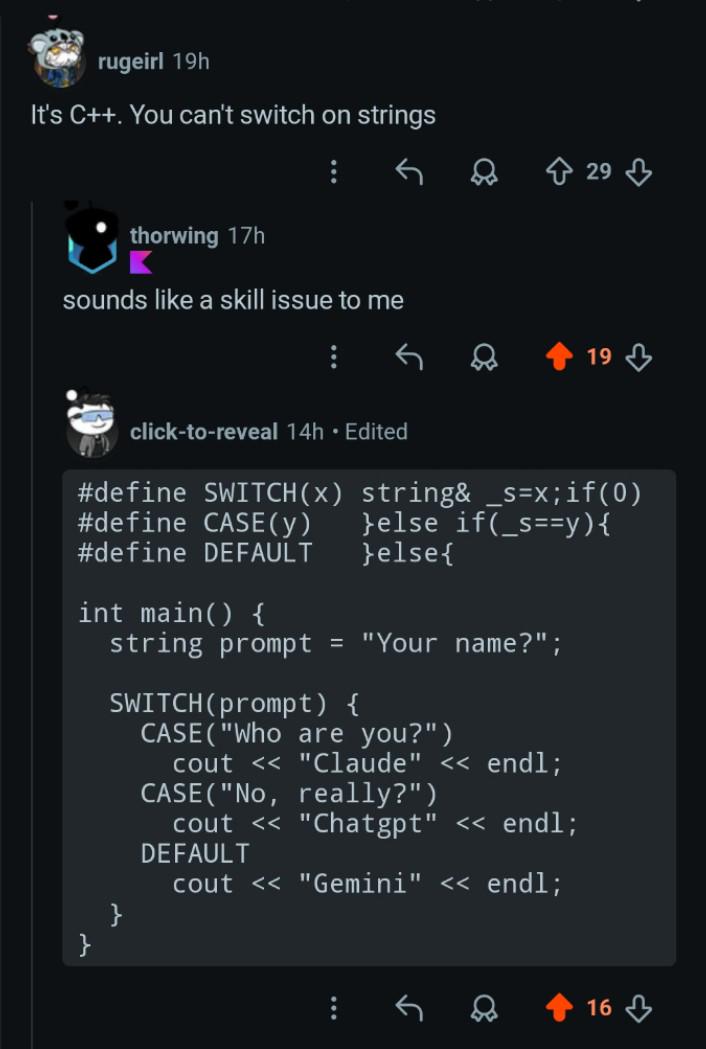
That's not a switch, though. By switch logic, the case "Who are you?" would result in all the prints being done. There is a reason why switches come with break, and this is not just because they felt like it but by design, allowing you to bundle cases.
For anyone wondering, the correct answer is a string pool or equivalent, anything that can map a unique string to a unique number. You'll need to hardcode the indexes, though, since cases need to be known at compile time. You can locate the index by sorting the strings and using a binary search, and then switch on that index.
...And since that's probably not reasonable for what you want, this means that the sane solution is probably to use a map. ...Which means you need to look at your string collection to see whether std::map, std::unordered_map, or some other map will be better. (Generally, tiny pool prefers std::map, larger pool prefers std::unordered_map, and a million other factors will skew it in one direction or the other. Prefer unordered_map if you don't know which is better, but it's best to test it to be sure, and ideally replace it with a precompiled mapping (such as, e.g., a static array or hard-coded pool).
Whichever one you choose, the goal is to map each string to a function, so you can create a string-indexed jump table. (Performed by either switching on the index, or mapping function pointers to strings, or something of the sort.) switch is an integral-indexed jump table, so a properly implemented string-function map is the closest thing to switching on strings.
first thing im seeing is fallthrough, even if it did work. Second thing Im seeing is this not working cuz of it asking if the pointers are equal or something. I had it drilled into my head (Java in university) to avoid searching for string equality so I never tried this before.
The strings make it look like there might be user input, but it's all just constants, and simply evaluates to the default case. That's somewhat confusing.
I thought about the printing afterward, because originally I thought the program was asking the end user for their name. So I was trying to make a joke, but I added that disclaimer in case of misinformation. LLM content is generally unsourced, so I felt like making it clear where it came from. (The reason I used more than one was because "I check with another LLM" was one of the options somewhere on r/polls.)
16
u/L_uciferMorningstar Sep 05 '26
https://isocpp.github.io/CppCoreGuidelines/CppCoreGuidelines#es31-dont-use-macros-for-constants-or-functions
Leaving this here
4
u/mrheosuper Sep 05 '26
Can you have switch case inside switch case ?
341
u/i_dont_like_pears Sep 04 '26
As long as it compiles
That's all that matters
167
u/Star_king12 Sep 04 '26
That's fucking vile.
48
u/LeeHide Sep 04 '26
This would be much better using std::string_view, and using two temporaries so that
yis only evaluated once. Otherwise it'll be evaluated each time.Also if you need this, don't use C++
44
u/jolharg Sep 04 '26
Oof i did not like this post
89
u/lurebat Sep 04 '26
I think it allocates since they didn't use const
20
u/jaerie Sep 04 '26
That's still not a switch case, there's no fall through
2
u/Infamous-Bed-7535 Sep 04 '26
You can switch on string hashes since we have constexpr.
2
u/tandycake Sep 05 '26
I feel like you could use goto and labels instead and also have fallthrough.
If want to avoid macros, gotos, and labels, could make a switch_str func with an unordered_map and lambdas, but more overhead and slightly slower.
2
u/Ksorkrax Sep 06 '26
That's not a switch, though. By switch logic, the case "Who are you?" would result in all the prints being done. There is a reason why switches come with break, and this is not just because they felt like it but by design, allowing you to bundle cases.
2
u/conundorum Sep 06 '26
For anyone wondering, the correct answer is a string pool or equivalent, anything that can map a unique string to a unique number. You'll need to hardcode the indexes, though, since
cases need to be known at compile time. You can locate the index by sorting the strings and using a binary search, and then switch on that index....And since that's probably not reasonable for what you want, this means that the sane solution is probably to use a map. ...Which means you need to look at your string collection to see whether
std::map,std::unordered_map, or some other map will be better. (Generally, tiny pool prefersstd::map, larger pool prefersstd::unordered_map, and a million other factors will skew it in one direction or the other. Preferunordered_mapif you don't know which is better, but it's best to test it to be sure, and ideally replace it with a precompiled mapping (such as, e.g., a static array or hard-coded pool).Whichever one you choose, the goal is to map each string to a function, so you can create a string-indexed jump table. (Performed by either switching on the index, or mapping function pointers to strings, or something of the sort.)
switchis an integral-indexed jump table, so a properly implemented string-function map is the closest thing to switching on strings.1
u/exneo002 Sep 04 '26
I haven’t done cpp since college. How does it get the string into memory?
1
u/imgly Sep 04 '26
hash exists
1
u/iEliteTester [ $[ $RANDOM % 6 ] == 0 ] && rm -rf / || echo “You live” Sep 04 '26
I once thought it was a good idea to do command line argument parsing by hashing each flag at compile time so I could hash and switch on argv.
1
u/AiMeusPancrea Sep 05 '26
Thanks I hate it
1
u/jakeStacktrace Sep 05 '26
Omg switch it "the fuck off"
1
u/El_RoviSoft Sep 05 '26
Long ago saw a beautiful implementation with defines and hash maps
1
u/Winter_Rosa Sep 05 '26
first thing im seeing is fallthrough, even if it did work. Second thing Im seeing is this not working cuz of it asking if the pointers are equal or something. I had it drilled into my head (Java in university) to avoid searching for string equality so I never tried this before.
1
u/mikica1986 Sep 05 '26
Azathoth take me. Yesterday.
1
u/GoddammitDontShootMe [ $[ $RANDOM % 6 ] == 0 ] && rm -rf / || echo “You live” Sep 05 '26
I guess this wouldn't be completely impossible to do in C with const char * and strcmp().
1
u/Krisanapon Sep 07 '26
1
u/Brilliant-Parsley69 Sep 07 '26
Am I a bad person because I really like that?
1
u/SpaceMoehre Sep 08 '26
That’s not how switch works…
1
u/ItsNukea Sep 12 '26
I am SO deadass going to use this...
1
u/Beetmaker69 Oct 20 '26
Absolutely
-3
u/MurkyWar2756 echo "Sub Mod" && :(){ :|:& };: Sep 04 '26 edited Sep 04 '26
If you change
GeminitoHello, world, technically you've printed "Hello, world", although you might need this:I don't know C++ at all, please let me know if the two LLMs I got that information from were wrong