r/programminghumor • u/ItsPuspendu • Mar 18 '26
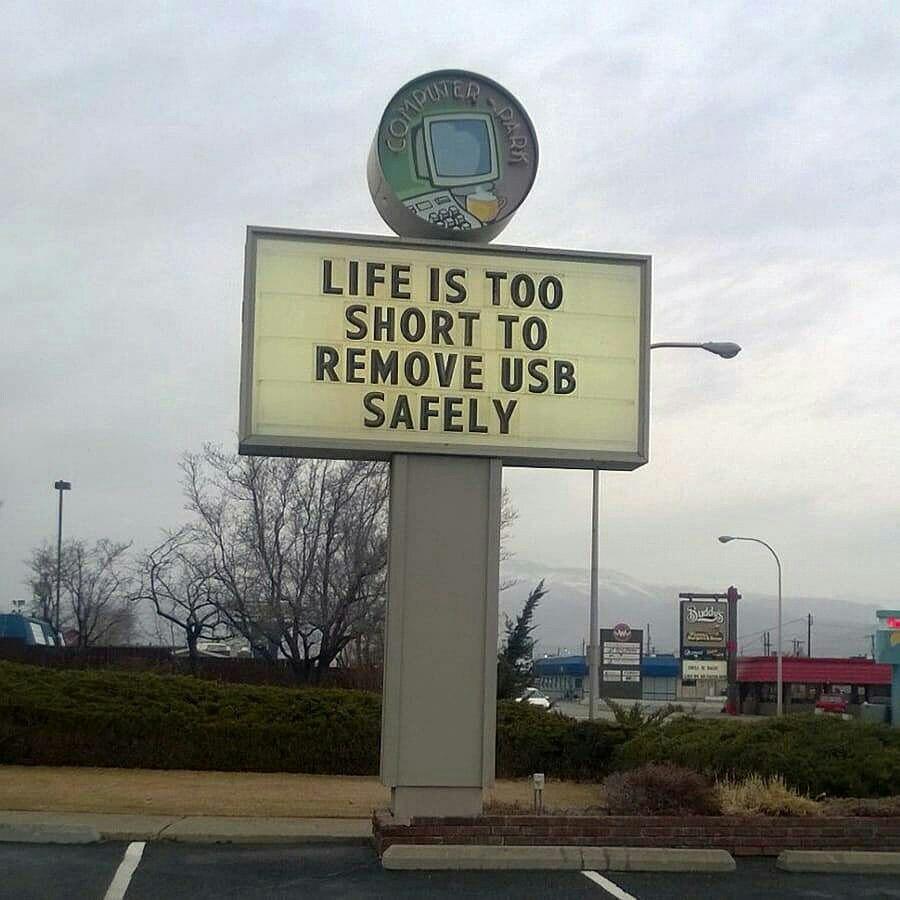
Safely Remove? Nah, I Live Dangerously💾
1.1k
Upvotes
r/programminghumor • u/ItsPuspendu • Mar 18 '26
15
u/csabinho Mar 18 '26
Once I f...ed up my iPod library by not safely removing. And also, if you're allowed to safely remove, you know that you've got no open files that could be lost. So it's actually quite useful.
7
u/jontsii Mar 18 '26
same thing for hardware
4
u/Circumpunctilious Mar 18 '26 edited Mar 18 '26
(Serious, for anyone interested how IT might mitigate): so they can’t remember “surprise ejects” are bad?
Now it’s generally safe to pull the drive without “safely ejecting”, as long as it’s not during a lights-blinking write. Tell them to pull when the light’s steady.
Caching is useful for stable power, if you’re mixing deletes and writes (fixed up in cache) or have lots of tiny operations, which has ridiculous overhead.
For reasons above, then ironically: since “safe eject” flushes cache once on demand (one suboptimal write) and disabling cache flushes (likely terrible, suboptimal outputs) with every write, then presuming they obey the write light, making USB safe to surprise eject will actually slow them down.
1
u/summer_santa1 Mar 18 '26
Sure, if you want to make your USB read-only all of the sudden.
1
u/HalifaxRoad Mar 19 '26
I have never safely removed a device and never had a problem....
1
u/ByteBandit007 Mar 19 '26
Ahoy
1
u/k-mcm Mar 19 '26
Ubuntu disables synchronous writes for USB drives. It gives you something like 10GB/s write throughout, but it's not ready to eject for half an hour.
1
u/TheFreeBotGuy Mar 19 '26
You opened my eyes.
1
u/M1CH4L3Q Mar 19 '26
damn i even forgot about that option
1
u/FAMICOMASTER Mar 21 '26
Knowing the rules allows you to break them. I know that this exists to let the write buffer flush so if I haven't done any writes I'll just pull it
11
u/[deleted] Mar 18 '26
[removed] — view removed comment
1
u/[deleted] Mar 20 '26
[removed] — view removed comment