1-indexing makes sense in a vacuum, at least for high-level languages where you aren't thinking of indices as pointer offsets, but in a world where 0-indexing is the default, deciding to go against that norm does nothing but cause confusion
The Unix terminal uses a 1-,based coordinate system! It made as o much of a mess for nested drawing areas, I just do it all 0-based and add 1 when generating the ANSI escape code.
Fortran was the first widely used language and is 1-indexed, as is the older language "autocode". So 0-indexing came later and had to buck the existing system
Funnily enough, you can do 0-index table by "hacking" it
local t = { "B", "C", "D" }
t[0] = "A"

local inext = ipairs({})

for i,v in inext, t, -1 do
    print(i, v)
end
Which you can wrap in your own ipairs version
local inext = ipairs({})

function ipairs0(table)
    return inext, table, -1
end

local t = { "B", "C", "D" }
t[0] = "A"

for i,v in ipairs0(t) do
    print(i, v)
end
function inext(table, previous_index)

    local next_index = previous_index + 1
    local next_value = table[next_index]

    if next_value == nil then
        return nil
    end

    return next_index, next_value
end
That's too simple. Because we use tables anyway intex it like this 10n * (-1)n -1. So the first will be 0 and the security will be -11 then 99 and so on
You could do that yeah, but again, lua starts treating the array as a dictionary, and eventually you end up with code that keeps trying to offset the index start. Until you miss a spot and the code breaks 😅
I hate that lua starts array indices with one, but I leave it alone, just an opinion though ¯_(ツ)_/¯
Arrays starting at one are a good thing for some data structures, such as with binary heaps. Otherwise you have to do some flooring math and it’s annoying.
Lack of class syntax to automate the prototype-based OOP it has.
"Everything is a table!" means the length operator has undefined behavior
It has floats and ints, but really doesn't want you to know, which can result in odd results from math since the ints are wrapping
I think it just went a bit too far into the idea of simplicity. And if you correct it, you are very close to JS with stackful coroutines as a library (good thing) rather than async/await.
That being said, it was the first language I had a lot of fun programming in, mostly in ConputerCraft. I loved it enough to be the guy who wrote half of the StackOverflow wiki on it back in the mid 10s.
Thank you so much, from my 12 year old self. I spent so much time on ComputerCraft, learning everything between StackOverflow and YouTube videos. I never would have built half the insane stuff I did without people like you!
The class syntax is not a big deal, plenty of libraries doing that.
It should be said that yes, the length operator has undefined behavior but it's only for sparse arrays, this is why table.pack returns an .n, for length, if you're going to have sparse arrays, add a __length that does what you want, sadly, once you have sparse arrays, it's hard to know the length unless you use next() and check all the keys, returning the largest element, you have to be careful with sparse arrays.
Tables can and should be used to create the data structure you want, sometimes I want to use sets and you can easily treat lua like an array language with operator overloading
3. I don't know what you mean... math.type() returns the number subtype, it has functions to convert to an int or float
That there's no proper array, but only array-like tables is by far the worst sin of Lua. You can write as many fancy helpers, but you can never outclass the wackyness that deep in a language.
Are you a programmer or did this subreddit get randomly recommended to you?
Anyway, an array is a list of elements in a sequence, usually represented by brackets, so:
[10, 5, 7, 2, 1] is an array with 5 integers.
In programming, more often than not, array counting starts at 0, so the 0th number here would 10, 1st would be 5, 2nd is 7, etc.
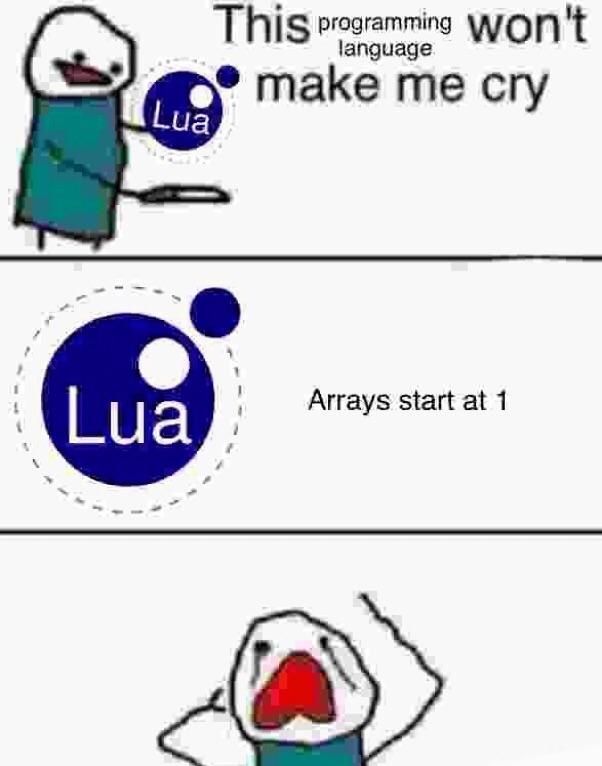
Lua is a programming language that this counting starts at 1 instead of 0, which although is more intuitive for most people, it isn't for experienced programmers
That's how arrays usually behave. If you want something dynamic, that requires constant reallocation to resize, which isn't always desireable. At a low level, arrays don't even exist. It's just raw memory. And in order for arrays to keep growing, you have to keep moving them to new places in memory that have enough space to hold all of the elements. Normally, the array grows by a factor of 2 upon resizing so that the next resize is further away each time.
È una lista di variabili (praticamente numeri o stringhe che decidi tu). Di solito, negli altri linguaggi di programmazione, il primo elemento di un array ha l'indice (il numero che usi per riferirti all'elemento) "0". In lua il primo elemento ha indice "1" che seppur possa sembrare più intuitivo finisce per essere il contrario.
Data collection formed in memory. Like you have 25 elemets of float. You need 25×float_size memory. Every elemet have iterator, like integer number, and you get access in memory use iterator*float_size. Array always direct to first element in memory. So, full access formula is first_element+iterator×float_size. And this is why array start with 0 iterator.
It's like a list, and each spot holds a value, and most start with 0 (code reasons), but in lua it's 1, which makes more sense to a person, but not to coders.
C does arrays using 0 plus an offset, whereas Lua just gives you the index itself.
It's actually why you can write 0[arr] instead of arr[0] and it still works just fine.
Other languages just follow the "0 + offset" design as convention. But Lua's way actually make more sense for a super high level language that has you never even thinking about memory
Other languages just follow the "0 + offset" design as convention. But Lua's way actually make more sense for a super high level language that has you never even thinking about memory
By convention and no other reason. None whatsoever. Because range computations make so much more sense with 1-based indices. /s
You trade one thing for another. All the .size-1 vanish with 1 based indexing and some other math becomes simpler.
Of course in exchange for the math that 0 based makes simpler, so it depends on what your language wants to do, both are valid, though I prefer allowing both.
One of it's inspirations is awk, which only has associative arrays as it's only structure type, if you want to keep the language small, associative arrays is the way to go.
I asked someone who made an embedded DSL if they had considered Lua before they wrote it, and they said "What's Lua?" I knew right then that their language was shit.
nope. its a scripting language, gaining popularity because of its readability and so on. its amount of use cases are almost comparable to python. its used in Factorio and lots of other games
I'm working on a mod for Friday Night Funkin' and I'm really dragging my feet at having to do some Lua scripts for it. I live in a world of Java and C++ smh
I like Lua as an embedded language (for modding and things like that). It definitely has a few quirks, but I find the only thing that really annoys me anymore is the lack of a continue statement.
Also depending on lua version some metatable methods have some unexpected behavior too, usually in the form of just deciding not to work at all for a particular data type as the value.
for k,v in pairs(tabl) do into[( #into - 1 )+ 1] = v end
When you fill an array, you count the length which returns 0, and add one to it, if the index was 0 based, you'd have to reduce the length first, there's many places which an offset is best, but when it comes to indexing, you want it 1 based.
That screws over half the people. We should agree that arrays can be indexed by arbitrary enumerable types like Pascal/Ada, so whichever you need you can use. It makes Array's so much safer and nicer while making everyone happy.
Unpopular opinion: it is the right way of counting. You don't count 0 apples, 1 apples,.. The only reason programmers start from 0 is because they save 1 bit by doing that. The first element in an adress is at Offset 0.
We don't need that today because we swim in memory. We only keep it for historical reasons
It's not at all about saving a bit. It's because if you index by offsetting the initial array pointer by some number, which is the cheapest and simplest way to do arrays, you get this kind of indexing.
251
u/y0shii3 7d ago
1-indexing makes sense in a vacuum, at least for high-level languages where you aren't thinking of indices as pointer offsets, but in a world where 0-indexing is the default, deciding to go against that norm does nothing but cause confusion
57
u/schewb 7d ago
What's worse is that you can fully legally assign and access index 0; the typical iterators just won't ever hit it.
21
u/Simpicity 7d ago
LuaU: It's like Lua but with OO and typechecking!
Me: Oh, I should typecheck my objects.
LuaU: I wouldn't if I were you...
16
u/carltr0n 7d ago
Can someone fork Lua and make it exactly the same but with zero indexing? Call it zlua?
12
u/0xt0bi03 7d ago
really??
12
u/teetaps 7d ago
R also starts at 1 and it was my first programming language, so imagine my surprise when I learned it’s an outlier
7
u/DefenitlyNotADolphin 7d ago
Any undeclarated variable is undefined, I think that's a larger comcern
12
u/Techrocket9 7d ago
1-indexing arrays is far from Lua's greatest sin.
6
u/ilmaestrofficial 7d ago
What's an array?
11
u/Gabriel_Science 7d ago
Yeah, it’s like saying the first number on a ruler is 1. It’s 0.
5
u/mapadofu 7d ago
The figure in the cartoon is E.W. Dijkstra
https://www.cs.utexas.edu/~EWD/transcriptions/EWD08xx/EWD831.html
5
u/NoodlyGirl2000 7d ago
that’s horrific lmao
6
u/chkno 7d ago •
In most languages, the syntax for array indexing is to enclose the index in
[and].Lua has a more verbose syntax where you have to enclose the index in
[and+1].4
u/cc_apt107 7d ago
it’s not a big deal bro
2
u/Haja024 5d ago
Lua is weird because it's like, "what if C but everything is tables" and nothing but games and Wikipedia runs on it. Which is a weird2 overlap.
5
u/GoogleIsYourFrenemy 7d ago edited 7d ago
I asked someone who made an embedded DSL if they had considered Lua before they wrote it, and they said "What's Lua?" I knew right then that their language was shit.
3
u/-Ambriae- 7d ago
Lua pains me so much I’m currently writing a replacement for it
2
u/Sad-Zucchini-949 7d ago
Is this a joke language like brainfuck?
1
u/Inst2f 7d ago
0 element would be the head of the table
1
u/jas2365 7d ago
Just found lua for lazyvim. Any advice
1
u/coldnitrogen 7d ago
Fortran has entered the chat ...
1
u/pseto-ujeda-zovi 7d ago
And people hate JS
1
u/Logical-Pause-3758 7d ago
Guess what `—` means
1
u/Maleficent-Bag-4850 7d ago
This is unacceptable
1
u/bschlueter 7d ago
You can make them start at zero if you want.
1
u/timonix 6d ago
Eh, I prefer arbitrary ranges. Have an array go from -6 to 53
1
u/overclockedslinky 6d ago
oh no, how traggic. anyway...
1
u/qwertty164 6d ago
Not to be confused with licensed user agreements.
1
u/zrice03 5d ago
Meanwhile in VBA:
Baby, I'll start an array wherever you want.
1
u/ThePython11010 4d ago
I like Lua as an embedded language (for modding and things like that). It definitely has a few quirks, but I find the only thing that really annoys me anymore is the lack of a
continuestatement.1
u/kinchkun 3d ago
- 1972: C doesn't have proper arrays, because dennies ritchie sucks at designing a language.
- 2026: Mediocre programmers still think it is good design that counting starts at 0, because they never question what they are used to
1
u/zeantar 3d ago
Never understood why it's such a big deal for people tbh.
1
u/PlainBread 3d ago
0 no
1
u/Brave_Abbreviations5 3d ago
SCILAB damnn
1
u/Zuruumi 3d ago
Let's go with prime sieve indexing. Arrays are indexed by numbers from 1, but all primes get skipped.
1
u/no_brains101 2d ago
that isn't even the worst part to be honest.
Try arrays with absent elements in the middle.
Also depending on lua version some metatable methods have some unexpected behavior too, usually in the form of just deciding not to work at all for a particular data type as the value.
Somehow still better than python.
1
u/_luki 2d ago
Wait.. WHAT THE FUCK?!?!
1
u/reesa447 1d ago
We have lua at work that needs to be updated like once every 3 years. Just long enough to completely forget how it works
1
u/zhaDeth 1d ago
the horror
1
u/masteraider73 1d ago
R
1
u/Adn0nnymous 7d ago
0-index lowkey sucks i loooovee 1-indexed arrays! if i have three things i want to be able to get the item at index three!
1
u/Sufficient_Risk_8127 7d ago
WHAT
1
u/Black_Swords_Man 7d ago
Non joke:
Is it really too late to standardize all languages? Just change it so arrays start at 0
1
u/psyfregle 7d ago
Of cause. Let us waste this bit.
1
u/himai1 7d ago
Who tf cares. Arrays could start at 5 and it wouldn't matter
0
u/BladeMaster7461 7d ago
how many times do we need to post this
-3
u/Supuhstar 7d ago
No, that’s a good thing
– a lead software engineer with 19 years experience
-4
u/ManagerOfLove 7d ago
Unpopular opinion: it is the right way of counting. You don't count 0 apples, 1 apples,.. The only reason programmers start from 0 is because they save 1 bit by doing that. The first element in an adress is at Offset 0.
We don't need that today because we swim in memory. We only keep it for historical reasons
0
u/cr34tive1 6d ago
I can bear this