r/romani • u/PrudentConfidence0 • 6h ago
Irina Murzsa sings a Hungarian Roma medley in Vylok, Ukraine
Love it. Romungre musicians living in Carpathia Ukraine. Wanted to post something happy. Enjoy Romale Sintale!
r/romani • u/PrudentConfidence0 • 6h ago
Love it. Romungre musicians living in Carpathia Ukraine. Wanted to post something happy. Enjoy Romale Sintale!
r/romani • u/PrudentConfidence0 • 5h ago
Yul Brynner in 1958 film Anastasia performing with the Dimitrievich family
r/romani • u/blue_sky87 • 4h ago
Hello guys! Can you help me to find my Romani tribe? We are from Romania, Wallachia. My mother is mostly Romanian, with 12.5% Greek ancestry, while my father seems to be 37.5% Romani (according to autosomal results). We never knew any clue about it. I have to mention that my father scores high Western Asian (Turkish/Caucasian).
My paternal side of my father was from Glavacioc village, Arges, in the interbelic times the name was Vlașca. Maternal side of my father was from Glodeanu-Sarat, Buzău. No records of Romani relatives or something else.
Thank you!
r/romani • u/PrudentConfidence0 • 4h ago
Another beautiful Roma brother and sister duo from France are Boi and Negrita
r/romani • u/Careful_Election_151 • 9h ago
Hi everyone, second time posting here. I have had a few thoughts and theories, lmk what you guys think of it.
My theory is, the roma were nomadic people who tried to enter the indian subcontinent, specifically the sindh and northwestern regions of modern day India, which they did but faced stiff resistance. (I also noticed the similarities between the name of the sinti community which may indicate to the group that migrated out of the sindh region).
They were already a Persian stock so genetically they were similar or looked similar, and staying in those regions influenced their culture a lot. In india, there still exists the banjara community which is a roma branch that didn't leave and moved inwards. (Also called lambadi afaik)
Interestingly, after someone from this sub pointed this out that the banjaras are referred to as "lambadi", i too noticed a word in a Punjabi song where it said "mere wargi tenu, nahi labhni", it means "you wouldn't find someone like me even if you move somewhere else". So the lambadi is a group which still somehow remains a foreign nomadic group. Also when the Punjabis say "labhni" it sounds like "lambadi" and it's in the north western side of the subcontinent, heavily influencing sindh.
Anyway back to the topic.
Failing to integrate, discrimination due to their practices, or maybe a few groups migrating on their own accord made them seek a home somewhere else so, they journeyed westwards.
They still retain the features from here, but as they moved, their genetic combination kept changing due to mixing with central asian, anatolian and balkan populations. They now have a skin tone like the Persian hunter gatherer stock, often times with light eyes causing a stark contrast. Also the fact that the south asian admixture is not the majority anymore in their samples.
I think roma people are more global and western than south asian now, both from the pov of culture and genetics. Even during the early days they struggled a lot because they were seen as foreigners. They might have originated close to india, but they were most likely never the South Asians we know even though they tried their best to adopt the identity.
What do you guys think?
r/romani • u/alertthedirt • 1d ago
r/romani
•
u/ANBOL_GANG
•
2d ago
(This takes 4¾ minutes to read.)
Romani and Jewish residents from the same localities were not only the victims of these orders, but in individual cases also the witnesses to each others’ relocations. Moreover, the relations in which Romani people in Slovakia were locally dependent on Jewish businesses as employees, trading partners, domestic helpers, etc., meant Romani families also became local co-victims of Jewish communities’ destruction and deportations.²⁹
This type of entanglement — while possibly being far from specific only to the Slovak context — is exceptionally well-documented in Slovak Romani survivors’ testimonies.³⁰
[…]
Importantly, some Romani survivors also mention individual members of Jewish communities who took advantage of offers from the Roma to hide in their communities to survive.³⁵
A number of Slovak Romani survivors also testified in a very emotional way about the destruction and looting of Jewish property. These testimonies also help uncover the locally existing socioeconomic ties between the two communities, especially in rural settings, and to point out other types of entanglements.
Romani men from Podskalka, for example, were regularly hired by local Jewish businessmen to help with logistics. This is how Romani survivor Jolana Kurejová remembered the deportation of the local Jews:
I remember how they took the poor people, even very small children […] they put them in wagons for carting pigs or cows. […] If you could see how many Roma followed them to the station! Lots of Roma, we cried for them, we wailed. […] They loaded them into the wagons and took them away. The [Hlinka] Guardsmen [did]. How much of their gold and furniture they left behind! Everything they had saved up in their lives was taken away from them. […] Then in huge trucks they [the Guardsmen] took it.³⁶
The existing testimonies reveal similar socio-economic ties in other localities as well. B. D. from Brekov, also located near Humenné in eastern Slovakia, recalled quite a complex entanglement of Roma and Jews in his home village.³⁷
According to his testimony, the Ehrenberg family hired Roma in their lime plant because of their experience with producing lime as small craftsmen and their flexibility with seasonal work. The Ehrenbergs also offered food aid to their employees in the off-season and were open to negotiating larger loans:
However, work was only done for several months because when October came, the Jews closed the plant down, since nobody needed lime anymore, and so we stayed at home all winter. In the meantime, the Jews always provided us with a sack of flour and sugar and things like that to get us through the winter. In the spring, we went back to work, and they deducted the money in small sums again.³⁸
In a detailed interview on the relations between Roma and Jews in Veľký Šariš, Elena Lacková revealed even more intimate mutual relations built on trust. Besides their willingness to aid each other when needed, as Lacková formulated it, Roma also served in Jewish households on Saturdays as “Shabbes goyim”:
There were eleven Jewish families [in the town]. […] they had shops, sold all kinds of goods, ran taverns. We got on well with them. […] When we needed something, they helped us, and when they needed something, we helped them. For example, on Friday night, a girl from Cajzler came to us and said: ‘Will you come and light our fire?’ […] I used to help at Cajzler’s, at Berger’s, who had a shop down the street. […] We were great friends with their children.³⁹
Elaborating on the quality of her friendship with the three Berger children especially, Lacková remembered they used to share jokes related to the use of Yiddish and Romani, as well as that her Jewish friends invited her to visit the synagogue. Lacková suffered a deep emotional shock during the deportation of her Jewish friends and their family. She managed to reconnect with one of them after the war (before he emigrated to Mandate Palestine), the only one surviving from the whole family.
She thus became the witness not only to the destruction of the local Jewish community, but also to the difficult postwar situations and decisions made by the Jewish survivors. In later years, she herself decided to join briefly in the migration of Slovak Roma to the Bohemian lands.
(Emphasis added.)
Quoting Ari Joskowicz’s Rain of Ash: Roma, Jews, and the Holocaust, pages 42–3:
While these narratives of rescue and resistance focus on bonds created under duress, others emerged from long-standing relations, such as arrangements in which Roma had performed domestic work for Jews. Such individuals often shared a table with their Jewish employers and were especially close in cases when Romani women worked as nannies for Jewish families.¹²⁰
Thanks to the work of Milena Hübschmannová, a pioneer in the field of Romani Studies, many such relations in rural eastern Slovakia are well documented.¹²¹ There, Romani interlocutors expressed the sense that these relations were better than those with non-Jewish Slovaks: they found that Jews tended to pay them in cash rather than in kind and were more likely to invite them into their houses than were Romanies’ non-Jewish Slovak employers in the region. Yet, even in such cases, a hierarchy inevitably persisted in these relations. It was the Jewish merchant of textiles, wood, or foodstuffs or the head of a Jewish household who paid for Roma’s services and thus also had the power to end the relationship.¹²²
At times or in places where anti-Romani policies were not consistently applied, Roma sometimes found that they were able to aid the Jews who had once been their neighbors or employers.¹²³ Two Jewish sisters from Slovakia remembered, for example, how a Romani boy their Orthodox Jewish family had taken in from a nearby village before the war subsequently managed to supply them with food once they were transferred to the local ghetto.¹²⁴
Other stories of rescuing former employers mirror the experiences that Sutzkever and Papusza rendered in poetic form. The best known is that of Hajrija Imeri-Mihaljić, a Romani woman who saved a Jewish child whom she cared for as a nanny. The child survived because Imeri-Mihaljić took her to a remote village in Kosovo and adopted her into her Muslim Romani family.
Such actions often eluded formal records. Imeri-Mihaljić’s case is one of the few exceptions: she became the only Romani person to be awarded the official title of Righteous Among the Nations for saving a Jewish life.¹²⁵
The relations between Slovakia’s Jewish employers and Roma bear a close resemblance to the relations between White Jewish American employers and African-Americans. Especially historically, White Jewish employers have occupied a somewhat awkward position in society wherein they reaped some benefits of White privilege but continued to suffer Judeomisia. As the old saying goes, beggars can’t be choosers; many if not most White Jewish employers were less picky about their workers than their goyische equivalents were, and some went so far as to sincerely befriend these employés: a type of interclass relation that is particularly rare today.
r/romani • u/alertthedirt • 4d ago
r/romani • u/joemama9243 • 4d ago
I'm currently a graduate student and I'm working on a project interviewing Romani people about the TV show Peaky Blinders. This is part of a larger project about Romani portrayal in fictional media. If you've seen the show and have thoughts about the Romani portrayal (positive or negative) I would love to hear about it! I actually found out about this subreddit while searching about Romani people's thoughts about the show.
If you would like to participate, here is a short questionnaire: https://docs.google.com/forms/d/e/1FAIpQLSe7PBfYzNUiNGNXYUmnYFQUctY4LitUkYmR6EZkjGvNrnY0Hg/viewform?usp=dialog
ALSO if I am able to use your answer for my paper (and passes AI check) I'll shoot you over a $5 Amazon gift card to your email! I know it's not much, but just a little thank you :)
EDIT: (Nov 22) I have two more gift card spots left! As long as your response isn't flagged as AI you'll get a gift card within 24 hours. All gift cards for participants who didn't use AI have been sent. Thank you
r/romani • u/audaciousfiregoat • 5d ago
I recently attended a presentation on discrimination against Romani people in Germany. One of the specialists, who was a Sintizza, said she dislikes it when people refer to the South-Asian ancestry of her people as they have been living in Germany for over 600 years and she perceives it as a form of Othering. She said this ancestry is very distant, scientifically disputed and personally plays no role in her life. And that it plays into the discriminatory idea of Romani people being "foreigners" which is also one of the reasons they have been genocided, marginalized and exoticized. I've also heard this from another Sinto.
I know Sinti and even more so Romani people are not a monolith, I'd just like to hear your personal perspectives on this. Do you feel like it's a form of Othering to refer to South-Asian ancestry or call Romani people a diasporic group that fled / migrated to Europe from India / Pakistan? Is this a more common perspective amongst Sinti people, maybe, or more specific to German / Western European communities?
I 100% respect her views and try to always adapt to individual preferences without questioning them. This is more an attempt to get an idea of how other people feel about this and if this is something to avoid when speaking about Romani people.
r/romani • u/Double-Aide-6711 • 5d ago
I'm simply making this post to set things straight and make people stop spreading nonsense about Roma genetics and their European ancestry.
I'm mainly talking about the Roma. The latest genetic study by Font-Porterias et al. (2019), published in PLOS Genetics, even though it doesn't cover all Roma populations around the world, gives us an important statistic: the European ancestry levels among the Roma populations studied range between 45% and 56%, with the majority of groups falling somewhere in the middle of that range.
And yes, the Romanichal have higher levels of European ancestry, that's true. But this isn't a competition, and it's not about saying that one person is any less Romani than another.
It's simply about reminding people that Roma also have significant European ancestry, alongside their South Asian origins, and that people need to stop spreading nonsense about our genetics and our history.
r/romani • u/blueroxc • 5d ago
Hello!
I am a reconnecting Ruska Roma, are there any on this sub? I would be curious to connect and chat.
I'm not going to ask for closed information, I am just looking for fellow members of the community <3
r/romani • u/Nebo9404 • 7d ago
Hi everyone ! I'm glad to know there is a romani community in reddit ;)
I wrote a post in another community and I had this question :
Is there anyone who knows about romani census in Croatia ?
Tell me if you're aware of any documents.
Thank you in advance for any help ! :)
r/romani • u/lioncoco • 8d ago
Hey everyone,
I posted here before, but wanted to clarify what I’m looking for.
My family is originally from Kosovo, and I’m hoping to meet other Roma, get to know each other and hopefully build some genuine friendships.
I speak Serbian, English and Dutch, and understand a little Romani.
I’m not looking to explore my ancestry, just hoping to connect with people from a similar background.
Feel free to reach out!
r/romani • u/Diver_Royal • 9d ago
I uploaded my Ancestry raw data to GEDmatch due to recent health diagnosis and was pretty surprised by my ethnic breakdown on the various tests there - on Ancestry’s latest update it said I was 100% from the UK and Ireland. According to Gedmatch PuntDNAtests (and Eurogenes) and HarappaWorld this is not true. I am about 50% North-east European, 30% Mediterranean, about 8% each Balochi and Caucasian, then remnants like about 2% South Asian, 1% African then half percentages Siberian etc.
When I ran my kit on RomanyDNA there were about 40 matches and endogamy was strong on one clan in the US but other than than, everything was cross-chipped and not huge matches (about 440cM all up) . It said my likeliest community was Scots border but only 23.5cM. However, in the section which shows migration path - none of my ancestors migrated after 1100. So could the south and west Asian have come from a much earlier migration (eg Ballynahatty woman)?
r/romani • u/Powerful-Item-2416 • 10d ago
Hey guys! I’m Serbian, though I was born and raised in Central Europe, and I’m researching more about your culture so I can try to understand Romani people better. Growing up, I’ve always been hearing very bigoted comments when it comes to Romani people from my family. It never sat right with me and I always tried to defend Romani people. I learned a lot about the discrimination Romani people faced throughout the centuries as well as in the present day and I deeply sympathise with you.
But I’ve also learned about certain aspects and values of Romani culture that, to me, are difficult to relate with and understand. I want to make clear that I am not in any way, shape, or form trying to spread hatred. If I phrase something in this post in a way that offends someone, I’m sorry, that wasn’t my intention.
I would like to hear from Romani people if the following things that I’ve learned about your culture are true and what your stance/justification/feelings are towards these aspects:
I would really like if someone could tell me if these things are true about Romani culture, especially in the modern day, and what your opinion on these matters are. Thank you.
Edit: I see now how my questions were deeply shaped by my bias and I’m sorry that I perpetrated the spreading of these stereotypes. Thank you for anyone that explained these things to me in the comments. I’ll leave this post up in case someone that wants to learn more about these things can look at the comments.
r/romani • u/KamavTeChorav • 11d ago
Bianca Babaşa plays Maja, a Romani street musician who adopts the main character Nero (the cat) against his will. She lives with her grandfather Papu Janko played by Romani musician Rumen Sali Shopov.
r/romani • u/PM_ME_YOUR_LIT • 12d ago
Hi everyone! Respectful outsider with a lot of curiosity here, hope that's okay. I've gone through the FAQ post and some top posts first to avoid potential spam.
I have very little background about contemporary Romani communities - I initially became curious because apparently the G-slur is (incorrectly) based on my own ethnicity (Egyptian), so I feel a little brotherhood across borders.
I realized one of the many things I don't know is the nature of the nomadic relationship. It could be any number of things: an outdated stereotype, a true and strong community belief, something done out of sheer necessity, a divisive unsettled question, a dream that is difficult to implement, completely different attitudes depending on specific community and country, etc.
So, how do the Romani brothers and sisters here feel about the nomadic lifestyle? Is it a relic of the past? Is it something you would be interested in if it were properly accommodated by society/government? Do you feel no differently about nomadism than the average non-Romani urban citizen?
Thank you all for your time
r/romani • u/VinceyBincey • 12d ago
r/romani • u/Icy_Company7747 • 15d ago
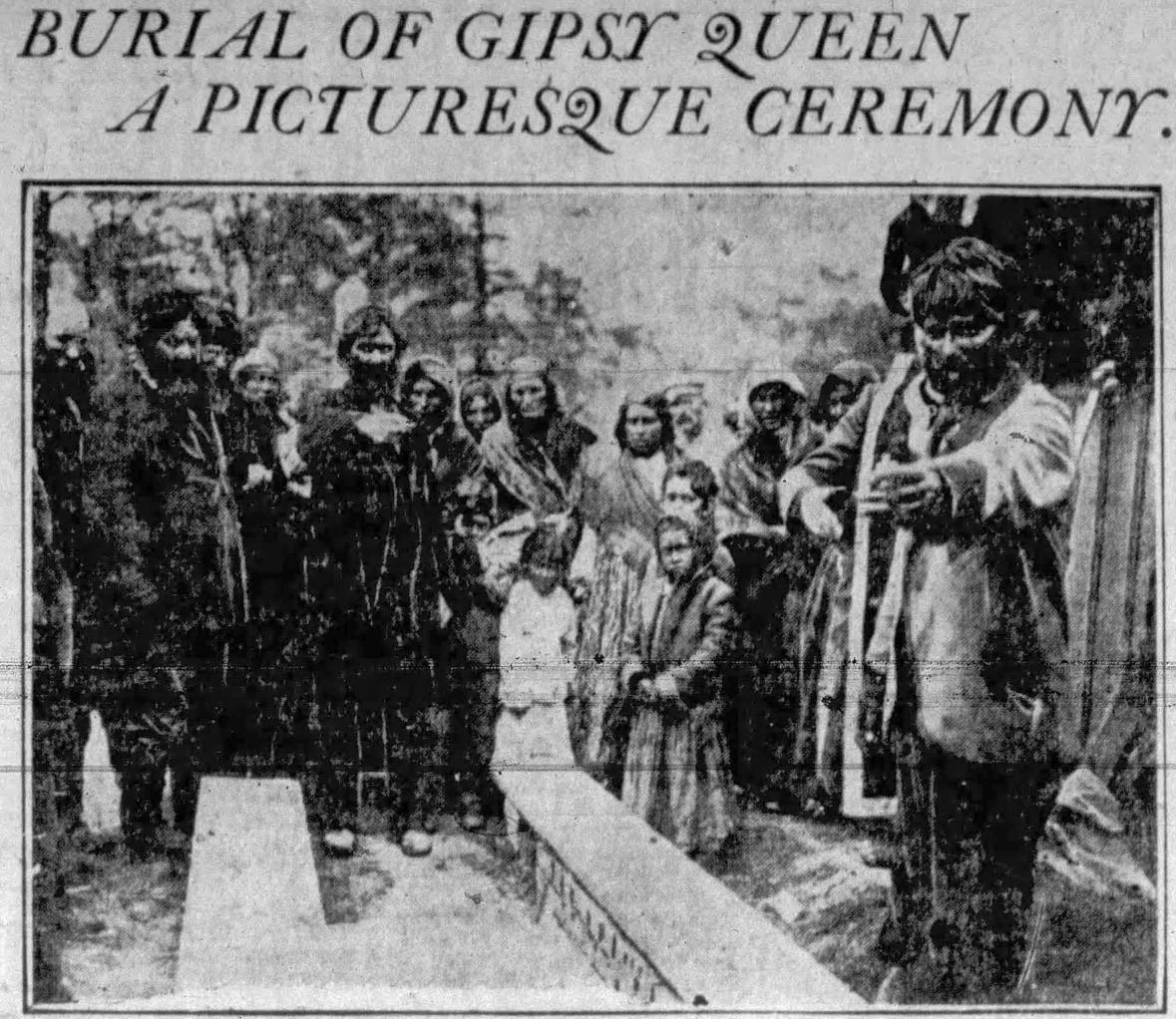
I can go back 6 generations to my great-great-great-great Grandparents, according to old families stories they were old when they came to the U.S on a boat in the 1890s with their adult children and they lived in the South but traveled all around and The old women died from a horse accident in 1904 about is a picture from the funeral. and that’s all I know. according to records I found online they were born in Europe in the 1830s or around 190 years ago. How far back can you go on your family tree?
r/romani • u/ameilamarks • 15d ago
I know there's lots of people in here who don't know the language, due to the disconnect of there Romani familys and many other reasons. But there's this Youtube "gypsylanguage6151" "gypsykidteaching6374" and they teach you a good amount of the language.
Is it the best? no but it works if you don't have anything else.
Hope this is helpful to those who want to learn (Romani only ofc)
r/romani • u/heavenlywineandroses • 17d ago
I felt inspired to make one based on my culture, and decided on the flag. I couldn't find a pattern with the wheel so i adapted this heart pattern!
r/romani • u/dialectlover • 17d ago
Hi, I want to make a post about Vlax Romani dialects on newly made community in r/Dialectdiversityvoice, that I made. I want anything about it. I write there not because I would be lazy to see wikipedia and other sources, I am doing that also but, I want the communities to actually also join making it and get information first hand.