r/solidity • u/jamesallen18181 • 1d ago
I built this tool to help auditors understand unfamiliar smart contracts much faster.
youtu.be
2
Upvotes
r/solidity • u/HOLUPREDICTIONS • Aug 03 '25
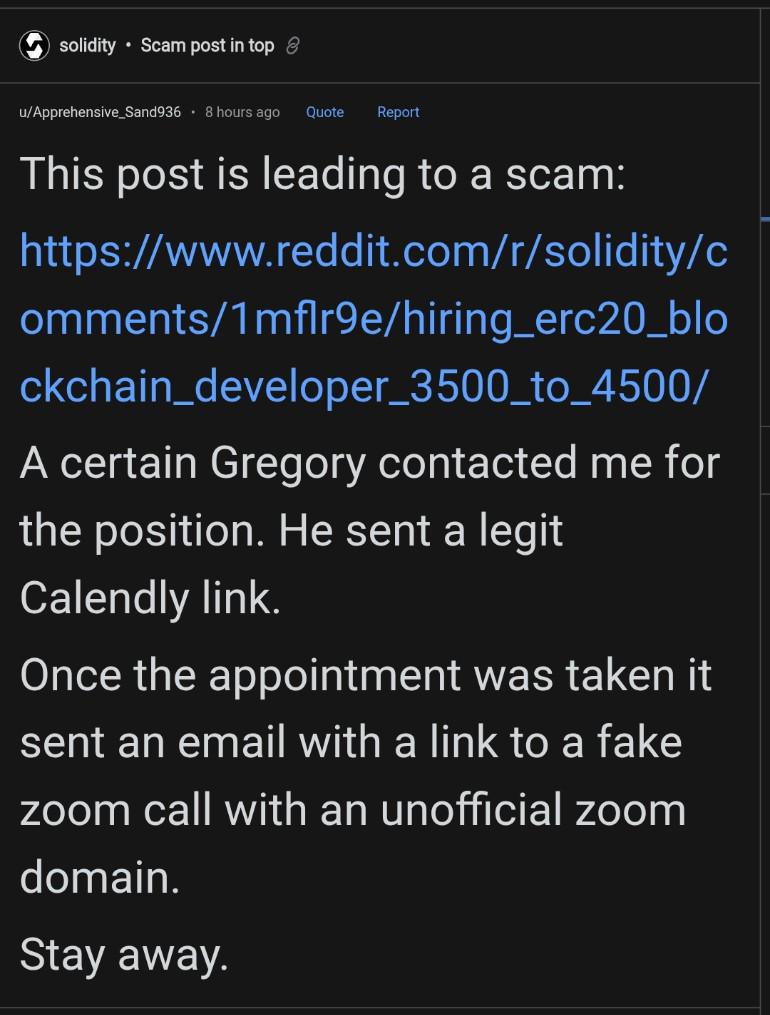
r/solidity • u/jamesallen18181 • 1d ago
r/solidity • u/Early_Power_6606 • 2d ago
Hey everyone!
I'm wondering if it's possible to learn about the crypto world through some kind of volunteer work or apprenticeship, since this isn't something they teach at school.
My parents aren't particularly familiar with this field either, but I'm genuinely interested in Ethereum, DeFi and Bittensor. My dream would be to become an Ethereum validator one day, although right now it still feels like a completely different world to me.
I've learned some basic Python and Solidity with the help of ChatGPT and Claude, but I feel like self-learning only gets me so far. I'm used to the structured learning system at school, whereas this field seems to require a completely different approach.
How did you guys get started? And when people talk about contributing to open source, what does that actually look like for a beginner? What are some examples of things I could contribute to? What are your biggest advices for catching Black Swans?
r/solidity • u/Noshock63 • 2d ago
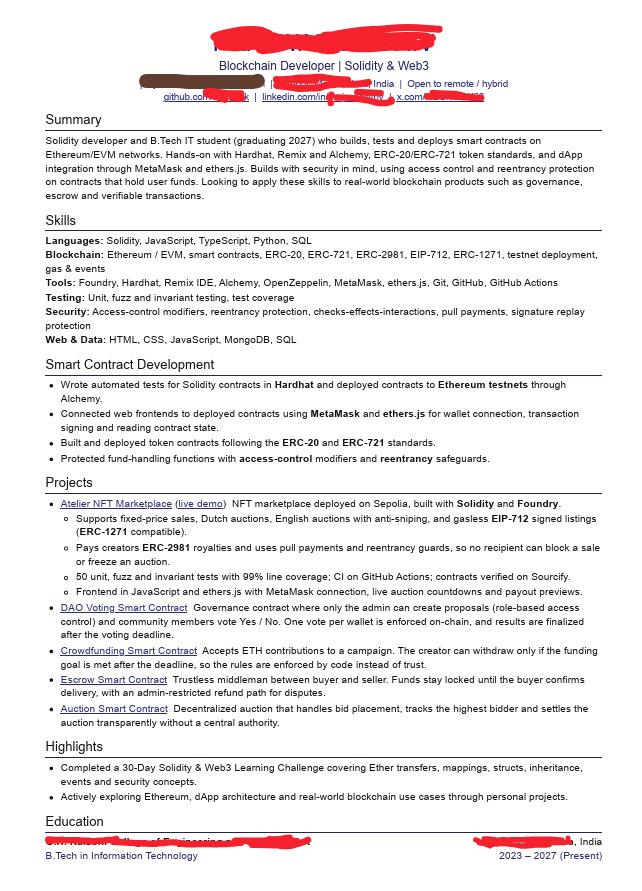
I'm a final-year B.Tech IT student (graduating 2027) from India, applying for paid remote blockchain developer internships. I'd really value honest feedback on my resume from people who hire or work in Web3.
Quick background:
• Solidity contracts: ERC-20, ERC-721, access control, reentrancy protection
• Hardhat tests and testnet deployments
• ethers.js + MetaMask frontends
• Currently building ChainVault, a crypto vault in Solidity/Foundry (still in progress)
• Also use TypeScript and Python
What I'd like feedback on:
r/solidity • u/ReferenceSouthern611 • 2d ago
Hi guys,
Actually I'm a beginner in block chain and Smart contracts.
For some one like me, what would be your suggestion (like how to start, where to start, what to learn etc, etc) if I say I want to learn solidity.
I'm a complete beginner, I do need this community help. Please!!
r/solidity • u/yachtyyachty • 3d ago
r/solidity • u/Fola_Tau • 5d ago
Hi all,
We at Tau just launched our developer bounty program with over $10K in rewards.
Tau is all about creating new features in blockchain, made possible with our proprietary formal specification language that enables to Tau formally represent and reason over everything in its system.
Here are the first set of rewards: https://tau.net/bounty-program
r/solidity • u/0xthiru • 7d ago
Our contracts took 709 seconds to build with solc. We tried tuning the build for a while, gave up, and wrote our own compiler.
oksolc is a reimplementation of solc 0.8.36 in Zig. Around 156K lines, no C++. It only does the optimized via-IR pipeline through Standard JSON, because that's what we ship with. For Foundry you just point FOUNDRY_SOLC at it.
The frontend is still sequential. The Yul optimizer and EVM codegen run per contract in a thread pool, which works because contracts barely depend on each other after the frontend.
The bigger win for day to day work is the persistent session. Each source file gets a semantic fingerprint, so editing a comment or reformatting doesn't invalidate anything. Import cycles are handled as SCCs and invalidate together. Artifacts are cached per phase in SQLite with HMAC-SHA256 on the entries, so a tampered cache can't hand you bytecode. oksolc serve --stdio keeps the whole thing warm between builds.
solc vs oksolc with 4 jobs:
Uniswap V4, full build: 59.0s vs 11.2s (5.3x) Pendle V2, incremental: 38.9s vs 1.4s (27.6x) Chainwall, full build: 709.8s vs 138.4s (5.1x)
Script is at test/benchmarks/external-compare.sh if you want to rerun them.
The thing I didn't expect going in is how much time we'd spend on what Solidity actually means. There's no formal spec. The language is whatever solc does. We run a weekly fuzz job that diffs our bytecode against solc on a public corpus, and CI builds OpenZeppelin, Uniswap v4, Pendle and Solady and pins the hashes. When the two compilers disagree, the diff shows you they differ but there's nothing that says which one is correct. We ended up with 9 places where we do something different from solc on purpose, and every one of those was an argument from the docs and from what the feature is obviously meant to do.
For most languages that's annoying. For this one it's worse, since the output can't be patched after deployment and often holds a lot of money. A compiler bug stays on chain. And fuzzing only covers the programs the fuzzer happened to generate, so at some point you want proofs, and you can't prove anything against a language with no definition.
So we started writing the definition. Solidity Spec is an executable formal model of Solidity in Lean. You can run real programs through it and compare with compiler output, and you can state properties about the semantics and get them machine checked. There's a paper, and machine-checked proofs for explicitly defined parts of the model. Coverage is still growing.
The long term goal is checking a compiler's output against a definition of the language, the way CompCert did for C and CakeML did for ML, instead of against another compiler.
If your Solidity builds are slow, try it. And if you work on semantics or verified compilers, I'd really like to know where the Lean model is wrong.
oksolc: https://github.com/okcontract/oksolc Solidity Spec: https://github.com/okcontract/solidity-spec
r/solidity • u/Guilty_Health_2491 • 9d ago
Hey everyone!
I'm currently looking for opportunities as a Smart Contract Engineer / Solidity Developer and would appreciate any referrals, job leads, or introductions.
I've been building in the Web3 and DeFi ecosystem, including VALP (Volatile Adaptive Lending Protocol), a DeFi project focused on lending, borrowing, collateral management, and adaptive vault mechanisms.
Technical interests:
My Project: VALP GitHub: https://github.com/Sankar202221/Volatile-Adaptive-lending-Protocol
I'm particularly interested in opportunities at DeFi protocols, Web3 startups, and blockchain companies where I can contribute to building real-world smart contract applications.
If you're hiring, know of any openings, or could refer me to a relevant team, I'd genuinely appreciate your help.
Thank you!
r/solidity • u/jamesallen18181 • 10d ago
r/solidity • u/Nearby-Blood-9817 • 11d ago
Solidity build rules for please with auto generated go bindings and hermetic foundry
r/solidity • u/codeforge87 • 14d ago
r/solidity • u/Tvpai • 15d ago
Hi all, I’ve been building 20questions.lol for fun lately and wanted to share how the fairness side works, since it turned out to be the most interesting part of the build. Quick context on how 20questions work: an AI picks a secret word, up to 5 players buy in for 2 USDC on Base, and everyone shares 20 yes/no questions. First correct guess wins the whole pot (lol). The obvious question everyone asks is “whats stopping you from just changing the word?” so heres how I tried to answer that on-chain:
keccak256(salt, spelling), and the Merkle root of those goes into the contract before the round opens. So the word is locked, and I can still accept “pisa” for “leaning tower of pisa” without picking one canonical answer.keccak256(roundId, player, keccak256(text), keccak256(guess), nonce). A separate model that doesn’t know the word pulls the guess out of the question before you pay, so your guess is locked in before the answer comes back. Including the player address means nobody can copy someone else’s commitment.Now the honest part, the trust gaps I haven’t solved:
Contract is verified on Basescan if anyone wants to poke at it: 0xf0925993D00F5E2c5C7c5053eD67309a0a9beF8c
Would really appreciate feedback from people who know this stuff better than me. Roast it honestly, I’d rather hear it here than after someone finds the bug with real money lol
r/solidity • u/driss_pop • 18d ago
r/solidity • u/yachtyyachty • 19d ago
r/solidity • u/nathanielbuilds • 19d ago
r/solidity • u/ransomusername42 • 22d ago
I've written an immutable ERC-721 contract where people claim a free monthly token by mining a proof of work. It's live on Polygon, so review findings can only change what I do in a later deployment, but I'd still like to hear them.
The parts I'd most like a second pair of eyes on:
- The difficulty uses a fixed-point 2^x. Every token ahead of schedule multiplies it by 2^(1/10). I measured a max error of 0.0117% and it's monotonic, but I'd like someone to challenge the math.
- Claims go through the ERC-721 receiver hook. I tested re-entrancy and found nothing, but I wrote those tests myself.
- Metadata is built as JSON on-chain from admin-supplied strings, with validation against injection.
There has been no external audit. Just my own review, 85 Foundry tests and static analysis.
Source: https://github.com/TheophileWalter/ArtPoW
Contract: https://polygonscan.com/address/0x74cda3cdd7a6046575d638964825c19cfeaf661f
Nothing is for sale. What would you have done differently?
English isn't my first language, so I used an LLM to help write this post.
Edit: You can now get the NFT without paying anything. Your browser still does the mining, but a relay sends the transaction and pays the gas, so you don't need any POL. If you don't have a wallet, you can create one with just an email. The relay can only mint to the address in your proof. You'll only need a little POL if you later want to transfer or sell the token.
r/solidity • u/Chemical-Type-9157 • 21d ago
r/solidity • u/mpeyfuss • 22d ago
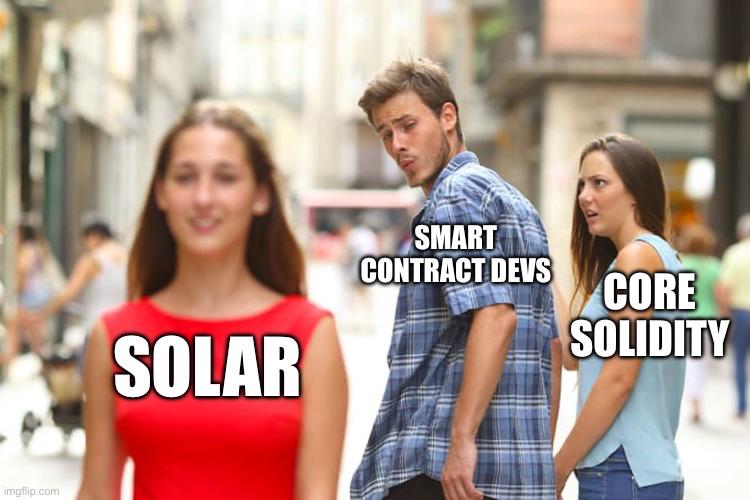
Solar looks to address the major concerns of “classic” solidity without the complete rewrite to “core solidity”. I mean it looks f*ckin awesome. Haven’t tried it yet.
https://x.com/gakonst/status/2117326277363597751?s=46&t=qlxg0vngPXLDPzs4aUmZLw
r/solidity • u/TakesThisSeriously • 23d ago