r/vajrayana • u/Starlight_Climber • 21m ago
The "snake in a bamboo tube" saying is not a teaching of the Buddha.
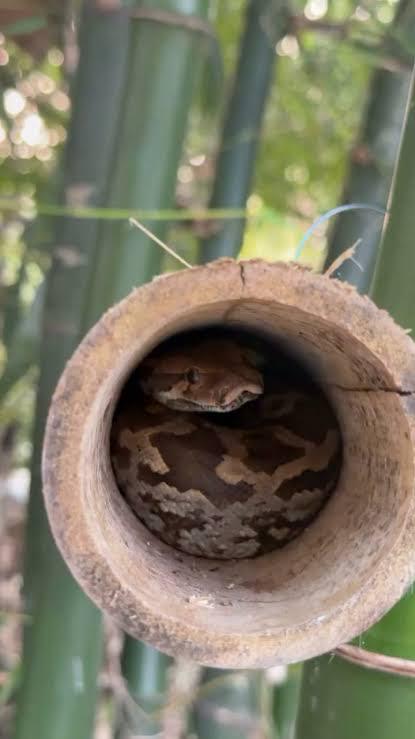
So there's a common saying among some Tibetan Tantric lineages, regarding guru worship and samaya. And it basically goes like this:
Once a student enters the tantric path, there is no lateral escape. One either goes upward toward awakening or downward toward failure and “vajra hell.” Teachers have used this image to describe the uncompromising nature of samaya, the vows that bind a student to the guru, the deity, and the tantric methods themselves.
This is repeated a lot in some Tibetan tantric circles, and some people will treat it like it's fact. Scholars have researched the earliest versions of this and found that it primarily comes from Patrul Rinpoche's book, Words of my Perfect Teacher, which he himself attributed to something Jigme Lingpa said.
However, it should be noted that the Buddha's teachings on rebirth (including in hell realms) does not actually accord with this saying. In Buddhism, whether or not one is reborn in a higher or lower realm, depends on the ratio of how much negative emotion is in your mind.
This is explained very clearly in the Surangama Sutra. In The Surangama Sutra, the Buddha describes the process of how rebirth in the upper or lower realms actually works:
The Six Planes of Existence Caused by Unenlightenment
(From the Surangama Sutra)
‘Ananda, in the round of births and deaths in Samsara, birth is caused by the habits (of passions) and death by the flow of (retributive) transformation. (This is why) at the moment of death and before the heat completely leaves the body, all good and evil deeds of a lifetime suddenly reappear to someone who is dead but on the point of being reborn.
The realm of devas
‘If his mind is wholly thoughtful, it will fly in the air and he will be reborn in heaven. If in this flight it is filled with blessedness and wisdom strongly sustained by his pure vow, it will open to let him behold the pure lands of all Buddhas in the ten directions; he will be reborn there as a result of his vow.
The realm of seers (rsi) and spirits
‘If his mind is more thoughtful than passionate, it will not be light enough for him to fly to distant places; he will be reborn as a flying rsi, a powerful king of ghosts, a flying yaksa or an earthbound raksasa. He will be able to roam freely in the heavens of the four deva kings. If he is good natured and has taken a vow to protect my Dharma and those who observe the precepts, repeat the mantras, meditate and realize patient endurance, he will dwell beneath the throne of the Tathagata.
The realm of human beings
‘If his thoughts and passions are in equal proportions, he will neither rise nor sink, but will be reborn in the realm of human beings where his intelligence comes from the clearness of his thoughts and his stupidity from the dullness of his passions.
The realm of animals
‘If his passions exceed his thoughts, he will be reborn in the realm of animals where great passions create beasts with hair and fur and mild passions produce winged and feathered creatures.
The realm of hungry ghosts
‘If his passions and thoughts are in the proportion of seven to three, he will sink into the wheel of water close to the region of fire, will endure intense heat and be reborn as a hungry ghost whose body is constantly scorched by heat and drowned in water, so that he will suffer from hunger and thirst for hundreds and thousands of aeons.
The realm of hells
‘If his passions and thoughts are in the proportion of nine to one, he will sink into the wheel of fire and be reborn where wind and fire meet. He will dwell in the intermittent hell if his passions are great, in the unintermittent one if they are very strong, and in the avici hell if he is completely dominated by extremely violent ones. If in addition he slanders the Mahayana,[212] breaks the Buddha’s precepts, distorts the Dharma when preaching it to deceive his patrons for selfish gain or for fame, and commits the five rebellious acts [213] and ten grave sins [214] he will be reborn (in turn) in all the avici hells.
In other words, your rebirth isn't determined by behavior, it's rather, your inner state that leads to rebirth. It just happens to be that certain kinds of behaviors tend to lead to certain kinds of inner emotional states.
But the idea that "once you start practicing tantra" that there are "only two outcomes" is just not the Buddha's teaching. For one, that's by definition: a dualistic viewpoint, and there is no dualism in the Dharmakaya. And for another, it's just not in accord with what the Buddha actually taught. Nor is it even in accord with other Vajrayana teachings such as teachings on even recitation of a single mantra of this or that mantra, (such as Vajrasattva) instantly purifies all past negative karma and breeches of samaya.
So people will repeat this saying, and it comes across as a method of control, or at best meant as a well-intended saying of motivation. But if often gets used to gaslight students away from acknowledging genuine problems with problematic teachers, narcissists, and people who are genuinely abusive. It also implies to the student that they will undergo spiritual catastrophe, for even refusing a teacher's sexual advances, or standing up to abuse. Or, simply walking away when they realize that another path is a better fit for them.
The saying, implies that such a student is headed for spiritual catastrophe if they do that. But again, that doesn't accord with the teachings of the Buddha. Scholars have actually researched this saying, and the earliest known reference is Patrul Rinpoche's book, Words of my Perfect Teacher. In it, he says as version of it, which he said came from Jigme Lingpa.
So it's important to note, that this saying represents a relatively recent development in certain Tibetan lineages, and is at most, less than 300 years old. This saying is not a teaching in Newar Buddhism outside of Tibet, nor in Shingon or Tendai. And even within Tibet, not every tantric lineage holds this view.
As long as someone continues to do some form of Buddhist training, (or really, any genuine form of spiritual training) and continues to honestly work on themselves and on their kleshas: —they're not going to be reborn in a hell realm. This is because they were already born in the human realm in this life: and so they're already starting this current life with their minds in a ratio of at least 50/50 emotions to thought.
And so they're already at the halfway point, and as long as they continue to train honestly (even if it's with another teacher, or other lineage, or other form of sincere spiritual training), they're going to be just fine, and rebirth in the human realm or other higher realms is essentially assured.
All of this fire and brimstone fear-mongering: "There are only two options! Success or hell!!!" —is just not what the Buddha taught. It's not based in the actual Dharma.
I say this because people can put so much emphasis on blind obedience in a teacher, that they can sometimes not realize that unscrupulous people are also attracted to religion, and so such an unscrupulous person will use sayings like that to discourage any critical thinking about their own behavior, in order to continue to have power over others.
Students of the Dharma should critically examine teachings, test them out, and compare them to existing Dharma teachings of the Buddha. It's striking to me how similar that saying is to Abrahamic Christian sayings from fundamentalists, that view that you must accept Jesus into your heart, or you're going to hell. I would encourage people when they are told traditional teachings, to think about them critically.
In either case, the viewpoint is simply not what the Buddha teaches.
“Now Kalamas, *don’t* go by:
- - reports,
- - by legends,
- - by traditions,
- - by scripture,
- - by logical conjecture,
- - by inference,
- - by analogies,
- - by agreement through pondering views,
- - by probability,
- - or by the thought, ‘This contemplative is our teacher.’
(Rather), *When you know for yourselves* that:
- - These qualities are skillful;
- - these qualities are blameless;
- - these qualities are praised by the wise;
- - these qualities, when adopted & carried out, lead to welfare & to happiness’
— *then* you should enter & remain in them.”
~The Buddha in the Kalama Sutra
...
By this merit, may all beings be freed from dualistic views,
And reside in equanimity, free from clinging, aversion, and close-mindedness.
✨🙏✨