r/voynich • u/FarkYourHouse • 12h ago
A Colonial Hybrid "Prop" Theory: tl Ligatures, Salvaged Vellum, and a Mesoamerican Counter-Codex
(Credit to Dr. Samuel Biagetti’s Historiansplaining podcast for the framework of "sincere illustrations, fake text"—though instead of a European fertility cult, I think the paleography points to 16th-century Mexico.)
Most Voynich theories assume either a real, untranslated language or a European hoax. I think it is a 16th-century colonial hybrid made as a ritual and political prop, and the strongest clue is paleography.
- The Paleographic Core: tl Ligatures
Plant drawings are easy to misread, and new words are easy to make up. New letterforms, however, are rare.
The Voynich "gallows" characters (t, k, p, f) use standard European quill strokes, but their tall, looped shapes closely resemble the tl ligatures developed in 16th-century Mexico. When Spanish friars and indigenous scribes (tlacuilos) adapted the Latin alphabet to write Nahuatl, they fused t and l into tall, looped symbols to represent the common Nahuatl tl sound.
2. The Vellum Timeline
How does a 16th-century script end up on vellum dated to 1404–1438?
- The Printing Press Shift (1438–1520s): A bundle of calfskin cured around 1438 only had to sit in a monastic storeroom for about 15 years before the Gutenberg press and cheap rag paper made handwritten vellum obsolete for everyday books. Once paper took over in the 1450s, leftover vellum easily sat untouched in chests for decades. Since 100 sheets only weigh a few kilograms, a friar packing for New Spain in the 1520s could easily toss old stock into a trunk for charters or choir books.
- Held Until Literacy Arrived: Mesoamerican cultures already used processed animal hides (like deerskin) for high-status codices. If an indigenous group acquired this fine European calfskin early on, they would recognize its value and keep it, even without ink, quills, or alphabetic literacy. Once Franciscan schools trained indigenous scribes in the 1530s–1550s, they finally had the tools and skills to use it.
- The Motive: A Counter-Prop
- Competing with Settlers: Indigenous religious leaders—working with mission-trained, bi-cultural scribes—wanted to compete with Spanish spiritual authority. Because Europeans treated books as objects of immense power, creating an unreadable, sacred-looking codex flipped the dynamic: suddenly, the colonizers were the ones who couldn't read the "true" record.
- Why Fake the Text? Pre-Hispanic Central Mexican writing was pictographic, not alphabetic. Inventing a consistent phonetic alphabet from scratch was unnecessary work when faking an unreadable script achieved the exact same visual authority.
- The Drawings: Mission-trained artists had access to imported European inks and monastic libraries full of woodcuts. The naked white women bathing in pools and the Italian-style castle walls on the Rosettes foldout are standard European book tropes—the exact exotic symbols of European culture a local observer would notice and remix alongside native plant and cosmological knowledge.
- Fluency and Zipf’s Law
- Muscle Memory: Mission-trained copyists spent years copying Latin texts without necessarily understanding Latin. When improvising a fake script from muscle memory, their hands naturally produced rapid, error-free European strokes, Latin abbreviation loops, and tl gallows.
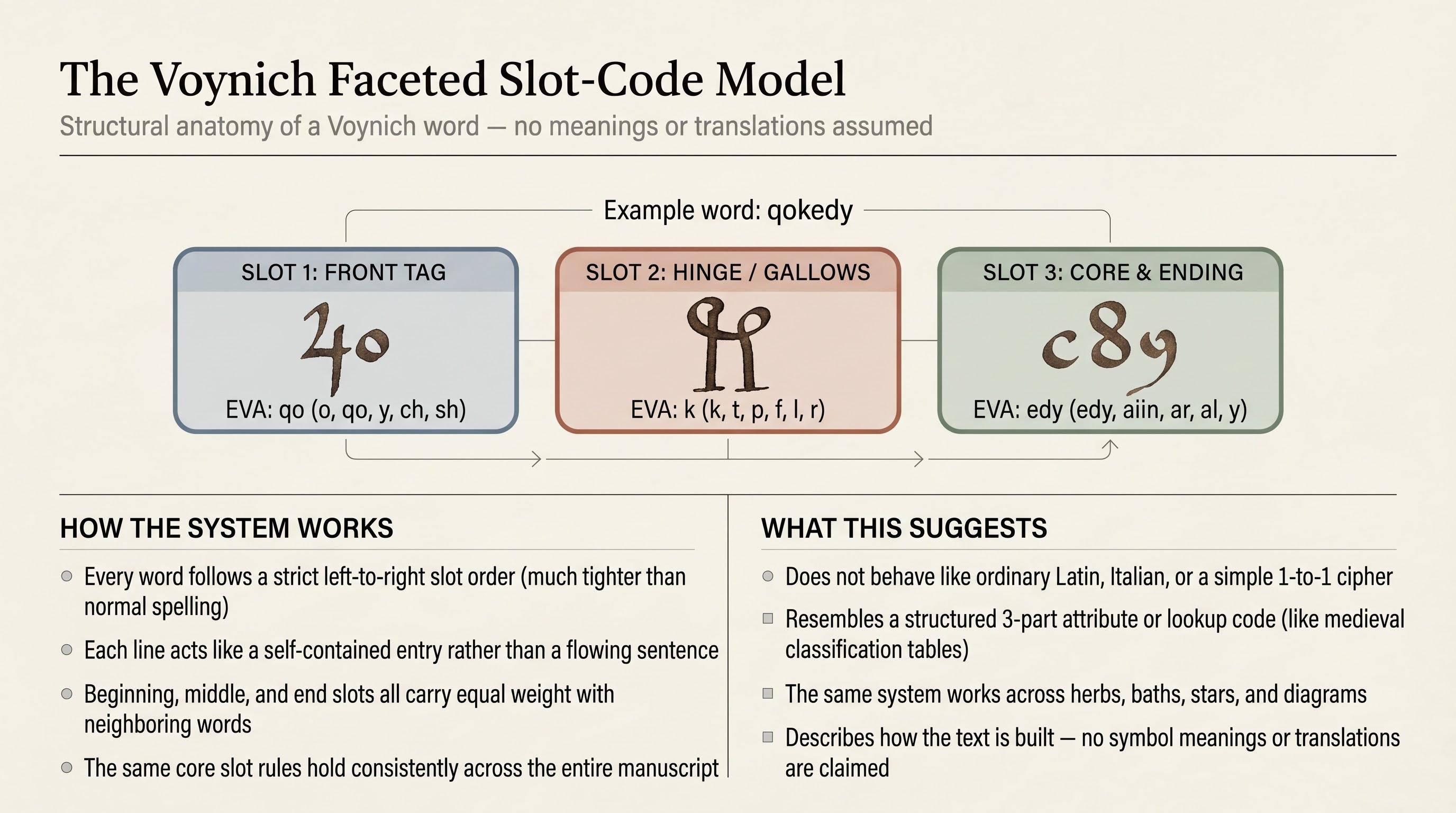
- Zipf’s Law: Both human improvisation and simple mechanical methods (like combining prefixes, roots, and suffixes from a basic slot-and-grid table) can automatically produce a Zipf frequency curve—no knowledge of statistics required.
While often outlandish, none of the steps here are impossible. I (a completely unqualified rando) would argue that the appearance in 15th century europe of a written character invented in 16th century america does cross that line.
People who know more about paleography than me would be the critics I would be most interested to hear from.