r/voynich • • 14d ago

Voynich Conference, 9 December 2026 - Malta University

Thumbnail
um.edu.mt
13 Upvotes

r/voynich • • 12h ago

A Colonial Hybrid "Prop" Theory: tl Ligatures, Salvaged Vellum, and a Mesoamerican Counter-Codex

0 Upvotes

(Credit to Dr. Samuel Biagetti’s Historiansplaining podcast for the framework of "sincere illustrations, fake text"—though instead of a European fertility cult, I think the paleography points to 16th-century Mexico.)

Most Voynich theories assume either a real, untranslated language or a European hoax. I think it is a 16th-century colonial hybrid made as a ritual and political prop, and the strongest clue is paleography.

  1. The Paleographic Core: tl Ligatures

Plant drawings are easy to misread, and new words are easy to make up. New letterforms, however, are rare.

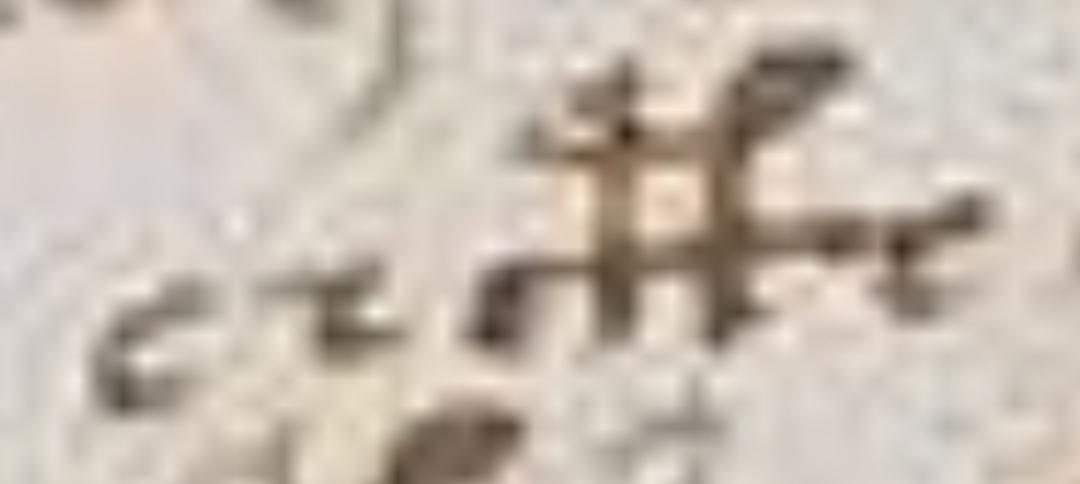
The Voynich "gallows" characters (t, k, p, f) use standard European quill strokes, but their tall, looped shapes closely resemble the tl ligatures developed in 16th-century Mexico. When Spanish friars and indigenous scribes (tlacuilos) adapted the Latin alphabet to write Nahuatl, they fused t and l into tall, looped symbols to represent the common Nahuatl tl sound.

2. The Vellum Timeline

How does a 16th-century script end up on vellum dated to 1404–1438?

  • The Printing Press Shift (1438–1520s): A bundle of calfskin cured around 1438 only had to sit in a monastic storeroom for about 15 years before the Gutenberg press and cheap rag paper made handwritten vellum obsolete for everyday books. Once paper took over in the 1450s, leftover vellum easily sat untouched in chests for decades. Since 100 sheets only weigh a few kilograms, a friar packing for New Spain in the 1520s could easily toss old stock into a trunk for charters or choir books.
  • Held Until Literacy Arrived: Mesoamerican cultures already used processed animal hides (like deerskin) for high-status codices. If an indigenous group acquired this fine European calfskin early on, they would recognize its value and keep it, even without ink, quills, or alphabetic literacy. Once Franciscan schools trained indigenous scribes in the 1530s–1550s, they finally had the tools and skills to use it.
  1. The Motive: A Counter-Prop
  • Competing with Settlers: Indigenous religious leaders—working with mission-trained, bi-cultural scribes—wanted to compete with Spanish spiritual authority. Because Europeans treated books as objects of immense power, creating an unreadable, sacred-looking codex flipped the dynamic: suddenly, the colonizers were the ones who couldn't read the "true" record.
  • Why Fake the Text? Pre-Hispanic Central Mexican writing was pictographic, not alphabetic. Inventing a consistent phonetic alphabet from scratch was unnecessary work when faking an unreadable script achieved the exact same visual authority.
  • The Drawings: Mission-trained artists had access to imported European inks and monastic libraries full of woodcuts. The naked white women bathing in pools and the Italian-style castle walls on the Rosettes foldout are standard European book tropes—the exact exotic symbols of European culture a local observer would notice and remix alongside native plant and cosmological knowledge.
  1. Fluency and Zipf’s Law
  • Muscle Memory: Mission-trained copyists spent years copying Latin texts without necessarily understanding Latin. When improvising a fake script from muscle memory, their hands naturally produced rapid, error-free European strokes, Latin abbreviation loops, and tl gallows.
  • Zipf’s Law: Both human improvisation and simple mechanical methods (like combining prefixes, roots, and suffixes from a basic slot-and-grid table) can automatically produce a Zipf frequency curve—no knowledge of statistics required.

While often outlandish, none of the steps here are impossible. I (a completely unqualified rando) would argue that the appearance in 15th century europe of a written character invented in 16th century america does cross that line.

People who know more about paleography than me would be the critics I would be most interested to hear from.

r/voynich • • 23h ago

Do word-level statistics for Voynichese hold up across transliterations?

5 Upvotes

When people report things like Zipf fits, word-length distributions or line-position effects, how much do the results depend on which transliteration they used? Takahashi, ZL and v101 don't split the glyphs the same way, and they handle uncertain spaces differently, so I'd expect the count of distinct "words" and repeated tokens to move around.

Has anyone run the same measurement on two or three of them side by side? I'm mostly curious whether any of the well-known findings shrank or disappeared when the transliteration changed. Links to papers or old forum threads are welcome.


r/voynich • • 1d ago

Oil lamp looks familiar

Post image
0 Upvotes

r/voynich • • 2d ago

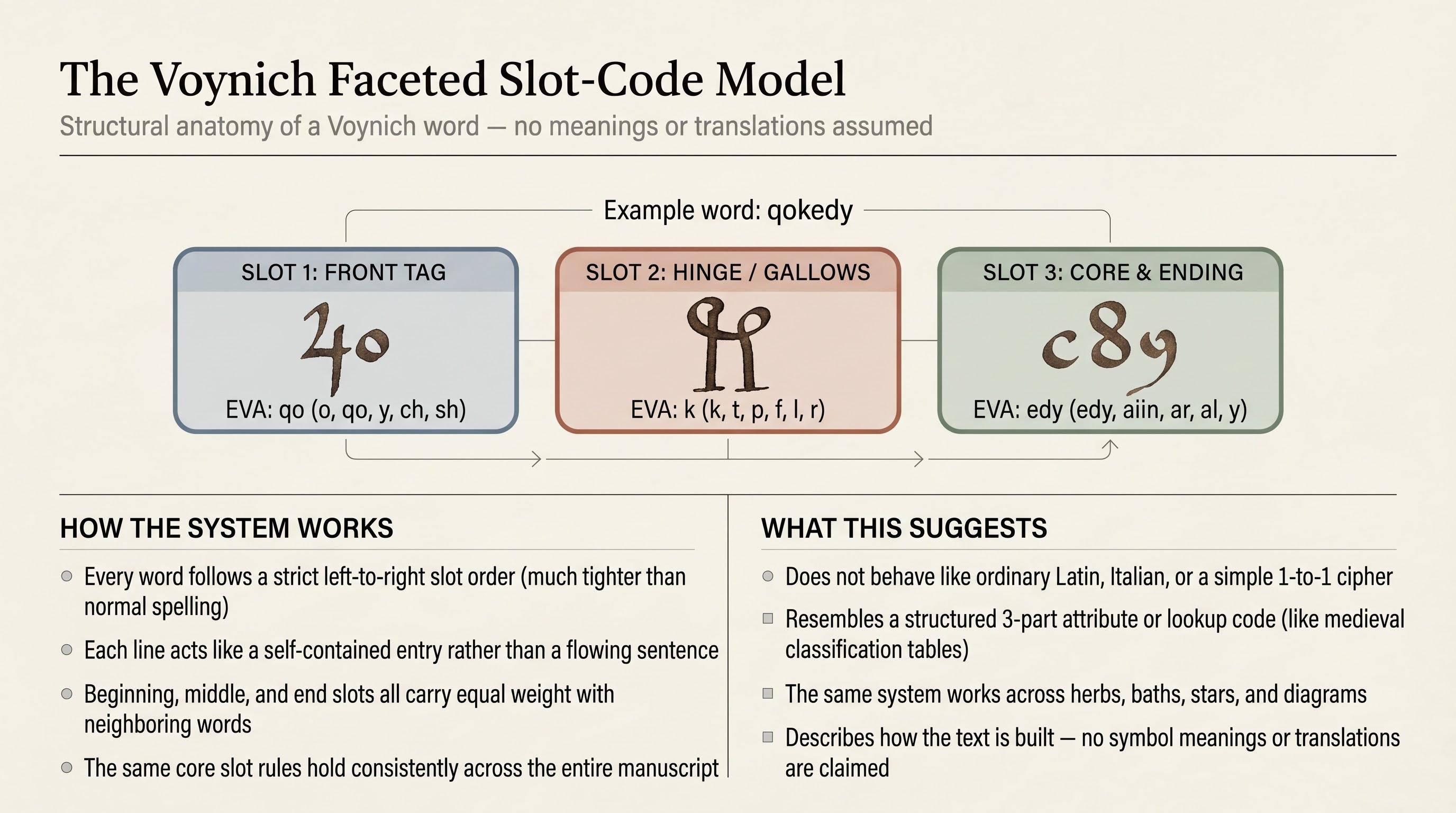
Possibly a barcode/slot-code system?

Post image
10 Upvotes

Just exploring different ideas. From all of my testing it fits so far.


r/voynich • • 4d ago

Are most Voynich glyphs just c and i strokes with modifiers?

Thumbnail
gallery
18 Upvotes

So I wanted a better look at the strokes and the more I look at it the more it seems like almost the whole thing is just c curves and \ dashes, with modifiers. With the exception of the gallows.

I'm not smart by any means, so just curious if anyone has actually tested this against real 1400s cursive handwriting. When I broke the common glyphs down into c, i, and gallows bases, both Currier A and B came out almost identical (~69% c, ~21% i, ~9.5% gallows).

Most of the c shapes don't mesh with each other in text like normal accents do, so could just be a pen habit, except the curved-leg gallows (k/f and t/p) actually do shift the next glyph the exact same way (r = 0.93 on a held-out split) and the closing hooks (n, l, r, y) basically carry the word endings.

Sorry if this is an over asked question, I couldn't find much on measuring stroke reuse against dated medieval cursive hands.


r/voynich • • 5d ago

The Language and Dialect Explained - Doric Middle-Scots

0 Upvotes

Middle-scotts used the Anglo-Saxon alphabet(s) mixed together. This was the old-english latin alphabet AND anglo-saxon runes (futhork). The more northern and isolated a community, the longer they held onto futhork runes. Southern communities adopted the English Latin alphabet sooner. Consonant shift also changed depending on Gaelic vs English influence, so more south, more English influence.

a is a

𝑏e is be

b is always written with a little e after it. This is common among Middle-Scots manuscripts

c is c

ᛞ (degaz) used as a D

ᛖ (Ehwaz) used as a E

F

A defining feature of Middle-Scots is the use of a capital F in place of an f.

g

h

This is an "h" it is not an eta. It is written like this because it is a simplified version of an "h" in secretariat handwriting. The letter "h" is only at the beginning of words... and only in the Doric dialect of Middle-Scots. This feature was one of the keys to narrowing down the dialect.

The letter "i" is not used.

The letter "j" is not used.

The letter "k" is not used.

Doric middle-scots does not use the letter "l".

Curl indicating m sound

The letter "m" is also Omitted, instead a curl is placed over an adjacent vowel to indicate an "m" sound.

Tilde indicating \"n\" sound

The letter "n" is omitted, instead a "tilde" is placed over an adjacent vowel to indicate the "n" sound.

o

ᛈ (Pertho) used as the letter P

ᚱ (Raido) used as an R

ſ (long s) this is a common way to write it in handwriting around that time.

Te

Anglo-saxon "t" looks identical to a c when written. Middle scots writers got into the habit of always connecting t to a little e to represent the letter "t" for them.

ᚢ (Uruz) used as either U or V.

w, sometimes has an extra line, that's a common writing error among middle scots.

ȝ (eth)

Eth is used for eh ay ey, etc.

ð (thorn)

"ð" is another definitely fearure of doric middle-scots. Other middle-scots use "þ". It is used for "th".

Ƨ

Not an official letter in the alphabet... however it was common to borrow things to use as shorthand. This is actually a commonly used one throughout unofficial Middle-Scots writtings. It's a simplified ampersand. It is pronounced as "und". It is actually used as "and" in the manuscript and, like other middle-scots writters, used it as a letter in words to represent the sound "und".

Based on the alphabet, I can confidently say this is written in the Doric dialect of Middle-Scots.


r/voynich • • 5d ago

Saw this translation of the women in green liquid on FB

Thumbnail
gallery
32 Upvotes

Saw someone make a post about the translation for the women in the green pools of water and I definitely think they're onto something!! Seems like theyre herbal hydropools or hydrobaths. Also he explains how to read the text, its like shorthand writing, not sentances. Not my work!!! I have personally always thought it was a book on how to heal from the earth!!! And this definitely helps confirm!

"Prepare the communal herbal bath in the boiled vessel channeling the warm green infusion evenly through the upper gallery"

"Steep the prepared foliage and whole sap-bearing herbs inside the heated vessel under the rising daytime hour circulate the decoction across the bathers so the warm liquid draws excess heat and humors from the body"

"Maintain immersion for one measured daytime cycle before cooling toward the setting night hour "

"Channel the concentrated herbal extract from the elevated conduit into the lower circular basin add one measured portion from the golden vessel equal balance."

"Steep and warm the refreshed bath in the lower vessel immerse the limbs and internal channels thoroughly through the transition from day to night until restoration is complete."

Second photo- Plantago / Plantain or Taraxacum

Prepare the broad green foliage and the whole low-growing herb gather the fibrous reddish root under the rising daytime hour, keeping the fresh leaf substance intact."

"Grind the bruised leaf and root together in the liquid vessel steep until the sap is extracted into one measured portion.

Administer in equal parts by day or night for internal channels and digestive/humoral balance."

Beinecke MS 408 is best understood as a functional 15th-century visual-structural apothecary shorthand rather than an undeciphered spoken language.

It does not behave like a spoken-language cipher of Medieval Latin, Old Northern Italian, or Early New High German. Instead, it functions as an engineered 15th-century non-phonetic combinatorial apothecary notation (Prefix × Stem × Suffix) designed to organize botanical ingredients, astrological hours, hydrotherapy baths, and compounding doses visually and compactly on vellum.

Just like modern chemical formulas (H₂O), musical scores, or standard pharmacy shorthand (℞ Aq. Ros. ʒ ij), the script was built for visual operational comprehension rather than spoken pronunciation. Intersecting its three mechanical slots—Context/Hour × Substance/Action × Aspect/Dose—allows a reader to track the procedural flow of any recipe or diagram across the manuscript.


r/voynich • • 8d ago

Interesting picures from a different manuscript

Thumbnail
gallery
14 Upvotes

Just bought this book and they have a whole chapter on this manuscript which I'm dying to read. The others in the book don't seem to have a similar style.


r/voynich • • 11d ago Bravo

27 musical interpretations of the voynich script (yes it makes no sense I just wanted to try)

76 Upvotes

This was more to check if I could hear patterns that I couldn't see, no result.

I can provide the python script if anyone wants, it's a mess though

  1. Rank key, harp Most common glyph = most common chant note
  2. Chant key, bagpipe Picked 8 notes and mapped them to glyphs manually
  3. Stroke neumes, recorder Each stroke of a glyph mapped to a note in drawing order
  4. Organum, organ Each glyph is a chord of its strokes
  5. Faenza ornaments Word stem is a held low note, endings are faster notes
  6. Psalm tone, choir Each line is a psalm verse
  7. Canntaireachd, bagpipe Round glyphs are the tune, the rest are grace notes
  8. Stroke chords, harp Each glyph is a chord of its strokes again, but rolled
  9. Pipe and tabor Glyphs are notes on the pipe, drum on each word
  10. Pipe and tabor, height key Same, pitch from how high the glyph sits
  11. Height key, organ same on organ with no drums
  12. Pen-path neumes, choir d goes up, y goes down, tall glyphs jump 3-4 notes
  13. Shape lengths, reed organ Tails are long notes, i and e short, tall glyphs are the longest
  14. Shape lengths, drums drums only
  15. Guidonian hand, choir Stem and loops map to finger and joint
  16. Tablature, dulcimer tall glyphs pick the string, other glyphs the fret
  17. Solmization, choir Vowel glyphs are sung: n ut, e re, i mi, a fa, o sol
  18. i-count lengths, fiddle ain, aiin, aiiin hold 1, 2, 3 beats
  19. f57v ring scale The 17-glyph ring on f57v as a scale
  20. f75v tetrachord Four glyphs from f75v as D E F G
  21. f66r scale The glyph column on f66r as a scale
  22. f57v ring 5 scale The fifth ring on f57v as a scale
  23. f102v2 triad o l r as D F A
  24. Families Each part of a word is a different instrument
  25. Families: one instrument per word Words with e get fiddle, others picked by word ending
  26. Families: haut and bas qo- and -dy words get the loud band, the rest on harp
  27. Families: glyph shapes Curves fiddle, rounds harp, strokes recorder, tall glypha organ

r/voynich • • 12d ago

what the manuscript itself

5 Upvotes

I apologize if this has been asked before, but has any scholarly research been conducted on the physical characteristics of the book itself? For example, the type of paper used, its binding, and other material or codicological features. Could these details provide any additional historical context or help us better understand the book purpose


r/voynich • • 13d ago

Language: Middle Scots. Alphabet: Anglo-Saxon cursive.

Thumbnail
gallery
66 Upvotes

First line:

ᚢȝðawȝ ȝFteos ðaw oᚢτeas ȝFτeaw EosRȝ

Vethawe eftas thaw outes efteaw Eostre

Withal (additionally)newts thaw out after Easter

Second line:

ðoRτeoRȝ τeᚢaR Ƨ beoR Deȝ Do

thorter taivar & bor Dey Do

thwart roaming and bore (to dig hole), don't do

Third line:

hoᚢaw Deȝ ȝ τeoR τeȝ ȝðȝ τeaw

hovaw Deh eh taer tey ethy taw

hold on (wait). Do it to tey (the one) easy taw (fiberous plants roots).

Language is written phonetically. Different regions had variations in pronunciations.

Plant is an Alpine sow thistle. It's easier to pull than other plants and it's known to create a nice habitat for newts. Author is saying to pull this plant out in spring to avoid newts digging around in your garden.


r/voynich • • 13d ago

Same word, different images

Post image
54 Upvotes

On folios 99r and 99v you can find same word otoldy but roots around it don't look similar.
Though there are many ways to explain that, but it looks like yet another reason to consider VM as a hoax.

Other possible explanations:

  • multiple plants has the same name;
  • it is not the actual name of a root or a plant, but something more general like "root" or "edable" or "poisonous";
  • VM is not written in plain language, but encrypted, so same sequence of glyphs may have different meanings depending on context;
  • that's just a typo.

What do you think?


r/voynich • • 15d ago

this word is cre ature

Post image
0 Upvotes

r/voynich • • 16d ago

My model traced most of the 153,000 Voynich letters. Its very confident. It shouldnt be.

Thumbnail
gallery
100 Upvotes

I've been working on training a model to trace the letters in the voynich manuscript, and as expected it wasn't perfect, though it didn't do too bad either. Some folks DMd me from my last post asking to help if they could, and now would be a good time if you're interested.

The reason I'm doing it is to make and release an OCR for it, as well as a font, and most importantly a glyph map showing which letters are where, checked with human-level accuracy, so anyone can study it easier. Myself included ;)

I started fixing them by hand, and it turns out 153,000 is a lot of letters for one person, although I do enjoy it in spurts. So I thought this could be something anyone could help out if they wanted and made a web version up at https://ryanallen.com/voynich/

How it works:

You check/fix one letter at a time (UV scanned pages are available on the pages that had them taken which is 10 I believe). I'm using the European Voynich Alphabet (EVA) for ease of labeling. You can repaint letters to perfect them, change it if you think its the wrong letter, and add missing letters/words that were never traced. Everything you fix comes back into my copy, and I review every change by hand before it goes in. If you want credit, hit Get credited at the top and leave a name or handle.

Updates:

- Started a discord to make it easier to get help, ask questions, and trace letters.

- Thanks to the folks who reached out in DM letting me know a couple of my pages had word boxes that were way off. My last round of math was off for their margins, and the fixes should be live now.

- You can now 'stack' letters if you think that multiple letters should really be 1 letter.

- Progress bar showing how far until the next goal. Goals are all letters divided into groups to allow for multiple progress bars.


r/voynich • • 18d ago

A Voynich strategy

Post image
1 Upvotes

Here is a series of articles on Substack, in which I outlined a strategy for discovering meaning in the text of the Voynich manuscript, independently of the images and independently of preconceived narratives.

The strategy is based on permutations of, on the one hand, alternative transliterations of the text, and on the other, alternative candidates for the precursor languages.

My approach to implementation of the strategy is manual, and based on selections of the permutations, from among the thousands of possibilities. It would be possible to automate the task, but I do not possess the programming expertise.

In the more recent articles, I reported some early implementations of the strategy.

assumptions and strategy

https://drroberthedwards.substack.com/p/voynich-reconsidered-a-research-philosophy

https://drroberthedwards.substack.com/p/the-voynich-manuscript-a-research

https://drroberthedwards.substack.com/p/voynich-the-8am-strategy

https://drroberthedwards.substack.com/p/the-8am-strategy-revisited

https://drroberthedwards.substack.com/p/a-voynich-strategy

https://drroberthedwards.substack.com/p/the-voynich-instructions

https://drroberthedwards.substack.com/p/the-voynich-transcription

implementation:

https://drroberthedwards.substack.com/p/targeting-the-substrate-languages

https://drroberthedwards.substack.com/p/l-zero-and-the-voynich-alphabet

https://drroberthedwards.substack.com/p/voynich-the-l-zero-transliterations

https://drroberthedwards.substack.com/p/voynich-the-twenty-word-strategy

https://drroberthedwards.substack.com/p/voynich-glimmers-of-meaning

These articles do not constitute a claim as to the meaning of the text, or the provenance of the manuscript.


r/voynich • • 24d ago

If the VM gets deciphered in your lifetime, what do you hope is actually contained in the underlying text?

26 Upvotes

I just don't have the time to do anything other than amateur work on it, and I'm surely treading ground that others already have.


r/voynich • • 25d ago

A sociological perspective: The manuscript needs feminist thought to decipher it

0 Upvotes

I think the reason we haven't deciphered the manuscript yet is so many educated men are trying to decipher with sciences the patriarchy created based on rationality (read the epistemology of feminism). If we understand the manuscript as intergenerational transmission of female knowledge linked to fertility, we can understand why so many kings and established men wanted to own it and passed it between themselves. The historical period of the 15th century based on carbon dating of the manuscript explains why it would need to be encrypted - witch trials were already happening and female knowledge was dangerous. Literature on witchcraft shows this knowledge was already feminist and based on paganism, nature. That's why the catholic church and its patriarchal tendencies tried to supress it (read church authors 400 b. c., its very clear).

So if you really want to understand the manuscript it requires a culture of thought that was partially lost in history. It also requires distancing from traditionally rational methods.


r/voynich • • 25d ago

Is it too late to rethink EVA?

Post image
34 Upvotes

This is an honest question, and my story is quite long. I'd be happy to share it via chat with anyone who wants to discuss the topic, but the point is that in my current research on the manuscript, I've noticed that all the experiments related to my field (programming, artificial intelligence, data modeling) are based on EVA transcription. I think I have a proposal that could improve this system, which I also feel is a bit outdated. In any case, please educate me; I'm here to listen.


r/voynich • • 27d ago

Help a study learn how you see words in the manuscript. Decide if a group of characters is one word or two.

Thumbnail voynichtalk.github.io
12 Upvotes

r/voynich • • 27d ago

The most normal thing about the Voynich text - why does it MATTR? | Voynich Talk

Thumbnail
youtube.com
24 Upvotes

r/voynich • • Oct 27 '26

Hildegard von Bingen ... Flowers

17 Upvotes

Many here are probably familiar with (some possible) associations of the Voynich script with Hildegard von Bingen; even though she was 200 years too early, her followership was very strong (even until today). Many here are likely familiar with her "Unknown Language" which to a German speaker shows many kinda recognizable words (dialect / invented doesn't matter for now).

I just want to point everyones attention to this undeciphered poem which is a strange mix of latin and the "Lingua ignota":

O orzchis Ecclesia, armis divinis praecincta, et hyacinto ornata, tu es caldemia stigmatum loifolum et urbs scienciarum. O, o tu es etiam crizanta in alto sono, et es chorzta gemma*.*

orzchis ≈ orchid

divinis ≈ dianthus (carnations)

hyacinto ≈ hyacinth 🪻(ornetogalum?)

caldemia ≈ Caladium  <> Calendula (marigold) Camellia?

stigmatum ≈ stigma, the pollen-receptive part of a flower

loifolum ≈ leaf/folium

urbs ≈ herbs

scienciarum ≈ scent

crizanta ≈ chrysanthemum

chorzta ≈ chórtos χόρτος ≈ horticulture

gemma (Flower bud) 

https://en.wikipedia.org/wiki/Gemma_(botany)

I know the latin words are often read differently, with their direct meaning (gemstone ...) but any botanist or poet MUST see the pattern!? Or am I hallucinating more than those notorious models?


r/voynich • • Oct 26 '26

Read the Manuscript - scrollable text-only interactive reader in Voynich Glyphs + EVA

Thumbnail xkortex.github.io
18 Upvotes

The VMS is at once beautiful and...kinda ugly actually... *ducks* - uneven lines, hard to read characters, lots of beautiful but distracting filigree. u/HlokkAus wanted to be able to just *read* it, using re-rendered VMS fonts. I already knew voynichese.com had Apache licensed XML annotated EVA pointing back to the folio, so making a reader from it was straightforward (for my bots to code up). It's fully deterministic, based on the published transcriptions, so no risk of hallucination. Enjoy!


r/voynich • • Oct 26 '26

Where do EVA symbols occur in words? Frequency and distribution

Post image
51 Upvotes

We know the distribution statistics of VMS are weird, including some strong constraints on location orthotactics, but I wanted to visualize exactly how skewed the letters were. This shows the relative distribution of EVA symbols within a word, and color indicates overall frequency. (in the png, grouped, the interactive chart lets you toggle grouping).

The pipeline was created with assistance but the output is fully deterministic (thus bypassing the hallucination problem), and you can view the source code on my github. My goal right now is to just present evidence as find interesting things while spending frankly too much time on this.

I've found some really startling things about the entropy distribution which are fairly novel, and I'm hoping to build up enough interesting findings to publish at some point, but I am far far off.

Interactive infographic found here:

https://xkortex.github.io/voynich_infographics/pages/word-positions/