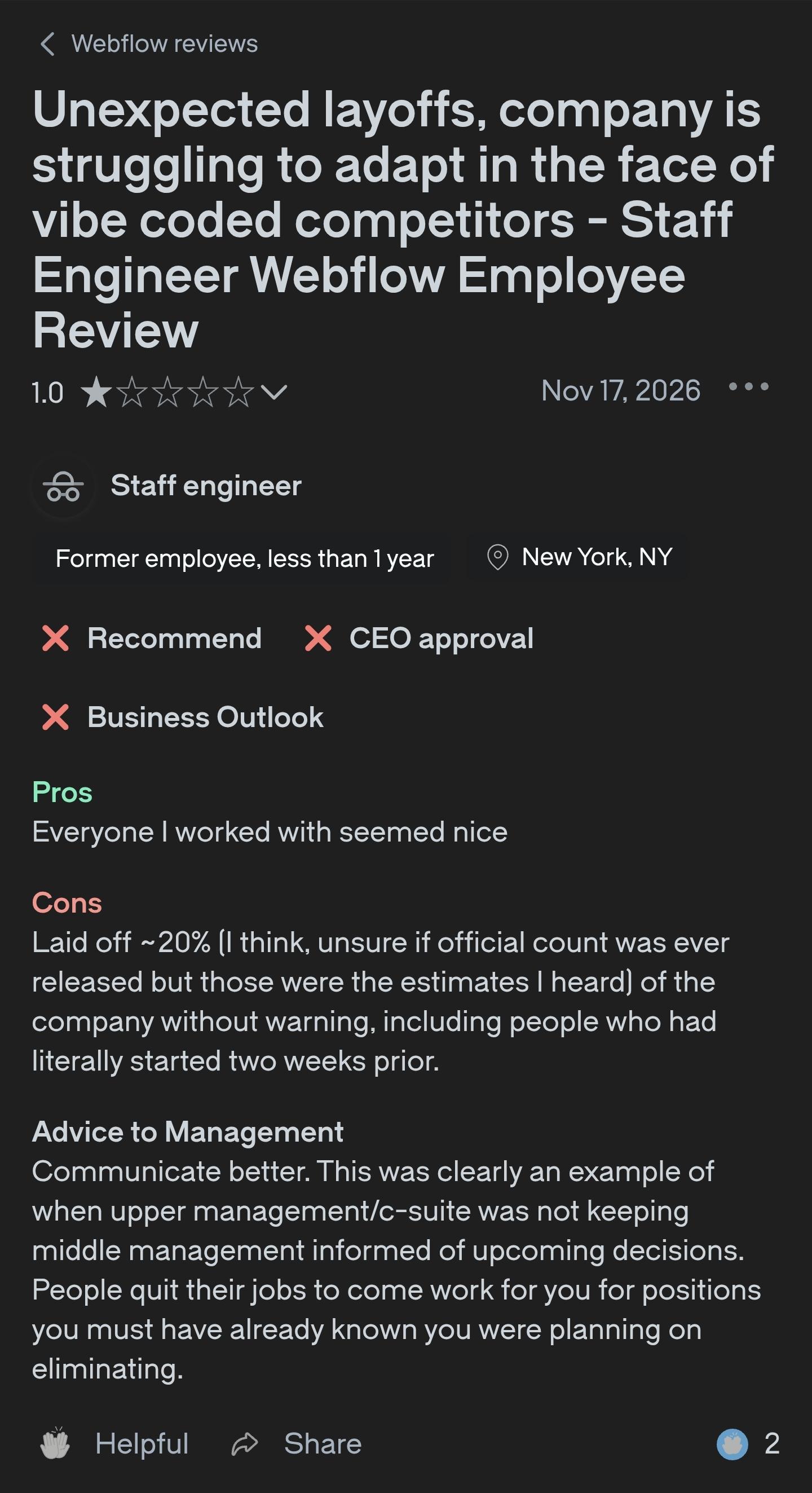
A while back several Webflow template developers in here talked about how they're seeing fewer sales, and part of this is that folks who would purchase templates are now moving to Claude for building their sites.I've been making templates and themes for a huge array of platforms since 2012. I've made themes/templates/page builders for Wordpress, Squarespace, Webflow, Weebly and other platforms.
I've also done extensive research on third-party template marketplaces, and talked with probably thousands of buyers who've purchased my templates. Most of my buyers were normies trying to build a site for themselves with templates (A lot later gave up and hired me lol). Some were web designers themselves.
I am convinced that this "dip" in template sales is a short term issue, and in the long run, AI will INCREASE the demand for templates/UI kits greatly.
Also I'm buzzing right now because I just had like 3 cups of super strong Vietnamese coffee (what the fuck do they put in these???) so just bear with me I know this is a long post. I'm sitting in this coffee shop shaking and typing away in a locked in state. And I'm not going to proofread any of this or refine anything with AI so sorry for any mistakes in advance because I'm procrastinating on important work while writing this so yeah.
By default, LLMs generate the statistical average.
Ok as designers who use AI we have to understand this. LLMs are prediction engines trained to regress to the statistical mean. They'll generate the corpus average of anything, including web design. That’s why AI built sites have very similar aesthetics. Safe spacing, predictable hero layouts, generic gradients, recycled SaaS rhythm etc. Labs are attempting to differentiate via Skill files and fine tuning but then we see those designs become generic.
You can build a genuinely original, gorgeous site with AI BUT only if you already think like a designer.
To pull an LLM away from its average, you're gonna have to do stuff like curate cohesive visual references, write good copy that actually fits the spatial rhythm of the layout, hold a complete visual mental model in your head before it exists and obviously know like what fucking words to use to to steer the model.
For a designer, AI is awesome. You already have a good vocab of design terms, you probably have your own web design inspiration library, and your brain is adapted to mixing and merging attributes of different designs to come up with something novel. But I'm not writing about you. I'm writing about normies. The guys who'd buy Webflow templates, and the guys who used to use Squarespace/Weebly/Wix/Duda.
How do they prompt a bento grid if they don’t know what a bento grid is? How do they ask for Swiss typographic hierarchy, asymmetrical editorial pacing, or restrained micro-interactions if those concepts aren't in their vocabulary?
I mean okay, they can sketch wireframes or hunt down design reference screenshots to feed the model but now they're doing actual design work which defeats the reason most non-techies reached for AI in the first place. Most of them have real businesses to run. An industrial engineer that runs a SMB in the energy supply chain isn't going to spend hours prompting an LLM.
Don Norman my beloved
The OG wrote about this in his book The Design of Everyday Things which is a staple in the UI/UX community. If you haven’t read it, you need to read it because a lot of what he talks about applies more than ever today with AI. Actually he predicted a ton of stuff with AI.
One of the things he talked about in his book was that the gap between a user's fuzzy goal ( such as "make my site feel boutique and credible") and the exact inputs required to produce it. The Gulf of Execution. Natural language is actually a terrible + lossy compression format for visual design.
We've seen this before
Right now, we’re in the honeymoon phase of AI-generated sites. It mirrors the early wave of Wix, Weebly, and Bootstrap/flat design when suddenly anyone could ship something "clean enough" in minutes.
Wait a few months. We already know what happens next when one aesthetic saturates the web. We're actually seeing this already with normies rejecting AI-generated posters. Look at insta comments and the memes on TikTok surrounding the AI-generated menus and imagery that restaurants are using.
Daniel Berlyne’s work on aesthetics showed that aesthetic pleasure follows an inverted-U curve tied to novelty.
Early exposure to a clean style feels great. That’s where we are with AI generated sites. But overexposure triggers habituation and boredom. That’s the exact psychological reason flat design eventually fractured and why "AI-default" layouts are already starting to trigger fatigue. Also normies are extremely well at “sensing” design. Just look at the Instagram comments for Insta ads where clear Claude-slop is shown.
Then we’ve got the MAYA Principle (coined by Raymond Loewy then empirically validated by Paul Hekkert et al). They wrote that aesthetic preference sits at the intersection of typicality ( familiar enough to use effortlessly) and novelty (ie distinct enough to feel fresh). LLMs max out typicality and drive novelty to zero.
Consider the 50ms credibility tax. Gitte Lindgaard (2006) found that users form an aesthetic and trust judgment of a website in roughly 50 milliseconds, before they even read your h2. Ties in to the Aesthetic-Usability Effect which states that visually refined designs are subconsciously perceived as more trustworthy and usable, and a generic look becomes a liability.
AI is the best thing to happen to template marketplaces
I think we all know this, but a big fatal flaw that website templates always had was they looked amazing in the live demo, BUT the second a buyer tried to customize them, they fell apart. Like if you swapped in a slightly longer headline the layout broke bc templates were rigid and non-designers didn't understand structure.
AI fixes the exact weakness and templates fix the exact weakness holding AI back.
For LLMs, a well crafted human template works as design guardrails. Its a dynamic and flexible design system that locks in typography, spacing rhythm, visual personality, novelty, while AI handles adapting layouts to your actual copy.
Normies are excellent at identifying "AI slop" because they're excellent at identifying visual trends even without knowing the terms. The human brain excels at pattern recognition.
Moviegoers can't explain color grading or 24fps vs. 60fps, yet they immediately sense when a clip looks like a cheap soap opera. We have (quite literally) decades of empirical evidence proving that everyday users detect stale, generic, and low-effort UI design intuitively (often in fractions of a second) long before they consciously analyze it.
Design is EXTREMELY important to us as humans. Something that techies often don't understand ("why can't everything be a boring HTML file with no animations no GSAP no movement!!")
Here's the DATA (alright yeah I did use AI for this part because I don't remember the study names):
- The 94% Mistrust Filter (Sillence et al., CHI 2004) - Researchers observed ordinary consumers searching for online health advice and discovered a two-stage trust model. In Stage 1 (a rapid, intuitive "heuristic" scan), 94% of the reasons users rejected or mistrusted a site were purely about visual design and look-and-feel—only 6% were about content. If a site felt dated, amateur, or generic, users bounced before they ever read the copy.
- The #1 Credibility Cue Is Visual (Stanford Web Credibility Project, Fogg et al., 2002): When 2,684 everyday users evaluated live websites and explained their gut reactions in their own words, "Design Look" was the single most cited factor (46.1%)—beating company reputation, credentials, and content accuracy. Users just knew when something looked "off" or generic (even calling out obvious stock photography as a trust killer once recognized).
- The "Amelioration Effect" (Robins & Holmes, 2008): Researchers showed users 42 web pages (21 pairs containing the exact same content, differing only in aesthetic craft) without telling them the study was about design. Even when participants thought they were judging information quality logically, the higher-craft version was rated significantly more credible within the first few seconds. The authors noted this happens at a visceral, pre-cognitive level - the nervous system reacts before analytical thought even turns on.
- Nielsen Norman Group (2016) points out, users' internal baseline for what counts as a "well-designed" site constantly shifts over time simply through daily exposure to modern web trends. You don't need design training to feel when a site is stuck in 2014—or when it looks identical to the last 12 SaaS pages you closed.
The Effort Heuristic
Why do normies reject AI slop? I mean if a website has the right content, who cares if it looks like Claude one-shotted it?
Well, it comes down to The Effort Heuristic. A very well studied phenomenon. Humans subconsciously use perceived effort as a proxy for quality and monetary value. And this heuristic kicks in hardest when the true quality of a product is ambiguous (like deciding whether to trust a new startup or service provider).
Crucially, Kruger found that novices rely on perceived effort just as heavily as experts. Once everyday users start seeing the same AI layout patterns everywhere, their brains stop reading clean design as an indicator that the company invested in quality, and start reading it as low effort / cookie-cutter.
My experience
So as a web designer I offer two tiers of web design service. My custom design packages are for larger businesses and start at five-figure pricing, and there I design a custom design for a client.
But I also offer a cheaper service for $3k-$5k where I basically start with a template and customize that for the client while partnering with a professional copywriter for content strategy.
I’ve been testing a hybrid workflow myself that looks something like this:
- I start with a high-craft Webflow template. Shoutout to BYQ, Medium Rare, 128.digital, a bunch of standout authors in the template marketplace.
- I export the template into HTML/CSS and convert it to astro
- I then build out the customers website with Claude Code
- Then when I’m done I re-import it into Webflow with the MCP.
It works really well.
My vision of the future is the templates won’t just be static themes, but rather they'll be AI-ready design systems built specifically to constrain (in turn, elevating) LLM output. Equipped with their own Skill files, components, visual validation, etc.
Ok now its time for me to get back to actual work :(