r/worldinsights • u/Flimsy-Push5788 • 9h ago
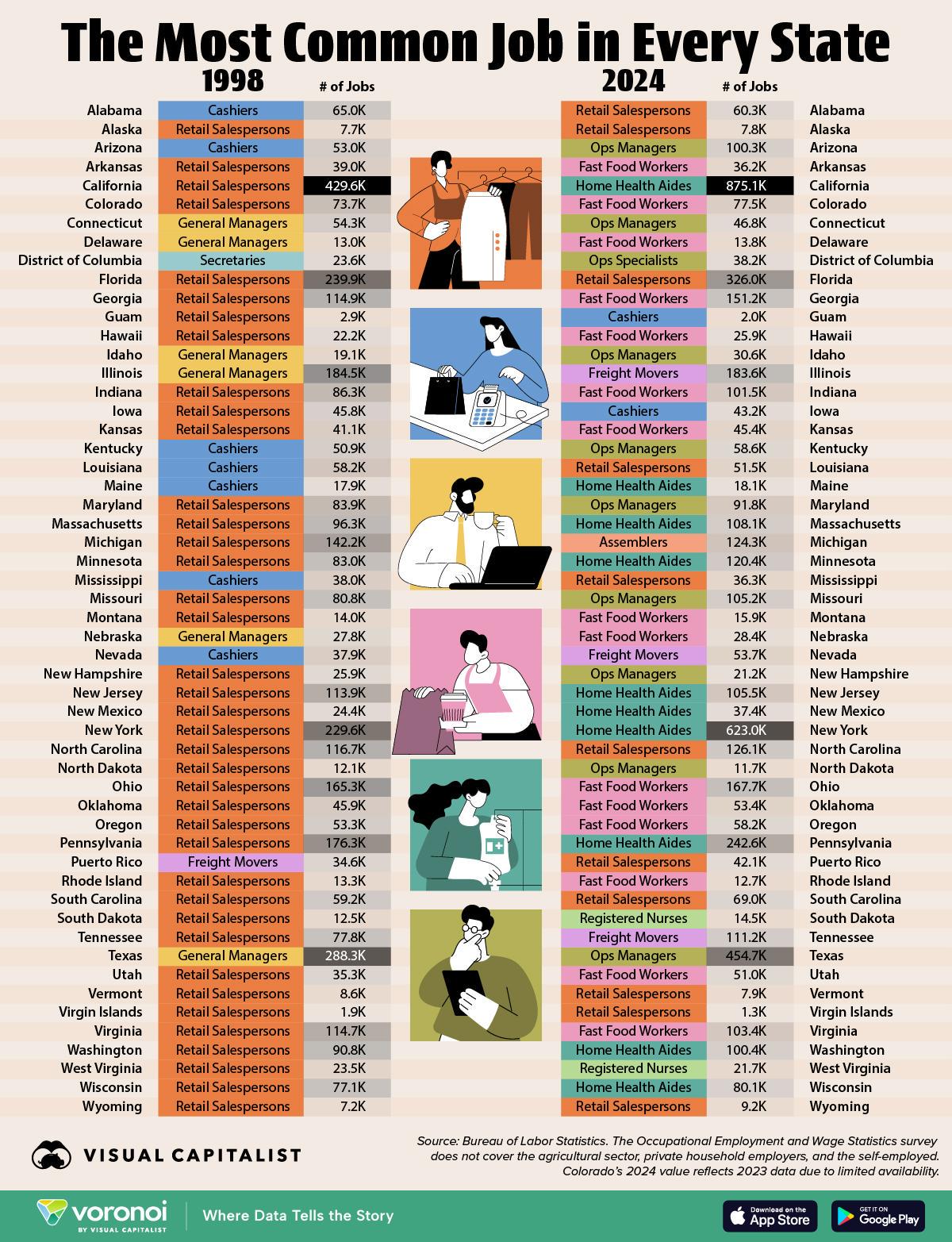
The most common job in every state in 1998 vs 2024
1
Upvotes
r/worldinsights • u/Flimsy-Push5788 • 9h ago
r/worldinsights • u/Existing-Log6417 • 4d ago

r/worldinsights • u/Junior_Abalone_8006 • 4d ago

r/worldinsights • u/bradnobred • 4d ago
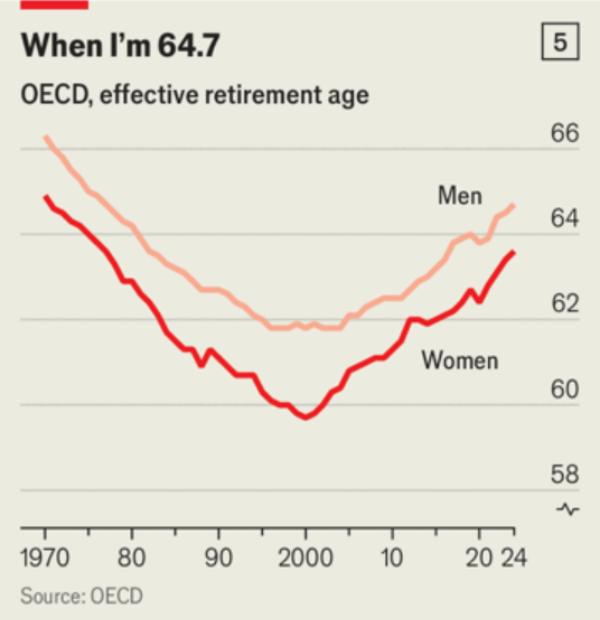
For the baby-boom generation, the golden age of state generosity is coming to an end. And it’s not only that governments have started spending less on the elderly: there are simply too many older people now for the old redistribution model.
In the US, until the 2010s, a person over 65 received roughly ten times as much federal money as people in younger age groups. The main items are Social Security and Medicare. By 2024 the gap had narrowed to about six times. Total spending on older people keeps growing, but it is now divided among far more people. A similar picture holds in most other rich countries. In Italy, even before the pandemic, spending on older people was almost 15 times spending on families and children; now the gap is below ten times. And in 26 of 32 rich countries, older people’s incomes are falling relative to those of working-age people. There is one more telling chart. The effective retirement age in OECD countries, after decades of decline, has turned upward: for men it has already risen to 64.7, for women to about 63.5. The deal with the boomers is slowly being rewritten: fewer perks per retiree, more years of work.
The old arithmetic is no longer adding up: with slow growth and high public debt, pensions can’t be raised forever.
r/worldinsights
•
u/Le0nel02
•
5d ago

Statistically, there really is a link. Where there are more billionaires per capita, consumption and life expectancy are higher, poverty, crime and corruption are lower, and people are on average more satisfied with life. However, according to Crémieux Recueil’s calculations, almost all of this correlation drops to zero once you adjust for GDP per capita.
By this data, billionaires by themselves don’t make a country prosperous: they are more like the tip of the iceberg, an indicator that a lot of money has accumulated in the economy in general. Rich countries simply create more opportunities for giant fortunes to appear. This is especially visible in innovation: the more a country spends on R&D, the more billionaires it has, even at the same income level. Moreover, rising research spending precedes the appearance of new billionaires, while there is almost no reverse effect.
But there’s an interesting nuance. When it is not the number of billionaires but their fortunes that grow, R&D spending and the number of researchers rise, but the number of new companies falls. The author explains it this way: huge capital makes it possible to fund projects that ordinary businesses can’t afford, and the corporations of the super-rich offer talented engineers and managers such salaries that working for them is more profitable than taking the risk of starting a company of their own.
On most other indicators the effect is practically zero. And here it all comes down to where the fortune comes from. A billionaire who made money in a competitive market through innovation and a person who got rich through state rents are economically completely different figures. R&D is linked specifically to the first group. A large number of state-made billionaires, by contrast, is linked to lower life satisfaction and, it seems, lower trust (the chart shows this at the same income level), while for market-made billionaires there is no clear link.
So what matters is not how many billionaires a country has, but where their fortunes come from. If it is from state privileges, then it is no longer an indicator of the economy’s wealth, but rather an indicator of how rents are distributed in it.
r/worldinsights • u/Existing-Log6417 • 7d ago

The story of Huang’s exit from Nvidia looks less and less like an ordinary corporate scandal. Officially the trigger was his personal life: Huang admitted to infidelity, and according to U.S. media reports, U.S. officials believe the woman he was involved with may have worked for Chinese intelligence. There is no proof, and the Justice Department has reached no conclusion. But just three days after the investigation was opened, the board accepted his resignation.
What came next looks odd for a private company. The U.S. president wrote on Truth Social that only Tim Cook could replace Huang. Treasury Secretary Bessent publicly called for a “dramatic shakeup” and an outside CEO. Even before that, Trump had said he believed Huang’s account that he didn’t know about the woman’s possible intelligence ties. When candidates to lead Nvidia are named at the White House, it is hard to call this an internal matter for the board.
The political context is clear: Huang spent years pushing for Nvidia’s access to the Chinese market and publicly praised Chinese open-source AI models, and in the middle of a tech Cold War that is a stance not everyone in Washington likes. No one has proved whether it was about the spy story or about politics: Chinese state media call it a “witch hunt,” while Steve Bannon long called Huang an “agent of influence” for Beijing. But it is a fact that the question of a successor is no longer being discussed only by the board.
The charts show what could happen to the company. The first one covers high-profile handovers at tech giants: a year after Jobs left, Apple shares were up 75% (that was when Cook, whom Trump is proposing now, took over); after Gates left, Microsoft lost 51% (the dot-com crash played a part too); after Bezos left, Amazon lost 15%. One headline, three different years. But none of those exits was scandalous. The second chart is about abrupt exits: over roughly 250 trading days, Apple rose about 77% after Jobs left due to illness, McDonald’s rose about 10% after firing Steve Easterbrook over a relationship with an employee, and Wynn Resorts and Nissan lost about 30% each after Steve Wynn’s resignation and Carlos Ghosn’s arrest. Nvidia is so far down 6.9% at Wednesday’s close and 13.8% in Thursday’s pre-market trading, measured from the November 6 close.
A study of 735 CEO turnovers at S&P 1500 companies shows that when successful CEOs leave, companies on average do worse. And Huang is a co-founder, the architect of the strategy, Nvidia’s chief negotiator with Washington and Beijing, and the creator of the ecosystem that modern AI runs on.
In fairness, McDonald’s shows it can go the other way. But if the choice of Nvidia’s next head is driven by politics rather than by the interests of the business, the company risks paying too high a price for loyalty. There are no irreplaceable CEOs, but the market can easily send a harsh bill for trying to replace the man who made it the main beneficiary of the AI race.
r/worldinsights • u/Existing-Log6417 • 8d ago

Pharma is gradually turning into one of the main megasectors of the global economy, even though attention is still fixed, out of habit, on tech companies. The 24 largest pharmaceutical companies have already accumulated about $5.6 trillion in market capitalization, and Eli Lilly alone has broken the trillion-dollar mark (it is now at around $1.2 trillion), joining an elite club that used to consist mostly of tech giants. Against the backdrop of the obesity epidemic and chronic disease, GLP-1 drugs are becoming the main gold mine of the modern economy.
The numbers speak for themselves: in the third quarter of 2026 alone, GLP-1 drugs for diabetes and obesity brought Eli Lilly about $17 billion. That is comparable to the quarterly revenue of leading AI companies like Anthropic. But while the huge data-center investments of AI companies have yet to pay off, “miracle pills” based on GLP-1 are already generating colossal cash: for 2026, sales of the two market leaders, Eli Lilly and Novo Nordisk, are estimated at about $101 billion.
r/worldinsights • u/Existing-Log6417 • 10d ago

Canada has developed a noticeable surplus of young men. Among 20-29-year-olds there are now about 108 men per 100 women, or roughly 219,000 extra men (an estimate as of July 1, 2026). In 2011 the ratio was about 101 per 100, and at its peak in 2024 it reached about 110. This is already a problem for the future marriage market.
In Asia, such imbalances arose mainly from decades of son preference and sex-selective abortion. In India, according to researchers’ estimates based on the 2011 census, about 39 million men aged 15-54 face a structural shortage of women, and in Punjab the “surplus of grooms” index reaches about 33%. In China, the sex ratio at birth peaked at around 121 boys per 100 girls in the early 2000s. The imbalance at birth in India is now slowly easing: from about 111 boys per 100 girls in the 2011 census to about 108 in 2019-2021.
Canada got here by a different route. The imbalance among young men there is largely tied to migration. In 2024, men made up 58% of work permit holders and about 56% of principal applicants in the economic class. India was the largest source of international students in Canada in 2024, although its share fell noticeably in 2025.
It makes for an interesting demographic loop: countries like India and China spent decades accumulating a surplus of men, and now part of that surplus is starting to move to places where it did not exist on such a scale before. And Canada looks like one example of how an Asian demographic imbalance is gradually being exported along with migration.
r/worldinsights • u/Le0nel02 • 12d ago
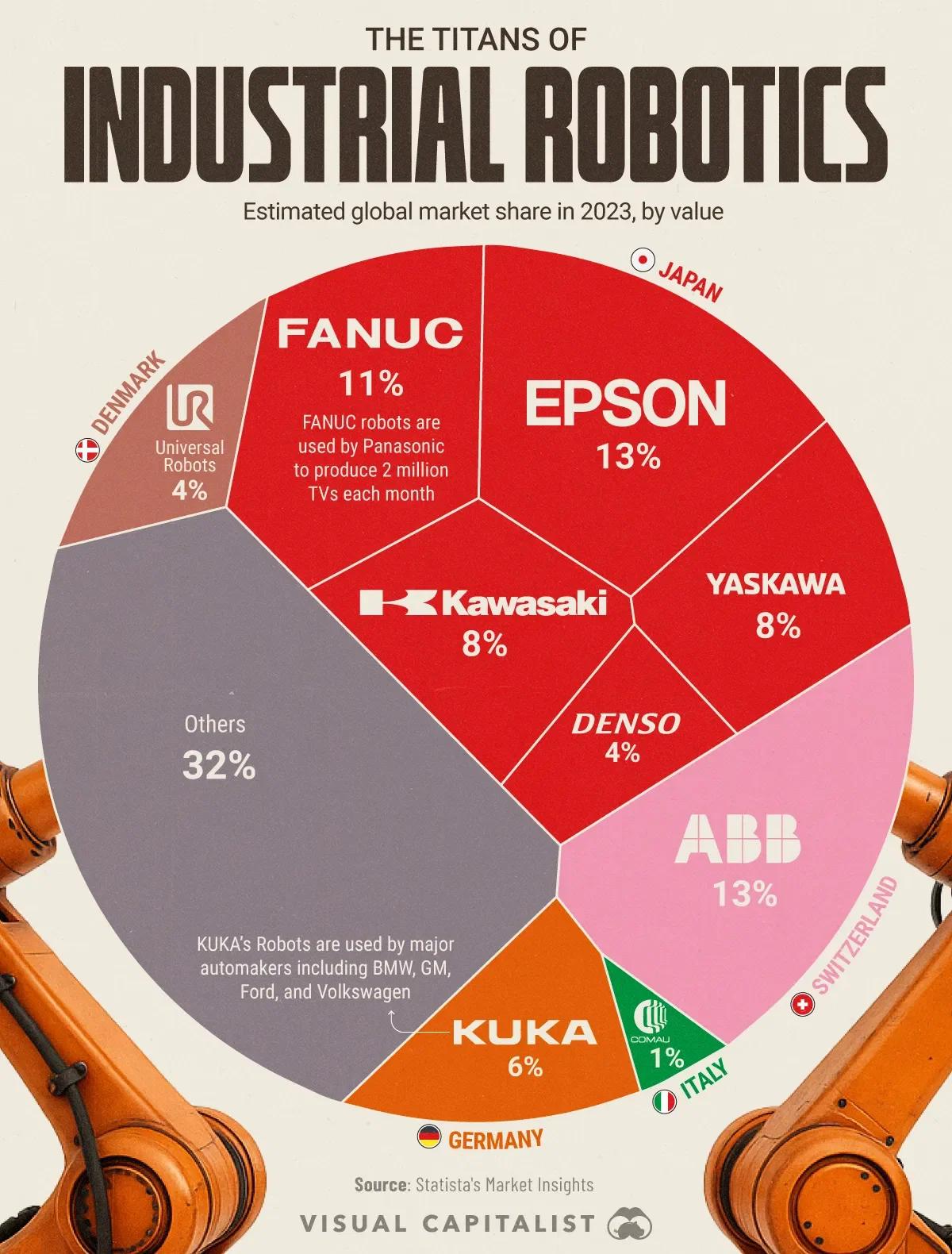
If the symbols of industrialization used to be steam engines, assembly lines or computers, today they are robots. According to Statista’s estimate, two giants lead the global industrial robot market in 2023 by market share in value terms: Switzerland’s ABB and Japan’s Epson. Each holds 13%.
Japan remains the undisputed center of gravity in this industry. Besides Epson, there are FANUC (11%), Kawasaki (8%), Yaskawa (8%) and Denso (4%): together, the five Japanese companies account for 44% of the global market, nearly half. This is the result of a long-term bet: Japan began using robots in its auto industry as early as the late 1970s, when the industry was growing and skilled welders were in short supply, and today the shrinking working-age population adds to it. Japanese robots now work in factories around the world, from automotive to electronics.
According to Statista’s forecast for 2025, the market was expected to reach $10.2 billion, with automotive (30%) and electronics (27%) set to be the largest segments of new installations, about 57% together. In effect, this means robots are becoming the working class of globalization 2.0. If in the 20th century competitiveness depended on cheap labor, now it depends on the speed of adopting automation.
r/worldinsights • u/profcyclist • 14d ago

r/worldinsights • u/bradnobred • 14d ago

Germany is noticeably changing the demographic makeup of its younger generations. According to Microcensus data, in large cities and many regions of the west and southwest of the country, children with a migration background already make up 40-50% of all residents under 16, and in places more than half. Migration background is defined broadly here: the child was born without German citizenship, or at least one of the parents did not have it at birth. In the east, in the former GDR, according to the map the picture is still completely different: more often below 10-20%.
At the same time, the gap between eastern and western Germany shows how uneven this process is. In some regions the demographic shift has already happened among children and teenagers, in others it has practically not begun yet.
r/worldinsights • u/DiggyJunior • 15d ago
r/worldinsights • u/bradnobred • 26d ago

Milton Friedman, the well-known American economist, put forward an idea back in 1999 that European elites find uncomfortable: you cannot have open borders and a generous welfare state at the same time. The thesis is still disputed, so let’s look at the data.
Let’s start with demographics. In Eurostat’s hypothetical no-migration scenario, the EU population would fall from roughly 452 million today to about 270 million by 2100. In the baseline scenario, which includes migration, about 399 million remain at the end of the century. The old-age dependency ratio (people aged 65+ relative to the population aged 15-64) in 2100 would be about 62% in the baseline scenario and about 74% without migration.
At the same time, immigrant employment in several EU countries is noticeably lower than that of native-born residents. According to the OECD, the gap is largest in the Netherlands, at about 13 percentage points. In Germany and Finland it is about 10 pp, in Sweden about 9, and in France about 7.
Education shows a similar picture. According to PISA 2022, 49% of second-generation immigrant students in France do not reach the baseline level in math (Level 2). Among students without an immigrant background the figure is 28%. In most continental European countries this share among the second generation is roughly 40-50%, and among the first generation it can be even higher (about 58% in Finland). In the UK, Ireland and Switzerland it is lower, around 20-30%. Part of the gap is explained by the socio-economic status of families.
Against the backdrop of the rapid aging of the native population, these integration problems threaten the future stability of Europe’s economy. Europe is getting not skilled taxpayers to support a horde of pensioners, but a huge class of perpetual welfare recipients locked in ethnic ghettos.
r/worldinsights • u/DiggyJunior • 27d ago
r/worldinsights • u/Le0nel02 • 28d ago

The chart shows countries where fertility is already lower than Japan’s. There are 17 of them, in very different parts of the world, from Taiwan and Thailand to Chile and Poland. How can this be explained when their cultures and income levels are so different?
r/worldinsights • u/MaksRudra • Oct 23 '26
TL;DR: Japan built a civilization optimized for perfecting physical things, then the 21st century rewarded fast, messy, risk-tolerant software — and it couldn't pivot.
The main reasons:
· Nominal GDP share fell from 17.8% (1995) to under 4% (2024)
· Overtaken by Germany in 2023; GDP per capita now 38th globally
· Debt-to-GDP at 260% — world's highest — stuck in borrow-to-service-debt cycle
· Decades of zero interest rates failed to generate growth; wages flat 20+ years
2. Demographic collapse
· Record-low 686,000 births (2024); population declining 16 straight years
· 29%+ of population is 65+
· Shrinking workforce, 4+ million vacant homes, collapsing rural economies
3. Missed the software/digital revolution (the technological heart of it)
· Wrong business model: the "SIer" custom-development model created low-margin "digital farmhands" instead of scalable product companies — a ¥5.5 trillion digital deficit
· Cultural mismatch: meticulous "Monozukuri" perfectionism is a superpower for hardware but fatal for software, which rewards speed, iteration, and embracing failure
· Risk aversion: failure carries deep social stigma; lifetime employment discourages job-hopping; low CEO pay kills the founder "jackpot" incentive
· Waterfall over Agile: rigid up-front specs instead of "release early, fix later"
· Legacy hell: aging systems (the "2025 Cliff") with too few engineers to maintain them
4. Weak startup & innovation ecosystem
· Big firms monopolize blue-chip clients, starving startups of revenue
· No VC engine comparable to the US
· Strong consumer privacy fears stifle data-driven business models
5. Political governance failure
· LDP took major election losses over slush-fund scandals and inflation
· Short-term factional politics can't deliver long-term strategy
· Slow consensus-driven decision-making ill-suited to fast-moving crises
6. Diplomatic isolation & historical baggage
· Wartime history disputes damage trust with Korea and China
· Caught between a rising China and an increasingly transactional US; the traditional balancing act is unsustainable
r/worldinsights • u/ConceptsOfAPlant • Oct 22 '26

r/worldinsights
•
u/ManufacturerDue6559
•
Oct 21 '26

This is perhaps the clearest illustration of why Germany’s Energiewende has become a cautionary tale for the world, proving that good intentions divorced from economic reality inevitably court disaster.
While France, backed by its nuclear fleet, keeps the carbon intensity of its electricity down to a mere 43 grams of CO₂ per kWh, Germany’s has soared to 398 grams. Had Berlin simply kept its existing nuclear plants online, its emissions would sit at a modest 103 grams.
Instead, Germany sank over €400 billion into green euphoria, only to end up not with an eco-utopia, but with the gutting of its energy-intensive industry and widespread job losses. Forced to burn coal and gas in place of clean nuclear power, the German grid now emits nearly ten times more carbon than France’s. Crushed by skyrocketing costs, manufacturers began offshoring en masse to Asia, where environmental standards are far looser: a car built in China and shipped to Europe, for instance, leaves a 70% larger carbon footprint than one made in Germany.
On a global scale, this experiment costing half a trillion euros has only made matters worse. European industry has lost its competitive edge, emissions have simply leaked abroad, and the much-hyped transition has turned out to be an exorbitantly expensive own goal.
r/worldinsights • u/Le0nel02 • Oct 16 '26

A new study shows that Generation Z falls dramatically behind all previous generations in fertility at the corresponding age. Zoomers want children less, and they are also more likely to face health problems that affect reproductive function.
This year the oldest members of Gen Z (born 1997-2012) turn 29. Women of this generation have children substantially less often than millennials, Gen X and baby boomers at every age from 20 to 26: according to the authors’ estimates, only a quarter of Gen Z women had at least one child by age 26, compared with about 47% of millennials.
Personal preferences are one of the main reasons: the probability of wanting a child among Zoomers is lower than in any previous generation at the same age. Gen X and millennials wanted children even more often than baby boomers, and Gen Z breaks that pattern: at 26, about 59% of Gen Z women want a(nother) child, against roughly 77% of millennials.
On top of that, physiological reproductive impairments in Gen Z women show up more often at every age for which data exist than in baby boomers, Gen X or millennials. Whether it is exposure to endocrine disruptors, stress, weight problems or other factors, it means that even those women who want children will face serious difficulties.
What is interesting is that for the earlier generations the story was mostly about health. Birth rates among Gen X and millennials fell primarily because of growing difficulty conceiving and carrying a child. Gen Z has become the only generation in the data where a sharp drop in desire has been added to these difficulties.
r/worldinsights • u/Wittymonkey • Oct 15 '26

r/worldinsights • u/Ok_Astronomer_7797 • Oct 13 '26
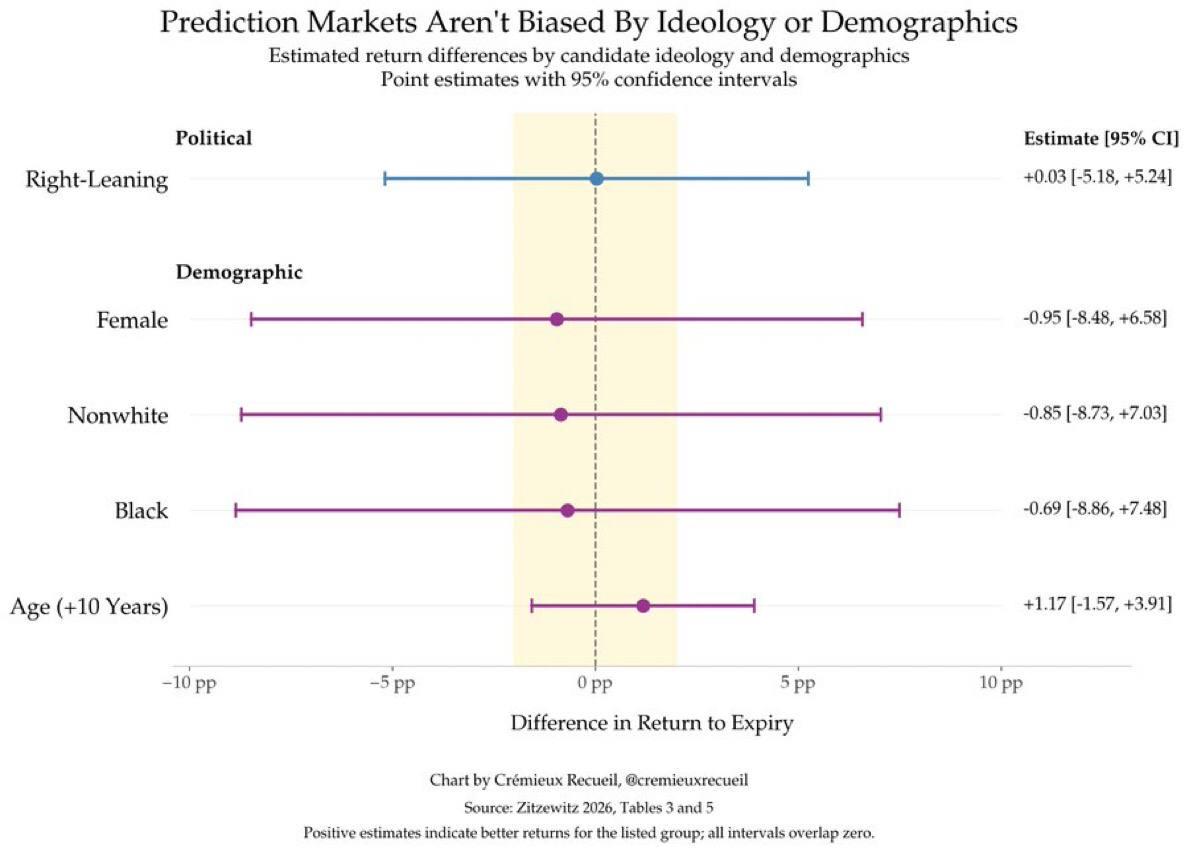
Prediction markets paint a much more sober picture than politicians’ slogans and sociologists’ calculations. An interesting study has come out from Eric Zitzewitz, an economist at Dartmouth. He took a huge body of prediction market data covering 145 years, from 1880 to the present day, ranging from archaic bookmakers to modern digital platforms like PredictIt and Kalshi. The key finding of the work demolishes the popular myth that these markets supposedly lie to suit the political sympathies of their participants. The empirical data confirm that there are no political or demographic distortions there.
There is a widespread belief that “markets are dominated by particular crowds (for example crypto guys, so-called Trump supporters or just bored white zoomers), and they drag the quotes in favor of their candidates.” Zitzewitz shows with numbers that a skew in who trades does not turn into a skew in prices. True, the demographics of players on these platforms do not match the real cross-section of voters: they are on average younger, more often male and better educated. But this does not affect prices. Neither the ideology nor the gender, race or age of the candidates themselves creates any systematic skew.
Classic Darwinism and greed are at work. The desire to earn money, as a rule, beats the desire to “vote with the heart.” As soon as an emotional crowd overstates the chances of its favorite (creating a “bubble of sympathy”), cold, informed speculators show up and short that bubble, returning the price to mathematical reality. The market punishes emotion with invested money and rewards cold calculation.
The main anomaly Zitzewitz confirms is the one classic for any betting: outsiders are overpriced and obvious favorites are underpriced. Part of it is psychology: people like to bet on a miracle for pennies in the hope of hitting the jackpot. Part of it is arbitrage: buying underpriced favorites takes capital, so this skew is hard to correct.
In the current climate of total political polarization, when opinion polls have turned into an instrument of propaganda and the media into partisan battle sheets, prediction markets remain almost the last institution where people answer for their words with their own money. And money, as we know, has no party affiliation.
r/worldinsights • u/bradnobred • Oct 12 '26
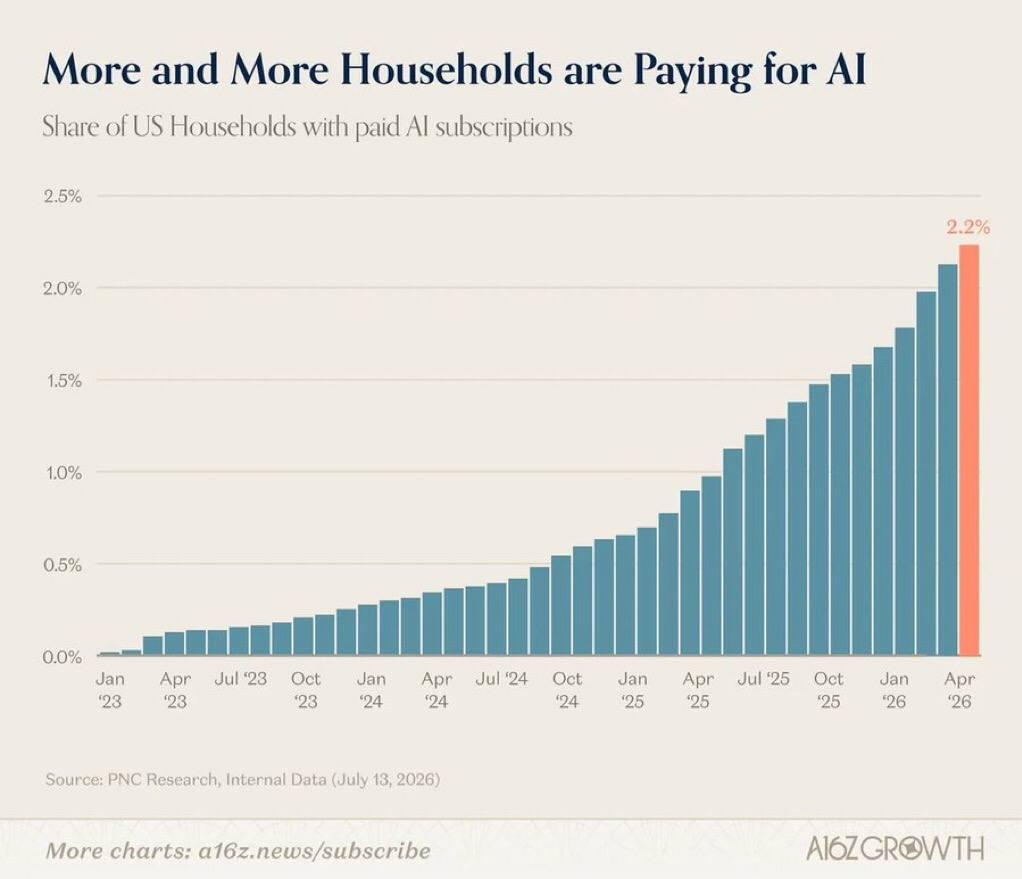
PNC Bank card data shows that only 2.2% of households among the bank’s customers pay for an AI subscription. If you apply that share to the whole country, you get roughly 3 million families out of 130-plus million, though this is only a rough estimate, since a sample of one bank’s customers is not representative of the country. A basic plan costs about $20 a month, and a paying household keeps its subscription for about seven months in a row on average. For comparison, in PNC’s May report 43% of households pay for streaming, 5.1% spend on gambling, and about 2% pay for AI (a three-month average).
At the same time, Big Tech is acting as if AI were already a necessity like electricity or running water. The four largest IT giants (Alphabet, Amazon, Microsoft and Meta) plan to sink around $725 billion into infrastructure this year alone, while OpenAI ran an operating loss of almost $21 billion on $13 billion in revenue for 2025. Giant sums are being poured into a system that, in PNC’s data, only two households out of a hundred pay for.
The most interesting figure here is exactly those seven months. It seems people are not exactly rejecting progress: they try the service in good faith, use it for half a year and see no reason to renew. Netflix took off back in the day because you could drop cable TV and save money right away, but AI still has no such obvious value proposition for the ordinary person. The product seems useful, yet no one can really explain which everyday problem or expense item it replaces. People happily use the free versions, which means they like the technology itself, but they still see no point in paying for it out of their own pocket.
Over the next couple of years, as the software gets polished, those 2% will most likely grow to 7-9%, and Wall Street will even declare that a victory. Yet the $725 billion in capex looks like a bet on far more mass demand, which means Silicon Valley has built massive infrastructure for a future that ordinary people have so far not invested in.
r/worldinsights • u/Le0nel02 • Oct 09 '26

According to Teikoku Databank, only 10,118 Japanese companies were still operating in mainland China by June 2026. That is the lowest figure in the entire period of observation, which has run since 2010. Over the past two years the number of Japanese companies has fallen by 22%, and it is down almost a third from the 2012 peak. Only 1,221 new firms decided to enter the Chinese market, while 4,137 companies either left or dropped out of the database.
With relations already strained, plenty of reasons have piled up.
First, China has grown from a cheap and obedient factory into a tough state-capitalist competitor: local producers pumped up with Beijing’s subsidies are aggressively squeezing out foreigners by dumping. Second, institutional risks are taking their toll: the repressive tightening of the espionage law, restrictions on rare metal exports, and the protracted systemic crisis in China’s real estate sector. On top of that come American tariffs, which put additional pressure on the profits of Japanese manufacturers in China.
As a result, Japanese capital is relocating to where risks are lower and labor is cheaper, to the new periphery of Vietnam, Thailand and India.
Geopolitics adds fuel to the fire. After the sharp remarks by Tokyo’s prime minister Takaichi on Taiwan, Beijing used its administrative leverage and restricted exports of dual-use goods to Japan, including some rare earth elements. Shanghai alone lost more than a thousand Japanese firms in two years (from 5,046 to 3,961). Small businesses are leaving more visibly than large ones: the share of companies with annual sales under ¥1 billion in the total is falling while the share of larger ones is rising, and big capital is still trying to hold on.
Of course, there is no talk of an instant break yet: China remains Japan’s main production base, since too much was invested there over the last 30 years. But the overall direction is clear: Japanese business is gradually closing off the old project of the Chinese economic miracle for itself and winding down its presence in the Chinese market.