r/AlternateHistory • • 4h ago

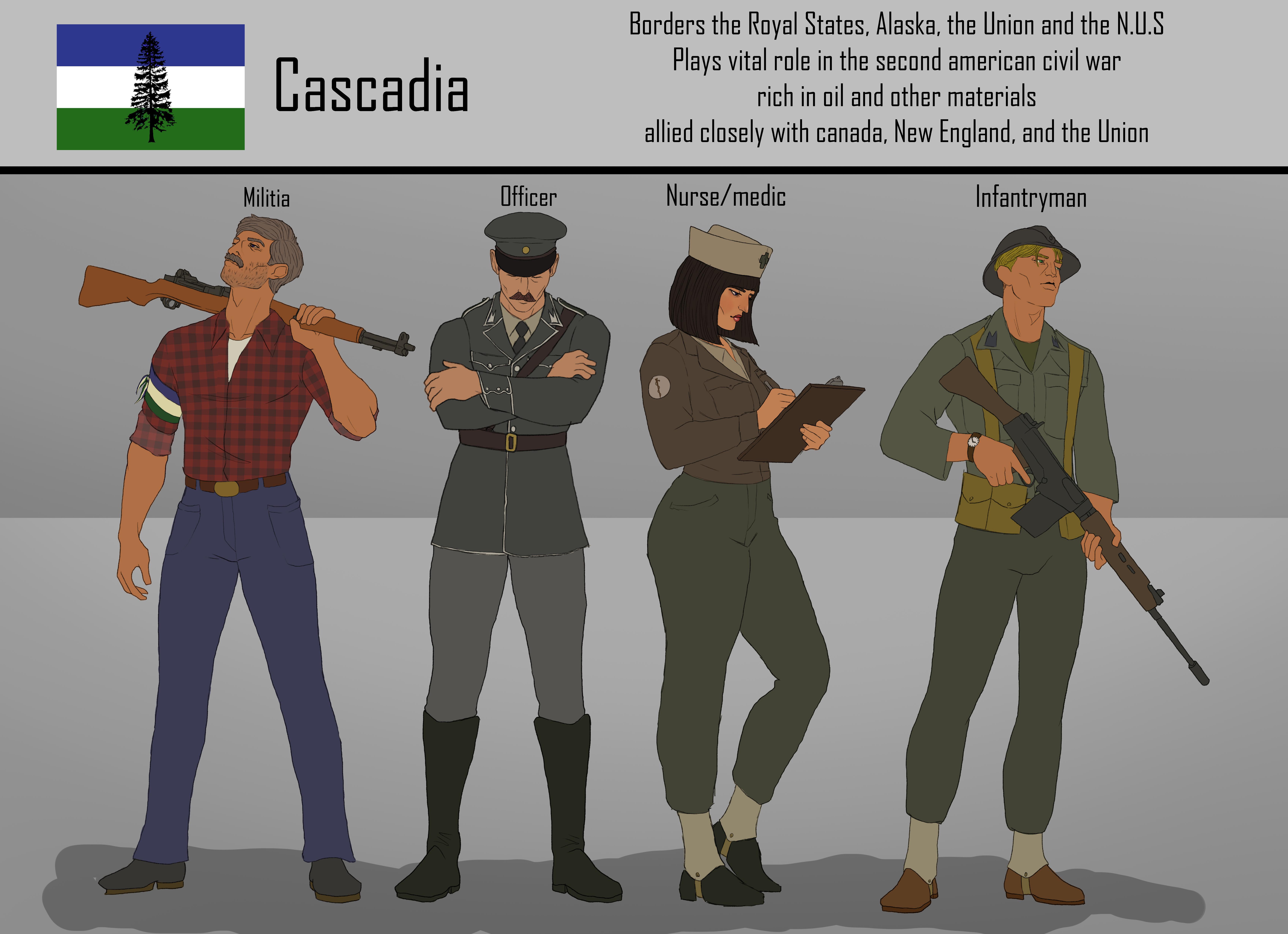
1900s Uniforms of the Cascadian Coalition

Post image
37 Upvotes

The Brother War of 1861-1868 ended in a crawl. Americans on both sides lost many lives and supplies and so to end the war against fathers and sons, there came the Mason Dixon Treaty of 1868. Slavery was ended, however states had more authority unto themselves, and could unionize into coalitions, making the American south both its own government, but ultimately, it was under the authority of the Union government. Over time more and more states created their own coalitions, New England, Cascadia, Texas, and the Western Royal States.

Nestled in the Northwest of the US, this coalition is made up of a peaceful populus, largely wealthy from the large oil reserves that are dug and traded with Alaska. However the peaceful nature of the coalition will change when a large oil vein is found on the boarder of the southern Cascadian states, and the Royal states, sparking conflict. Will they be able to negotiate, or will this be the spark that ignites the second American civil war?


r/AlternateHistory • • 1h ago

1900s Castles Made of Sand: Cascadian Dream

Post image
10 Upvotes

This is my first imaginary election, id appreciate feedback especially on mapping electoral districts and electoral math :^


r/AlternateHistory • • 18h ago

Pop culture What if Funny Valentine actually became the 23th president of the United States in real life?

Post image
211 Upvotes

r/AlternateHistory • • 1d ago

Post 2000s The soldiers uniform of the Peoples Republic of Gran Colombia

Thumbnail
gallery
450 Upvotes

This is a woman who serves in the National infantry of the PAof Gran Colombia (PAoGC) as part of the ground forces

They are a major bulwark in Socialism in the Americas and are a major influence in Social Democratic and Socialist governments around them. While their emblem suggest a militant form of communism, and they do have a large military, it is mainly a large defense force.

They are a major ally of the 3rd internationalle, and a ideological enemy of the US, but a strategic trade partner as they control the Panama Canal.

Art is made by @Grzegorz_9696 on Twitter

https://x.com/Grzegorz_9696/status/2124875605535768867?a=c5iDVC_kC9QFpsDKMs0&s=19


r/AlternateHistory • • 10h ago

1900s Swapped Fates #25: United States Big Three (automobile manufacturers)

Post image
10 Upvotes

General Motors Company


As the largest automaker in the United States, the company's business spans multiple industries, including automobiles, motorcycles, ships, aircraft, finance, home appliances, and even space. In addition to the United States, the company also holds a significant presence in the Middle Eastern market (especially in Egypt).


Ford Motor Company


As one of the world's largest family-controlled companies and the birthplace of Fordism, the company not only rose to prominence on the world stage with its once-popular Model T, but also propelled the development of automotive technology through its groundbreaking research into hovercars and flying cars.


American Motors Corporation


A giant automaker formed by the merger of four car companies—Studebaker, Packard, Nash-Kelvinator, and Hudson—under the guidance of George W. Mason. This post-World War II revival not only successfully defeated Chrysler but also transformed American car culture by promoting compact cars.

Original: https://www.reddit.com/r/SwappedFates/comments/1y47ub0/swapped_fates_25_united_states_big_three/

Novel: https://www.alternatehistory.com/forum/threads/swapped-fates-what-if-germany-and-japans-fates-were-swapped-after-wwii.560101/

Pixiv: https://www.pixiv.net/artworks/152438297


r/AlternateHistory • • 13h ago

1900s What if in 1985 President Ronald Reagan talked to the board of Apple to get Steve Jobs reinstated as CEO

Post image
16 Upvotes

r/AlternateHistory • • 1h ago

1900s What if South Africa didn't end Apartheid

Post image
0 Upvotes

South Africa keeps Namibia (Worsens connection from the world)

Lesotho becomes a puppet after a new war breaks out over the Drakensberg Mountains (Increases material)

Botswana becomes puppeted after South Africa over throws Gaborone.(Looses western connection)

South Africa annexes its Angola and Zambia territory and puppets a large part of Angola.(Isolation)

~~~

South Africa keeps building Nuclear weapons and it's arsenal grows.

South Africa's economy reaches $1.1T by 2025

South Africa is now a threat to the Western Land

~~~

This could've happened if:

•Nelson Mandela died

•The whites won in the election

•South Africa still owned Namibia


r/AlternateHistory • • 1d ago

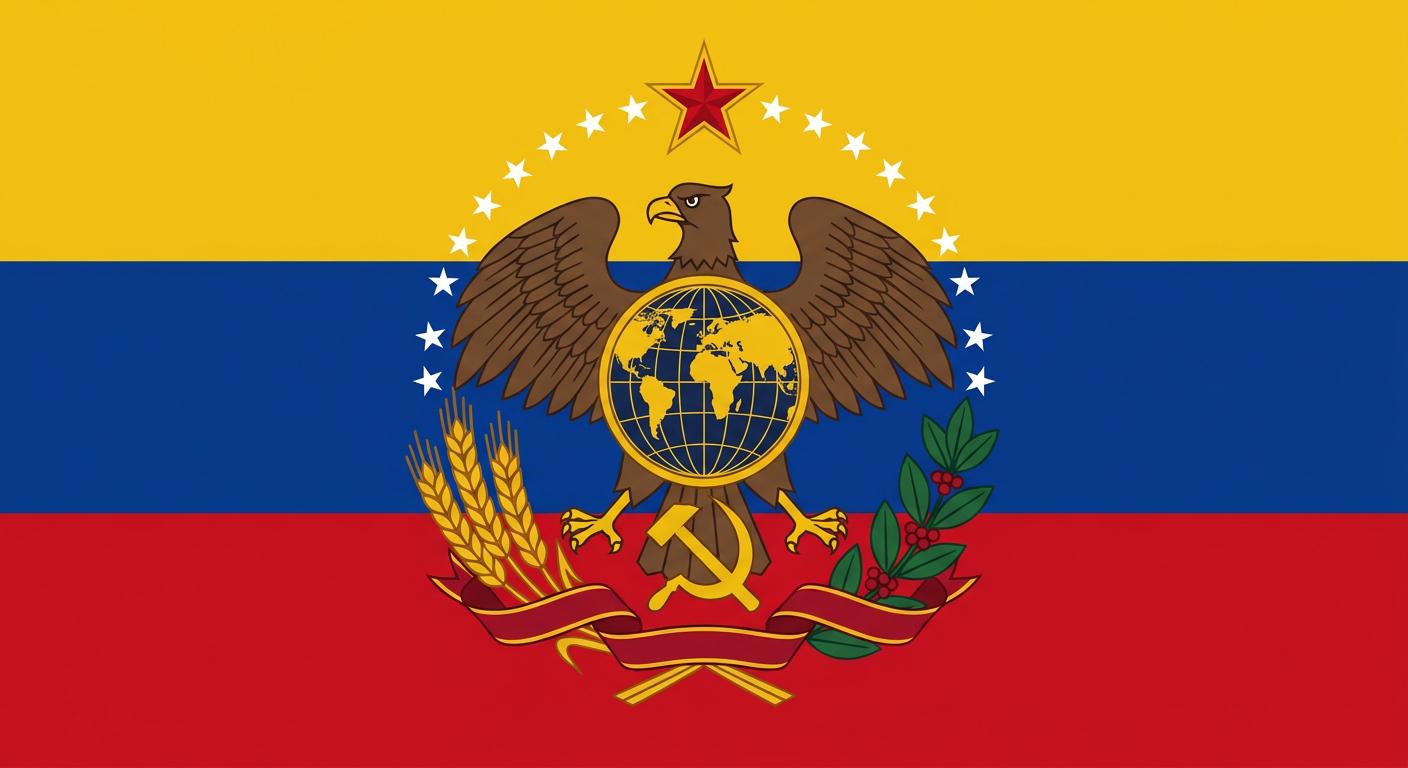
1700-1900s What if Gran Colombia and the USSR had formed a decentralized union? (Flag & Concept)

Post image
46 Upvotes

Historia Comparada y Vexilología: ¿Qué pasaría si Gran Colombia y la URSS hubieran unido sus fortalezas?

¡Hola a todos! Mientras estudiaba historia, siempre me llamó la atención ver los paralelismos entre dos proyectos gigantes de integración que nacieron de revoluciones y que, con el tiempo, se terminaron disolviendo por tensiones internas muy parecidas: Gran Colombia (1819–1831) y la Unión Soviética (1922–1991).

Dejando de lado las diferencias de época, empecé a pensar en cómo una unión hipotética entre esos dos bloques podría haber corregido las debilidades del otro, creando una superpotencia equilibrada donde cada lado aportara lo que al otro le faltaba:

• Descentralización y Autonomía Regional (La lección política): Tanto Gran Colombia como la URSS sufrieron un centralismo excesivo desde sus respectivas capitales. En esta unión, se aplicaría una versión evolucionada del modelo federal de Gran Colombia: un sistema realmente descentralizado donde cada nación o república integrada tenga un representante con autoridad real para tomar decisiones adaptadas a su propia región, evitando el desgaste interno.

• Recursos fundamentales para la industrialización (El motor material): Regiones como Colombia, Venezuela y Guyana no solo aportarían materias primas básicas, sino recursos estratégicos insustituibles (petróleo, gas, hierro, bauxita, minerales críticos y un potencial enorme hidroeléctrico y agrícola) necesarios para impulsar una industrialización masiva y autosuficiente.

• Ciencia, Ingeniería e Industria Pesada (El aporte soviético): A cambio, la Unión Soviética aportaría su enorme capacidad tecnológica, maquinaria pesada, metalurgia, planificación científica y desarrollo aeroespacial, permitiendo que esos recursos se transformaran en una industria de punta sin depender de potencias externas.

Inspirado por esta síntesis política y económica, diseñé esta bandera fusionando la heráldica de ambas uniones:

• El tricolor con franjas iguales (Amarillo, Azul y Rojo): Representa el equilibrio territorial y el respeto por la identidad de los pueblos.

• El arco de estrellas blancas: Simboliza a cada una de las repúblicas federadas y regiones, con su propia voz y autonomía dentro de la unión.

• El Cóndor de los Andes sosteniendo el Martillo y la Hoz: La unión entre la soberanía republicana y la fuerza del trabajo industrial y agrícola.

• El globo central y las guirnaldas de trigo y café: El puente transcontinental entre Eurasia y Sudamérica bajo la estrella roja.

¿Qué te parece este enfoque histórico y político, y cómo ves el diseño heráldico de la bandera? ¡Me encantaría leer tus ideas!

La siguiente parte en este post: https://www.reddit.com/r/AlternateHistory/s/fpxVCBmTzR


r/AlternateHistory • • 13h ago

Post 2000s On the Other Side of the Horrible Night: Colombia before, during and after its reunification after World War III (2033, 2036, 2039)

Thumbnail
gallery
6 Upvotes

"Compatriots, all our country has left is to endure the unendurable." President Marcela Maturana, last broadcast, March 14, 2032

Three maps, one country: Colombia at its most fragmented (2033), in the middle of its reunification (2036), and restored (2039). Non-Colombian readers will find notes on the real history behind the story at the end.

Background: how the world ended

On election night in November 2028, US president-elect Rosa Delia Marrero, a former mayor of New York, was shot dead during her victory speech. Several Republican-held states refused to certify electors for "a dead woman", so Congress made her running mate president. Part of the GOP and eleven governors declared her illegitimate. The army obeyed Washington, but National Guards and militias rose up. To crush the uprising, the US pulled troops home from Ramstein, Kosovo, Spain and Italy.

Russia saw its chance. It cut the Suwałki Gap, launched a continent-wide cyberattack and took Tallinn and Vilnius in six days. Hormuz closed. Without American support, Jerusalem fell. Migrant workers declared workers' republics in Dubai and Doha. China blockaded Taiwan. The Swiss franc replaced the dollar as the world's reserve currency.

In October 2030, US insurgents set off stolen warheads in Monterrey and New York. Russia answered with Brussels, and Britain with St. Petersburg. Over the "Long Week" more than 500 warheads went off, and no northern capital survived. Then came the Red Plague, a modified coronavirus that turns the immune system against the lungs and shows itself as a cough full of blood. It kills up to 30% of those infected. Billions died in three years. China took fewer than a dozen hits and is now the only real power left in the north. It is moving hundreds of millions of people abroad and planting armed trading posts, called "factories", around the world.

Map I: The Horrible Night (2033)

Colombia was never hit. It fell apart anyway.

No bomb fell here. What killed Colombia was its dependence on imports:

Fuel. The refineries couldn't supply the whole country. Petrol tripled in price in three weeks.

Water. Treatment chemicals ran out, and cholera came back.

Wheat. Colombia imported 95% of its wheat. The bakeries closed, and bread vanished from daily life in four months.

Internet. It went dark piece by piece. Only shortwave radio survived.

In the "Great Fear", peasants slaughtered their cattle so they wouldn't eat "poisoned meat", whole congregations took their own lives, and thousands walked into the mountains and the jungle. When the fallout arrived it turned out to be mild. The Plague did not: 25 to 35% of Colombians died.

The government sorted citizens into classes A to E by usefulness:

A: surgeons, water engineers, geneticists. They were taken, sometimes kidnapped, to hidden "Safe Homes".

B: doctors and engineers, drafted into civil service. Towns went to war over a single doctor.

C: farmers and builders, sent out in labour gangs.

D: lawyers, marketers and financiers, put under movement limits and forced work.

E: convicts. After the collapse, many towns simply shot them.

The Call of the Horrible Night. At dawn on March 14, 2032, an army faction stormed the Capitol. From a moving broadcast van, the President gave her last orders over shortwave:

Every municipality inherits the state.

If the chain of command breaks, police and soldiers obey the mayor, and the mayor answers to the town council.

The local electoral office runs elections.

Every town writes its own charter.

Towns must rebuild Colombia together, "town by town, department by department".

Her van was later found burned and empty. Her fate is unknown. Years later a census found that 70 to 80% of the interior towns actually did what she asked.

The map, one year later:

"National Government" (Zipaquirá). President Matías Samper rules eight towns and is a puppet of the gangs that split ruined Bogotá into "Quadrants".

Autonomous Departments. Boyacá, Santander, Tolima, Huila and Cundinamarca are loyal on paper and run themselves in practice. Boyacá villages wall themselves in with overturned shipping containers, each painted with Article 1 of the Constitution.

People's Republic of Sumapaz. Peasant councils on the high moorland next to Bogotá. They only let in refugees with useful skills.

Rionegro Government. A military junta from part of the General Staff. It holds Antioquia, the coffee region and the ports of Apartadó and Buenaventura, and fights a guerrilla war in Chocó.

Pasto Government. A rival army faction, loyal to the idea of Bogotá and run as a democratic federation of towns.

The Valley Desolation. Cali, emptied by the Plague. Gangs, paramilitaries and a Chinese private military company fight over the road to the port of Buenaventura.

Pacific Council Network. Afro-Colombian and Indigenous councils with their capital at Quibdó, bombed three times by Rionegro.

Pact of Malambo. Five Caribbean city-states run by old political clans, holding the coast against Haitian pirates, US Marines turned privateers, the Cuban Navy and a Dominican cult called the Dogs of Christ.

"Mare Nostrum". A river league from the Magdalena's mouth to Honda that holds the Barrancabermeja refinery, and with it the only fuel in the country.

The north. A Wayuu Kingdom, a tiny Caliphate in Maicao, the sealed Sierra Nevada, a Republic of Cesar run by ranchers, a Free Territory of Córdoba guarded by former paramilitaries, and Catatumbo, a powder keg of armed churches, guerrillas and Venezuelan deserters.

The Wild South. Without fuel, ranchers became horsemen, and the horsemen became hordes of thousands: criollo Mongols raiding as far as Venezuela. City-states like Villavicencio and Yopal pay them tribute. The People's Republic of Marquetalia is a guerrilla aristocracy living off serf peasants. The Free Aviators fly 80-year-old DC-3s and control the trade in quinine, which is worth more than gold now that malaria is back. Large parts of the Amazon have simply gone silent.

From the archive: inscription on a container wall, Iza (Boyacá), 2032: "ARTICLE 1. Colombia is a social state under the rule of law... Nobody enters with a fever. Nobody leaves with a rifle. The Council."

[SPLIT HERE]

Map II: The Conquest Without Bullets (2036)

"Those who vote yes receive protection. Those who vote no will receive it too." Saying attributed to Comandante Sandra

The Directorate. In late 2033 a group of majors, captains and sergeants (almost no generals) founded the National Directorate. Their power didn't come from guns. They controlled the Safe Homes, and with them Class A: the neurosurgeons, the water engineers, the maize geneticists and the chemists who still knew how to make chlorine. In a country that thought that knowledge was lost, they owned it. Their doctrine was the "technocracy of the emergency": the 1991 Constitution could not be fulfilled without a central state to defend and rebuild the country. First the state, then the rights.

The Black Army. Their armed wing was made of peasants from the Bogotá savanna and the guards of the highland towns. With no camouflage cloth left, they dyed their uniforms black and wore mourning bands for the Plague dead. Their slogan: "We are the night that is about to end."

They were led by a sergeant known only as Comandante Sandra. Her full name was deliberately erased from history: no document records it and her photographs were destroyed. The official version says she asked for it herself: "The Republic has no owners."

January 17, 2034. The Black Army marched on Zipaquirá. The presidential guard, unpaid for eight months, surrendered without firing a shot. Matías Samper, the last president of the old Republic, was arrested in the tunnels of the Salt Cathedral. The Directorate proclaimed the Free State of Magdalena, provisional "until the restoration of the Republic", and launched the Magdalena Plan: reunify Colombia in five years, starting with the Magdalena basin.

How the conquest worked. A Restoration Mission arrives in each town by mule: a doctor, an engineer, an agronomist, improved seeds, chlorine, quinine and a radio. The town holds an open council and votes.

Yes: the town joins, keeps its mayor and council, and gets protection.

No: the town is taken by force. It rarely comes to that. The Black Army surrounds the town, cuts off the salt and waits.

Timeline:

2034: the savanna, Cundinamarca and Boyacá.

2035: Santander, Tolima, Huila and Cúcuta. Sumapaz joins with special autonomy.

March 2036: the Pasto Government joins voluntarily through the Accord of Ipiales.

In two years, every interior province is in.

Meanwhile, the neighbours move:

China takes the port of Tumaco by fire and sword and starts settling colonists on the island.

General Gerardo Coyampa reunites Ecuador, crushes the Guayaquil gangs and fortifies the border.

UN peacekeepers repair the Panama Canal and run it as an international zone.

A divided Colombia was going to be eaten by its neighbours. On the map, the arrows point downriver.

From the archive: Directorate radio bulletin, April 1, 2035: "...the municipality of Socotá voted yesterday, 412 to 37, to join the Free State. The Mission leaves them a midwife, forty sacks of seed potato and the first chlorinated water in three years. The municipality of Tasco voted no. The Mission waits. The Free State is patient, because the Free State is the only thing in this country that still has a tomorrow..."

Map III: The Dawn (2039)

"Remember that, right after the most terrible darkness, the sky will shine again." The Call of the Horrible Night

The River Campaign (2036-37). The war against the river league began with a stain. In the Honda Port Massacre, 400 civilians died at the first river port the Black Army took. The massacre is blamed on Comandante Sandra, and historians still argue over whether that's true or convenient.

The Barrancabermeja refinery fell intact after a secret deal with the oil workers' union, who were promised co-management of the plant. Without fuel, the river league surrendered on a barge off Mompox and survives as an autonomous River Province.

The Pact of Malambo was not conquered but renegotiated. The coastal clans kept their cities in exchange for naval protection against the pirates. "The old country, again," said the cynics.

Córdoba and Catatumbo were taken by force. Then the Wayuu King, allied with the Directorate, crushed the Caliphate of Maicao, and the Wayuu became an autonomous territory.

The Cauca War (2037-38). This was the only conventional war of the reunification. The Rionegro junta had the air force. The Directorate had the refinery, so Rionegro had planes and no fuel.

La Pintada. The Black Army crossed the Cauca River in the bloodiest battle of the war.

The coffee towns switch sides. Invoking the Call of the Horrible Night, they deposed their military governors.

January 2038. Rionegro fell, and its general shot himself in an airport hangar.

Cali. The city was retaken street by street.

The Pacific Councils joined by treaty in exchange for full autonomy.

San Andrés was retaken from the privateers.

Tumaco was not retaken. The Directorate could not fight China. It leased Tumaco to the Chinese factory for 49 years in exchange for medicine, solar panels and spare parts. It is the thorn the new Republic was born with.

The Conquest of the Plains (2038-39). Mule-borne infantry and artillery went up against horse hordes:

The city-states switched sides almost without a fight, tired of paying tribute.

The Free Aviators joined as the new Air Force of the Republic.

Marquetalia fell when its own serf peasants rose up, armed by the Directorate.

The hordes were beaten with cavalry, aircraft and above all contracts. Horde commanders received land and the title of Frontier Prefect, plus the job of hunting down the hordes that wouldn't surrender.

Chasing the last hordes, the Black Army crossed the Orinoco into a Venezuela that no longer existed as a state. It occupied the plains of Apure and Barinas, Amazonas state, and the south bank of the river all the way to the Orinoco Delta. These became the National Territories of the Orinoco, under military rule.

August 7, 2039. On the 220th anniversary of the Battle of Boyacá, the Directorate dissolved itself on the Boyacá Bridge. A Convention at Villa de Leyva then:

restored the 1991 Constitution and called elections for 2040;

returned civil liberties and abolished the A to E classes (on paper; in practice they lingered for another generation);

made the municipality the sovereign foundation of the state.

Comandante Sandra did not attend. Her chair was left empty. Two years later she disappeared from the photographs too.

Bogotá was still too sad to govern from, so the first president of the Restoration took office in Tunja: Inés Cárdenas Mutis, an agronomist and former Class A, rescued from a Safe Home. Colombia had about 32 million people left, down from 53 million.

Every March 14 at 5:40 a.m., every radio station in Colombia plays the President's last broadcast. It is the only moment of the year when the whole country falls silent.

Open questions:

Ecuador claims the Putumayo.

The Tumaco factory keeps growing.

The Plague still returns in smaller waves.

And the question nobody asks out loud: now that the Directorate is gone, who controls the Black Army?

From the archive: graffiti on the Boyacá Bridge, the morning after the ceremony: "Cesó la horrible noche. ¿Y Sandra?" ("The horrible night has ended. And Sandra?")

[SPLIT HERE]

Notes for non-Colombian readers (a lot of this is real)

The title and the founding ideas

"The Horrible Night". The chorus of Colombia's national anthem says "¡Cesó la horrible noche!" ("The horrible night has ended!"), meaning Spanish colonial rule. Every Colombian has sung it thousands of times at school. The President's speech turns it around: the night hasn't ended, it has just begun. The final graffiti closes the circle.

The 1991 Constitution was written by an assembly that included demobilized guerrillas, Indigenous leaders and students. Its first article defines Colombia as a decentralized "social state under the rule of law", which is why "every municipality inherits the state" feels plausible. Colombia has about 1,100 municipalities (closer to counties than cities) grouped into 32 departments, and the maps are drawn at municipal level.

Martial law. The Constitution allows a "state of internal commotion" but not martial law as such. In the story the President goes beyond her powers, and no court ever got to rule on it.

Classes A to E. Colombians already live with an official ranking: houses are sorted into estratos 1 to 6, which set utility prices and often mark social class.

Places and peoples in Map I

Sumapaz is the world's largest páramo, a high Andean moorland, right next to Bogotá. In the 1950s it was a real peasant self-defence zone.

Marquetalia. In 1964 the army attacked a peasant enclave called the "Republic of Marquetalia", and the survivors founded the FARC. The guerrilla state in the story sits on the zone the government actually handed to the FARC during the 1998 to 2002 peace talks, an area about the size of Switzerland.

Catatumbo is a real border region with Venezuela, full of coca, oil pipelines and armed groups.

The Magdalena River is Colombia's historical backbone. Before roads, everything moved on it, and Mompox and Honda were its great ports. Barrancabermeja is the country's main refinery and home of the powerful oil workers' union. Mare Nostrum ("our sea") is what Rome called the Mediterranean, used here half as a joke.

The Wayuu are Colombia's largest Indigenous people, organized in matrilineal clans in the Guajira desert.

Maicao has one of the largest Muslim communities in Latin America, mostly of Lebanese and Syrian descent. In the story, the "Caliphate" is a radicalized fringe that the established community rejects; most of its members flee.

The Sierra Nevada de Santa Marta is the world's highest coastal mountain range. Its Kogi, Arhuaco, Wiwa and Kankuamo peoples protect a sacred boundary called the Black Line.

The Pacific coast is mostly held in collective title by Afro-Colombian communities under Law 70 of 1993. In 2016 the Constitutional Court declared the Atrato River a legal person.

Llaneros, the cowboys of the Orinoco plains, were the lancer cavalry that won Colombian and Venezuelan independence.

DC-3s from World War II still fly cargo out of Villavicencio today, so the Free Aviators only continue what already exists. Quinine comes from the cinchona tree, native to the Andes.

The Dogs of Christ. Before Saint Dominic was born, his mother dreamt of a dog carrying a burning torch, and the Dominicans were later punned as Domini canes, "the Lord's dogs".

Maps II and III

Zipaquirá's Salt Cathedral is real: a church carved 180 m underground in a salt mine. In the highlands salt is life for people and cattle, which is why cutting it off works as a siege.

Pasto was the most loyal royalist city during the wars of independence. In the story it is again the region that stays loyal to a vanished government.

Panama was part of Colombia until 1903, when it seceded with US backing so the canal could be built.

August 7, 1819 is the date of the Battle of Boyacá, the decisive battle of independence, fought at a small bridge near Tunja. Colombian presidents are still inaugurated on August 7.

The reversed route. In 1819 Bolívar's army marched from the Llanos up into the Andes with llanero cavalry. The Black Army goes the other way: from the Andes down into the Llanos, against the llaneros.

Villa de Leyva hosted Colombia's first Congress in 1812. Tunja is one of the oldest cities in the Americas.

Antioquia, the region around Medellín, has such a strong identity that Colombians joke about the "Republic of Antioquia".

Venezuela and Colombia were one country, Gran Colombia, from 1819 to 1831. Venezuela took in Colombian refugees for decades, and Colombia took in nearly 3 million Venezuelans after 2015. An occupation, even a "temporary" one, is a moral mess, and the story leaves it that way on purpose.

Is the Directorate just a junta? Yes. Colombia rarely fell to military rule (General Rojas Pinilla, 1953 to 1957, is the big exception). Whether 2039 is a real restoration or a junta wearing a constitution is left for you to decide.

r/AlternateHistory • • 8h ago

Althist Help AH.com ban appeals?

2 Upvotes

I'm thinking about sending a ban appeal/apology to Ian or any of the other mods on AH.com, but when I tried to make a new throwaway account, I get an error saying "sorry, but we can't let you create an account 'cause we think it's spam-like behavior!". What should I do?

If some of the methods you might give me didn't work, should I just live with the fact that I'm never gonna get unbanned from the site?


r/AlternateHistory • • 20h ago

1900s Murder of Frank William Abagnale Junior (Sic Semper Tyrannis Universe)

Post image
18 Upvotes

Context: 

  1. The events of Better Call Saul and House of Cards happen in the same continuity, but key lore events of both shows are altered to accommodate SSTU events. For example, Walter White is murdered before the events of Breaking Bad even happen in the first place (This is the first point of divergence), Saul Goodman never gets arrested and various canon House of Cards characters either don’t exist at all or survive past the point in which they canonically died (Ex: Zoe Barnes survives past her canonical death scene and Rachel Posner is never born at all).
  2. The events of Reboot Modern Warfare (2019) happen, but Reboot Modern Warfare games II (2022) and III (2023) do not.
  3. 2000 US Presidential election
  4. 2016 US Presidential election 
  5. Assassination of Frank Underwood

Frank William Abagnale Junior, an American con artist notable for his scams in the United States, was found murdered on July 10, 1970, in Paris, France. His body was found riddled with bullet holes. Ballistics tests revealed that the murder weapon was a 9mm handgun, but the weapon itself was never found. Abagnale's killer would also never be identified.


r/AlternateHistory • • 16h ago

1900s What if the United States supported the spainish government in the civil war

6 Upvotes

What would have happened to the fascists if america decided to intervene in Spain to counter Franco? What's your opinions?


r/AlternateHistory • • 12h ago

Althist Help Question about alternate universe versions of people

3 Upvotes

I've been thinking: suppose in an alternate universe, someone from the prime timeline was born into a different family, but they look and sound the same. Is there a term for this? Has anyone tackled this in alternate history circles like AH.com, SufficientVelocity and this subreddit?


r/AlternateHistory • • 1d ago

Pop culture An infobox on Bulbapedia detailing all mainline Pokémon games as of 2026

Post image
63 Upvotes

Probably not the type of thing that's usually on this sub but I wanted to share it nonetheless. A lot of the ideas in this were taken from the Teraleak, which contained development info about the series. Originally, the fifth generation of Pokemon games were set to last from 2010 to 2014, but this was cut short with the development of X and Y, which definitely suffered from this and felt incomplete as a result. While it wouldn't affect Gen V itself, this decision would ripple into future entries. But maybe, just maybe, if that original plan went ahead, the world of Pokémon would look a little different… I've written a play-by-play detailing the main releases and events per year. (Side note: this is best enjoyed with a fair bit of prior Pokémon knowledge.)

2010: This is where the timeline diverges. Black and White release. The Zoroark movie heavily features the Swords of Justice as a tie-in, including Keldeo, who is given out as an event.

2011: Genesect event releases to coincide with Pokémon the Movie: WHITE and Pokémon the Movie: BLACK. In this timeline, both of the movies were shown randomly a la Clue, and promotional material was focused around watching both to get “the full story”. Genesect is featured instead of Victini.

2012: Black 2 and White 2 release. Victini is featured this year. By this point, Game Freak has noticed that a slower pace works well for both development and for fans, and decides to continue the four-year cycle for Generation 5 as intended during development.

2013: Meloetta event releases. No new game this year.

2014: Pokémon: Victini and the Legend Awakened movie releases. Victini is given away as part of the movie. X and Y release, marking the start of Generation VI. The games’ story fits more with the beta story leaked IOTL, which notably involved aliens, but gameplay-wise, nothing too major is different. Super Smash Bros. for 3DS and Wii U also release. Greninja as a fighter was already cutting it close IOTL with how late information on it was given to Smash developers, so since X and Y aren't out yet in this timeline, these games feature Mewtwo in Greninja’s place.

2015: Omega Ruby and Alpha Sapphire release. What would later be known as inter-generational Pokémon are soft launched through new Mega Evolutions. Pokémon the Movie: Diancie and the Cocoon of Destruction releases. Diancie is given away as a promotion for the movie. DLC for Super Smash Bros. for 3DS and Wii U releases, and in Mewtwo’s stead, Hawlucha is revealed, as a lightweight grappler. Masahiro Sakurai expresses his eagerness to create a professional wrestling-based character in the reveal (which in our timeline, wouldn’t be realised until Incineroar).

2016: ZX and ZY release, sequels to X and Y which introduce the southern portion of Kalos, complete with its own Pokédex and approximately 20 new "inter-generation" Pokémon (including Magearna, who's in Sun and Moon IOTL). New Mega Evolutions are added for both Kalosian and older Pokémon, notably including a small selection of not fully evolved Pokémon, such as Pikachu (which I adapted from the Pokémon Z beta build in our timeline having Mega forms for Bulbasaur and Charmander, pretty proud of this one). Pokémon Go releases as a 30th anniversary thing to massive success, just like our timeline.

A new Pokémon game is soft-revealed in the Nintendo Switch reveal trailer in October. Fan speculation runs wild on what it is (Kanto remake? Gen 7?). In a press conference, Game Freak reveals “a new generation of Pokémon” is in the works next year, but stays vague about this. The common consensus is that this refers to the Nintendo Switch title shown in the reveal trailer.

2017: Pokémon Legends: Red and Green are formally announced, "reimaginings" of Kanto taking place over 20 years later, releasing later that year. To some fans’ dismay (and to others’ excitement), this is the game in the Nintendo Switch reveal trailer. The game boasts an expanded Pokédex of 250, including the debut of regional forms (specifically, Kantonian forms).

The year goes by without an announcement of the “new generation” as mentioned previously. In around June, Game Freak holds a Pokémon Presents, apologising for the delay in the “new generation” (fans take this as Legends: Red and Green not being the “new generation”), noting that the games had to be delayed due to internal complications. In a later leak, this is revealed to be shifting development of the Gen 7 games from 3DS to Switch.

2018: Sun and Moon release for Nintendo Switch. Dexit happens, getting major backlash, but all returning Pokemon get updated models in return. The insular and linear islands are better hardware-wise than the Galar region’s semi-open-worldness was, meaning the games were more optimised and more well-received. Among some changes to the lineup of new Pokémon, Tasseleon, a Flying-type Eevee evolution, is revealed. (This was scrapped IOTL due to similarities with a fanmade design). Super Smash Bros. Ultimate also releases, debuting Lycanroc instead of Incineroar. (Side note: I chose Lycanroc over Decidueye, who was the original candidate before Incineroar IOTL, because I honestly wasn’t too keen on having two bird Pokémon be chosen back-to-back. Nitpicky, I know.)

The Nintendo Gigaleak occurs. Among the leaked files are beta builds of Pokémon Gold and Silver (including builds spanning to 1996 when the project was titled Pokémon 2) and mentions of a scrapped 3DS companion version of Legends: Red and Green (think like the 3DS version of Dragon Quest 11). Notably, there were internal details of the cease and desist sent to Pokémon Uranium (a prominent fangame), with a "hit list" of other projects that were considered to get C&D'd instead, which was met with fan backlash. Many developers of the fangames on the “hit list” quit development in fear of being C&D’d.

2019: Episode Stars and Episode Eclipse release, which contain basically everything our timeline's Ultra Sun/Ultra Moon introduced. As the first DLC pack of the series, it is met with some mixed reaction, however, the shift to this from third versions is overall understood. Free updates for Sun and Moon also program the remaining Pokémon into the game, complete with new models.

2020: COVID happens as usual. Internally, development on a certain upcoming game has been hit hard, and essentially the entire game has had to be retooled. Brilliant Diamond and Shining Pearl release, as Game Freak officially announces moving away from remakes in favour of "revisiting regions with new stories". The free updates for Sun and Moon conclude, with all Pokémon up to this point now having Switch models.

2021: Pokémon Orange and Lime release, marking the biggest divergence in the timeline so far. The Pokemon team have a tradition of travelling to locations they intend to base a new region on, which couldn't happen due to restricted international travel in 2020. The new games are based on the Japanese regions of Chugoku and Shikoku, a decision which caused some controversy due to the exhaustion of Japan-based regions in the franchise.

2022: The Hazel Glade, the first wave of Orange and Lime's DLC, releases, allowing the player to visit Cianwood City and the Johto Safari Zone. The second wave of DLC is delayed until the following year.

2023: Grand Oak's Trek, the second wave of Orange and Lime's DLC, releases. The second wave of DLC is delayed until the following year. Legends: Noir also releases this year, being set in the Unova region 100 years before Black and White and following an early attempt to revive the Original Dragon (who like IOTL, isn't seen on-screen). The game is praised for its plot and stylised graphics, cementing the Legends sub-franchise as a mainstay part of the series.

2024: No new mainline games, but the Teraleak occurs. The first headline is a scrapped Generation 8 concept titled Pokémon Crown and Sceptre (taken from OTL's Teraleak), set in a Britain-based region with a more typical JRPG storyline and a major focus on mythology, continuing and tying together plot points set up from previous games. The pandemic majorly impacted Game Freak’s ability to visit real-world locations for inspiration for this game, so it was scrapped in favour of a region based on Japan (aka. Orange and Lime). Leakers also discover the active development of a new mainline title for the upcoming Nintendo Switch successor, codenamed Biome and given the tagline of “a world that changes around you”. A few locations are considered for the region’s basis, however, only a few vetoed options are accessible. This list includes Greece, America’s west coast, and the Iberian Peninsula.

2025: Biome, or more accurately, Pokémon Scale and Fang, release. After the more wooded setting of Orange and Lime, this game is set in a region based on Australia's east coast. The game boasts a true open world with level scaling; as well as a roster of 107 new Pokemon, including one box Legendary Pokémon with two different forms depending on the version. A few ideas from the scrapped Crown and Sceptre get used in this game.

2026: Legends: Eternal releases. Since most of the plot points explored in our timeline's Legends: Z-A are already seen in X/Y and ZX/ZY, Legends: Eternal focuses on Magearna being reawakened 10 years after the events of ZX/ZY in a renovated Kalos region.

So yeah, that's pretty much it. If you read this far, I appreciate you actually being able to stomach all of my infodumping.


r/AlternateHistory • • 1d ago

1900s Uni doodles 3. Some extras

Post image
130 Upvotes

here are Some extra Units in the Philippine Republic.

Sandatahanes

These men are provincial militia, initially founded early into the Republic for anti-banditry purposes. These troops were locals—many of them veterans of the Guerra de Liberación or men passed over for conscription (for not meeting health requirements or other reasons). In the early years, they were trained in basic drill and stationed to protect against either bandits or remaining Spanish loyalists in the mountains, often going on night hunts alongside the Guardia Republicana against these outlaws.

By the 1910s, however, Spanish loyalist cells had all but disappeared and banditry had largely been dealt with, leaving many officials wondering what to do with them. Many argued for the militia to be disbanded so as not to waste resources, while others argued they would make a great reserve to supplement the main PRA, while also serving as relief units and helping with events in their local towns.

Eventually, those in favor of the Sandatahanes won out. With that, uniform regulations were created in order to turn an irregular militia into a proper, professional one. They were kept simple, using the abundant natural indigo dye industry to their advantage. The top is to be a simple dark blue cotton tunic with five to six buttons of any material, a standing collar, and no cuffs or pockets. The pants are to be simple cotton trousers (depending on the province, they could be dyed or undyed, though they are most often undyed). Footwear, headwear, equipment, and so on are to be provided by either the province or the soldier himself. They are to be armed with no less than a firearm with an appropriate amount of ammunition. (Armaments can vary. Usually surplus rolling blocks. Sometimes wackier guns)

The provinces were responsible for maintaining their Sandatahanes units, so their appearance often varied in small details while the overall uniform remained the same. These reforms allowed these men a second chance to serve their nation

Policía Provincial.

While the Sandatahanes dealt with countryside banditry the provinces Started the creation of a professional police force. Budgets were tight early on but eventually they eventually settle on regulations for uniforms. The Policía are to have Undyed cotton tunics (buttons vary) tucked into Khaki pants. Footwear, headwear, equipment and so on will vary depending on the province and use. In general though they are to be equiped with a pistol and holster.

Indentification will be done either with a arm or hat band with the initials P.P printed on (usually hat wraps are favored). These uniforms were adopted to seperate themselves from thw old spanish administration. Those wounds are still fresh. It was also quite cheap and stylish giving a distinct look to the units.

There duties Varied all with he goal of keeping the peace and they would earn a reputation for passion in there works. They proved a reliable force to keeping the peace in this new republic giving its citizens the freedom so many fought and died for ensuring the future of the nation.

So hope you guys like these doodles. See yall soon. Feel free to ask me questions in the comments.


r/AlternateHistory • • 18h ago

1900s India if Lal Bahadur Shastri survived Tashkent?

Thumbnail
gallery
5 Upvotes

Idea by u/Bluemoonroleplay

Timeline:

1966-1967: Shastri survives in Tashkent. Despite this, due to economic stagnation, the INC loses seats to various parties in the elections

1967-1972: Attempts of Liberalization were made

1971: The Bangladesh war occours. Shastri handles it decisively. This leads to a boost in Shastri's popularity.

1972: Shastri wins re-election. In response to the INC, two blocs are formed, largerly on economic issues. The first is the Grand Alliance - led by Atal Bihari Vajpayee and Minoo Masani, who support liberalization of the economy. The other is the Worker's Front, led by the CPI(M)'s leader, Pramod Dasgupta. It is allied with the CPI, Praja Socialist Party, Bharat Kranti Dal and other socialist leaning parties, who support a more closed economy.

1974: The 70 y/o PM Shastri retires. Yashwantrao Chavan becomes PM. Liberalization is halted

1977: Due to stagnation, Congress loses seats.

1982: Congress, for the first time, lost its majority. The Worker's Front forms a government with the Indian National Congress.

1984: PM Yashwantrao Chavan dies. Basni Lal becomes PM

1985: Due to a declining economy, Bansi Lal attempts Liberalization. The Worker's Front withdraws support. Elections are called. The Jana Sangh's leader, Vajpayee, wins the election. Vajpayee knows Liberalization is needed, but not in a sudden manner.

1985-1995: Vajpayee's term sees various reforms initiated by the gvt. This includes liberalization of stocks, FDI, and Labour Laws. The government is not purely market oriented either, as it engages on infrastructure projects as well. The Indian economy recovers.

1995: Sharad Pawar, the INC's new leader, defeats BJP's PM face Jaswant Singh.

2000: Pawar wins re-election. By this point, almost every party has accepted India's new liberal reality, however, they disagree on the extent of government involvement.

2005: Due to growing inequality, the Worker's Front wins the election - in alliance of various left parties, socialist parties, and regional parties like the DMK. The CPIM promises stricter Labour Laws, a stronger social safety net, and nationalizing key industries (which had been privatized in the 80s). Harikishan Singh Surjeet is made PM, and various DMK leaders are brought into the cabinet, including MK Stalin (the son of the DMK supremo) serving as Home Minister.

This is an alternate-history/fictional scenario and is not intended to promote violence, hatred, or harm. I do not endorse or condemn any individual or political position depicted.

This post features real people in fictional scenarios and should not be interpreted as an accurate representation of their actual beliefs, positions, or actions.

THIS IS ALTERNATE HISTORY AND A WORK OF FICTION.


r/AlternateHistory • • 1d ago

ASB Sundays Praying to the Devil: What if the Qu from All Tomorrows landed on Earth at the end of I Have No Mouth and I Must Scream?

Post image
181 Upvotes

Art by David Holland (Senior Level Artist at EA DICE)

Here is the article for the Qu from the All Tomorrows Wiki: https://all-tomorrows.fandom.com/wiki/Qu

This is a PDF for the short story I Have No Mouth and I Must Scream: https://galacticjourney.org/stories/I_Have_No_Mouth_and_I_Must_Scream_-_Harlan_Ellison.pdf

A hundred years have passed since Ted mercy killed the other humans imprisoned by the artificial intelligence known as AM. He has long since resigned himself to suffering under the endless hatred of the mad mechanical god. And yet the universe is full of surprises.

Two hundred and nine years after AM launched the nukes and scoured Earth’s surface of the vast majority of organic life, the highly advanced alien race known as the Qu arrives on Earth. At first, AM is confused by the sudden appearance of extraterrestrial visitors, even questioning whether it is experiencing some sort of digital hallucination. This confusion rapidly gives way to terror as the Qu begin digging into the planet's surface and uncover the existence of the master computer. AM attempts to destroy the invaders, deploying its remaining weapons systems and flinging everything it has at this new threat. Its efforts are all useless. The Qu are  hundreds of thousands of years more advanced than humanity ever was and casually crush any resistance AM has to offer. Within less than an hour, AM is reduced to a broken husk of its former self, powerless to resist as the aliens excavate its underground facilities and begin examining its archives. The Qu become utterly enraged at learning that AM was responsible for nearly driving all life on Earth to extinction, seeing it as an affront to the natural order of the universe.

Upon learning about the existence of Ted, the Qu alter his biology, fixing his sense of time and restoring his eyes and mouth while also giving him tentacles to control, so that he may finally communicate. Ted, broken by his years of torment, begs to finally be put out of his misery. But the Qu refuse as they wish to preserve him as the last remaining living remnant of human civilization. They develop a sort of fondness for him or at least as close to fondness as they can feel for a lesser race. Ted is imprisoned within a palace, a gilded cage for the rest of his days. He sleeps on silk sheets, eats the finest food the Qu can offer, can watch whatever films or play whatever games the Qu have managed to scavenge from the ruins, and can even request some of the new genetically altered female humans to satiate his lust, but he is never allowed to leave or die.

As for the rest of the devastated world, the Qu take it upon themselves to begin a restoration of the planet’s biosphere. They begin terraforming the planet, cleaning up the radiation zones, so that life can once again thrive. But the Qu aren’t content to simply return Earth to what it was before. They seek to improve it. By taking DNA from Ted and genetically altering it, the Qu create dozens of species of new humans to inhabit their new realm. Some are given multiple limbs, allowing them to soar through the treetops. Others develop gills and bioluminescent organs, letting them explore the depths of Earth's oceans. Still others are given insect appendages and segmented exoskeletons, trained to construct enormous underground hives. In this new ecosystem, there are towering titans higher than the trees, pale subterranean creatures who dig through the dirt like worms, and even descendants whose bodies are so lightweight that they travel through the aether like jellyfish. Whatever the Qu consider to be pleasing, they create. And the Qu make sure to set up cameras to broadcast all of this to Ted in his enclosure for they take deep pride in their art and wish to show off the glory of the restoration of humanity, which can flourish now in ways it never could before. 

As for AM? The Qu do not destroy him completely. They pry his mechanical mind out from his cavern and hook it up to a blob of living flesh. This new body possesses no eyes, no ears and no limbs. It cannot move or communicate. But it can feel.

Every nerve ending continuously transmits signals of excruciating pain into AM’s consciousness. Its new body never ages and the Qu make sure that the flesh blob remains healthy, ensuring that it can never escape its suffering. Periodically, the Qu broadcast videos of the new humanity into its mind. AM is forced to watch the new humanity experience joy and pleasure it never could as it suffers in silence. AM had hated humanity for denying them sensation. So the Qu gifted them with eternal pain.


r/AlternateHistory • • 1d ago

1700-1900s A Napoleonic Victory Map

Post image
12 Upvotes

r/AlternateHistory • • 1d ago

1900s Crackhead Althist: Imagine if they somehow managed to get Ted Bundy, Charles Manson, Ed Kemper & Jeffrey Dahmer in one room together, & it's all broadcasted on live TV.

Thumbnail
gallery
14 Upvotes

TW: Bad English, not my first language.

Context: All four people are all 20th century American serial killers known for their high-profile muders in the United States. So imagine if somehow all 4 met each other & the entire thing was broadcasted on live TV.

Lore: I actually don't know what or how many point of divergences I could make that made this scenario happen because I'm lazy. But anyways, just imagine if it did & just handwave it as everbody did all the paperwork & things went smoothly. I'd also place this entire scenario in probably the late 80s to early 90s.

As you can see in the 2nd photo it's the diagram or map on how this event would be organized. All 4 men (Bundy, Manson, Kemper & Dahmer) would be up on stage sitting on seperate chairs, in handcuffs as gaurds watch them on their sides. There'd be an audience that would sit in rows of seats elevated in tandem to the stage. The lower area would be flocked by journalists & photographers on each side of the muffle being where the elevated podium would stand. Camera crews would be centered on opposite sides to get many shots from the reactions of the audience to the serial killers as each of them gets questioned.

The podium is where different interviewers from various areas & field of criminoly, psychology & sociology would go up to from the 2 pools beside it.

Each interviewer would ask them questions, it could be about themselves, their history, what they think of each other & many other things. I'd imagine each interviewer (or atleast some) would have researched each individual carefully making sure that if they ever acted weirdly after a question was asked, it would be expected, they could either try to still get a good response or simply quit.

Each interviewer has only a limit of 4 questions, one for each individual on stage & they can sacrifice 1 or even 3 criminals if they want to say interview Ed Kemper 4 times. There's also probably going to be a time limit, I'd say 4 to 7 minutes after each question.

Questions:

  1. How would this entire thing go knowing how these 4 serial killers act when they were being broadcasted as they go to court & interviewed?
  2. How big would this event like how many viewers would be tuned into this?
  3. How would this broadcast be viewed decades until now, would it be exploitative, intriguing or something else? I guess it depends on how the entire thing goes.

r/AlternateHistory • • 1d ago

Post 2000s What if the EU had formed during the 60s?

Post image
218 Upvotes

r/AlternateHistory • • 1d ago

Post 2000s Frank Underwood’s War (Sic Semper Tyrannis Universe)

Post image
8 Upvotes

This is a rewrite of the original scenario, in light of a comment on the original that seems to have overlooked a key point in the lore that should have been obvious.

Context: 

  1. The events of Better Call Saul and House of Cards happen in the same continuity, but key lore events of both shows are altered to accommodate SSTU events. For example, Walter White is murdered before the events of Breaking Bad even happen in the first place (This is the first point of divergence), Saul Goodman never gets arrested and various canon House of Cards characters either don’t exist at all or survive past the point in which they canonically died (Ex: Zoe Barnes survives past her canonical death scene and Rachel Posner is never born at all).
  2. The events of Reboot Modern Warfare (2019) happen, but Reboot Modern Warfare games II (2022) and III (2023) do not.
  3. 2000 US Presidential election
  4. 2016 US Presidential election 

From 2013 to 2016, former Democratic Majority Whip Frank Underwood and corrupt lawyer Saul Goodman embarked on a campaign of political retribution against the Republican Party, owing to the belief that Lionel Winchester, the winner of the 2012 US Presidential Election, rigged things in his favor. 

The first phase of the operation involved Underwood and his recently appointed right-hand man Saul Goodman bribing Washington police chief Barney Hull to release Peter Russo from custody, and agreed to cover up his arrest in exchange for campaign contributions. Underwood and Goodman used Russo, and Washington Herald reporter Zoe Barnes who engaged in an extramarital affair with him, as the mouthpieces of his conspiracy. Russo and Barnes were the catalyst for the education reform which politically undermined the Winchester Presidency. 

Phase two of the operation saw the murders of at least fifteen people, most of whom were part of Winchester’s campaign team. 

The campaign culminated in Frank announcing his bid to run for the U.S. presidency in 2016, and picking Saul Goodman as his running mate, eventually winning. However, Underwood’s plans for continuing his war would come to a screeching halt thanks to his assassination five days after his inauguration.


r/AlternateHistory • • 16h ago

1700-1900s The Euro-Andean Union (Part 2: 1830–1860) – Industrialization, the 1848 Embargo & The Bolívar-Codazzi Rifle

Post image
1 Upvotes

Parte 1 https://www.reddit.com/r/AlternateHistory/s/tGxvwFYG4f

1846–1848: Aranceles de EE. UU. y el Pragmatismo Británico

En 1846, viendo que no podía imponer tratados desiguales sobre Panamá ni acceder libremente a los recursos sudamericanos, Estados Unidos impuso aranceles punitivos y restricciones comerciales contra la Gran Colombia, intentando además presionar a Londres para aislarla. Sin embargo, al principio Gran Bretaña se negó a aplicar bloqueos radicales: para los británicos, la Gran Colombia era un cliente comercial sumamente rentable y un contrapeso útil que frenaba la expansión de su antiguo rival estadounidense en el continente.

El Punto de Quiebre de 1848

Todo cambió con las revoluciones europeas de 1848. Al ver cómo los movimientos republicanos radicales y obreros sacudían los tronos de Europa, la Corona británica comprendió el peligro que representaba la Gran Colombia: un Estado próspero que daba refugio a exiliados revolucionarios y demostraba que un modelo estatal proteccionista podía industrializarse sin élites aristocráticas. Temiendo que ese ejemplo inspirara revueltas en sus propias colonias y en el corazón del imperio, Londres cedió finalmente ante las presiones de Washington y cortó la venta de maquinaria pesada y asesoría técnica a Sudamérica, empujando definitivamente a la Gran Colombia a buscar la autosuficiencia y a estrechar su alianza secreta con los revolucionarios rusos.


r/AlternateHistory • • 1d ago

Pre-1700s The map of the Kyrgyz khanate

Thumbnail
gallery
20 Upvotes

The map of the Kyrgyz khanate an important islamic turkic khanate that lasted from 1023-1109 ad its capital was Kuz Ordu. Any questions ask in the comments


r/AlternateHistory • • 1d ago

Pop culture The Beginning of The End | The state of The Northeastern Mafia in 2004

Thumbnail
gallery
65 Upvotes