r/AmazighPeople • u/Optimal_Respect_6400 • 19h ago
❔ Ask Imazighen Guys I'm genuinely happy we have our own Reddit community ⴰⵣⵓⵍ ⴼⵍⴰⵡⵏ 💙💚💛
53
Upvotes
r/AmazighPeople • u/Aniguran • 23d ago
Azul everyone,
Since you guys share many interesting projects here, I thought it'd be great to do a monthly recap to highlight our community's amazing projects. Note that these projects are presented in no particular order:
Awal LM by u/rachid-n: The first AI engine for Tamazight in pure C++
Kabyle Maps by u/Yiften_: A collection of linguistic maps of Kabylie
Amazia by u/atllaaa: An app that helps you learn Tamazight languages (Kabyle and Central Atlas Tamazight)
TifinaghDB by u/Scholablade: A Database of Tifinagh Inscriptions
Awar n Arif by u/Status_Entertainer64: An app to learn Tarifit
Amazigh Dictionary 1.2 by u/Scholablade: An online dictionary that supports 7 Amazigh languages
Tasuqt by u/Scholablade: High-quality shirts with Amazigh designs
If your project isn't present here, please let me know in the comments, as it might be a mistake. For those who posted before october, don't worry, there will be a yearly recap at the end of 2026, so it'll get featured then.
Thank y'all for your amazing creations and see you next month!
r/AmazighPeople • u/ZollaOFF • Jun 13 '26
Use common sense, people. One more overtly racist comment and you will be perma-banned. Please be respectful.
r/AmazighPeople • u/Optimal_Respect_6400 • 19h ago
r/AmazighPeople • u/ZOELOEss • 3h ago
Hi everyone, I'm 17 and I was born in a Western country so i got taught very little Amazigh culture in my upbringing. I want to change that, I want to fully dress traditionally Amazigh in my daily life, it aligns with my true identity and it is also an effort against Arabization and Americanization. My mother is from the Rif and my dad is from Tunisia (which is much more arabized). I'd love to wear a mix of clothes from all Amazigh sub-cultures, it doesn't neccesarily need to come from the regions I mentioned above, but I would give those a priority of course.
The items I currently know about are: Djellaba, Burnous (my fav so far), Aserwal and MAYBE a tuareg turban cuz those look dope as hell. I also want shoes and stuff like that.
Besides clothing I'd also love some jewelry and henna but I have no idea if it's normal for men to wear that? I personally don't care about social norms (I'm about to dress like a timetraveller to school so I feel like that's kind of obvious), I'm just curious if North African men wear those too. And if they don't, has that always been the case or is it a more recent phenomenon after islam made certain stuff haram to wear for men? All tips are very much appreciated!!!
r/AmazighPeople • u/TimesEcho • 20h ago
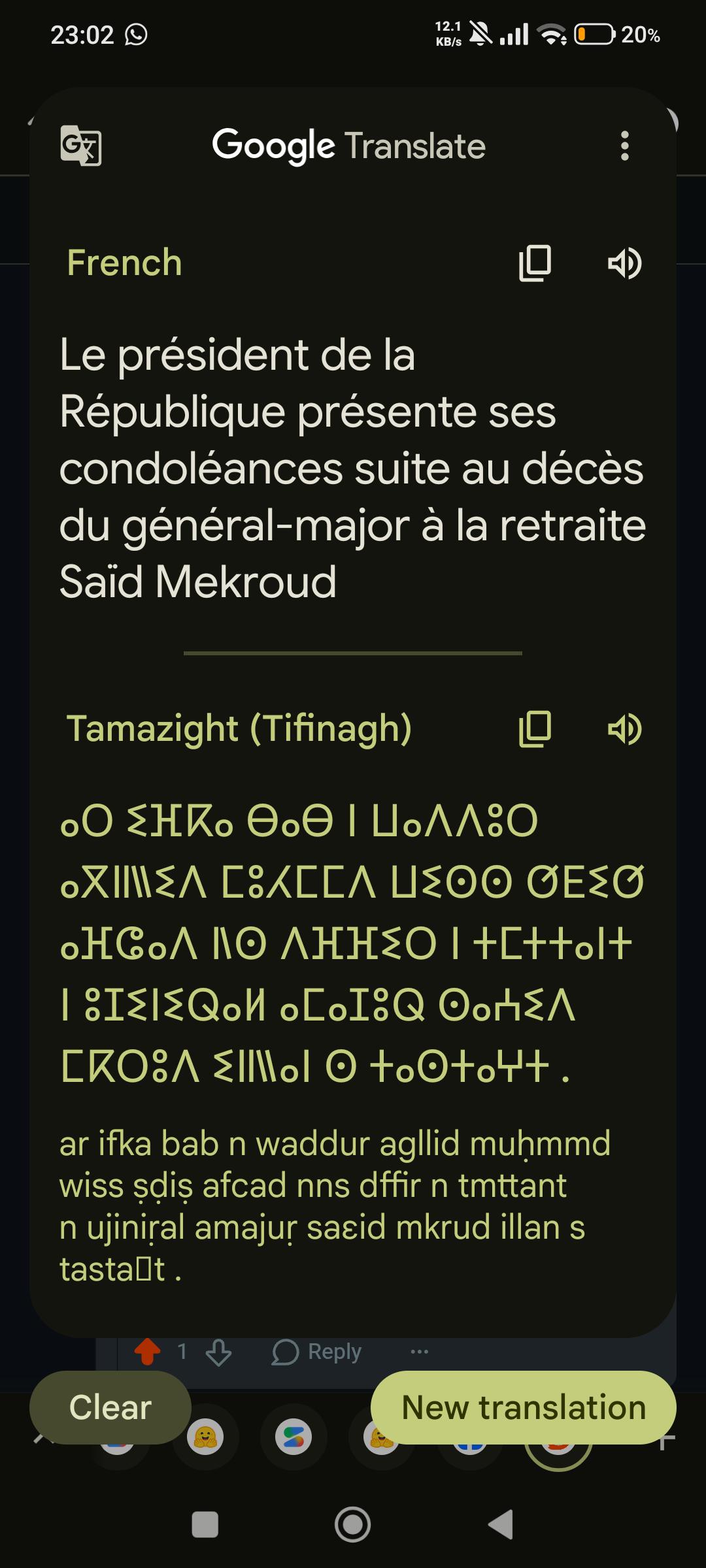
I posted before about a news title gone wrong about President Abdelmjid Teboune being replaced King Mohammad the sixth in the title! Google translate was the culprit: this title has President of... And around that word, it goes directly to mentioning the King of Morocco instead of actually translating what is being given.
r/AmazighPeople • u/That_Blackberry_978 • 1d ago
Title
r/AmazighPeople • u/Kooky_Computer1163 • 1d ago
Berberism is not simply the celebration of cultural diversity or ''we wuzzing''. It is an indigenous movement concerned with the historical continuity, collective interests, identity and future development of the Amazigh people (this includes ethnicity and demographics). It should not have to justify its existence through the language of generic multiculturalism, internationalism or somebody else's political ideology. (It must seperate and form itself as its own peice of the puzzle for Amazigh people)
There is a difference between supporting cultural diversity and having a political movement dedicated to the preservation and advancement of a particular people. Multiculturalism may provide a framework for different communities to coexist (In theory, and sometimes in practice but with much state intervention), but it does not automatically defend the interests of any one of those communities
(Multiculturalism in some cases is resulting in demograhic warfare that can take form in redlining like in america or gang wars that target ethnicity and culture or outright indirect segregation no amount of internationalism or marxism fixes this ethnic differences some regions apply DEI style hiring but this also creates resentment undermining thier multiculturalism and diversity).
Berberism must be able to do that for the Amazigh.
I increasingly see a problem within parts of the Amazigh movement, particularly among certain diaspora and left-wing circles (mainly left wing): Berberism is being diluted until it becomes little more than a collection of symbols, festivals, progressive slogans and fashionable political positions. The movement is increasingly expected to accommodate every ideology except its own national and cultural interests. That is not a sustainable direction or survivable direction.
Multiculturalism and Berberism are not interchangeable. Multiculturalism concerns the coexistence and recognition of different cultural communities. Berberism concerns the particular historical identity, continuity and interests of the Amazigh people.
These are different political priorities.
An indigenous movement should not be satisfied with being recognised as one cultural component among many while the institutions, educational systems, political structures and public narratives that shape society remain indifferent to its interests.
The Amazigh people have their own history, languages, traditions, regional identities and collective experiences. These deserve to be taken seriously in their own right. We should not need to translate every demand into the language of universal multiculturalism before it becomes legitimate.
This does not mean rejecting coexistence with other peoples. It means refusing to confuse coexistence with political subordination or cultural assimilation.
One of the most irritating arguments in these discussions is the suggestion that preserving Amazigh identity necessarily means being xenophobic, isolationist or hostile towards other cultures.
This is another false dichotomy.
An indigenous people can maintain cultural boundaries while participating in international society. It can preserve its languages while learning other languages, maintain its traditions while developing new ones, and defend its historical identity while embracing science, technology and modern institutions.
Cultural exchange is not inherently a problem. The problem arises when exchange becomes one-directional assimilation, when the ''weaker'' culture is expected to disappear, or when the preservation of its identity is treated as an obstacle to progress. other use this to create false dicotomy that you must be ''open and inclusive'' to be modern and intellectual throwing aside naunce.
Arabisation in North Africa cannot simply be described as harmless cultural exchange. It involved historical processes of political power, religious authority, linguistic hierarchy and state-building. The consequences were not identical in every region, but the marginalisation of Amazigh languages and identities is a documented part of modern North African history. (This exposes a hypocracy of the left wing idealogy as Arabizatoin can be treated as wrong and hostile and must be reserved whilst ignoring other forms of assimilation.(
Why should the preservation of Greek antiquity, Kurdish, European languages or other national histories be celebrated as cultural continuity, while Amazigh people are expected to treat their own historical continuity as an embarrassing form of exclusion?
We do not have to choose between living in the past and assimilating into somebody else's identity. We can build an independent Amazigh modernity without cultural self-erasure.
My criticism of left-wing Berberism is not that Amazigh people should never engage with left-wing ideas. Individuals are free to hold whatever political views they want (Provided its within reasonable limits and doesnt advocate for death of thier own people). My objection is to the subordination of Berberism to foreign ideological frameworks, particularly when those frameworks take priority over Amazigh national and cultural interests.
There is a difference between borrowing an idea and allowing an entire movement to become an extension of an imported ideology. that extends to the ''right wing too with some goes as disgustinglyfar as natsoc, or nordicism. (Not saying that there cant be a native berber fascism or far right movement but one must call out imported idealogy such as nordicism and natsoc which WAS INTENDED FOR GERMANIC PEOPLES not berbers)
Certain left-wing currents approach every political question through class struggle, proletarian internationalism, Marxism and revolutionary solidarity. These frameworks can be useful for analysing particular economic or social problems, but they are not automatically suitable foundations for an indigenous national movement.
The Amazigh question cannot be reduced to class. A wealthy Amazigh person and a poor Amazigh person may have different economic interests, but both can still have an interest in the survival of Tamazight, the preservation of Amazigh history and the recognition of Amazigh identity. Cultural and national questions do not disappear simply because class differences exist.
I also find the admiration for foreign revolutionary figures particularly misplaced when it becomes more important than understanding our own political history. Che Guevara is one example (And Gaddafi). I regard him as a prolific supporter of Arabism, and I see the celebration of figures such as him within parts of the Amazigh left as revealing a serious contradiction. Why should an Amazigh movement place foreign revolutionary icons on a pedestal while neglecting the intellectual and political traditions that emerged from its own communities?
That is my political assessment, and I do not expect everyone to share it. But it is a legitimate question to ask why international revolutionary solidarity is sometimes treated as more important than the interests of the indigenous people the movement supposedly represents.
Internationalism is not automatically solidarity. It can become another way of redirecting attention, resources and political energy away from the people whose interests should be central.
Berberism should be able to cooperate with international movements without becoming subordinate to them.
Another problem is the commercialisation of Amazigh identity. Our culture is increasingly presented as something to be consumed: traditional clothing, jewellery, tattoos, dances, music, handicrafts, festivals and decorative symbols.
None of these things are inherently bad. Cultural festivals, traditional crafts and tourism can provide economic opportunities and help preserve certain practices. The problem is when these become the entire public image of Amazigh identity.
Amazigh culture is not simply a tourist attraction.
Consider how traditional clothing and jewellery are marketed as exotic products, how performances such as Ahidous can be staged primarily as tourist entertainment, and how Amazigh symbols are sometimes used as branding without any meaningful engagement with their historical or regional significance. The culture becomes commercially visible while its political, intellectual and institutional dimensions remain neglected.
We can sell traditional handicrafts and still build universities. We can organise festivals and still establish research institutions. We can promote tourism and still demand proper language education, political representation and economic development.
The issue is not commerce itself. It is the reduction of an entire civilisation and its living communities to a marketable aesthetic.
This is not exclusively a left-wing problem. Governments, tourism industries, private businesses and political organisations across the spectrum can all contribute to folklorisation. But left-wing activists are not exempt from criticism when they participate in the same reduction of Amazigh identity, especially when they present cultural traditions as acceptable only after stripping them of their historical, social or political meaning.
A culture should not have to become commercially attractive or ideologically fashionable before it is considered worth preserving.
I also disagree with the attitude in certain diaspora and left-wing Amazigh circles that cultural gatekeeping is inherently evil. There seems to be an assumption that every boundary is oppressive, every standard is exclusionary and every attempt to protect cultural practices is reactionary.
That is an absurd position for an indigenous movement.
A culture cannot preserve itself if it has no interest in distinguishing between informed participation, genuine cultural belonging, commercial exploitation, superficial appropriation and deliberate misrepresentation.
This does not mean imposing arbitrary ideological loyalty tests on Amazigh people or pretending that there is one universal standard of authenticity. Amazigh identity is diverse, and regional, linguistic, religious and historical differences matter. Ethnic belonging should not be confused with agreement with a particular political faction.
But cultural practices do have meanings, histories and contexts. They should not be treated as interchangeable accessories.
Take Amazigh tattoo traditions, for example. Their meanings and designs have varied between regions, communities and individuals. They have carried social, aesthetic, protective and other forms of significance. They should be researched and documented properly rather than treated as a universal collection of decorative symbols.
I support the revival of Amazigh tattoo traditions and the freedom of Amazigh women to participate in them without social or religious coercion. But revival should involve historical research, consultation with communities, documentation and education. It should not be reduced to somebody discovering a symbol online, placing a tiny tattoo behind their ear and declaring themselves part of a cultural revolution.
There is a difference between understanding and reviving a tradition and simply adopting its appearance.
We should not freeze culture in the past, but neither should we strip it of meaning in the name of unrestricted personal expression. Preservation requires knowledge, responsibility and some willingness to maintain standards.
There are concrete Amazigh examples showing why a movement centred on collective identity, national consciousness, cultural continuity and political organisation can be more useful than one that subordinates those priorities to generic multiculturalism or foreign ideological agendas.
The point is not that every successful Amazigh activist was right-wing (but the succesfull and impactfull ones had center right or leaned right wing in certian aspects such as political, ground-work, or even trade/economics). The historical movement has included socialists, liberals, secularists, conservatives, cultural nationalists and people who do not fit neatly into these categories. The point is that its most consequential advances came from people organising around specific Amazigh demands rather than abandoning those demands in favour of abstract ideological solidarity.
Kabylia and the Berber Spring, Algeria, 1980
The Berber Spring is one of the clearest examples. In April 1980, demonstrations erupted in Kabylia after the authorities cancelled a lecture by Mouloud Mammeri on traditional Kabyle poetry at the University of Tizi Ouzou. The protests were rooted in wider opposition to Arabisation and the exclusion of Amazigh language and culture from public life.
This was not simply a demand for multicultural appreciation. It was a political mobilisation around the recognition of a distinct identity and the right to preserve its language and cultural heritage.
The subsequent 1994–1995 school boycott in Kabylia, often called the grève du cartable, provides another example. Teachers and students boycotted schools to demand the introduction of Tamazight into education. The mobilisation contributed to the establishment of Algeria's High Commission for Amazighness in 1995.
The Black Spring of 2001 followed, after the killing of Massinissa Guermah by gendarmes and the subsequent unrest. The events led to the deaths of more than a hundred people and thousands of injuries. The political pressure contributed to the 2002 constitutional recognition of Tamazight as a national language, followed by its recognition as an official language in 2016.
These cases demonstrate the value of a movement that can identify a specific collective grievance, mobilise a population and maintain pressure until political concessions are made. The demands were not vague calls for diversity. They concerned language, education, recognition and the political status of Amazigh identity.
Morocco: the Agadir Charter and the institutionalisation of Tamazight
The Moroccan Amazigh movement offers another important example. The Agadir Charter of 1991 provided a platform for demands concerning the constitutional recognition of Tamazight, its integration into education, media and administration, and the development of Amazigh regions.
The 2000 Manifesto for the Official Recognition of the Amazighness of Morocco, associated with Mohamed Chafik (Conservative), brought together a broad range of political, economic, social and cultural demands. It helped consolidate a movement that was not content with cultural celebration alone.
The creation of the Royal Institute of Amazigh Culture (IRCAM) in 2001, the introduction of Tamazight teaching in primary schools in 2003 and the constitutional recognition of Tamazight as an official language in 2011 were important institutional developments.
These achievements were not the work of a single ideological faction, and the monarchy's role in this process should not be confused with complete political liberation. The implementation of language rights has remained uneven. Nevertheless, the example demonstrates what organised, sustained and specific Amazigh demands can achieve.
It also shows why building institutions matters. A movement needs language researchers, teachers, educational materials, publishing networks, cultural organisations and political advocates. Identity cannot survive through slogans alone.
Kabyle political organisation and the question of self-determination
The development of Kabyle political movements after the Black Spring also demonstrates the importance of treating territorial and political questions seriously.
The Movement for the Self-Determination of Kabylia (MAK), founded by Ferhat Mehenni, developed demands for Kabyle autonomy and later self-determination. It is not representative of every Kabyle or every Amazigh, and its political programme is contested. The FFS, RCD and other political currents have pursued different approaches, including political participation within Algeria and regional autonomy.
Nevertheless, the emergence of these different political projects demonstrates that Amazigh politics cannot be confined to language festivals or cultural recognition. Questions of territorial governance, political representation, economic interests and self-determination are real political questions.
I do not consider separatism automatically unrealistic. What matters is whether a movement has a serious strategy. Any project for independence or autonomy must address economic viability, institutional capacity, popular legitimacy, geopolitical realities, security and the consequences for the population. Simply declaring independence without answering these questions is not a political strategy.
But dismissing every discussion of autonomy or self-determination as inherently extremist is equally unserious.
The Nafusa Mountains and the Libyan revolution
The Amazigh communities of Libya's Jabal al-Nafusa and towns such as Yefren and Nalut provide another example. Under Gaddafi, Tamazight was repressed, could not be taught in schools and was excluded from official recognition. Amazigh communities played an important role in the 2011 uprising and used the political opening that followed to demand recognition of their language and cultural rights.
The post-revolutionary period saw the introduction of Tamazight teaching in some schools, public use of the language and the establishment of Amazigh political and cultural organisations. A 2013 law recognised the languages of Amazigh, Tuareg and Tebu communities and provided for mother-tongue education on a voluntary basis.
Yet the interim constitutional framework did not make Tamazight an official language, and Amazigh representatives continued to protest their exclusion from political institutions. This illustrates both the value and the limitations of mobilisation: military and political participation does not automatically guarantee constitutional rights or lasting institutional power.
The lesson is straightforward. A community needs organisation, political leverage and institutions capable of defending its interests after the immediate struggle has ended.
These examples do not prove that every right-wing Berberist programme is correct, nor do they establish that the achievements belonged exclusively to the political right. They demonstrate something more important: national consciousness, cultural preservation, organised political demands and the pursuit of collective interests are indispensable. Any faction that neglects these things, regardless of whether it calls itself left-wing or right-wing, weakens the movement.
I do not think the Amazigh movement can afford to ignore its own failures.
Certain left-wing Berberist circles have, in my view, spent too much time trying to reconcile Berberism with internationalist ideologies that do not necessarily prioritise Amazigh interests. They have sometimes treated national consciousness with suspicion, cultural boundaries as inherently oppressive and traditional institutions as obstacles to be dismantled.
The result can be a movement that is very good at adopting fashionable political language but much less effective at building lasting Amazigh institutions.
Internationalist alliances can also become sinking-ship alliances. They spread limited resources across causes that may have little direct connection to Amazigh priorities, create ideological dependencies and redirect political energy towards foreign struggles. Cooperation is useful when it strengthens our position. It is counterproductive when it makes our own movement secondary.
But right-wing Berberist currents should not escape criticism either.
They have often failed to establish the lasting institutions, intellectual networks, educational organisations, publishing initiatives, economic structures and political organisations necessary to become a serious counterweight. Nationalist rhetoric is not enough. A movement cannot survive indefinitely on declarations of identity, historical grievance and political ambition.
Where are the sustainable research institutions? Where are the independent educational networks? Where are the serious publishing initiatives, economic organisations, cultural archives and political structures capable of operating across generations?
There is also a question about political strategy and state repression. I have sometimes wondered whether the relatively different treatment of certain left-wing currents, compared with the persecution and imprisonment experienced by some right-wing Berberist activists, reflects differences in how seriously the state perceived their political challenge. I do not regard repression as a reliable measurement of political effectiveness or threat, and it would be simplistic to treat every instance of state violence as proof of ideological strength. Governments repress movements for many reasons. Nevertheless, the question of which currents have been capable of challenging established power structures, and which have been more easily accommodated or absorbed, deserves serious examination.
Some right-wing Berberist currents have been crippled by repression, internal divisions and a lack of resources. Others have failed to turn their ambitions into institutions. These are failures that must be addressed rather than excused. The movement needs more than ideological purity. It needs competence, organisation, strategic thinking and the ability to build something that lasts.
and the problem with that, is that once you build you realise how left wing follies collapse on thier feet.
I reject the idea that Berberism must choose between cultural preservation and modernity.
Amazigh modernity should mean developing our own intellectual, scientific, technological, economic and institutional capabilities while maintaining historical continuity. It should mean universities, research centres, technological development, advanced education, publishing, modern infrastructure and economic strength.
There is no contradiction between being Amazigh and embracing modern science. There is no contradiction between preserving Tamazight and learning other languages. There is no contradiction between maintaining traditions and developing new cultural expressions.
The mistake is to assume that modernisation requires assimilation, or that cultural preservation requires stagnation.
An Amazigh movement should not be satisfied with preserving fragments of the past while leaving the future to others. We should be interested in producing knowledge, building institutions, developing economic capacity and participating in every field of modern life.
Nor should we treat Amazigh culture as something that must remain frozen in an imagined ancient period. Traditions evolve. Languages develop. Societies change. The purpose of cultural continuity is not to prevent change but to ensure that change does not require the disappearance of the people themselves.
Berberism should be an independent political and cultural movement concerned with the historical continuity, collective interests and future development of the Amazigh people.
It should prioritise:
The Amazigh movement should not exist merely to provide cultural decoration for the states in which Amazigh people live. It should not become a tourist brand, an accessory to Marxism, a recruitment platform for foreign revolutionary movements or a generic multicultural organisation that has forgotten why it exists.
We can cooperate with other peoples without subordinating ourselves to them. We can learn from foreign political traditions without allowing them to define our priorities. We can welcome cultural exchange without treating assimilation as inevitable. We can defend our traditions without becoming prisoners of the past.
Our identity is not a costume, our history is not a tourist attraction, and our movement is not a recruitment platform for foreign ideologies.
The Amazigh movement needs its own direction, its own intellectual foundations and a serious vision of its future.
r/AmazighPeople • u/Scholablade • 3d ago
# Tutu Transcribe 2, Production-ready Speech to text for Tachelhit
Hello, I have been working on Tutu Transcribe which is the second iteration of speech to text. It's trained on 4.5 hours of Tachelhit data which is 50% bigger than Tutu Transcribe 1. A cleaned up 3 hour dataset along with a new 1.5 hour dataset that I myself mostly voiced. It's trained on a rented RTX 4070.
Tutu Transcribe 2 is actually really good. I was shocked when I was used it after the training run. It's not perfect but it's excellent and am proud of it.
Tutu is a nickname for ant in Tachelhit. Ants are seen in Amazigh culture as characters of civilization so the name is only fitting. When a full general AI that can speak Tamazight is built, it'll be named as such.
If you are Tachelhit speaker, help with data collection for Tutu Transcribe 3 at https://dataset.tussna.org/record
Try out the Speech to text at https://speech.tussna.org
Thanks.
r/AmazighPeople • u/Puzzleheaded_Try_649 • 3d ago
Salam everyone, my dad was Riffian from Nador. He passed away when I was young, so I was raised only by my mom, who isn't Riffian, and I never had the chance to learn Tarrifit. Now that I’m older, I feel like a part of my identity is missing and I really want to learn the language, but I don't know where to start.
r/AmazighPeople • u/TimesEcho • 5d ago

ⵜⵉⵎⵉⵣⴰⵔ ⵏⵏⵉⴹⵏ ⴷ ⵜⴼⵉⴼⵖⵉⵏ ⵢⴰⴹⵏ
r/AmazighPeople • u/doualiland • 5d ago
الفكرة التي أريدك أن تحتفظ بها
عندما تقرأ التاريخ المغربي، لا تحكم على أصل السلطان من اسمه، ولا على هوية السكان من لغة الدولة.
يوسف بن تاشفين: اسم عربي، وأصل أمازيغي صنهاجي.
عبد المؤمن بن علي: اسم عربي، وأصل أمازيغي كومي.
يوسف بن تاشفين أسس إمبراطورية المرابطين، وعبد المؤمن بن علي بنى إمبراطورية الموحدين.
أما السعديون والعلويون فقد استندوا إلى نسب عربي شريف معلن، إلى جانب القوة السياسية والعسكرية.
وهكذا فإن تاريخ المغرب ليس تاريخ شعب استُبدل بشعب آخر، بل تاريخ مجتمع تشكل عبر قرون من التفاعل بين الأمازيغية والعربية والإسلام والصحراء والأندلس وإفريقيا.
What do you think ?
r/AmazighPeople • u/cesttresdrole • 5d ago
Hello! I am reposting my post from r/translator. I requested some help identifying the language the woman sings in this clip from the film Razzia (Ayouch 2017). I only speak English, French, and some Modern Standard Arabic. I suspected she is singing in a language of the Imazighen people, but I wasn't sure which dialect. A few users identified it as either Tarifiyt, Tamazight, or Tachelit.
Is there anyone here who could identify the language and maybe translate it into English, French, or Arabic? I am conducting some research on the film and it would tremendously help me to analyze this scene with more depth.
Also, I apologize here for having used the term "Berber" in my original post. I should have written Amazigh or Tamazight, which I had even known of before posting.
Thank you / Tenmirt ! 😄
r/AmazighPeople • u/TimesEcho • 5d ago

ⴰⵙⵙ ⴰⵎⴰⴹⵍⴰⵏ ⵏ ⵓⵙⴽⴽⵉⵍ ⴰⵎⴰⵣⵉⵖ, ⵜⵉⴼⵉⵏⴰⵖ.
r/AmazighPeople • u/Environmental-Ear279 • 6d ago

r/AmazighPeople • u/AvalonFound • 6d ago
I am Canadian. My father is originally from El Kef, Tunisia and his father probably is as well. I have only spoken to his parents once over Skype so long ago as a kid and I don't remember what we spoke of.
My father, who considers himself Arab (Tunisian), went off radar in 2018 and I have no way to contact him or know where he is. I grew up alongside him but we did not always see each other after my parents separated.
I have no way to "know" for certain if I am Amazigh or not. I don't want to sound like I'm insensitive though. I have no way to find my relatives on FB and ask them if my grandfather was one. I took an Ancestry DNA test and I'm like 50% northern African with 4 different clusters, but I know it doesn't tell you everything. The only other pieces of information I have are memories of my dad showing me on Google Maps where his parents lived in El Kef, and then my last name (and his).
I feel displaced and frustrated at the lack of information. I also learned about the heavy arabization of Imazighen and intermixing of lineages. I don't know what to think. I don't want to be special. I just want to know my origins. What should I do?
r/AmazighPeople • u/xyefuh • 6d ago
Hello! A lot of what I know about our ancestors’ history is through what people close to me have told me and what I’ve read online, which, to say the least, is embarrassingly not much and I’m struggling to confirm a lot of it. So, I’m looking to expand my knowledge about Amazigh history, from before the Arab Conquest, to during that period, to the centuries after it, to how Amazigh people were affected under french rule and to even more recent history.
I know the title says books but it can be anything from articles to books that are reputable, the only request I have is that they should be either in English(preferably) or Arabic, as I can’t speak french and although I can read Tifinagh, I, regretfully, can’t speak any of the Amazigh languages.
PS. I am Moroccan, and although I’m interested about Moroccan Amazigh history, recommendations about Amazigh history from other countries, regions and tribes are also welcomed!
Thanks in advance, any recommendations are deeply appreciated!!
Edit: I appreciate the recommendations but unfortunately all of them so far are French and I don’t speak it at all… I can only speak English and Arabic.
r/AmazighPeople • u/Adorable-angel-06 • 7d ago
So this is not really that common but i have seen it and experienced it myself and i want to talk about it because if this spreads it will hurt amazighs and back fires.
I have came across amazighs who do speak the language reject arabzied amazighs who don't , and call them "arabs" or make fun of them for calling themselves amazigh and claiming the culture, i am half kabyle and half ichnewi and unfortunately grew up arabic speaking , however as of now im putting effort into learning tamazight and i remember i got made fun of by a friend for saying that I was amazigh and owning a kabyle traditional dress (???) Now of course i won't let this experience make me generalize all the community because i have plenty of tamazight speaking friends who were happy I'm learning the language and even offered to help me , but i also saw few videos saying things like "if you dont speak the language then ur not amazigh" or making fun of arabized amazighs who put the yaz symbol on their bio.
This mentality is dangerous, will back fire and hurt us , if we keep rejecting arabized amazighs and make fun of them this will obviously alienate them and cause them to adopt pan-arabism which literally accepts anyone and says anyone who speaks arabic is an arab even if the arabic in question is darija that sounds unintelligible to other arabs in middle east, this is how you literally go extinct in your own land on one hand you have pan-arabism that accepts literally anyone regardless of ethnic background who speaks a variant unintelligible form of arabic taking over and continously erasing our culture and language and then on the other hand you have amazighs who instead of trying to win back arabized ETHNIC AMAZIGHS alienate them and laugh at them for trying to reconnect with their roots and vulnerable culture 🤦♀️🤦♀️🤦♀️.
r/AmazighPeople • u/Aylanmazighheadded • 8d ago
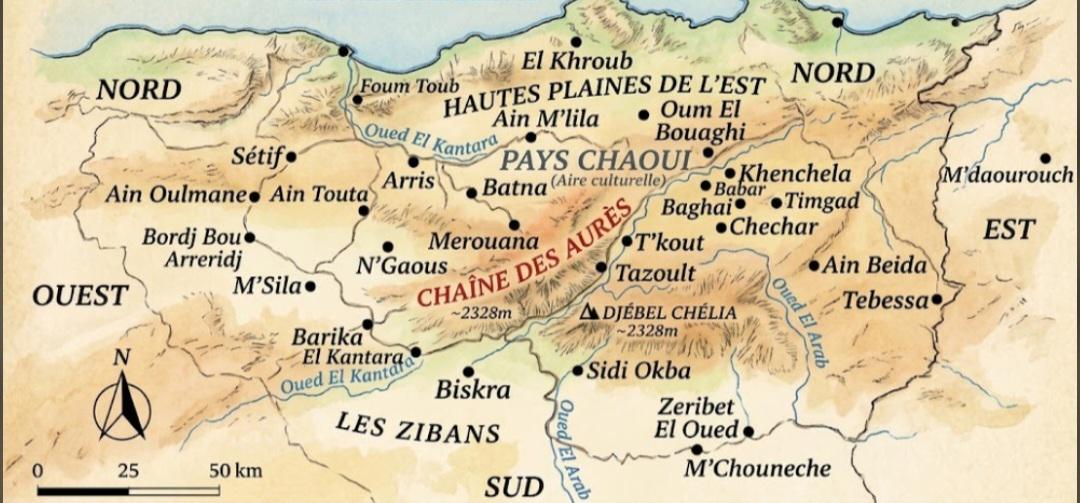
A map encompassing the Aurès Mountains and even the high plateaus that were also inhabited by the Chaoui people. We will provide feedback and criticism to improve or add more spaces.
r/AmazighPeople • u/Kindly-Lychee-2697 • 8d ago
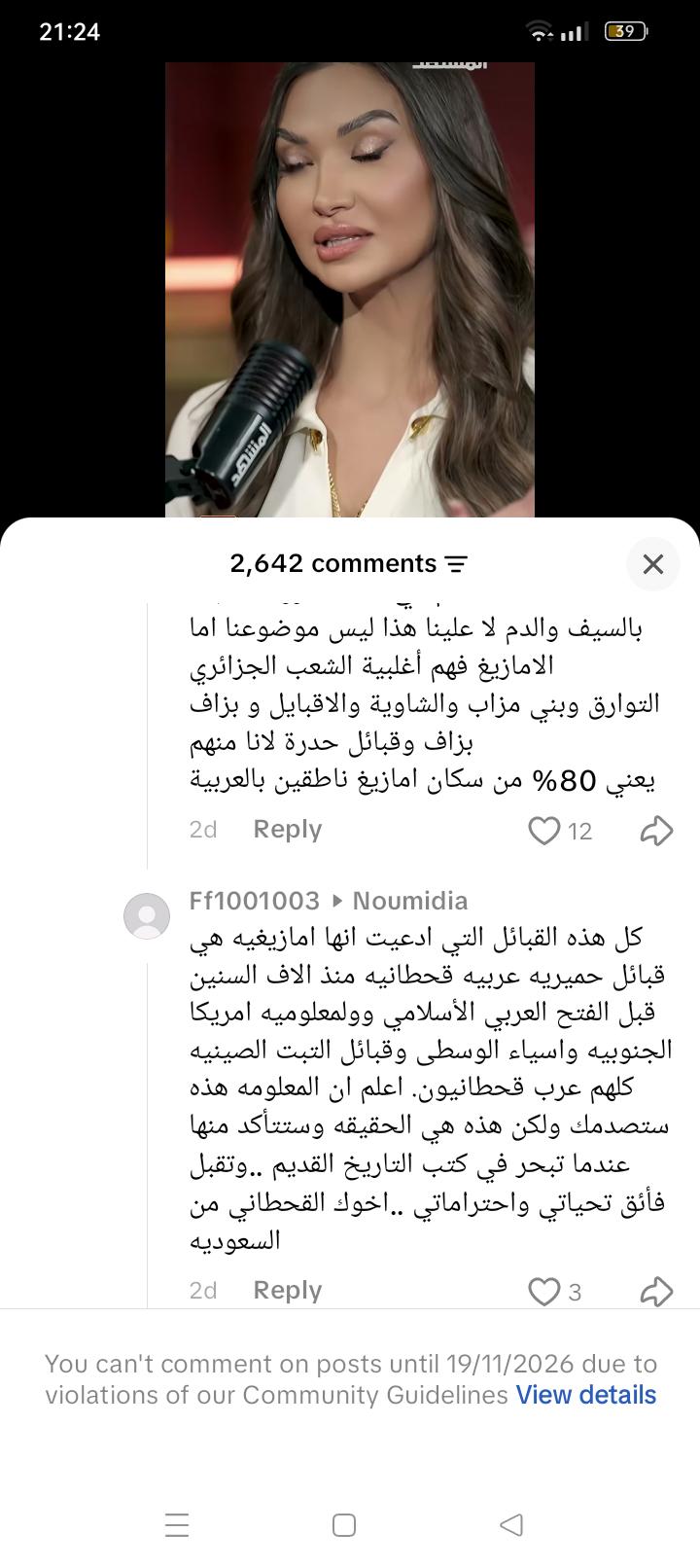
I found this one saying that all those are ancient Arabs
r/AmazighPeople • u/BeforeOrion • 8d ago
Cultural exploration of Amazigh in North Africa.
r/AmazighPeople • u/Aylanmazighheadded • 10d ago

r/AmazighPeople • u/Reasonable_Screen653 • 10d ago
Im an amazigh from bettiwa(algeria) and my ancestors are from rif, i wanna know if someone can give me stories about the reason of my ancestors immigration to current day bethioua
r/AmazighPeople • u/Beautiful-Forever-66 • 10d ago