r/AncientCivilizations • u/CosmicMoofin • 11h ago
Europe Bronze Age Castles of Ancient Sardinia
588
Upvotes
r/AncientCivilizations • u/TraderAman2000 • 14h ago

Imagine carving an entire temple complex out of a single massive mountain, removing an estimated 200,000–400,000 tonnes of rock without modern machinery.
Fun Fact - 200,000–400,000 tonnes of rock were removed during the construction of the Kailasa Temple at Ellora, yet no enormous dumping site containing all that excavated rock has ever been found.
r/AncientCivilizations • u/MunakataSennin • 13h ago
r/AncientCivilizations • u/ismaeil-de-paynes • 11h ago

The concept of “Demotic heritage” refers to that corpus of knowledge and accounts relating to ancient Egypt that passed to Arabian Historians through multiple channels, the most important of which are: (1) late Demotic texts that were still being read in some circles until the early Islamic eras, especially in Upper Egypt; (2) popular oral traditions transmitted by generations about kings, monuments, and wonders; (3) Coptic texts that translated some ancient Egyptian knowledge; (4) Greek and Latin sources that Arab historians translated or knew indirectly; (5) popular interpretations of ancient monuments that people saw in Egypt, such as the pyramids, temples, and statues.
Modern studies, especially the study of Okasha El-Daly (And before him, the Egyptologist Ahmad Kamal) , have indicated that Arab historians were not merely passive transmitters of information, but practiced a kind of historical verification, compared sources, cast doubt on contradictory accounts, and tried to explain strange names in light of their knowledge of the Arabic language and genealogies. Therefore, what appears to us today as “legends” or “distortions” was, in their view, a serious attempt to understand the history of ancient Egypt in light of the cognitive tools available to them.
Hieroglyphic texts had ceased to be directly understood since approximately the fourth century AD, after the link between the sacred script and the late Egyptian language was broken, and knowledge of ancient Egyptian writing became monopolized by a narrow class of priests, then this knowledge vanished entirely with the spread of Christianity and the decline of ancient Egyptian religious institutions.
The researcher Okasha El-Daly indicated in his pioneering study on Egyptology in medieval Arabic writings that these writings, despite their often legendary character, constitute a “missing millennium” in the history of Egyptology, as they preserve echoes of ancient Egyptian knowledge that did not reach us through classical Greek and Roman sources.
In this framework fall the figures addressed by this article (the founding fathers of ancient Egypt) Menes Narmer, Khasekhemwy, Djoser, Khufu, Khafre, Menkaure — and their counterparts in the Arab tradition: Manqaus, Khaslim, Disara, Sourid, Hujib, Karuras.
And what you can notice is that these names and their counterparts are similar in that they are at the beginnings of ancient Egyptian history, the original names belong to the era of the early dynasties, and their Arabian counterparts belong to the period of the kings of Egypt before the Flood of the Prophet Noah.
------------------------
Manqaus ibn Shaddad or Menes Narmer, The Unifier of the Two Lands!
The ancient Egyptian historical tradition, as reflected by Manetho and Herodotus, attributes to Menes (Mina) Narmer the founding of the first ruling dynasty in the history of Egypt, the unification of the two kingdoms of the North (Lower Egypt) and the South (Upper Egypt) under a single central rule, and the founding of the city of Memphis as the capital of the country. Egyptian sources mention that Narmer founded a city called “Inb-Hedj,” meaning “the White Wall,” which later became known as Memphis.
Narmer chose the site of Memphis at the head of the Delta, at a strategic point controlling the movement of the Nile and separating Lower Egypt from Upper Egypt. According to the tradition transmitted by Herodotus, Menes is the one who ordered the diversion of the Nile’s course to build the city of Memphis, so he diverted the Nile from its old course, filled in the bend that was in the river, made the city in the place of the old Nile, and surrounded it with an embankment on the southern side and two lakes on the northern and western sides to protect it from flooding and the enemy.
The founding of a fortress (or fort) at the site of Memphis is also attributed to Mina Narmer, along with the formation of a strong army to protect the unity of the country, and the establishment of royal traditions that continued for thousands of years, among them the celebration of the festival of “the Unification of the Two Lands.”
The figure of Mina Narmer in ancient Egyptian consciousness was not merely a historical figure; rather, it acquired mythical and religious dimensions. Unification itself was viewed in Egyptian belief as the realization of cosmic order (Maat) on earth, and the spread of order at the expense of chaos (Isfet), which was symbolized by the scattered forces of the North. Therefore, unifying kings were often depicted in Egyptian art striking their enemies or controlling wild animals, in reference to subduing the forces of chaos. The Narmer Palette itself is a visual expression of this ideology: the king appears as Horus on earth, subduing his enemies and establishing the cosmic order.
as for the Arabian name Manqaus ibn Shaddad, it appears in a number of medieval Arabic sources, the most important of which are Al-Khitat by al-Maqrizi, Muruj al-Dhahab by al-Mas‘udi (Herodotus of Arabs) , and other books. These sources vary in the detail of his biography, but they agree in attributing him to before the Flood or to the first eras of Egypt, and in attributing to him a group of major architectural works, the most important of which is the building of the city of Memphis.
The first basis for comparison between the two figures is the phonetic similarity between the two names. The name “Mina” (Mena) or “Menes” in Greek transmission consists of the consonantal root m-n-s. The name “Manqaus” consists of the consonants m-n-q-w-s, or m-n-q-s if we drop the long vowel (w). It is noticeable that the two roots are similar in the first two consonants: m-n, and differ in that “Manqaus” adds a guttural sound, q, between the n and the s. This difference can be explained by the q being an intrusive element in the Arabic transmission, either added to facilitate pronunciation, or as a result of scribal alteration, or as a phonetic substitution from another sound.
Some sources mention other forms of the name such as Manaus and Manqaush (and it seems that the name Manaus is closer phonetically to the name Menes than the name Manqaus).
Manqaus is attributed in Arabic sources to Shaddad ibn Adim, a genealogy that resembles the names of pre-Islamic Arab kings, such as Shaddad ibn Aad, which indicates that Arab historians may have tried to integrate the figure into an Arab genealogical framework instead of attributing it to an ancient Egyptian origin. This integration is not unique to Manqaus; rather, it is a general pattern in Arabic historiography of ancient Egyptian figures, where historians sought to “Arabize” these figures or at least link them to Arab/Eastern origins. Some accounts mention that Manqaus was a wise, virtuous king, a priest, who performed wondrous works and built marvelous things, and ruled for ninety-one years.
Other Arabic accounts add that Manqaus built the city of Memphis for his sons or his daughters, that he made it the center of his kingdom, surrounded it with walls and temples, and organized its administrative affairs. The sources also mention that Manqaus is the one who built the city of Ain Shams (Iunu - Un - On - Heliopolis), which was the center of sun worship in ancient Egypt, which makes him a founder of the major religious centers in Egypt.
The division of the land of Egypt into kuras (administrative districts) is also attributed to him, an administrative act that reminds us of what Greek historians attributed to the early kings of Egypt regarding the administrative organization of the Egyptian land. The number of kuras mentioned (one hundred and thirty kuras) may not be historically accurate, but it reflects an Arab awareness that ancient Egypt was divided into administrative provinces, and that the founding king (Manqaus) was the one who established this division.
This correspondence in the founding role is what makes the comparison between them more than a mere passing phonetic similarity. Both are depicted as the founding king who moves Egypt from a state of fragmentation to a state of stable statehood with a fixed capital. This similarity is reinforced by other elements: both are associated with regulating the waters of the Nile or diverting its course. Mina/Menes, in the Herodotean account, diverted the Nile to build Memphis. Manqaus, in some Arabic accounts, is credited with organizing irrigation and building embankments and lakes.
It is noteworthy that the Arab tradition did not preserve the name “Narmer” or “Nermer” in its ancient Egyptian form, but preserved only the name “Manqaus.” This in itself is evidence that the Arab transmission was not direct from hieroglyphic texts, but from oral accounts or from late Demotic or Coptic texts. The name “Narmer” is a Horus name, and it was written inside a serekh, and was not the king’s common name in daily life. As for “Mina” or “Menes,” it was the name more commonly circulated in popular and classical tradition, and it is the one that reached the Arabs through Manetho and Herodotus and others, whether directly or indirectly, and then was altered into “Manqaus.”
Arabic sources give Manqaus personal traits beyond merely being a builder of cities. He is “a wise and virtuous priest,” and this reminds us of the image of the king-priest in ancient Egypt, where the king was the intermediary between the gods and people, and responsible for performing religious rituals and ensuring the continuation of the cosmic order.
The account “he ruled for ninety-one years” also reflects an ancient Eastern tradition of attributing extraordinary ages to founding kings, a tradition we find in the Torah (the ages of the early patriarchs) and in Egyptian myths (where some gods and kings are attributed reigns lasting thousands of years). These traits — wisdom, priesthood, long life, and architectural construction — are the typical traits of the founding king in medieval Arabic literature, and they were all combined in the figure of Manqaus.
This transformation from king-god to king-sage reflects a shift in religious vision, and it seems that Muslim Arabs were not prepared to accept the idea of the king-god, so they turned the first founder of Egypt into a wise king and priest, which is an image consistent with Islamic heritage that knows figures such as Luqman the Wise, al-Khidr, or Solomon and David the prophet-kings.
------------------------
In the next article I will talk about King Khasekhemwy and his counterpart in Arabian history King Khaslim, and it will be a more exciting article, with larger number of historical and literary evidence.
r/AncientCivilizations • u/LegacyAcrossTime • 21h ago

Photo: Turkmenistan.gov.tm.
The latest excavation season at Gonur-depe, Turkmenistan, yielded around 160 finds. The report also describes a cluster of five burials created in successive stages. The team is continuing work to study and conserve thousands of fragments from Gonur’s ancient mosaics. Gonur-depe was a major center of the Bronze Age Bactria–Margiana Archaeological Complex, also known as the Oxus civilization. What would you most like archaeologists to learn more about: burial practices, daily life, or mosaic-making? https://turkmenistan.gov.tm/index.php/en/post/112002/research-gonur-depe-planned-continue-spring-2027For broader background on the BMAC and Gonur Tepe, I made a 27-minute documentary. It doesn’t cover this latest excavation season, but may be useful as a visual introduction: https://www.youtube.com/watch?v=7ZJskIHlzC0
r/AncientCivilizations • u/deniz_aydiner • 1d ago

One of the ancient symbols that might seem the most peculiar to us today is the phallus/penis symbol. It was a popular good-luck charm throughout the Roman Empire and was carried by the Roman army to distant provinces, such as Britain, where the local population had no tradition of phallus worship. These figures were typically carved onto functional structures such as millstones, bridges, and doorways; they served as good-luck symbols intended to protect an enterprise or trade from the evil eye. Indeed, more than 60 phalluses have been found along Hadrian’s Wall. The phallus shown in Image 1 is an example of this.
Priapus, the god of fertility, was also depicted as a man with a large phallus. He can be seen on the reverse side of the Septimus Severus coin shown in Image 3.
However, although rare, the phallus was also used in a negative context. The phallus example known as the “Vindolanda phallus” (Image 2) was not created to ward off the evil eye. Above and to the right of the erect penis is the following inscription: SECVNDINVS CACOR; this is an abbreviation of the phrase “Secundinus cacator” or “Secundinus, the shitter.” Essentially, it served a function equivalent to giving Secundinus the middle finger.
The phallus symbol you can see in the last image is called a fascinus/fascinum. During the Roman period, it became a symbol of continued fertility and a part of Rome’s security, and was frequently used by the Vestal Virgins. It has also been reported that this symbol was frequently used in Rome during the festivals of Father Liber and Dionysus:
Varro says that certain rites of Liber were celebrated in Italy which were of such unrestrained wickedness that the shameful parts of the male were worshipped at crossroads in his honour. … For, during the days of the festival of Liber, this obscene member, placed on a little trolley, was first exhibited with great honour at the crossroads in the countryside, and then conveyed into the city itself. … In this way, it seems, the god Liber was to be propitiated, in order to secure the growth of seeds and to repel enchantment (fascinatio) from the fields. (De civitate Dei. 7.21)
r/AncientCivilizations • u/MunakataSennin • 1d ago

r/AncientCivilizations • u/Iron-Will07 • 1d ago

Most Achaemenid artifacts we see today come from imperial centers like Persepolis or Susa, making the Oxus Treasure an unusual outlier. It turned up way out east along the Amu Darya River, right on the modern Tajikistan-Afghanistan border.
Between the 5th and 4th centuries BCE, people left gold jewelry, figurines, and vessels as offerings at a major temple in ancient Bactria. Around the time Alexander the Great arrived and nomadic raids intensified, the priests likely buried the hoard on the north bank to keep it from being looted.
It stayed hidden until local villagers stumbled across it between 1877 and 1880. Not realizing the historical value, they treated it like scrap bullion, chopping up and melting down some of the larger pieces to split the gold evenly (local accounts even mention a solid-gold tiger that didn't survive the split).
In May 1880, three merchants from Bukhara bought most of what remained to sell in British India. On the mountain road between Kabul and Peshawar, bandits ambushed the caravan and hauled the treasure into a cave. One servant escaped and alerted Captain Francis Charles Burton, a British political officer, who raided the cave at night and recovered about three-quarters of the stash. As a thank-you, the merchants let him buy one of the griffin armlets on the cheap.
Breakdown of the photos:
(The wider hoard also included an embossed gold scabbard, silver jugs, signet rings, and roughly 1,500 coins.)
The merchants eventually sold the remaining pieces in Rawalpindi. Collectors Alexander Cunningham and Augustus Wollaston Franks spent years tracking them down through local dealers, and Franks bequeathed the reunited collection (including Burton's armlet) to the British Museum in 1897.
r/AncientCivilizations • u/platosfishtrap • 2d ago

r/AncientCivilizations • u/Mendi_0 • 1d ago
I want to learn more about ancient history but have no idea where to start. I don’t know much because I didn’t care about history much in school and when wars are mentioned is when I start to switch off. I enjoy hearing about the way people lived and survived and the types of knowledge they had, morals, norms and fun facts. I know pretty much nothing about ancient history other than some bits about ancient Egypt, but I couldn’t possibly put a date on any of it.
Can you historians out there please send me links or titles of documentaries that can help me to educate myself? Documentaries for dummies at first, and then easing into the more nitty gritty? I have YouTube, Netflix, Disney+, prime video, Apple TV, Paramount plus, bbc iPlayer, channel 4 OD, channel 5 OD, ITV player to choose from if you could suggest some on those channels that would be great. Also open to podcast episodes!
Also please leave me your suggestions on what civilisations to look into first, and your personal favourite time periods or historians.
Thanks in advance!!
r/AncientCivilizations • u/DecimusClaudius • 2d ago

Roman lead the water pipes with signatures:
“A by-product of silver extraction, lead is an inexpensive metal that is easy to work with. The craft of lead-working is well-documented in Vienne, evidenced by more than 70 signatures left by lead-workers—most notably on pipes. It is believed that the local lead mines, which were intensively exploited in the 19th century, were already being worked in antiquity.” Using google translator per the Gallo-Roman Museum of Saint-Romain-en-Gal, France where this is on display.
On the top, one can even see Emperor Antoninus Pius, consul for the 4th time and Balbinus, consul for the 2nd time if I read it correctly. However those respective consulships did not occur in the same year so I am not sure what to make of it.
r/AncientCivilizations • u/FunGuy-not-Fungi • 2d ago

The Kushan Empire under Kanishka I (c. 127–150 CE)
The Kushan Empire was one of the most consequential powers of ancient Central Asia, occupying a pivotal position between the Iranian world, the Indian subcontinent, and the civilizations of the Silk Roads. At its height during the second century CE, it extended across much of present-day Afghanistan, Pakistan, northern India, and parts of Central Asia, becoming a major political, commercial, and cultural power.
The chronology of the Kushan dynasty has undergone significant refinement over the past several decades. The once-contentious question of when Kanishka I began his reign has largely been resolved through the work of scholars including Harry Falk and subsequent numismatic and epigraphic research. The prevailing chronology places the inauguration of the Kanishka Era in 127/128 CE, with Kanishka I conventionally dated to approximately 127–150 CE. This dating is supported by the Rabatak inscription, dated inscriptions from his reign, and the broader chronological framework established through coinage and comparative evidence.
Kanishka belonged to a dynasty of Central Asian origin, descended from Kujula Kadphises, whose successors transformed the Kushan political confederation into a formidable imperial state. The Rabatak inscription, discovered in Afghanistan in 1993, is particularly important. Written in Bactrian using the Greek alphabet, it identifies Kanishka’s dynastic ancestry, describes the establishment of his era, and records the extension of his authority over important cities of northern India. Its evidence substantially changed our understanding of the geographical reach and political ambitions of the early Kushan Empire.
Under Kanishka, the empire became a major center of international commerce. Its strategic position connected the Roman world, the Iranian plateau, Central Asia, and the Indian subcontinent. Kushan merchants and commercial networks participated in the movement of silk, spices, precious stones, textiles, metals, and other commodities. The circulation of Kushan gold and copper coinage across this enormous geographical area reflects both the sophistication of its monetary economy and the importance of its trade connections.
Kanishka’s reign was also a remarkable period of religious and artistic pluralism. Although traditionally celebrated as a great patron of Buddhism, particularly for the development of Buddhist institutions and artistic traditions in Gandhara and Mathura, his imperial religious policy was considerably broader. His coinage depicts an extraordinary assortment of deities drawn from Iranian, Indian, and Greco-Roman religious traditions. These include Nana, Mithra, Oesho, Helios, Heracles, and even the Buddha. This was not simply decorative variety: it reflects the diverse cultural and religious communities incorporated into the Kushan political world.
Kushan coinage is among the most fascinating expressions of this cultural synthesis. Kanishka’s bronze and gold issues frequently portray the emperor standing in Central Asian attire, wearing a long tunic, trousers, and boots, with flames emerging from his shoulders. He is shown making an offering over a small altar, an image that conveys royal authority and religious legitimacy within an Iranian-influenced ceremonial tradition. The reverse typically depicts a deity accompanied by a Bactrian inscription. Early in his reign, the transition from Greek to Bactrian language on the coinage also reflected the changing administrative and cultural character of the empire.
The artistic legacy of the Kushans was equally significant. Gandharan art combined Hellenistic artistic conventions with Buddhist subjects and local traditions, while Mathura developed a distinctive sculptural vocabulary that would profoundly influence subsequent Indian religious art. These were not isolated artistic developments but expressions of an interconnected imperial environment in which artists, merchants, religious communities, and ideas circulated across considerable distances.
Kanishka I’s importance therefore extends well beyond his reputation as a Buddhist ruler. He presided over an empire that connected civilizations, facilitated international trade, encouraged extraordinary artistic experimentation, and helped shape the religious and cultural landscape of Asia for centuries. The increasingly secure chronology of 127–150 CE provides a much firmer historical framework for understanding this remarkable period.
The Kushan Empire was not merely a bridge between East and West; it was a civilization in its own right, and Kanishka was among its most consequential architects.
r/AncientCivilizations • u/paulianthomas • 2d ago

r/AncientCivilizations • u/CosmicMoofin • 3d ago
r/AncientCivilizations • u/ismaeil-de-paynes • 2d ago

Did the Mongol invasion of Baghdad burn the only Arab manuscripts that held the true secrets of the pyramids?
Could the destruction of Baghdad's libraries have delayed the world's ability to read hieroglyphs by centuries?
How did Arab scholars describe the pyramids with such astonishing accuracy?
r/AncientCivilizations • u/penthesilea7 • 2d ago

Did you know the ancient Greeks created a machine that could predict solar and lunar eclipses over 2,000 years ago?
The Antikythera Mechanism is often called the world's first analogue computer!
Discover the fascinating story behind this incredible invention.
r/AncientCivilizations • u/Livid-Instruction-79 • 3d ago

Ancient Egyptian block with Hippo used in the construction of the Fatimid era gate Bab al-Futuh. Apologies for crappy photo! Was there last week and found this interesting.
r/AncientCivilizations • u/Rajesh000vns • 3d ago

Thought I'd share this neat piece of ancient South Asian numismatics. This is a heavy copper coin from the Kushan Empire, which ruled over northern India and Central Asia during the early centuries CE.
Even with centuries of wear, the iconic silhouette of the standing Kushan king sacrificing at an altar is still very distinct, framed by traces of earthy green patina. Always blows my mind thinking about how many hands a piece of pocket change like this passed through along the Silk Road!
r/AncientCivilizations • u/RazzmatazzAccurate82 • 3d ago

Himiko is one of the most famous rulers in early Japanese history. However, we only know about her from Chinese sources. Japan’s own chronicles never mention her by name. So, what happened to her memory? I believe the answer lies in the Nihon Shoki’s treatment of Empress Jingū.
The Sources
The Records of Wei (Weizhi, late 3rd century) describes Himiko as a queen of Wa who ruled from a polity called Yamatai. She practiced a “way of spirits,” remained unmarried, and governed through a younger brother. She sent envoys to the Wei court in 239 CE and received the title “Queen of Wa, Friend of Wei.” She died around 248, and after a period of turmoil, a young female relative, Iyo (or Toyo), succeeded her.
The Nihon Shoki (720 CE) never names Himiko. However, in its chapter on Empress Jingū, the legendary regent who ruled after Emperor Chūai, the compilers quote the Weizhi directly. Under Jingū’s 39-43rd years, they note that “the queen of Wa” sent envoys to Wei. Those years correspond to 239, 240, and 243. In other words, the compilers knew the Chinese record of Himiko and lined up Jingū’s reign with hers.
The Scholarship
That doesn’t mean Jingū is Himiko. True, there are parallels (a female ruler, oracles and spirit possession, and a male figure handling practical affairs, etc.). However, Jingū’s story also carries 4th-century Korean campaigns and later royal customs and culture. So, based on the evidence, I believe Jingū is best understood as a composite legendary figure anchored to Himiko’s dates.
A Power Struggle and a New Regime?
The Nihon Shoki deliberately grafted Himiko's dates onto Jingū. That much, I think, is well-supported. Some scholars think Himiko's line simply continued into later Yamato. But the Kojiki (712) never mentions her at all, and the Nihon Shoki (720) preserves her chronology without once naming her. In my mind that's strong evidence of a succession break, not just selective memory.
The Weizhi records “turmoil” after Himiko’s death. Though Iyo restored order, it shows rival factions already existed. Notably, the Shoki has Ōjin born in Kyushu, with Jingū then fighting rival princes to secure his throne in Yamato. To me, that sounds like a takeover dressed up as a legitimate succession. Additionally, this wouldn’t be the only seam in the Shoki’s “unbroken” line. The Shoki gives Sujin the epithet 御肇國天皇 (“first to rule the land”), paralleling Jimmu’s 始馭天下 ("first to ruled all under heaven"). Across East Asia (Taejo of Koguryo, Wang Geon of Goryeo, Yi Seonggye of Joseon) 太祖 / Tàizǔ (Taiso in Japanese) marks a dynastic founding. Japan’s court couldn’t use the temple name openly (that would imply operating inside the Chinese tributary framework), but it appears to me that the Shoki gives Sujin the functional Japanese equivalent.
Conclusion
Thus, I believe a rival line eventually took over and grafted its history onto Himiko’s. Rather than name a queen from the old regime, it gave her dates, and the prestige of her recognition by Wei, to its own legendary matriarch: Jingū. That would explain why Himiko was never named in the Shoki. This is a personal inference, and a minority view, and I fully acknowledge that.
Most scholars see the graft as a chronological device rather than a political/succession one. However, a purely chronological device doesn’t explain why the compilers kept Himiko’s deeds and dates but erased who she was. Embarrassment over her Wei vassal title (亲魏倭王) is the consensus explanation. But that explains suppression of her title better than suppression of her name and identity, and the compilers kept her friendly relations with Wei and dates intact. A change of regime explains both more parsimoniously.
I welcome discussion and pushback, especially from those who see the graft as purely chronological.
r/AncientCivilizations • u/DecimusClaudius • 3d ago
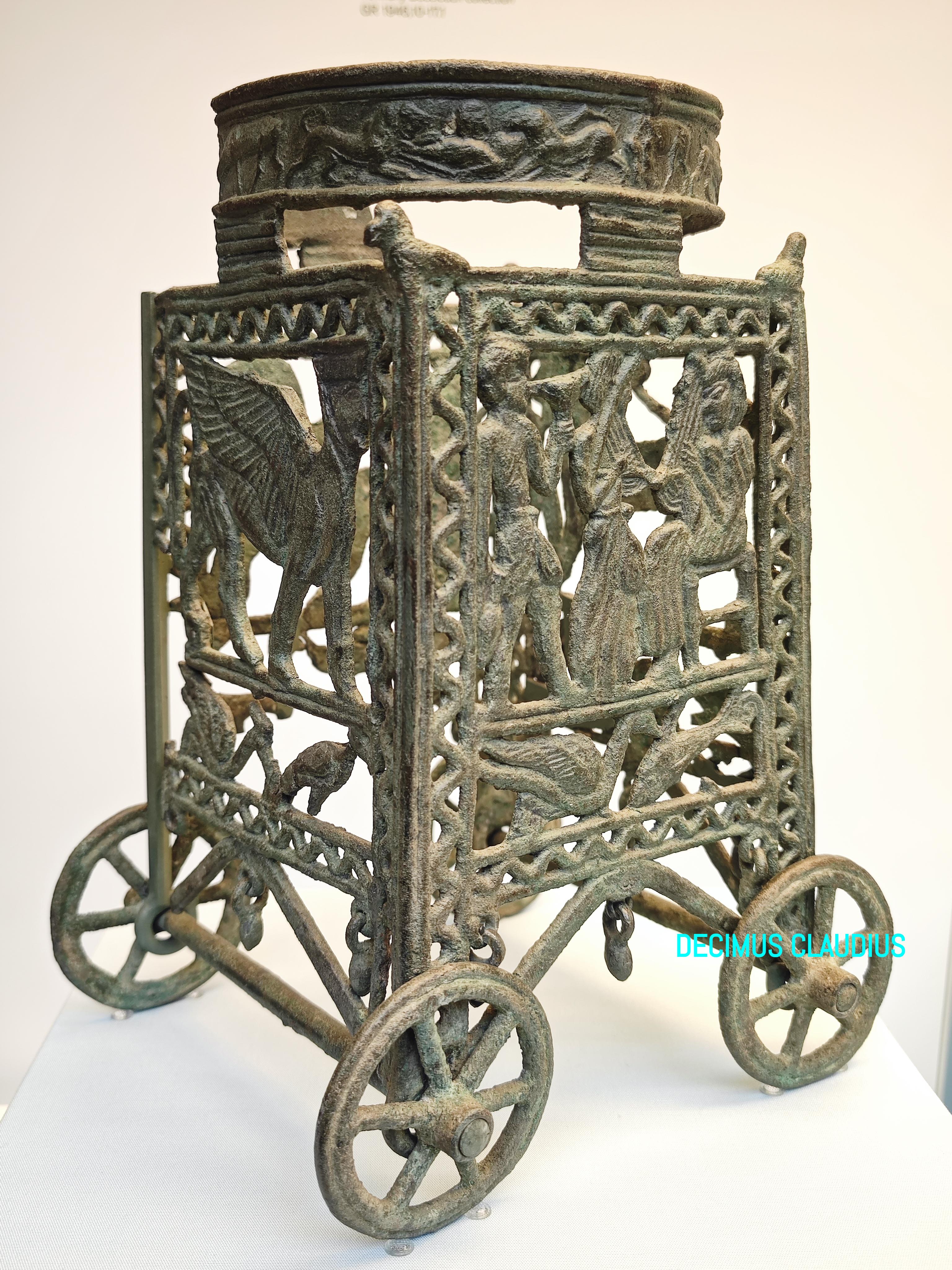
An ancient bronze vessel stand from Cyprus.
"This bronze wheeled stand was designed to support a bowl or incense burner during an important ceremony or feast. The stand combines high technical skill with artistic motifs drawn from the surrounding region. The elaborate panels decorating each side include groups of musicians and revellers, a hunting lion, a sphinx, a charioteer and other wildlife. They may have had religious or mythological significance. Cyprus, 1250-1100 BC." Per the British Museum in London, England where this is on display.
r/AncientCivilizations
•
u/amelix34
•
4d ago

r/AncientCivilizations • u/MidnightAbbess • 3d ago
I’m not a good researcher whatsoever so any pointers in the right direction would be awesome. I’m mostly interested in the Mesopotamian, Celtic, and Slavic & Baltic areas. I’m interested in all topics, but I’m especially interested in fashion, religion, and architecture
r/AncientCivilizations • u/works-in-progress • 4d ago

r/AncientCivilizations • u/Brighter-Side-News • 4d ago

Stone points, hippo remains and traces of toxic plants have survived together beside a vanished lake in southern Saudi Arabia. The approximately 125,000-year-old site offers an unusually detailed view of people making tools and using plants in Green Arabia. Freshwater and grassland supported wildlife where desert surrounds the basin today.
The study in Science brought together the Saudi Heritage Commission, King Abdullah University of Science and Technology, Griffith University and international collaborators. At Uruq al-Julaybah, also called ‘Uruq Aljelibah in the paper, they combined landscape reconstruction with dating, fossil surveys and microscopic examinations of stone tools.
“This site gives us a rare and richly detailed view of how people lived in a landscape that looks nothing like Arabia today,” said Chris Clarkson of Griffith University. Clarkson co-led the research with KAUST geologist Frans van Buchem and colleagues.
Earlier research on Arabian lakes has shown how dramatically the peninsula’s environment changed. Mundafan adds evidence of the activities those wet intervals supported.