r/Archaology • u/hassusas • 12h ago
r/Archaology • u/haberveriyo • 9h ago
1,500-Year-Old Gold Medallions May Reveal Rome’s Bid to Win Over an Ancient Kingdom
r/Archaology • u/haberveriyo • 12h ago
Sasanian Rock Carvings of Human Hands Reveal Clues to Ancient Persian Religious Rituals
r/Archaology • u/haberveriyo • 21h ago
New Study Identifies Possible Location of 2,000-Year-Old Roman Legionary Camp in Jerusalem
r/Archaology • u/Nachtfalke19 • 17h ago
Reconstructing Fyrkat Viking Ring Fortress - PixStory
What can a thousand-year-old Viking fortress teach us about mapping? More than you might think.
Our latest PixStory explores Fyrkat, one of Denmark's UNESCO-listed Viking ring fortresses, where drone imagery, digital mapping, and archaeological research come together to reveal one of the Viking Age's most precisely engineered sites.
From the circular earthworks to the carefully planned arrangement of sixteen longhouses, Fyrkat demonstrates how modern geospatial technologies can help us visualize, document, and preserve cultural heritage.
Read the full PixStory here: https://pixelement.com/.../2026/07/24/pixstories-fyrkat.html
r/Archaology • u/desertgodfather • 18h ago
Dr. Eid Al-Yahya reports directly from the Qusairat Aad excavations (Al-Aflaj, Saudi Arabia, ~370–400 km south of Riyadh), run by the Heritage Commission and King Saud University, including a jar repaired with bronze patches and rivets.
A documentary episode by Dr. Eid Al-Yahya follows the Saudi Heritage Commission's excavations at Qusairat Aad. The site lies in Al-Aflaj Governorate, about 370–400 km south of Riyadh, and the work is done jointly with King Saud University's Department of Archaeology.
Video : https://youtu.be/sGAjdaFBz-4
The video is in Arabic, so I translated and summarized the main points below.
The site
• It is linked to the springs of Al-Aflaj, which dried up in 1983. Excavators found underground water channels and calcareous deposits that connect the site to those springs.
• It appears in medieval sources such as al-Hamdani and Yaqut al-Hamawi, and was visited by Philby.
• Locals call it "Qusairat Aad" ("the little palaces of ʿĀd") because they attribute its old structures and wells to the legendary people of ʿĀd.
• It was only described in a 1979 survey. Focused excavation began in 2019.
Finds shown in the video
• A large black-slipped jar resembling pottery from the site of Layla, with an ancient crack repaired from inside using bronze patches and rivets.
• Water basins and a tightly sealed storeroom, possibly for liquids or for making fermented drinks and date molasses (residues were found on the walls).
• A room with grinding-stone bases and four floor sockets that held wooden looms.
• A building with three successive occupation phases. A woman's skeleton was found about 5 m deep, carefully laid out with hands on the chest, and dated to roughly 400–450 CE.
• On the first mound, massive stepped walls of mudbrick. The excavators suggest a religious function because of braziers with burn marks. Radiocarbon dates on bone and charcoal place some layers in the 1st century BCE.
r/Archaology • u/haberveriyo • 1d ago
13,000-Year-Old Human Skeleton in Mexico Reveals Clues to America’s Early Inhabitants
r/Archaology • u/haberveriyo • 1d ago
A Syrian Goddess, a Storm God, and a Celestial Symbol
Beside the central divine couple stands a Syrian goddess wearing a cylindrical headdress topped with a bird. Above them, a prominent star-disc adds another layer of symbolism to the scene.
The pairing brings together two complementary aspects of divine power. While the male Storm God embodies warrior authority, the goddess introduces themes of fertility, dynastic continuity, and divine intervention.
What makes the imagery particularly interesting is how these different forms of power are brought together in a single composition.
r/Archaology • u/haberveriyo • 1d ago
Medieval Silver Treasure Found in Moldova Contains Sound-Making Jewelry and Snake-Headed Clasp
r/Archaology • u/haberveriyo • 17h ago
Wood Samples from Noah’s Ark Research Site Dated to 4,300 Years Ago | Arkeonews
r/Archaology • u/haberveriyo • 1d ago
Ancient Rock Art in Colorado Reveals Centuries of Native American History
r/Archaology • u/haberveriyo • 1d ago
8,000-Year-Old Storage Complex Offers Clues to the Lives of the Caucasus' First Farmers
r/Archaology • u/haberveriyo • 1d ago
New Roman Discoveries in Portugal: 13 Archaeological Sites and Unfinished Marble Sculptures | Arkeonews
r/Archaology • u/haberveriyo • 2d ago
360-Year-Old Sealed Lead Coffin Reveals Remains of Croatian Statesman
r/Archaology • u/haberveriyo • 2d ago
Wooden Coffins and Ancient Textiles Found in 2,000-Year-Old Jericho Tombs
r/Archaology • u/haberveriyo • 2d ago
Hittite Pottery Reveals an Unusual Lion and Deer Scene With No Known Parallel
r/Archaology • u/haberveriyo • 2d ago
A Mediterranean Stranger’s Final Resting Place: A Gladiator Vase in Roman Britain
r/Archaology • u/haberveriyo • 3d ago
Gold ornament in the form of a Herakles knot with a cupid without a wing in its center. Hellenistic period, between the end of the 4th and the 3rd century BC © The Trustees of the British Museum
r/Archaology • u/deniz_aydiner • 2d ago
Phallus
One of the ancient symbols that might seem the most peculiar to us today is the phallus/penis symbol. It was a popular good-luck charm throughout the Roman Empire and was carried by the Roman army to distant provinces, such as Britain, where the local population had no tradition of phallus worship. These figures were typically carved onto functional structures such as millstones, bridges, and doorways; they served as good-luck symbols intended to protect an enterprise or trade from the evil eye. Indeed, more than 60 phalluses have been found along Hadrian’s Wall.
r/Archaology • u/haberveriyo • 3d ago
The Banquet scene from the Tomb of the Leopards, Tarquinia, fresco, c. 480-470 BC. Source: Archaeological Museum, Tarquinia
r/Archaology • u/haberveriyo • 3d ago
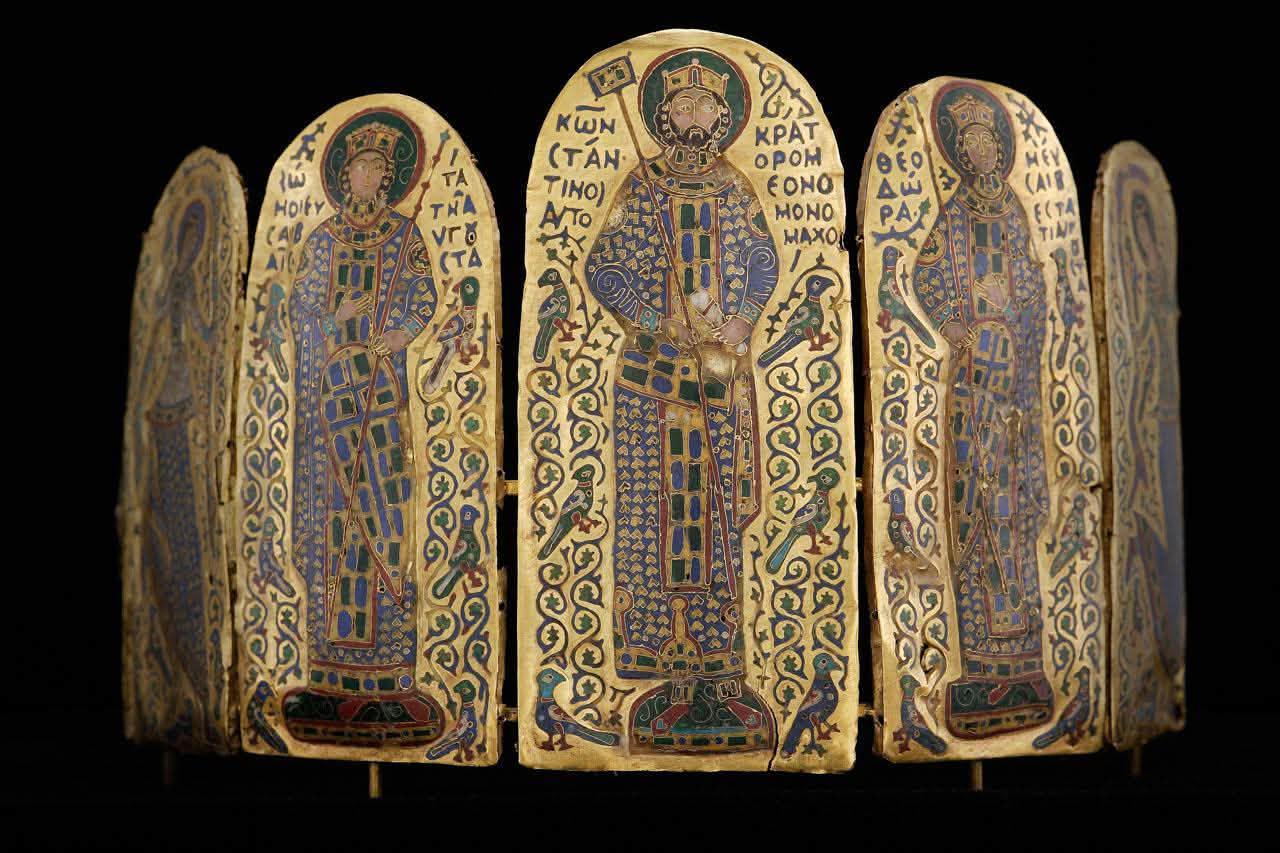
The Crown of Constantine IX Monomachos: An 11th-Century Byzantine Treasure Discovered in Slovakia
The Crown of Constantine IX Monomachos is an extraordinary example of Byzantine goldsmithing, dating to approximately 1042–1050 CE.
Made from seven gold plaques decorated with cloisonné enamel, the surviving ensemble features Emperor Constantine IX Monomachos at its center, flanked by Empress Zoe and her sister Theodora. Other plaques depict female dancers surrounded by birds and foliage, alongside allegorical representations of Truth and Humility.
The plaques were discovered in 1860 during agricultural work near Ivanka pri Nitre, in present-day Slovakia, then part of the Kingdom of Hungary.
One theory suggests that the object was presented as a diplomatic gift to King Andrew I of Hungary. However, its original function remains debated, including whether the plaques actually formed a wearable crown.
The remarkable craftsmanship reflects the sophistication of Byzantine imperial workshops in Constantinople during the 11th century.
Today, the ensemble is preserved at the Hungarian National Museum in Budapest.
What do you think these plaques originally belonged to: an imperial crown, a ceremonial headdress, or something else?
r/Archaology • u/desertgodfather • 3d ago
Did the Story Begin Here?
Savanna Engravings and the Alphabet in the Arabian Peninsula
November 20, 2026
Dr. Eid Al-Yahya (@eidelyehya) presents an Arabic Thamudic alphabetic script engraved beside a lion and a zebra, in the same style and with the same patina of age. If it is proven to date from their time, the story of the origin of the alphabet may need to be revisited.
The Prevailing View: Where Was the Alphabet Born?
Historians relate that the alphabet was born roughly 3,000–4,000 years ago between Egypt and Sinai. There, workers who spoke Semitic languages borrowed symbols from hieroglyphics and made each symbol stand for a single sound.
The Phoenicians then carried this script along with their trade and ships. It passed to Greece and then Rome, and many alphabets branched off from it. This is the account that generations have learned in schools and books. In it, the Arabian Peninsula appears as a recipient of the alphabet, not a source of it.
The Arabian Peninsula When It Was Savanna
The Arabian Peninsula was not always a desert. Some 6,000–7,000 years ago, and perhaps earlier, it went through a wet phase in which grasslands and seasonal lakes covered it. This is known as the Savanna Age.
The Peninsula's engravings include images of animals resembling those we see in the savanna today, such as the lion and the zebra. Dr. Eid Al-Yahya believes they date from that phase. Rock preserves what is carved on it for thousands of years, so these engravings can serve as a witness to the life of people and animals in that era.
What Is Dr. Eid Al-Yahya Presenting?
In his videos, Dr. Eid Al-Yahya presents sites in the Arabian Peninsula with engravings of a lion and a zebra. He points to Arabic Thamudic writing engraved beside them. He observes that the alphabetic script and the two animals share a single engraving style and the same patina, that is, the same degree of weathering on the rock surface. He believes this suggests that whoever engraved the two animals may also have engraved the writing.
The age of the animal engravings is estimated at no less than 6,000–7,000 years, and it may reach 10,000. On this basis, the alphabetic script beside them would be of roughly the same age. This is Dr. Eid's own reading and estimate, not yet a peer-reviewed scientific finding.
Why Does This Matter?
If the alphabetic script beside the two animals is proven to be as old as they are, it would be far older than the prevailing account (3,000–4,000 years). The story of the alphabet's origin would then need to be reconsidered. Did the Arabian Peninsula play a bigger role than we think? Were its ancient inhabitants pioneers of writing?
The value of the question is that it opens a door to research, not that it settles the answer in advance.
What Is Needed to Prove It?
Before any account changes, specialists require specific evidence. The most important are:
Direct scientific dating of the rock or of the deposits covering the engraving, since a similar patina alone does not determine the date.
Superimposition: does one engraving cut across another? The more recent one lies over the older one.
Patina comparison inside the carved grooves of both the animals and the writing.
Proof that the marks are writing: alphabetic writing with phonetic values, not mere symbols or signs, with a line of descent connecting it to the later alphabets.
Documentation and careful surveying, with close-up shots and coordinates, and examination by specialists in archaeology and inscriptions.
None of this diminishes the value of the discovery. It is the path by which a field observation becomes a result accepted by scientific studies.
Conclusion
We were told that the alphabet came from outside the Arabian Peninsula. Yet here are the Peninsula's rocks telling a story that may be different: a lion and a zebra from the Savanna Age, and beside them an Arabic Thamudic letter in the same style and with the same patina.
Today we cannot be certain of its age. But the Arabian Peninsula deserves to have its sites documented and its engravings studied by specialists, before time erases them. If what Dr. Eid Al-Yahya sees is proven, the story may have begun right here!
r/Archaology • u/haberveriyo • 3d ago