r/ArtHistory • u/Either_Gap6101 • 4h ago
Discussion Monet and Renoir painted side by side in 1869. What difference do you notice in the water?
297
Upvotes
r/ArtHistory • u/kingsocarso • Dec 24 '19
This is the only Discord server which is officially tied to r/ArtHistory.
Rules:
r/ArtHistory
•
u/PlasterGiotto
•
Oct 25 '26
As a support to rule 6 (Image posts require OP to make a comment conducive to art historical discussion) we are adding a rule that any image posts also need to have some level of citation.
"When posting images of artworks, please include, if possible, the artist's name, title of the artwork and year/time period of creation, at a minimum. Medium and artwork museum and/or location would also be appreciated when relevant."
r/ArtHistory • u/Either_Gap6101 • 4h ago
r/ArtHistory
•
u/Scorchyy
•
48m ago
You can wishlist it on Steam here! Let me know what you think, it's my first game
r/ArtHistory • u/Mastbubbles • 6h ago

The Rijksmuseum's collection entry calls her simply: "She was the company mascot." Richard Whiddington (Artnet, 2025) explains the chicken: "her glowing tresses carry a dead chicken, whose claw was the troop's emblem."
The crown is less settled. Nina Siegal, writing in Frieze in 2019, quotes Petria Noble, then head of paintings conservation at the Rijksmuseum: "There has been a lot of speculation that the crown she wears was once a halo of feathers, said Noble, but no one has really been sure about it."
Has anyone seen a mascot figure like this in other Dutch militia portraits?
I've been going to museums all my life and only recently learned how to read paintings, so I started collecting details like this, each tied to the person who said it.
r/ArtHistory • u/Fair_Tip2915 • 3h ago
Something that was insightful, interesting and not annoying! to you!
Edited: Sorry, to add about me: I really don't enjoy Waldy & Bendy and in general Waldemar's channel, unfortunately...dunno, just not for me, not my vibe/aura/voice. I used to adore whatever Robert Hughes was saying/writing, now I think I like this podcast called Art Stories, and The Art Angle, and some bits from David Zwirner.
r/ArtHistory • u/vscarlett206 • 22h ago

r/ArtHistory • u/caeneus723 • 6h ago

pls let me know if this isn't the right place to ask! I visited an Alphonse Mucha exhibit with a friend and we came across this painting titled Nativity (1934) (it was titled "Madonna" something at the exhibit, which made searching for it somewhat difficult, and adds to the mystery).
We were (and still are) very perplexed by the green lizard at the bottom right and would appreciate possible interpretations! The only thing that came to mind was lizard≈snake, but it feels like a stretch. We've scoured academic databases to our best abilities but to no avail. Please help if you have any leads, it's driving us crazy. 🦎
r/ArtHistory • u/jamievurnilla • 1d ago

I keep coming back to the hands. In Anguissola's painting one sister raises her palm as if she has just realised she is losing, while her older sister calmly rests her fingers on a piece and looks out at us. De Man does something similar, with the man throwing up both hands and the woman in green velvet holding her piece and glancing back at the viewer, completely insouciant. It feels playful and a little smug. I like that you can almost tell who is winning without seeing the board.
The board barely changes across four centuries, but the room around it does. Campi and Anguissola crowd their games with onlookerd: fur-hatted men, a jester, a grinning younger sister, an elderly maid. Those scenes feel convivial, as if chess is an excuse to gather. Daumier and Eakins, painting within a decade of Schwarz, strip it back to two or three quiet men and pure concentration. Schwarz keeps the watchers but sets them in a tsar's palace, looking back in time. Somehow a cat keeps sneaking in too, sitting by de Man's fireplace, batting a fallen piece under the tsar's table, and waiting on Eakins's rug. They add a quiet bit of intrigue, and I wonder why it was specifically cats that these painters kept including.
Part of me wonders whether artists returned to chess because it let them paint thinking, which is usually invisible. A furrowed brow, a hovering hand, a watcher leaning in: all of it turns a cerebral game into something you can see. It also gave painters room to show off rich fabrucs, carpets, and faces at every age, from Anguissola's little sister to Eakins's white-haired players. I am curious whether the appeal was the challenge of showing a mind at work, or simply the drama of two people locked in quiet competition.
I wonder how a painter today would handle this, now that many games happen on phones. Daumier already shows how little is needed: two heads, a few blurred pieces, and unmistakable tension. But would two people hunched over a glowing screen still read as chess players, or does it need a real board, a hovering hand, and someone watching?
r/ArtHistory • u/zhenying-li • 59m ago
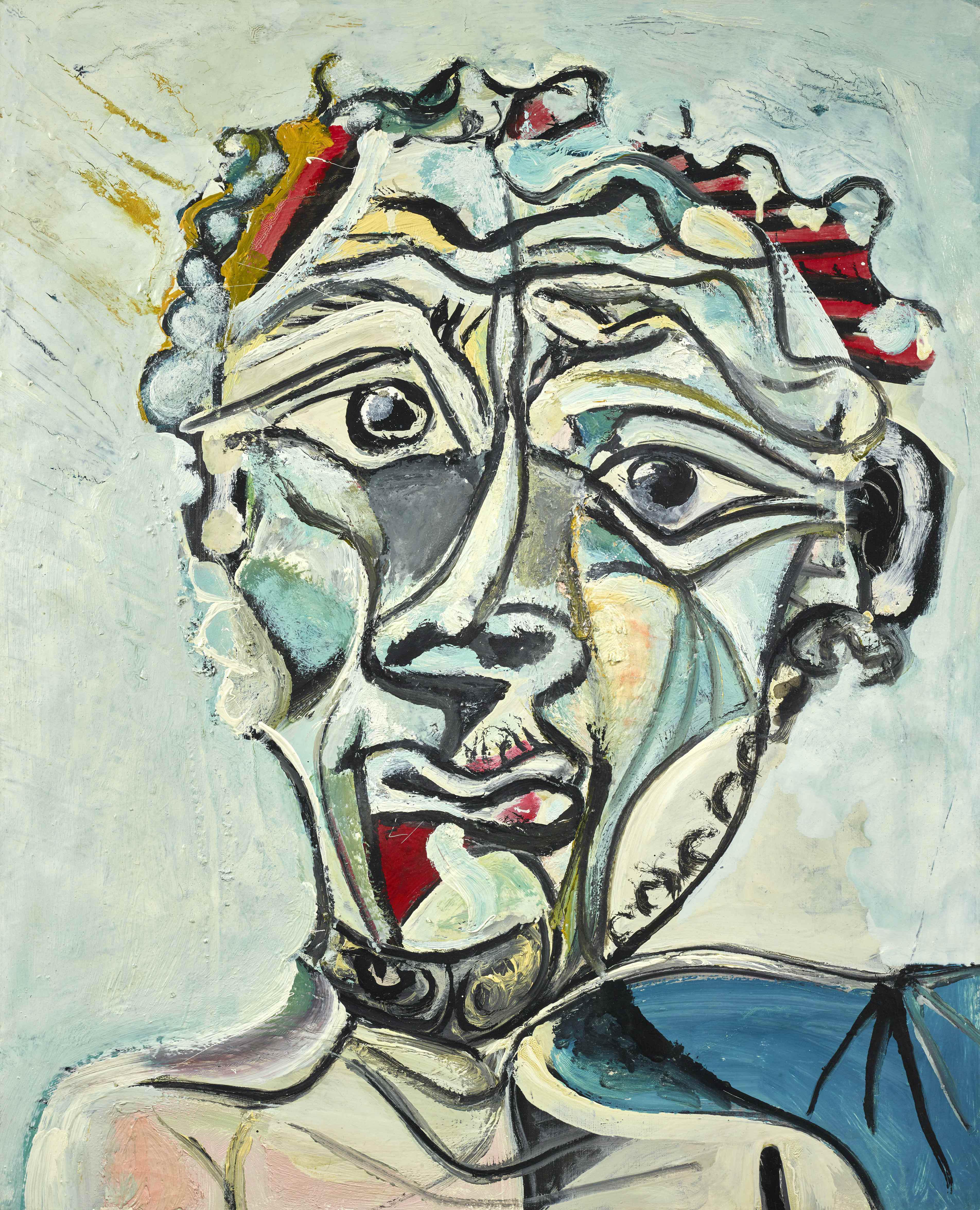
This was not my first time seeing a Picasso painting. But the thick, forceful brushstrokes in Head of a Man (1971) still held my attention.
The image is intense. So are the marks. I kept looking at the paint and the overlapping traces, wondering how he had made this painting.
Some areas looked like two layers to me, as though something had been painted over. But I have not found evidence confirming that this work covers another painting. And the possibility of something underneath was not the only thing that interested me.
Since taking up oil painting myself, I pay particular attention to the traces of painting and revision in other people’s work. The figure before me is finished, but this was once a painting in progress—one that could still change.
I don’t know how Picasso felt as he painted. I can’t read his personality from a single brushstroke. But through looking and discussing the work together on this visit, those brushstrokes made him feel more present to me.
Standing before the original, it felt like more than a painting—like an encounter across time.
For those who study Picasso’s late portraits: what evidence would you look for before interpreting visible layers as revisions—or as an earlier composition underneath? I’m interested in where close looking ends and technical or documentary evidence becomes necessary.
Pablo Picasso, Head of a Man, 1971. Oil on canvas, 81 × 65 cm.
Image source: Taichung City Government. © Succession Picasso 2026.
https://www.taichung.gov.tw/3391644/post
Exhibition: The Scorpion and the Frog: Masterworks from the YAGEO Foundation Collection, Taichung Art Museum.
r/ArtHistory • u/Wondering-traveler33 • 2h ago
Hello! I am an art history/studio art student at public university and just got rejected from an internship. I want to know what my goals should be for my resume. So far I work at an art gallery, have curated one art show, and am apart of a collecting/purchasing art program at the school where we buy contemporary art for the school’s permanent collection. I can’t seem to get internships but would like to know what kinds of things I can do to help grow my resume before applying more. Thank you!!
r/ArtHistory • u/zhenying-li • 3h ago
Looking at Artemisia Gentileschi’s Mary Magdalen in Meditation, I began wondering what it took for her to become a painter in her time.
Born in 1593, she trained in her father’s workshop, later worked independently, and in 1616 became the first woman admitted to Florence’s Accademia delle Arti del Disegno.
I paused at “the first female member.”
It marks an achievement. It also reminds me that before her, no woman had been admitted.
Looking back today, we know it was difficult for women to pursue art then. But to get closer to the restrictions she actually faced, the opportunities she fought for, and how she understood her achievements, we need more specific evidence.
I don’t want to assume I understand her simply because I know something about her circumstances.
“First” makes me notice the barrier. It also makes me want to know how she got there.
Returning to the painting, I want to do more than remember her as a woman who broke through restrictions. I want to keep looking at how she arranged the figure, light, and color—how she made contemplation tangible.
Her life deserves understanding. Her paintings deserve careful looking too.
Artemisia Gentileschi, Mary Magdalen in Meditation, 1610s–1620s. Oil on canvas, 156 × 117 cm. Exhibited in The Scorpion and the Frog: Masterworks from the YAGEO Foundation Collection.
Image and artwork information: Taichung City Government / Taichung Art Museum.
Exhibition: https://www.tcam.museum/zh/exhibition/thescorpionandthefrog

r/ArtHistory • u/ElvisIsNotDjed • 8h ago

r/ArtHistory • u/Proper_Club_3151 • 1d ago

In the 1800s, Ferdinand Georg Waldmüller became famous for hyper-realistic, sunlit scenes of Austrian life. To the Nazis, his style was the ultimate «pure» Germanic art and many of his masterpieces were earmarked for Hitler’s planned «Führermuseum» in Linz. After WWII, many looted Waldmüllers weren’t returned. Instead, they quietly slipped into museum storage and state collections across Europe.
Decades later, the search for justice continues. Using old customs stamps, auction records, and labels hidden on the backs of canvases, provenance researchers are still uncovering the paintings’ histories and helping return them to the heirs of their original owners.
Even in 2025 and 2026, lost Waldmüllers are still being identified.
Masterpieces displayed:
- The Grandparents’ Visit (1863)
- The Good-natured Child (The Beggar) (1859)
- Familie Gierster (1838)
- Little Count Esterhazy in trousers with a rabbit (1827)
- Children on Their Way Home from School (1836)
- The Cured (1864)
__________________________________________________________________________
Discover more art stories and curated galleries in our app, The Art: Daily Culture (iOS)
r/ArtHistory • u/SurpriseFamous8034 • 1d ago
i'm becoming a lot more appreciative of classical arts and everything, but most of my feed is lacking cultures outside of european history. does anyone have sources to find things from others? or any ig or tumblr accounts you know of that feature more art by black and poc communities?
my main taste is things with religious imagery (not just christian), any form of gothic, darker styles, horror esque, but im open to all styles
EDIT: thought it was self explanatory but i meant historical artists, modern artists, and social accounts that share mostly such artists. of course i know what a museum is if i had a museum i could just into my city with these specific ideas i would 🙄
accessibility is important
r/ArtHistory • u/Maximum-Operation147 • 17h ago
Howdy, I'm putting together an educational video about Ellington, and would love to include examples of his visual art. It's a shot in the dark considering he attended Armstrong Manual Training School in his early childhood, before switching over to jazz. You never know, though! Grateful for any help.
r/ArtHistory • u/MistressLurex • 19h ago
Hi all, I'm an undergrad wrapping up my art history core courses and hoping to focus more on 20th century and contemporary topics before applying to MA programs. I've read the usual survey texts but feel like I'm missing deeper foundational works that grad students are often expected to know
Any recommendations for key books, essays, or primary sources that helped you build a stronger base in modernism through the present? Especially anything that bridges theory and specific movements or artists. Appreciate any suggestions!
r/ArtHistory • u/General_Body_2160 • 21h ago
im a recent graduate of a masters degree in art history; but im having a tough time finding work. so far ive applied for starter positions in various museums or archives, unesco internship and other general administrative work which has nothing to do with art history because ive not had any luck with that. im looking for some other career paths, which have some affilitation with art history, but are not museums.
thx in advance,
kind regards,
a jobless woman
r/ArtHistory • u/Dazzling-Toe-4955 • 8h ago
r/ArtHistory • u/ArtBobby • 1d ago

In the social world of Medieval and Renaissance Italy several contemporary rituals were subtly incorporated in the marriage scene between Joseph and Mary, after having first been explicitly expressed by Giotto’s pioneering frescoes in the Scrovegni Chapel. Perhaps the most intriguing aspect she highlighted was the ritualistic slap on the back that the 14th-century Italian groom traditionally received during the ceremony. Giotto incorporated it with his usual humour and wit into a gentle vignette of an amused young rival barely able to control his laughter at the notion of the divinely sanctioned choice of the doddering Joseph. Read more here: https://ideasroadshow.substack.com/p/irrational-immoral-and-infuriating.
r/ArtHistory • u/mhfc • 1d ago

r/ArtHistory • u/Puzzled-Product-7060 • 1d ago
currently planning to attend UH for Art History as the internship opportunities within Houston’s museum district are phenomenal. however, I do plan on applying to several other places just to be safe, and to also keep options open. my husband and i are toying with the idea that if i get accepted into a school in a different state, it may be the perfect excuse to live somewhere new.
so my question is, where did you get your degree? would you or would you not go there again if given the chance to redo it all? and where do you think the ultimate university for this major is located? Thanks!
r/ArtHistory • u/CauliflowerMundane78 • 1d ago
Hi everyone! I’m currently applying to MA programs in Art History, with the intention of specializing in Renaissance art history. I’m hoping to get a head start on reading before beginning graduate school.
Are there any books, scholarly articles, primary sources, or important texts that you would recommend reading to build a stronger foundation in Renaissance art history?
I’d especially appreciate recommendations that you think would be helpful for someone transitioning from undergraduate to graduate-level art history. Thank you!
r/ArtHistory • u/Miesmoes • 2d ago
I am making a special advent calendar for a friend
His hobby is mathematics, mine is art, so I was gonna go for a great mix. With every present I give him one painting or other piece of art to chew on.
I have quite some ideas already (Escher, Piero, Brunelleschi) but I would love some more!