Although it’s very useful and includes all the necessary steps, I thought it would be interesting to expand on it a bit more. Some steps aren’t that straightforward. I know it works on Windows, but I personally used the Linux procedure on a Raspberry Pi.
Note: This is a first version of the guide, and I’m very open to feedback. Please don’t hesitate to send me comments, especially if you notice any mistakes, so I can correct them. The goal is to improve it and make it as helpful as possible for everyone.
And once again, a huge thank you to RL. Without him, I would never have been able to do this. I felt it was important to pay it forward, just as he generously shares his time and expertise with incredible dedication.
1) Disassembly
To dump and replace the device firmware, we need to access the programming port located inside the machine, which requires some disassembly.
Tools required
You will need the following:
T10 Torx screwdriver
ST-Link/V2 STM32 programmer (there are clones available, but I strongly recommend using the original)
TC2050-IDC or TC2050-IDC-NL programming adapter — I recommend the TC2050-IDC, as it securely attaches to the PCB (Printed Circuit Board), unlike the NL version, where you have to hold the connector by hand during the process
Five 0.1" male-to-female jumper wires
OpenOCD installed and some basic Linux knowledge
Disassembly steps
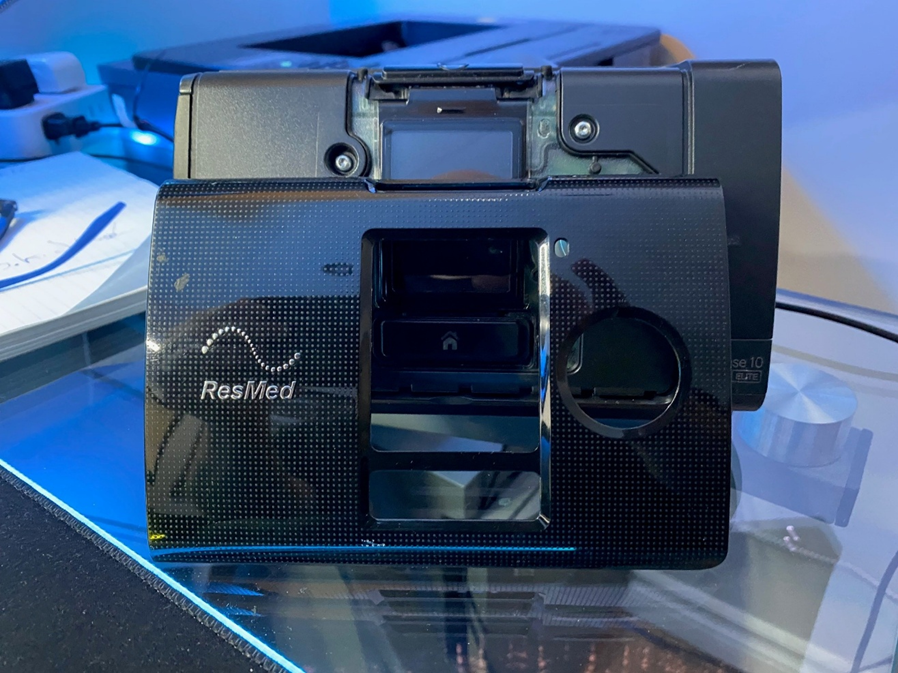
Remove the front faceplate. It’s only clipped in place — there are no screws.
2. Remove the second faceplate — this one is secured with four screws. The first two are located on the front.
For the last two screws, you’ll need to access the underside of the machine.
You can then remove the cover. The bottom latches need to be gently pried open using a flathead screwdriver or a spudger.
3. Remove the knob. It needs to be pulled straight out from the board with a firm, steady motion.
4. Remove the gasket.
This can be done from the front by releasing the latches at the bottom (which are accessible), then pressing inward on the two side latches located near the middle of the gasket. Be careful when lifting it off around the power button at the top of the device (see the components list for the part number if a replacement is needed). Removing the circuit board from the device is not required.
This is what it should look like. The arrow indicates where the TC2050-IDC needs to be connected.
The male end of the TC2050-IDC:
Here it is connected to the PCB.
2) Wiring
This setup allows Linux to communicate with the machine to perform the flash.
This part isn’t very straightforward. I’ll include photos of the setup I used. Otherwise, there are explanations here: https://airbreak.dev/disassembly/
Once your setup is complete, before proceeding, make sure the ST-Link is connected to your Linux computer and the TC2050-IDC is connected to the machine’s PCB. The ResMed device must also be powered on.
Open Linux.
First, make sure this repository (https://github.com/osresearch/airbreak) is cloned and located in your working directory. Keep the folder structure intact.
This is what it should look like in Linux:
Your firmware files should go into the source path (airbreak-master).
Now it’s time to communicate with the machine. Make sure your programmer is attached to the PCB, then start OpenOCD.
In your airbreak-master directory, open a terminal and enter the following command:
If your device is connected properly, you should see a lot of output, ending with:
Info : stm32f4x.cpu: hardware has 6 breakpoints, 4 watchpoints
Now, open a second terminal, also in the airbreak-master directory, to connect to the OpenOCD server:
telnet localhost 4444
This step is mandatory:
Here, you can dump the current firmware of your device in case you want to reuse it later. Simply type:
dump
After a few seconds, the main firmware will be backed up as stm32.bin in your working directory — it should be exactly 1 MB.
If you decide to make a copy of the firmware, you then need to patch it using the following command:
./patch-airsense stm32.bin stm32-unlocked.bin
This will unlock the vendor modes and configuration bits.
4) Flashing
Now, place the firmware (.bin) you want to use on your device into the root of the airbreak-master directory.
The command to use is as follows (you need to use the terminal where you opened the telnet connection to access the OpenOCD console):
flash_new stm32-unlocked.bin
Here, stm32-unlocked.bin is the name of your new firmware, as in the following example:
This step takes about 20 seconds, after which the device should automatically reboot. Once the device has been reflashed and restarted, you can access the clinician menu by holding down the Home button while pressing the knob for three seconds. You should then be able to select from all the vendor modes included in the .bin firmware you installed.
I have a handful of serviced APAP/CPAP machines and mask systems (higher hours) that I would like to get into the hands of people who actually need therapy than leave on a shelf.
These are free/donation machines. I am not charging for the machine or mask system. You would just need to cover the actual shipping cost.
This is mainly for people who are uninsured, underinsured, stuck waiting on a DME, cannot afford a machine right now, or otherwise have a legitimate need where we can help them.
Machines will be cleaned, checked, and tested before they leave here. Depending on what I have available, I can usually include a hose, humidifier chamber, power supply, and a mask system as well.
Please note that these are CPAP/APAP machines, not bilevel units.
If you need one, please send me a message (or email here: pc7579pc@gmail.com) with a little bit about your situation, whether you already have a prescription or sleep study, what pressure/settings you were prescribed if known, and what size/type of mask you normally use.
Please do not request one just to have a spare or flip it. I would like these to go to people who genuinely need access to therapy.
If anyone else has usable PAP equipment they would like to donate, feel free to reach out as well. I am happy to keep getting these units and full packages that I compile, back into circulation instead of letting perfectly functional machines end up in a closet or landfill. Also please feel free to cross-post this thread to other pap communities so more folks can see it, thank you kindly. Regards, RL.
I'm using an ASV machine to manage my central and obstructive apneas. Over the last month, my sleep has gotten worse and worse. I'm tired all the time, wake up multiple times a night, and starting to get worried about whether I should drive or not.
My AHI is 0.25 and I use my machine 7–8 hours a night.
Something in the settings isn't right and I don't know enough to know what to change. I suspect that I'm holding my breath for about 5–10 seconds and that wakes me up, but it isn't long enough to be classified as an apnea. Before I had my ASV machine, I would hold my breath for 20+ seconds.
In previous questions on Reddit, some has suggested lowering my PS min to 1.0 (currently at 2.0). I've tried that in the past (several months ago), but it didn't seem to make much of a difference. I would love to have someone help me identify what to change and what to look for in my data. I've linked my sleephq data.
I'm happy to have an extended conversation in chat if that is needed.
Hi everyone, I'm hoping to get some help. Ever since I got really sick with a virus in 2021, I’ve been dealing with chronic nerve pain and breathing issues. About two years ago I got diagnosed with mild sleep apnea. I'm waking up around 10 times a night and I'm exhausted every single day. It's making my other health issues worse and honestly making me pretty depressed.
The problem is I can't seem to tolerate any of the treatments. Every time I use my CPAP, my sinuses get inflamed and I get a mucus buildup in the back of my nose that takes days to clear. I've messed with the humidity settings and tried azelastine, mometasone, Atrovent/ipratropium, sinus gels, saline sprays, and different combos of them, and nothing helps. I've seen 3 different sinus specialists and they all say my sinuses look fine.
I also had a custom dental appliance made, but it aggravated my nerve pain so I had to stop using it. I tried the Bongo Rx device and just felt worse the next day. I can't even sleep on my side because it makes my nerve pain a lot worse.
Inspire isn't an option since my apnea is only mild (and I'd be worried about it triggering my nerve pain anyway), and my ENT advised against jaw surgery because of the nerve pain too.
I really don't know what else to try. It's getting really hard to get through each day feeling this drained. Has anyone dealt with anything similar? Is there something else I could try that I haven't thought of? I'd really appreciate any suggestions.
Not affiliated with SHQ but the MCP for LLMs are now available in public beta and seem handy so far!
Here’s an example:
Your SleepHQ account is connected, and I can now read and analyze your actual sleep therapy data directly from SleepHQ rather than relying on screenshots, exports, or public links. I verified the connection and found eight registered devices, including your AirCurve 10, AirCurve 11, and multiple O2Ring entries. What I can do with SleepHQ Capability What I can investigate Breath-by-breath analysis Examine flow-rate waveforms, breathing irregularities, recovery breaths, and possible RERA-like patterns Oxygen and pulse correlation Compare SpO₂ drops and pulse spikes with respiratory changes Therapy trends Compare AHI, leaks, pressures, flow limitations, and usage across nights Settings history Identify when therapy modes or pressures changed and how measured results differed Sleep stages Compare Apple Watch sleep stages with CPAP events, when stage data is available Sleep journal Read notes and, with permission, add observations, feeling scores, and flags Longer-term comparisons Compare different treatment periods, devices, and oxygen measurements The particularly useful capability for your situation is retrieving raw flow-rate, pulse, and oxygen signals on a shared timeline. This lets me investigate relationships that are difficult to establish from SleepHQ screenshots alone. A quick look at your actual data I also retrieved your three most recent nights. Here’s what SleepHQ currently reports: Night AirCurve 11 AHI Usage O₂ nadir Nov 20 0.00 9h 13m 86% Nov 21 0.33 9h 00m 88% Nov 22 0.50 7h 59m No ring data Your November 21 night is particularly interesting: despite an AHI of only 0.33, your O2Ring reported an ODI-3 of 6.9/hour and ODI-4 of 3.2/hour. That discrepancy is worth investigating, although it doesn’t establish that the machine missed respiratory events. The two current O2Ring entries appear to contain identical nightly summaries, so I’d avoid double-counting them. What I’d investigate first Given our earlier work on UARS, suspected RERAs, your AirwayLab results, and pulse spikes, I would prioritize three questions:
Do your pulse accelerations follow abnormal breathing? Examine the airflow immediately before each pulse surge.
Are there recurring flow-limitation or recovery-breath patterns that the machine’s AHI misses? Identify candidate events without treating them as clinically confirmed RERAs.
How closely do oxygen dips correlate with those breathing disturbances? Account for clock offsets and the physiological delay between ventilation changes and peripheral SpO₂ readings.
SleepHQ now gives me direct access to the underlying signals needed to investigate these questions. It doesn’t provide EEG-based arousal confirmation, so I can’t definitively diagnose RERAs from the CPAP traces alone. Choose an investigation Pulse–breathing investigation Detailed analysis of November 21, including raw signals AirCurve 10 versus 11 Compare machine results and oxygen measurements over time My first choice would be the pulse–breathing investigation, especially given the relationship you noticed in your recent SleepHQ graphs. Any treatment decisions should still be reviewed with your sleep clinician.
So I got pneumonia out of the blue. Then I had a thought about whether it could possibly be tied to my CPAP. Turns out there is a higher risk of pneumonia for CPAP users and even slightly higher if you're older (which I am). So, until I get this pneumonia resolved, I feel like I need to stop my CPAP until I figure out a better plan. I'm also on night time oxygen but only 2 l. I'm actually more worried about not getting the night time oxygen than I am about skipping my cpap. I've been very consistent with wearing my CPAP for the last 1.5 years.
But now I'm worried. Once I get this pneumonia resolved, I'm wondering if I should even go back on CPAP? If I'm part of the population that could be prone to developing pneumonia, maybe I need to weigh the pros and cons of using a CPAP. Fyi, I'm actually on an airsense 11 which I understand to be a BiPAP machine?
I have quite a few CPAP machines, mostly ResMed but also some other ones. I'm honestly not too familiar with where people buy or sell these things. Located in the US, and I can ship nationwide.
I'd ideally like to sell them as complete bundles with the carrying case, power adapter, and any new masks and tubing that someone might need. (I have more tubes/masks than what's shown in the photos)
Is there a specific website or community where people sell them? Has anyone done this before? Not really sure where to start. Any advice would be appreciated!
The past several nights, when my APAP pressure climbs toward 10-11 cm H20 during the night, the airflow feels extremely forceful and wakes me up with a sense of overwhelming pressure like it's blowing up my lungs. I try to relax and just breathe but it feels like I'm hyperventilating. I have a call into my DME and sent a detailed message but their office is closed today. The doctor has been less than helpful and told me to work with the DME. He started me off as a 4-10 and then couldn't believe that i had problems breathing. I've been struggling so i understand to a degree, but the aid from the medical community has been unbelievably not helpful. I had the same problem with this mask when i first started using it, but switched the mask setting to full mask and that seemed to help. I'm in between sizes the small is too small so i've been pushing the medium and blocking partial airflow which I'm thinking now the pillow cushions are getting softer I'm not able to rig it like i was. I have mild COPD and am worried the way it feels in my lungs. Can you please look at my info and see if you could give me any insight if i could make any adjustments to alleviate the pressure I'm experiencing?
As you can see I have posted this question before on our sister site, SleepApneaSupport. Questions are still coming up often from our guys with facial hair, so hoping to get more comments from our Guys in the Know! Thanks for your help :)
any fixes for this? it always says usage 0:00h on the device, OSCAR doesnt even recognize them as days. I have my SD-Card unlocked in the my RM AS10 with Bipap setting