r/CanadaHousing2 • u/Few_Guidance2627 • 13h ago
Is Canadian money making Spain's housing crisis worse?

1
Upvotes
r/CanadaHousing2 • u/Few_Guidance2627 • 13h ago
r/CanadaHousing2 • u/RootEscalation • 2d ago
These are all data from the CMHC.
Source: www03.cmhc-schl.gc.ca/hmip-pimh/#Profile/1/1/Canada

YTD 2025 - Starts: 197,841
YTD 2026 - Starts: 192,023
By far, 2026 has shown that housing starts are down. I doubt the governments pledge of 500,000 homes will ever be built. Moreover, as per source: Canada real estate: Housing minister won't reaffirm pledge Housing minister won't reaffirm Liberal pledge to double home construction.
The Liberals campaigned during the 2025 election on a pledge to double the annual pace of housing starts to roughly 500,000 over a decade.
...........
“While Budget 2026 announces new measures for homelessness and housing affordability, it is not on track to double housing starts per Budget 2025, with year-to-date housing starts 4 per cent lower in 2026 than 2025,” one of Ryan’s report read.
Side note, lets make a real estate investor housing minister.
r/CanadaHousing2 • u/aroseinthehouse • 2d ago
RSVP link: https://luma.com/s6n343t6
Soaring levies on construction & development are making it financially impossible to build the housing British Columbia needs. But to cut development charges, municipalities need alternate sources of revenue. Join Common Wealth Canada, Homes for Living, and a panel of experts from industry and politics to discuss land value return as a way to fund government without suppressing construction.
Panelists:
With introductory remarks by Homes for Living organizer Jarren Butterworth & Common Wealth Canada founder Floyd Marinescu.
Moderated by Common Wealth Canada BC Strategist Andrew Rose.
Agenda
Cash bar and complimentary finger foods will be available. We'll have the room until 10 PM, so please stick around to grab a drink and continue the conversation.
Common Wealth Canada is a non-partisan think tank working to replace harmful taxes on work and productivity. Development charges are a great example: if we replace them with revenue from land values, more housing will pencil, and Canada will start building again.
Hosted in partnership with Homes for Living, a community advocacy group pushing to solve the housing crisis through local action.
RSVP link: https://luma.com/s6n343t6
r/CanadaHousing2 • u/Future_Procedure6078 • 3d ago

r/CanadaHousing2 • u/A2D2Charlie • 4d ago
Hey everyone! I’m interning at a property tech startup, and for my final assignment I’m trying to hear from a few Toronto or GTA brokers and realtors who work with rentals. I have 48 hours to turn it in, so even one connection would help a lot 😅
I’m doing a quick 3-minute survey about what takes up the most time when handling rentals.
If you work with rentals or know someone who does, please drop a comment or DM me. A public business profile or an intro would be great!
Thanks a lot in advance! 🙏
r/CanadaHousing2 • u/slykethephoxenix • 10d ago

r/CanadaHousing2 • u/BizAcc • 16d ago
Here’s the video if you want your blood to boil today: https://youtu.be/tcr7Qh4hk-k
Did anyone else watch this absolute clown show? I got massive second-hand embarrassment watching Brendan Ogmanson, the so-called "Chief Economist" (read: glorified PR shill) for the BC Real Estate Association, squirm and totally try to avoid the question about how foreign investors are supposed to help housing affordability.
The interviewer flat-out asks him [06:44] how bringing foreign capital back into the pre-sale market won't just prop up artificially high condo prices instead of letting them correct to local incomes. And what does this scum say? He literally says the premise is wrong, claims that hoping prices will correct to median incomes is "not how housing markets evolve," and casually drops that people just need the "bank of mom and dad" to buy a place now.
He completely dodges the question because the truth is: foreign investors will never help housing affordability.
These parasitic real estate lobbies are sitting on a massive glut of overpriced, tiny investor-special condos that working Canadians can't afford. But instead of letting the free market work and forcing developers to lower their prices, they are begging the government to open the floodgates to foreign cash to bail out their bad investments.
These guys only care about keeping housing prices artificially inflated and keeping actual Canadians in permanent hardship so they can keep benefiting from it. The absolute audacity to go on live TV and pretend this foreign buyer exemption is about "helping" us is sickening. They want you poor, renting forever, and desperate, just so developers and realtors can keep lining their pockets.
r/CanadaHousing2 • u/venrodis • 17d ago
r/CanadaHousing2 • u/Future_Procedure6078 • 20d ago

r/CanadaHousing2 • u/Howard__24 • 21d ago

r/CanadaHousing2 • u/toronto_star • 26d ago

r/CanadaHousing2 • u/BizAcc • 28d ago
According to their latest report: “Since 2005, real house prices in Canada have more than doubled, outpacing most developed countries. Strong population growth, rising incomes and low borrowing costs drove housing demand ahead, while housing supply growth remained relatively stable. Fewer homes per person may also have made Canada more exposed to affordability pressures than comparable countries.”
NO KIDDING?! CanadaHousing‘s realtor mods should ban CMHC immediately!!
r/CanadaHousing2 • u/Head_Crash • 28d ago

r/CanadaHousing2 • u/eazed • 29d ago

r/CanadaHousing2 • u/BizAcc • Oct 20 '26
The federal ban on foreign buyers purchasing residential property expires on January 1, 2027. Ottawa hasn't committed to extending it, and one option being floated is an Australian-style model that lets foreign buyers purchase new builds.
A few things worth knowing:
- When the ban was introduced, the industry's line was that foreign buyers were too small a share of the market to matter. Royal LePage said it had "virtually no impact". However, CREA has lobbied against it since day one. If it doesn't matter, why is lifting it a priority?
- Australia is a strange model to copy. Its national median multiple is 9.7, compared with 5.4 for Canada, and Sydney is one of the least affordable cities on the planet.
- About 76% of Canadians support the ban. This isn't a fringe position.
I'm tired of competing with foreign and institutional investors just to put a roof over my head. This gets decided in the next ten weeks, and over the holidays it's easy for something like this to lapse without anyone noticing.
If it matters to you, tell your MP and the Housing Minister before January 1. You can find your MP at ourcommons.ca.
r/CanadaHousing2 • u/joe4942 • Oct 20 '26

r/CanadaHousing2 • u/joe4942 • Oct 19 '26
r/CanadaHousing2 • u/KootenayPE • Oct 17 '26

r/CanadaHousing2 • u/rahu_ • Oct 16 '26
Renters keep asking whether their rent is normal, so I built a small, free, anonymous check. Pick your city, neighbourhood, unit size and move-in year. If you moved in recently, it compares your rent to current asking rents (Rentals.ca/Urbanation). If you've been there longer, it uses CMHC averages. It covers 40 cities and 319 neighbourhoods, with no signup and no ads.
What stands out is how far apart recent movers and long-term tenants are. Curious whether your number matches what you're seeing. It's Canada-only, and I'm a solo builder, so feedback on the data is welcome.
r/CanadaHousing2 • u/BeautyInUgly • Oct 12 '26

r/CanadaHousing2 • u/nantuko1 • Oct 09 '26
What I really want is the best housing policy that every country in the world should use that makes housing as cheap and attainable as possible for EVERYONE.
Should housing primarily be a place for people to live, or an asset whose owners can profit from its scarcity?
A policy that makes housing attainable for everyone has to address both sides of that problem: make it easier to create enough good homes, and ensure people who need housing can access it even when they have little money. Simply banning investors, building more houses, or subsidizing buyers addresses only part of the system.
There is no single law that will work identically in every country. Countries differ in land ownership, income, population growth, infrastructure, construction capacity, and government resources. But a common policy framework can be built around universal principles, with implementation adapted to local conditions.
I would structure a global housing policy around one principle:
Every person must have access to safe, adequate, stable housing at a cost they can afford, while the rules of the housing market must prevent artificial scarcity and discourage profit-seeking that undermines that access.
This doesn't mean every person is entitled to a free detached house in any location they choose. It means nobody should be forced into homelessness or unsafe housing because their income is too low, and governments should not make affordable housing structurally difficult to build.
That approach is consistent with the direction of UN-Habitat's housing framework and with OECD research emphasizing both housing supply and affordable, social housing.
Here is how I would turn that principle into policy.
Governments would establish housing targets based on population growth, existing shortages, household formation, and local demand.
Why: If demand rises while the supply of homes is artificially constrained, competition for existing homes pushes costs up. The World Bank and OECD both identify restrictive land-use rules as a barrier to housing supply.
Every country would maintain a substantial, long-term stock of public, cooperative, and nonprofit housing.
Why: Private construction alone does not guarantee homes for people who cannot pay market rents. The OECD's 2026 policy brief specifically identifies expansion of affordable and social rental housing as a key part of closing the affordability gap.
Shift more of the property-tax burden toward the value of land, especially valuable land left unused in areas where housing is urgently needed.
The distinction matters: A land-value tax targets the location value of land, not the value added by building or improving a home. The OECD discusses land-value taxation and land-value capture as tools for addressing housing inequality and discouraging land hoarding.
The goal should be to stop housing from being treated as a vehicle for extracting wealth at the expense of residents, while preserving responsible rental housing investment.
A critical safeguard: Buying an existing home does not automatically create another home. But banning every company or investor from owning existing housing could also reduce rental options, maintenance investment, or the supply of professionally managed rental units. Rules should target measurable harm, with exemptions for new construction and legitimate rental provision.
Rent regulation needs careful design: overly rigid caps can discourage new rentals or maintenance, while no protections can expose tenants to sudden displacement. Countries should evaluate tenant stability and rental availability together rather than treating either as the only goal.
A person should not need to be wealthy or have a large developer behind them to build a lawful, basic home.
This is especially important in lower-income countries, where formal housing rules and land administration can exclude people who could otherwise build gradually. UN-Habitat's land-policy guidance specifically discusses simpler administrative processes, incremental construction, and diverse forms of land tenure.
The international benchmark can be affordability: UN-Habitat commonly uses housing costs exceeding 30% of household income as an indicator of housing unaffordability. That is a useful warning threshold, not a perfect rule for every income level or country.
The order of implementation is important. If a government suddenly restricts existing housing investment before it has expanded alternatives, it could reduce rental supply or make financing new homes more difficult. Conversely, if it only builds homes but leaves land hoarding and exclusionary rules untouched, affordability gains may be captured by landowners.
I would implement the framework in four stages.
First 12 months — Establish the rules and baseline
Years 1–3 — Start building and unlock existing homes
Years 3–7 — Scale up and rebalance incentives
Years 7–15 — Make affordability durable
These are proposed implementation windows, not a guarantee that a country could eliminate its housing shortage within those periods. Existing shortages, construction capacity, public finances, and population growth would determine the actual pace.
No housing policy is cost-free. The aim should be to use existing resources more effectively and spread costs transparently.
| Funding source | What it can pay for |
|---|---|
| Land-value taxes | Infrastructure and housing programs, with protections for cash-poor owners |
| Taxes on vacant property and speculative landholding | Local housing and vacancy-enforcement programs |
| Recovery of publicly created land-value gains | Transit, utilities, and affordable development |
| Public borrowing | Long-lived housing and infrastructure assets |
| Rental income from public housing | Maintenance, operations, and part of future construction |
| Private and cooperative investment | Additional construction under affordability and tenant-protection rules |
| General taxation | Emergency housing and support for people unable to afford even cost-based housing |
A key design principle is to avoid relying on ever-rising home prices to fund government. When governments depend heavily on transaction taxes, development charges, or revenue linked to rising property values, they can face conflicting incentives. Land-value taxation and better recovery of publicly created land value are among the approaches discussed by the OECD and UN-Habitat.
This is as important as the housing rules themselves. A theoretically good policy can fail if it is full of exemptions, poorly enforced, or written by those who benefit from scarcity.
I would require:
No government can guarantee that every person will agree with a housing policy. It can, however, make it harder for any one interest group to quietly prevent housing from being built or to capture the benefits of public investment.
I would judge the policy by whether people's actual housing conditions improve, not by the total value of real estate or the number of homes built alone.
These are proposed targets and indicators, not current global statistics.
Affordability
Track the share of income spent on housing, separately for low-, middle-, and high-income households.
Housing access
Track homelessness, overcrowding, unsafe housing, waiting lists, and the time needed to secure a suitable home.
Supply and cost
Track completed homes, construction costs, permit delays, vacancies, and the supply of homes near employment.
Fairness
Track the distribution of housing benefits, land concentration, evictions, displacement, and access to homeownership or stable rental housing.
A practical long-term goal would be for every household to have access to adequate housing without sacrificing essentials such as food, healthcare, and transportation. The 30% housing-cost threshold is a useful starting indicator, but a household earning very little may need more assistance than that threshold alone suggests.
Several attractive-sounding policies can backfire when used alone.
| Policy | Main risk if implemented in isolation |
|---|---|
| Ban all corporate ownership of homes | Could reduce some rental options or investment in professionally managed housing |
| Freeze all rents indefinitely | Could discourage maintenance and new rental construction |
| Subsidize every buyer | Extra purchasing power can push prices up if housing supply is constrained |
| Force developers to build without fixing permits and infrastructure | Projects may become financially or physically infeasible |
| Build only public housing | May not create homes quickly enough if public budgets and construction capacity are limited |
| Abolish all building regulations | Can create unsafe, unhealthy, or disaster-prone housing |
The aim isn't to protect property investors from every loss, nor to punish everyone who owns more than one property. It is to make the housing system deliver adequate homes reliably, while allowing investment and construction that contribute to that objective.
A global framework would be a shared standard, not a single worldwide housing law. National and local governments would retain control over their own implementation.
The sequence could be:
UN-Habitat already works on international housing frameworks and policy support, providing a foundation for this kind of cooperation.
The central policy change is to stop treating housing affordability as something that will automatically emerge from the market, and instead make it an explicit public objective.
That means building enough homes, keeping a permanent supply of non-speculative housing, making land hoarding less attractive, protecting tenants, and making it possible for ordinary people to build or obtain a home without excessive cost or bureaucracy.
One final distinction matters: housing does not have to be entirely free of private ownership or profit to be broadly attainable. The test is whether the system reliably provides homes to people who need them, including people who cannot offer investors an attractive return.
If a country can build many expensive homes while people remain homeless, its housing policy has not met that test. If it protects property values but makes it impossible for workers to live near their jobs, it has not met that test either.
A housing system should ultimately be measured by the people it houses—not just by the value of the property it creates.
TLDR - 7 Pillars to the policy:
Make it legal and practical to build enough homes
Build a permanent supply of homes outside the speculative market
Tax land speculation, not homebuilding
Restrict harmful speculation without destroying rental supply
Protect people who rent
Make homebuilding accessible to ordinary people
Guarantee emergency housing and measure results
r/CanadaHousing2 • u/boiyo12 • Oct 07 '26
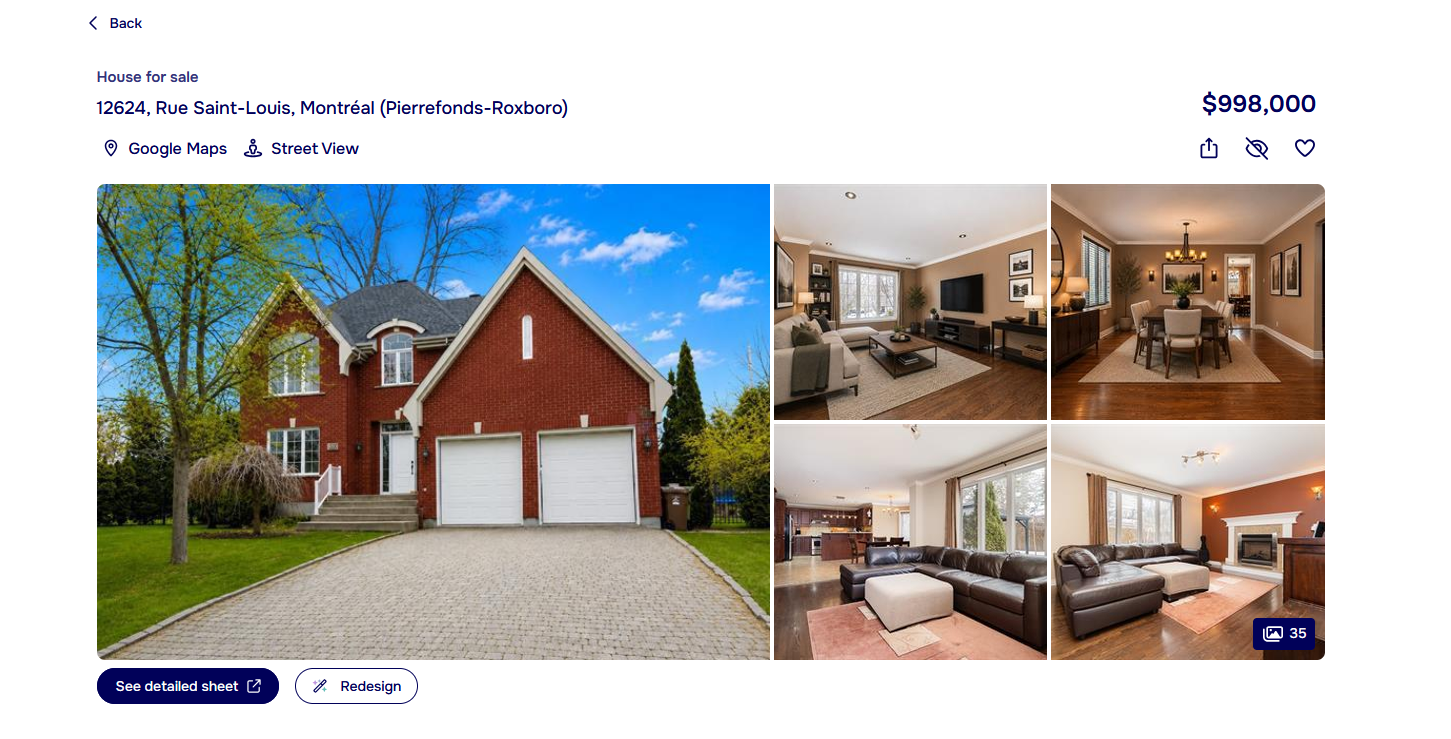
Listen ik montreal is cheaper to live in; im from there. But bro. Im looking at houses in toronto and montreal and this is insane.
A condo in VAUGHAN, not even toronto, is more expensive than a 2 garage house in montreal.
How do people in Toronto actually buy houses? Like the salaries are higher and taxes lower but even then it's not even close to enough to justify it. People make jokes and quirky lil comments when I ask this question but im being serious. How hasnt the housing market there exploded yet?