As many of us are well into chilly fall weather, we're starting to get more concerned posts asking what can be done for our community cats as winter hits. For any new caregivers to stray or feral community cats visiting in and wondering how to help keep them comfortable in the cold, in this post you'll find two very basic shelter designs to get you started that can be built quickly, easily, and affordably.
action shot with an example tote shelter
You'll also find additional tips and tricks for reinforcing them based on your winter extremes. Keep scrolling for info on how to keep water or wet food available in freezing temps as well as general care and best practices in cold, wet, or windy weather.
And for seasoned caregivers, feel free to show off your own shelter setups in the comments too, whether they're homemade or pre-built/store-bought! I've seen some wonderful shelters shared here over the years, it's always an inspiration to see what the community's come up with!
Basic Insulated Tote Shelter
For something more permanent, you can make an effective and relatively inexpensive shelter following along with this guide by IndyFeral using a few basic materials. More below!
NOTE: cut your entrances on the long side instead so your cat can tuck in out of the wind!
20-30 gallon plastic storage tote. A 20 gallon tote can work well for a single cat, a 30 gallon tote is great for sharing; double check the dimensions to make sure the height is suitable once insulation, bricks, etc. are added. Remember: the strength of an insulated shelter lies in its ability to trap a cat's body heat. Too large of an interior will be less efficient for a single cat. Some DIY builds place a smaller (~18 gallon) tote inside a larger (30+ gallon) tote with insulation or an air gap in between them. Using a much larger tote in a nested build also allows for a "mud room," further protecting the shelter interior from wind and moisture being tracked in.
Use a hairdryer to heat up and soften the plastic while you cut out your opening(s).
If you're building multiple shelters or are using heavy duty totes, a 5-6" hole saw or variable temperature hot knife (on low heat, in a ventilated space!) may be a worthwhile investment for easily cutting through plastic.
You'll also want duct or gorilla tape to cover any rough edges.
A styrofoam cooler or 1" thick foam board insulation. Foam board can be found in smaller 2x2' project panels (example), or in larger 4x8' sheets that are ideal for making multiple shelters. Pay attention to the listed R-Value when shopping for insulation, the higher the R-Value, the better the insulative property of the board. Some insulation boards, such as R-Tech's, come with one side lined with foil. When placed facing inward, this foil can help make your shelter warmer by reflecting the cat's body heat back towards them. Or the reflective side can face out with a slight air gap between it and the tote walls to increase the effective R-Value of the board.
Shelter interiors can additionally be lined with mylar blankets orbubble foil insulation to reflect the cat's body heat to achieve a similar effect. This is a great option for store-bought shelters that may not have enough space for even thinner (0.5") insulation board, or that are an odd shape for outfitting with rigid insulation. Foil tape can be used to seal any seams and minimize drafts.
Higher R-Value = better insulation from the cold, and better trapping of body heat. Note: it's vital that gaps in insulation are sealed to minimize drafts. Plan your cuts well if using foam board, and consider covering the seams with tape or using spray foam insulation to seal any gaps (be mindful of just how much it expands!).
Straw for bedding. Straw is both moisture repellent and mold resistant, it acts as an insulator, and when fluffed up in your shelter your cat will be able to burrow into it to help trap their body heat all around them. Note: there is a difference between straw and hay. Alley Cat Allies explains here; in short hay does the opposite of what you want inside a shelter. Also avoid blankets/fabric bedding in your winter shelters. This includes self-heating beds; use mylar or bubble foil insulation with straw instead! Fabrics will get damp in rainy/snowy conditions and will either freeze in cold temps or will get moldy. This type of bedding can make your cat colder. Stick with straw!
Straw bales can typically be found at feed stores, garden centers, local farms, and even online! Steer clear of chopped straw or straw with additives such as tacking agents, however.
Chewy conveniently nowalsocarriesbedding strawin three sizes and tends to have very quick delivery times. Full-sized, untreated bales can also be found at Home Depot.
Untreated mini bales can often be found at craft stores (Michaels, Hobby Lobby, etc.) and will also work well in a cat shelter, especially if you don't need much straw. Note that the straw may be cut into shorter pieces than other straw bale options which may make it track more and require more frequent fluffing and refilling.
After Halloween and towards winter you may even have neighbors discarding their fall decorations. You may be able to find someone in your area that has a straw bale they no longer need! Nextdoor or neighborhood Facebook groups can be helpful with this.
Placing a few bricks/pavers along the bottom of your shelter underneath your insulation flooring is helpful for adding weight to keep it from budging in extreme wind. Sand or gravel can be other good options for adding weight to the interior of your shelter. This can also help with raising your entrances to mitigate snow buildup!
Also consider taping or weighing your tote lid down to keep it from blowing open in high winds.
Plan out where you want your entrance!
On a tote shelter, cutting your entrance on the short end will leave your cat in direct line of the opening when occupied. Consider cutting it off-center on the long side of your shelter instead so that your cat can turn into the shelter to curl up away from the drafty opening.
Cut your entrance up high enough that your shelter floor will have a substantial lip after insulation/bricks are installed for keeping your straw from spilling out as cats go in and out. If you're in an area that sees snowy winters, having a higher entrance will also help keep your cats from being snowed in as easily, and it will minimize the amount of splashback from rain.
If you cut a second entrance for wary cats, save the leftover insulation so you can use it to plug the hole back up in bouts of extreme cold and minimize drafts!
Note that there are pros and cons to whether a shelter needs two entrances. If your primary concern is protecting from the cold, it can be counterproductive to cut two holes into your shelter. However, if your cats are at risk from predators (or even other cats), they may feel most comfortable in a two-door shelter that affords an escape route. More on this can be found in our community wiki (special thanks to u/silentsixty for the write-up!).
Alternate entrances for your shelter may include:
Plastic cat flaps. These can also be a great compromise on a second entrance for wary cats! Secure them open and they're like miniature awnings, or close one to turn your second entrance into a window to allow your cat to feel more secure while reducing excess heat loss from a second opening.
Flower pots with the bottom removed can be inserted into your shelter opening to create a short tunnel. This provides a nice clean edge for the cat to move through, and also helps protect from rain and snow blowing in at an angle.
Thin vinyl flaps to provide light cover over openings. Note that cats may not figure solid flaps out right away and may need time to get used to using the shelter with an open entrance first. Cutting the flap into strips may help as there will be gaps that can encourage the cat to poke their face through.
Raise your shelter up off the cold ground to help keep it warmer. Wooden pallets and 2x4s are popular options for this.
Interested in roofing? PVC Roofing Panels can be a great addition to your tote shelter to help keep snow from building up around it or blowing in. 8' panels can be carefully cut with heavy duty scissors into smaller sections to fit your tote lids and provide more of an overhang. Round the corners after cutting if they have sharp edges!
This can also be used as a lean-to to provide some cover in front of shelter openings!
Remember to periodically check your shelters for any issues such as tape coming loose, scratched up foam board, or flattened straw. Refill or refresh your straw bedding as needed, and check on them ahead of particularly cold or snowy forecasts.
Emergency Cardboard Shelter
For temporary use as a last resort if the cold is closing in and you're short on time and aren't able to run around for supplies. You can make a temporary emergency shelter using a cardboard box, heavy duty garbage bags or drop cloth, and duct tape to hold it all together, then filled with shredded newspaper for bedding (check often and refresh as needed, especially in rain/snow!). It's simple, but in an emergency it can make all the difference and will help tide your cats over until a more permanent shelter option can be set up.
(1) Tape all the seams on the cardboard box shut with duct tape.
(2) Wrap the box completely with the drop cloth or contractor bags. Secure onto the box by tightly wrapping duct tape around the plastic, covering all seams.
(3) Cut a doorway (6 in. x 6 in.) in a shorter side of the box, keeping the bottom of the door a few inches above the box's bottom.
(4) Put lots of shredded newspaper inside.
For added insulation, start by placing a slightly smaller cardboard box inside a larger one and fill the gap between them with rolled-up newspaper. Then proceed with steps 1 through 4, above, being sure to cut the doorway through both boxes.
u/SilentSixty has taken the time to write up a more detailed guide on building your own feral cat shelter that's loaded with more helpful tips, tricks, and tutorials. It goes into great detail on designs and additions that can be used to improve your cat shelters. Check it out if you're looking to build something that's a bit heavier duty or you want to try beefing up your setup from previous winters! Topics covered include heated vs unheated shelters, considerations for a second exit on your shelter, location, and what it might mean if the cats just aren't using your shelter.
Shelter Galleries
Alley Cat Allies and Neighborhood Cats have both compiled lists of various store-bought and DIY shelter schematics into their own galleries if you'd like to see more options and designs than what were covered here. There are lots of creative builds and setups to be found!
Heated Shelters, Pads, and Bowls!
If you have an outdoor electrical outlet, heated shelters and pads can be great ways to provide for your cats in the colder months. However, these should not be your only shelter option; in the most extreme winter weather, power outages are possible, and heavy snow can still cause fabric coverings on heated pads to get damp and cold, or even freeze. Plan ahead and keep some spare unheated, straw shelters as a backup. Heated shelters are a very kind and generous way to keep your cats out of the cold, but a DIY tote shelter is truthfully more than enough, and it's much lower risk to provide.
Please stay safe when implementing any sort of electrical product into your colony setup! Make sure that you are plugging into a weather-resistant GFCI outlet and have an in-use weatherproof cover installed. If using an extension cord, use one that is outdoor-rated and insulated for cold weather, and use junction covers or electrical safety boxes to protect from moisture. Outdoor-rated smart plugs or thermostatically controlled outlets can be great ways to make sure your equipment is only heating when absolutely necessary. Check specs and reviews for anything electrical to ensure you're buying the appropriate equipment, and from a reputable brand. You do not want to take chances with electronics that will be exposed to extreme temps and that you won't be able to keep a close eye on.
K&H Pets is a reputable brand that makes outdoor-rated, MET listed products intended specifically for outdoor cats (note: their products can often be found at much lower price-points on Amazon or Chewy than buying direct). The Kitty Tube is similarly well-regarded and exceptionally well-insulated, though pricey. Clawsable is a newer brand whose heated outdoor cat products are now also MET listed. With any product of this nature, particularly when shopping on Amazon, be sure to check the reviews (before, and even long after purchase) for widespread safety issues or concerns! Avoid products that only have a handful of reviews; don't test unknown products with your cats in extreme weather conditions! For tried and true outdoor heating options you can also broaden your search to products meant for dog houses or chicken coops.
Here are some products that may be a good starting point for your search:
K&H 32oz Thermal-Bowl: a basic plastic heated bowl that works great for water! Available in larger sizes as well, uses 12-25w depending on size.
K&H Thermo-Kitty Cafe Bowl: 12oz and 24oz heated bowls (30w) with removable steel inserts that's ideal for feeding wet food and providing water.
K&H Extreme Weather Heated Kitty Pad: 40w 12.5x18.5" heating pad, also available in Petite size (9x12"). These pads heat to the cat's body temperature, approximately 102°F which can help make a well-insulated shelter quite cozy.
The Kitty Tube Low Voltage Round Heating Pad: Made to fit the Kitty Tube shelter, notably this 12 volt/18watt heating pad is marketed as being safe to use alongside straw which is the exception among heated pads.
Note: K&H shelters, and often other store-bought options, may require additional weatherproofing depending on how cold and wet your winter extremes are. They may not be adequately waterproofed to hold up to constant snow or wind, particularly if out in the open. It's best to test them out in milder conditions so you have time to reinforce them before the cats absolutely need them. Check reviews to see how other caregivers have set them up too!
Keeping Water from Freezing
Aside from providing adequate shelter, the other challenge caregivers face during the winter is keeping a fresh supply of water readily available at all times. A heated bowl is the most convenient way to provide water in below freezing temps, but for those without outdoor electrical outlets, here are some tips and tricks that might help cut down on how often you need to refresh your water:
Don't refill with hot water. Scalding hot water can evaporate faster in a cold environment, leaving your bowl with less water that will then freeze more quickly. Use room temperature or warm water instead to minimize the impact and slow down the freeze.
Find the right bowl! A deeper bowl with a narrow mouth will take longer to freeze. Avoid ceramic or steel bowls and instead opt for a plastic one, the thicker the better. Get two and nest them to make your bowl double-walled!
Find the right placement! Keep your bowl sheltered from wind and snow. Building an insulated feeding station can help slow your water from freezing and protect your food (and the hungry cat!) from the elements. Alternatively, placing your water bowl where it will be in direct sunlight is a great way to keep it warmed up during daylight. Pick a dark bowl or use dark materials to help it absorb sunlight more efficiently.
Additional measures include applying spray insulation around the exterior of your bowl, or placing it inside a styrofoam cooler or insulation board structure to help block out the cold air and wind.
Note: Adding a pinch of sugar is a common suggestion meant to lower the freezing point of your water. This is technically true, but requires a substantial amount of sugar to make a non-negligible difference. For 1L water, every 10g of sugar added drops the freezing point by approximately one tenth of a degree, Fahrenheit.
Snugglesafe Microwave Heating Pads
Another popular option for heating both shelters and water bowls without electricity is the microwaveable Snugglesafe Disc. Be mindful of the heating instructions as they vary by wattage, check your microwave to determine how long the disc should be microwaved for. It is possible to overheat and melt the discs if you are not careful! Also take into consideration that having to swap out a heating pad every couple of hours may spook more feral-leaning cats from your shelters when they need them most. It may be best to focus on weatherproofing and insulating and let the cat provide the heat to do the rest!
Cold Weather Health & Safety Tips
Provide Extra Food as cats will burn more energy keeping warm as the temperature drops. It's estimated that cats will consume about 20% more food during the winter months. Kitten food is more calorie dense than adult/all-stages food, so it can be helpful to mix it into your regular food to provide a boost. Wet food takes less energy to digest than dry food so it can be preferable in the cold, but only if you're able to make sure it doesn't freeze before the cats can get to it!
Check your cars! Cats seeking shelter from the cold are known for hiding under or even inside cars, having climbed up from the tires and up towards the engine where it might still be warm. This leaves cats vulnerable to severe injuries or death as the engine heats up during use, or if a panicked cat tries taking off in transit. If you know you have community cats in the area, provide alternative shelter options to help steer them away from trying this! Consider making a routine out of making a little noise before getting in your car and starting your commute. Tap on your doors, honk your horn, and pop open the hood if you're suspicious; try and wait a few minutes to give a scared cat time to flee. If you've had recent snowfall, checking for pawprints around the car can be incredibly helpful. Even if you're staying put, if snow is building up on and around your car, be sure to brush it off and shovel out underneath to prevent cats from potentially getting snowed in and trapped underneath! If you are handling anti-freeze, be extremely careful and cleanup any spills as it is very toxic to cats.
Shoveling Take note of the paths your cats take around your property going to and from their feeding area and shelters and do your best to keep them clear; if you know there aren't any cats around, consider shoveling to keep it from building up in case your shelters are occupied later! Do a little bit whenever you can so you won't have to risk disturbing your cats or spooking them out of their shelters later on. Make sure all shelter and feeding station entrances are kept cleared from snow to protect your cats from being snowed in. Also be mindful of snow buildup on top of cars, shelters, garages, etc. and try to clear it off before it avalanches in a way that might trap your cats, especially in heavy snowfall. Also make sure your shelters aren't in line with any forming icicles as they can fall and do some serious damage!
Ice Melt can be toxic to animals if ingested (licked up directly from the ground, or indirectly off of paws and fur) or can irritate your cats' skin as they walk through areas treated with it. If it's necessary for you to use rock salt or ice melt around your property, look for products that are marketed as being pet or paw friendly. Note that these products are safer, but still not completely safe. Use with care around high-traffic areas for your cats. PetMD has more on the topic here.
Medical Emergencies
Read up on these quick guides so you can be prepared if you find a cat struggling out in the cold!
This guide has mostly covered average weather conditions, but it's important to consider weather events and extremes such as blizzards and hurricanes as well. Check Alley Cat Allies' Quick Tips to Disaster-Proof A Community Cat Colony and lengthier How to Prepare and Keep Cats Safe in a Disaster guide. The Humane Society also has a page on Community Cat Disaster Preparedness. Please read up now for information on what you can do to help get your cats and colonies through the worst weather so you can be prepared in an emergency, but above all make sure you're staying safe yourself!
There has been recurring debate in the comments recently regarding spay-abort procedures, so I want to address this directly. r/Feral_Cats is a pro spay/neuter subreddit. We're focused on the humane care of feral/stray/community cats via Trap, Neuter, Return (TNR) and socialization to adopt, where possible. There are far more cats than there are homes that are willing and able to take them in, and especially with feral-leaning cats, it's just not possible for every cat in our care to be happily placed in a home with humans. Bare minimum, sterilizing the cats that we're seeing and feeding is vital for starting to get a handle on the population of roaming cats.
To that end, this community supports and encourages spaying cats that are suspected or confirmed to be pregnant. This decision is not made lightly by caregivers. There is a limit to how much each individual caregiver can provide for every cat in their care. We are all operating within very real limits of time, space, and funding, not to mention foster availability and shelter capacity on top of that. Not everyone can safely confine a pregnant feral cat for months. Not everyone has the resources to process an entire litter before those kittens begin reproducing themselves. Holding a feral cat through pregnancy and until kittens are old enough to separate means two to three months of confinement at minimum. That is incredibly stressful for a feral-leaning cat and resource-intensive for her caregiver. And this is often not just one cat at a time. Many caregivers are managing multiple intact females at once, and pregnancies snowball quickly once kitten season hits. Expecting someone to foster every pregnant cat, raise every litter, socialize the kittens and then find homes is not realistic, particularly when homes are already hard to come by and shelters and rescues are at limited capacity.
Allowing kittens to be born outdoors instead also does not guarantee positive outcomes. Survival rates for kittens born outside are very low. Many will not make it to adulthood due to illness, injury, exposure, or predators; there's also the risk that something may happen to their mother at any moment, leaving them alone and vulnerable. The kittens that do survive must still be trapped and sterilized before the females begin going into heat themselves, which can happen as young as four months. Taking in a preventable litter might mean that another cat loses their space or is euthanized for room. If rescues aren't open, the burden of socialization and long-term care then falls back on the caregiver. In some cases, the only remaining option is to sterilize and return those kittens outdoors, further adding to the strain on the colony. These are the realities caregivers are navigating when we're making these decisions.
When it comes to TNR, once a cat is trapped, there is no guarantee she can be trapped again if released due to a potential pregnancy. Delaying sterilization can mean losing the opportunity to trap her again easily in the future, resulting in additional litters being born outside and suffering for it. There is also the very real chance that a female cat is not actually pregnant but may instead have a uterine infection (pyometra) that is fatal without an emergency spay. The risk of pyometra increases with age, and with each consecutive heat cycle that does not result in pregnancy. Pregnancy and labor in turn also carry real risks of complications that can be fatal for both mom and kittens.
In many situations, prioritizing the health and safety of the cat in front of us and preventing further population growth is the most responsible course of action available. It's also the most logistically practical option for caregivers who are already often operating with limited resources and support in their communities.
I understand that this is not an easy discussion to have for those unfamiliar with this side of TNR and rescue work, and you're allowed to have an opinion on it. However, debates opposing sterilization, including spay-abort procedures performed as part of TNR efforts, are not in the spirit of this subreddit. Shaming or judging caregivers for choosing to proceed with a spay-abort is not allowed here. If you are arguing in favor of fostering through pregnancy, please do so only if you are fully aware of the time, resource, and logistical costs involved.
I'm grateful for a lot today! I've got some really wonderful people in my life, friends, family, and acquaintances alike. Also grateful for little moments like this-
Spooky used to be feral. With the help of MAKK’s Street Cat Rescue, Inc. we got him fixed a while back, and not long after that he started warming up to us super fast. Earlier this year he started to let me pet him, which was HUGE progress at the time! Tonight, he even let me towel him off when I went out to give my street crew some warm wet food and tuna soup! He was very polite when he told me he was done, too!
Grateful to Makk's for giving me invaluable TNVR guidance, and Public Vet for offering an affordable spay/neuter service. I've been able to get 13 cats fixed this year, and planning to do one more in December. That's all thanks to folks helping to pitch in with donations of supplies and money to cover the spay/neuter appointments. I really could not have gotten as many cats fixed this year without that help.
Pet Friendly Services is a major reason why I was able to fix so many. Their financial aid and SNAP vouchers enabled me to get several community cats fixed for just $25 each. That is WILD. I can not express enough how grateful I am for that.
Sitting here reflecting on all that I have to be thankful for, the local animal rescue/ welfare community is high on my list.
At the very top, I am really just thankful that I have so much to be thankful for. Life is good!
After several days, I haven't seen this cat, not since we saw and fed another, looks very much like Kat, except it is a Manx. He is much more skittish, and when I did see it, I wasnt able to get a photo...
But today, as my Thanksgiving day guests were leaving, I could hear Kat meowing to let me know he was hungry.
So he got fed.....probably not as good as the ham we had on our table. But he let me pet him while he ate. His purr motor might need a muffler, he sure was purring wide open!
I was able to get the cat that’s been hanging around for months inside and to the cat clinic. First surprise: it’s a girl not a boy! And she’s quickly becoming the most cuddly thing.
I’ve purchased a couple of these insulated, waterproof, raised, heating pad cat shelters for my yard.
The heating pad has a little flannel cover for it. Is that okay, or should I still add some straw on top for them or will that detract from the heating pad? (As long as I turn it on enough so it does not get cold or freeze)?
They’ve come such a long way! We started with them outside before moving them into the garage and now the house. The mom is still outside(kittens were caught after it was clear they were weaned off of milk) but efforts to eventually catch her for TNR are there. Some are still hand shy but they went from not allowing people near to cuddling, even if they’ve decided 4AM is the optimal time for cuddle piles and have ruined my sleep as a result.
This sweetie (with a clipped ear) has been hanging in our alley. She’s been too scared to come to me…until I busted out the churru. Now she comes when I call her, and will crush a can of wet food in one sitting. How else can I help her? My son made a cat hideout for her, but I think we’ll need something more insulated. We do already have a cat (indoor/outdoor), so bringing Lucy inside isn’t an option right now. We do have a detached garage, and I’ve been thinking about leaving the door open, but I doubt my husband would be comfortable with that. Ideas?
So, I was thinking of trying to TNR this guy, I've been seeing him over the last few months after bringing my last feral inside, I assume this one has come in to take over the open territory. I'm also assuming it's male because I saw "him" spray and guessed from that but I could be wrong. The only thing is, I feel like I don't know enough to TNR. I've asked around to see if he's a pet and nobody has come forward in over a month but what if I'm missing someone? I'm not sure if he's really feral, he bolts if I open the front door but he could just be a slightly skittish but friendly stray. And he's not ear tipped but if he is/was a pet, maybe he's already fixed and I'd be trapping him for no reason. The spraying leads me to believe he's intact but I'm not sure enough.
My local humane society does free TNR but the cat has to be truly feral and they will get annoyed with you if you bring in a cat that they determine doesn't count. They did it with my last feral, who I knew for a fact WAS feral at the time and they just poked him repeatedly with a pen and then said "he's not feral cuz he's not trying to bite me." They did end up doing it for him anyway and I'm not sure what he did to change their minds but they were calling him feral by the time they returned him lol. But god forbid I assume this cat is feral and he's not, and they get mad. They don't like me for some reason.
Also, I have a job now and I'm not sure how people manage to do TNR with their work schedule. I don't think I'd be able to be home for both trapping, the dropoff time, and the pickup time. ALSO I don't know where to keep the cat, because having a yowling intact cat in the house is going to stress out my indoor former feral. I could keep the tux in the garage but it might be too cold, and my cat might still hear him if he yells. Should I wait until it's warmer out maybe, and/or until I know more about this cat? He mostly only comes at night, he was coming in the morning for a few days but I think he stopped that because every time, I tried opening the door and maybe he's decided it's too scary now. I've seen him a few times out the window and have otherwise been watching him on the wildlife cameras on the porch.
He eats dry food here every night and last night I put my trap outside so he can see it and get used to it being there, and I can start trap training now even if it ends up being a while before I trap him, if I do.
This situation is just a bit more complicated than with my last one, and I wanna help him but I'm unsure about so many things.
TLDR; thinking of TNRing this cat but am worried it could be a pet, could be intact and I'm just wrong, and also how I'm gonna hold onto him and get him to the TNR place at the right times considering my work schedule. Also only 85% sure i know the gender
This big lad (14lbs) showed up in the summer time absolutely terrified and sort of mean. Hissing, fighting, territorial over food, terrified of us, the works. We caught him easily as he loves food and got him neutered. He was always a bit scared of us but came to eat every day. I was able to talk to him from a distance for a while. Every. Day. For. Four. Months. Then finally (!) one day I went out to feed him, he was about 100 feet away. He was meowing and crying like a baby and came running over to me and he let me pet him. He was DESPERATE for contact after that first pet. Ever since that day he just wanted love and pets, he even jumped on my lap and head butted me! He slept on our porch in a cat house and meowed at our door for about two weeks until we got a vet appointment—he's perfectly healthy—and transferred him into a home (a family member's since we couldn't take him). Now we just visit him a few times a week. He's doing great.
He loves being inside and was a total house cat before, not a feral like we believed. That pic is 24 hours after bringing him in.
He also used the litter box right away and knew all about scratching posts! Jumping on the counters and tables is a different story...
Bucky showed up out of nowhere - as they do - four years ago. Skittish, independent, strong and sensitive. Feral, but content to come around for food and lay in the sun on our patio.
Bucky fiercely marked the perimeter of our yard, and though the neighborhood ladies are all spayed, they loved him. He was always a gentleman, and quietly charming and mysterious as he would come and go as he pleased.
For a while he hung around a lot, and during that time he adopted and raised an abandoned tortoiseshell runt. He walked her right up our driveway, and when we failed to catch her, he raised her in our backyard for three months until we could finally bring her in. I’ve never seen anything like it. He gave her his food, taught her how to hunt, and cuddled with her in the rain.
Eventually Bucky moved on to another area, but would still pop in for meals once or twice a day whenever he felt like it. He knew our regular schedule and would try to make it, but he was off doing Bucky things.
Once he started coming around more sporadically, he got more friendly. He started to let us pet him and comb him for fleas. He started to love getting scratched and began to trust us. He trusted me enough to take home to the vet a couple of times to treat an abscess and a hanging tooth.
In the past year I could see the guy was tired. It’s a rough life out there. Every time he’d miss a meal I’d be a little worried, but then he’d pop up again. But it’s been 8 days and 8 cold nights.
I hope he’s still out there, on some adventure. Maybe he’s charmed his way to a closer, safer source of food, or maybe he’s adopted some other kitten in some other yard. I miss the guy.
Hello everyone. I recently got into tnring my neighborhood cats after feeding them for awhile. I recently tnr’d my first cat and he is currently resting with food and a pee pad in my garage in the trap. However, I want to create a space for them to rest well after surgery.
I was thinking of buying this cage so they can rest in after surgery. I can put the cage in the garage and wheel it out when i want to let them free
I am using my parents garage for the cats (i live in an apartment and cannot take care of the strays there, but i live 5 minutes away from my parents, so i always check in with the kitties).
Also, I am low income so I cannot buy alot of materials, i try to budget to help the kitties.
The pictures are this space in my parents backyard that i use for when it is raining (i live in the central coast of California, the lowest it gets here is 30 degrees Fahrenheit). I provide the kitties food and shelter there. I am trying to get platform so the rain doesnt get to them (like i said, i dont earn enough money and i try to budget for this)
Any advice ? I am also happy to answer any questions
I was chosen through the Cat distribution system by 2 bonded TNR cats. One has a bad leg but gets around pretty well. She is very sweet and cuddly and purrs constantly. Her name is Rose. The other cat seemed to protect her and would often bring her mice and chipmunks and had a lot of spunk. That was Blanche. I have looked after them for years. Yesterday I came home to find Blanche dead in my front yard. I believe she was hit by a car. Needless to say, I’m really very sad about losing her.
My concern now has to be making sure that Rose is ok despite losing her best friend. Maybe that sounds dumb but I’m worried about her. Despite buying them a few heated houses they always ended up sleeping under the deck even when it was coldest. Now that she doesn’t have a cuddle buddy, I think she’s going to be cold so I bought another new heated supposedly indestructible home for our upper deck. I have fed them since they showed up so that will of course not stop. She also got a special Thanksgiving dinner tonight because I’m a dork. Anything else I can do to help her get through this? Any advice is so helpful. Thank you!!
Posted earlier about which trap to get, and my favorite is the Tomahawk GT608! They’re on sale so I was thinking of getting one while the sale lasts, but I just looked at the shipping and it’s around $40 in Florida 😭 Do y’all know if there’s anyway to get a lower shipping cost, or any other places that sell it that might be closer and have lower shipping costs?
Today he seemed in pain, he ate a bit and then took a long pause breathing fast and then ate a bit more and did the same thing. Barely ate something really. He also has really bad diarrhea. He is super skinny and has a bloated belly so I think it has worms but I don't have money to take him to the vet. He also has his mouth swelled. I don't know if you can see it in the picture. I gave him kibble soak in warm water to softened it and make it easier for him to eat.
What do I do? I don't want him to die but he is in rreally bad shape. I'm from Venezuela and I can't take him him. I rescued a kitten in August and couldn't find her an adopter so she is living with me. I live with my parents and I can't take more animals in, my dad hates it.
Any advice please. Like do a give him medication ? Without a vet? I'm scared of making it worse and I don't know if I can't buy him the meds
I'm about 2 weeks into my first real socialization attempt. I think it's going well but I'm getting some mixed signals and am not certain how to proceed. I have a 3+ year old mom and one of her 6 week old kittens. My original plan was to keep the kitten with mom until 8 weeks old and/or her spay appintmrnt on the 9th, and then ideally rehome them both. Mom turned out to be more feral than I thought, which isn't necessary a problem, but her progress is kind of out of order. She's very food motivated. She doesn't care about anything so long as she's eating. I was able to hand feed her treats almost as soon as I introduced them and I can fully pet her while she's having a meal, make her flap her ears at me, the whole nine yards. But those milestones don't seem to translate at all once the food does away. Without it, she doesn't come down from her shelf when I'm present, hisses if I move too much, and won't let either a hand or a long-handled brush within arm's reach of her. And that has not changed much in 2 weeks
I think part of the problem is that her shelf is her safe space, her hiding spot. It wouldn't be productive to try and reach out to a cat while they're hiding in their scaredy house or something, no matter how slowly you go, so I've stopped bothering her up there. Perhaps a shelf isnt ideal to have in this scenario but it can't be blocked off and the room she's in is very small so I think she does better with it. That said, I don't know how else to lure her down. I feel like I've done everything I can with food and truthfully, she gets a little aggressive when I stop feeding her. She's immediately gets hissy and may even swat if I don't have anything for her.
That's not to say she's completely unresponsive. I've seen her play with toys twice very briefly. She'll come down to use the litter box even if I'm right next to it but I have to have perfect body language and she leaves immediately after. She's honestly really chill when she's on her shelf. She'll watch me without seeming scared, groom herself, and take some really zonked out naps. Not to mention she interacts positive with her kitten and lets me handle him. Maybe she just needs more time to lower her fear and she'll come around before long. But I just feel like I'm wasting a lot of time just letting her stay up there unchallenged. And if she needs a lot more time, idk how long it would be appropriate to keep her in this small of a room, especially when the kitten leaves. I dont feel like I have the experience to judge the situation adequately so any feedback would be welcome.
Plan is to make sure my kitties are up to date on their vaccines (I think they are or not too far off but I’m going to make sure not just assume). One of the outdoor cats we brought in last winter and had him scanned for a microchip. He stayed in the bathroom but he hated it so we let him back out. Pls don’t judge, at the time we didn’t have the bandwidth to spend more time with him but we do now as my partner works from him and I’m working only part time. He has a friend who has been spending more and more time in backyard and she has really opened up to us. We’ve asked around and these cats are tnr’ed and not owned.
Please point me to any resources on this topic or if you’d like to share some advice, I’d really appreciate it!
We want the outdoor cats to transition to a fully indoor life while keeping our resident cats safe.
A cat has been roaming onto our apartment porch. My mom and I decided to take him to a shelter etc. cause we thought that he was a stray/left behind.
Come to find out it sour upstairs neighbors. She said he got out, won't come back/let her pick him up, he's not neutered, and does not have any shots. And she saw him spitting something up and doesn't want him back in because of her kiddos. And the little girl was like terrified he followed her.
But it's cold. I've been feeling him, and I at LEAST want him neutered?? I want to do him that favor. But I don't want to get into trouble etc.
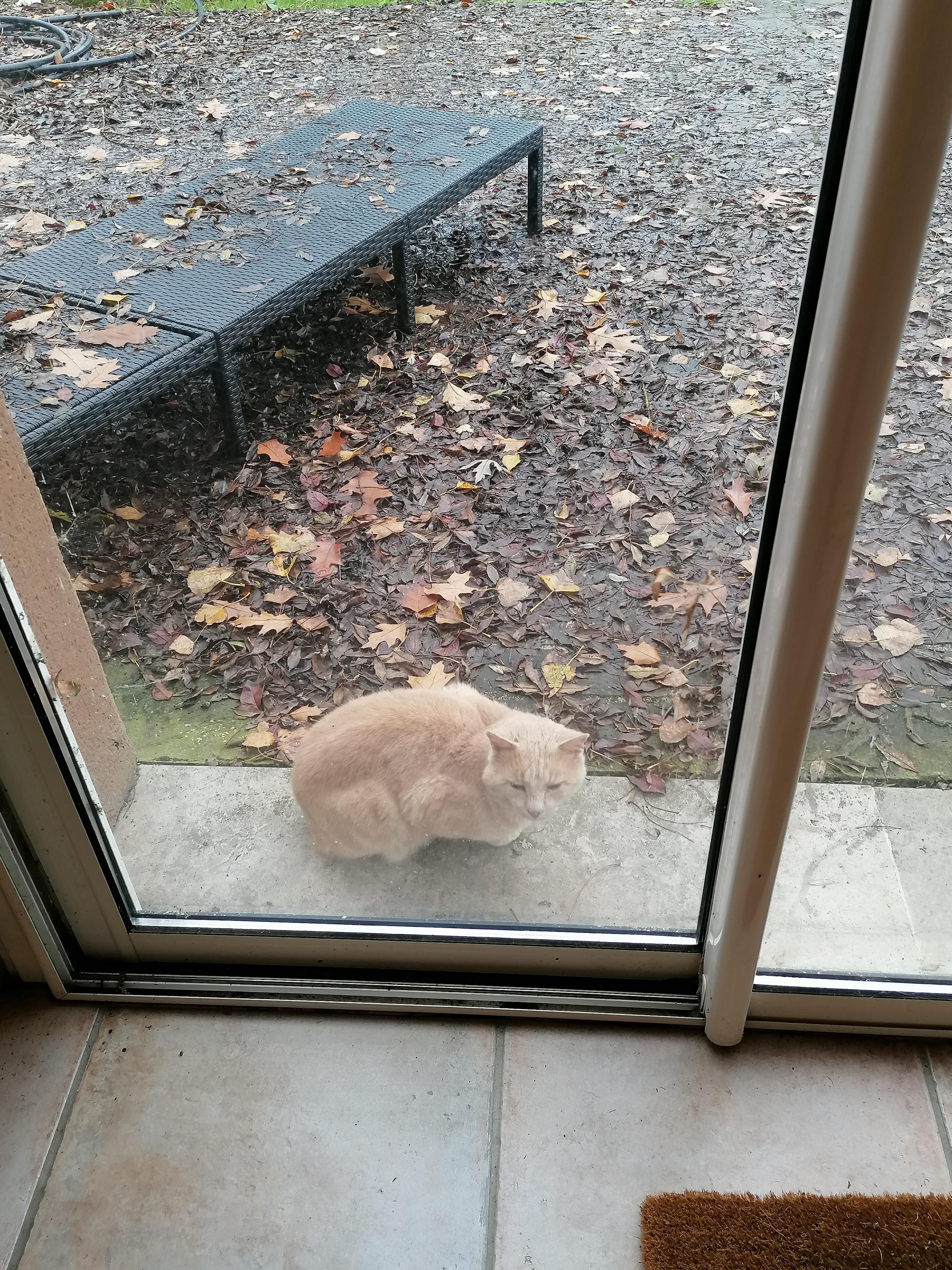
This cutie has been hanging around our house for about a year now. He (she?) used to fight with our beloved cat back then, being attracted by the leftover in out compost. But has been free roaming since the death of our cat earlier this year.
While we thought he had a family before, we've been seing him much more this last month, and he has become much less skittish (meaning not running away at out mere sight). To the point he has now spent three days sitting right next to one of the glass doors.
We've been feeding him, and I would happily bring him inside, but he is still wary of us and hisses, growls, and meows each time we open the door. We can't pet our touch him at all also, making it hard to put him in his own room.
I suppose we should just keep feeding him until he warms up to us more? I never tamed a feral cat before so all advices are welcome.
Hace 4 meses adopte a un gato feral que estaba en una perrera, lleva desde que tenía 7 meses encerrada en una jaula de unos 60cm² la adopte siendo completamente feral,ahora acepta dulces de mi mano y tolera que me siente cerca de ella no escapa de mi, cuando voy a verla (la tengo separada de mis otros gatos) empieza bufando muchas veces por un minuto y luego para, he oído que hay que dejar que el gato se acerque a tí pero honestamente está gata no está acostumbrada al tacto en absoluto y no se cómo empezar, honestamente me da miedo tocarla ya que a veces al acercar la mano me abre la boca o gruñe
enseño un video para demostrar lo cerca aque me deja estar de ella