A sword is more than a piece of metal. When someone finds one in a forest, hidden beneath the earth, inside an old tomb, or among buried treasure, it is difficult not to wonder who once carried it and what happened to them. Perhaps it was used in a great battle, perhaps it belonged to a king or a warrior, or perhaps it was passed down through generations. Even when its story is lost, a sword seems to carry the memory of something that happened long before it was found.
Throughout history, people have given swords meanings that go far beyond their use as weapons. They have represented power, honour, justice, loyalty, death, protection, and destiny. Some were believed to possess magical powers, others became symbols of royal authority, and some were remembered because of the people who carried them. In myths, legends, and stories, a sword could be just as important as the hero himself.
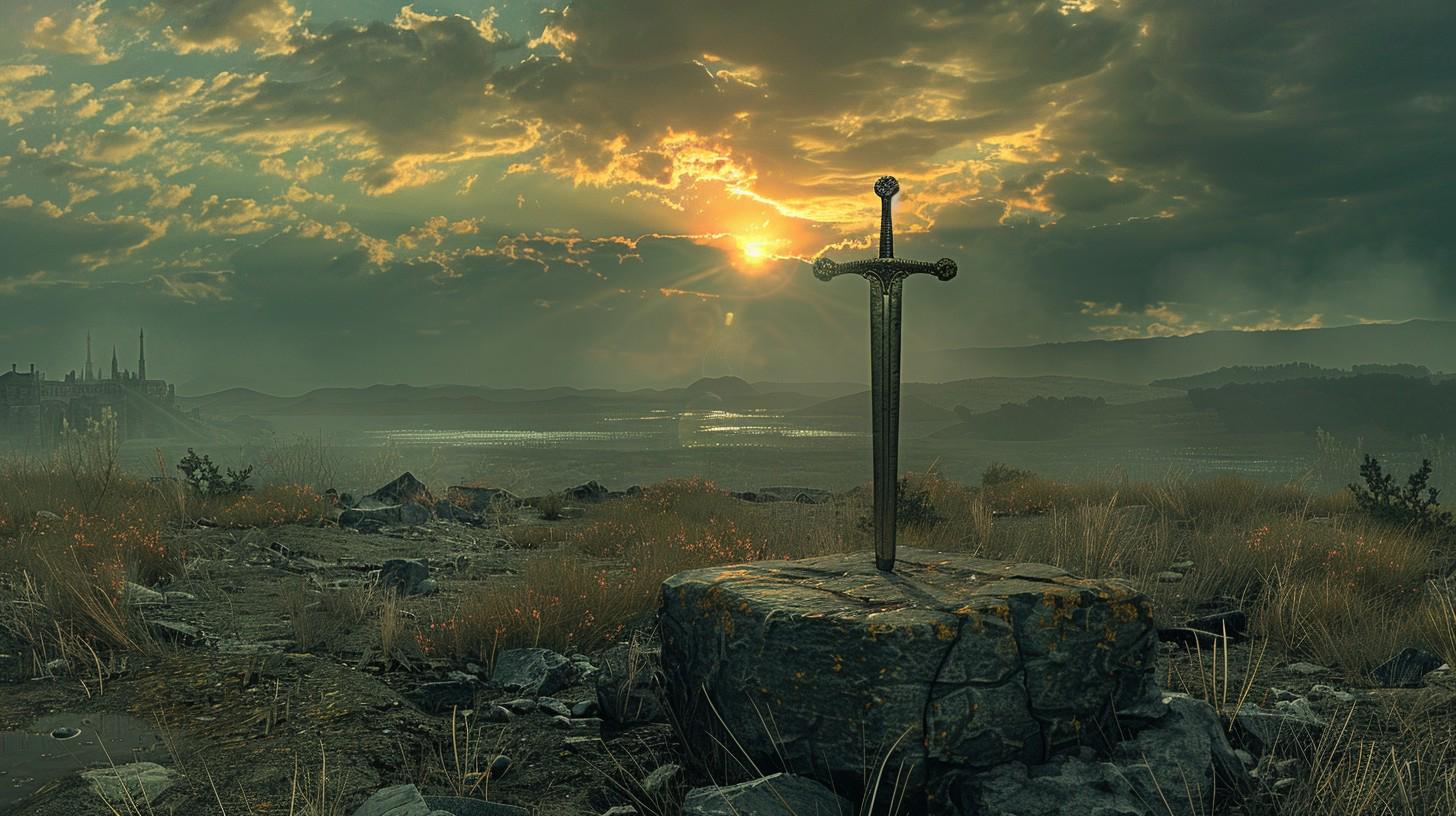
In many legends, a sword is not simply found or made. It has a special origin, and sometimes only one person is worthy of carrying it. The best-known example is Excalibur, the sword associated with King Arthur. In one part of the Arthurian tradition, Arthur proves his right to rule by pulling a sword from a stone. In another, Excalibur is given to him by the mysterious Lady of the Lake. These are not always the same sword in the older versions of the legend, although later retellings often combine the stories. Either way, the sword becomes a sign of kingship and a reminder that Arthur's authority is something extraordinary.
Greek mythology gives us another famous example through Perseus. Before facing Medusa, he receives a special curved sword from Hermes and a polished shield from Athena. The shield allows him to see Medusa's reflection without looking directly at her. His victory depends not only on the weapon, but also on preparation, intelligence, and help from the gods. The sword is part of a larger story in which even a seemingly impossible enemy can be defeated through courage and cleverness.
In Norse mythology, the sword of Surtr has a much more terrifying purpose. Surtr is a fire giant who appears during Ragnarök, the final destruction of the old world. His shining, blazing sword is associated with the fire that consumes the world. It is not a weapon used to win a battle or protect a kingdom. It is an instrument of the world's destruction, a reminder that even the gods and their world cannot last forever. The image of a sword bright enough to set the world ablaze is one of the most striking images in Norse mythology.
Other legendary swords have their own histories and curses. Gram, the sword associated with the hero Sigurd, is reforged after being broken and is later used to slay the dragon Fafnir. Tyrfing, on the other hand, is a cursed sword forged by dwarves. Its power brings death and tragedy to those connected with it. One sword becomes part of a heroic destiny, while the other seems to carry a destiny of its own, dragging its owners towards disaster.
Japanese mythology also has a sword with a special place in the history of a nation. Kusanagi-no-Tsurugi, often translated as the Grass-Cutting Sword, was discovered in the tail of the great serpent Yamata no Orochi by the storm god Susanoo. It later became one of the Three Imperial Regalia of Japan, objects associated with the authority of the emperor. In another part of its legend, the hero Yamato Takeru uses the sword to cut through grass and escape an enemy's attempt to trap him in a fire. Here, the sword is not only a weapon or a magical object. It becomes part of a country's identity and tradition.
Slavic folklore has its own extraordinary weapons, including the sword known as Kladenets. It appears in different tales and is often described as a remarkable or magical sword, far beyond an ordinary weapon. Serbian epic poetry also gives the sword an important place in the stories of heroes such as Prince Marko. In some traditional tales, Marko helps a fairy, and the encounter becomes connected with the extraordinary strength for which he is remembered. These stories show how a sword, a hero, and the supernatural world can become closely connected.
Not every sword in a story needs to be magical to carry a deeper meaning. The ancient story of the Sword of Damocles is a good example. Damocles is allowed to enjoy the luxury and power of a king, but a sword hangs above him by a single hair. It represents the danger that always accompanies power. The sword never needs to be used. Its presence alone is enough to remind Damocles that a position of great privilege can also be a position of constant danger.
The sword also became a symbol in the real world. In ceremonies, a sword placed on someone's shoulder can represent the granting of knighthood. In royal traditions, swords have been used during coronations and other ceremonies as signs of authority, duty, and the responsibility to protect a kingdom. The same object that could be used in battle could also be used to recognise someone's honour or position.
Swords were also connected with death and remembrance. In some historical burial traditions, warriors were buried with their weapons, including swords. These objects could reflect the person's status, identity, or role in life. A sword placed beside the dead was not simply another possession. It could be a sign of the life they had lived and the world they belonged to. In other circumstances, swords were used in executions and acts of violence, reminding us that the same weapon could represent honour to one person and terrible suffering to another.
There is something striking about the shape of a sword, too. Its long blade and crossguard can resemble a cross, which is why swords are sometimes used in films, games, and other stories as visual symbols of sacrifice, duty, or protection. This does not mean that every sword has a religious meaning, or that every creator intends such a connection. Sometimes the resemblance itself is enough to give an image a particular feeling.
Even the making of a sword could become part of its legend. The blacksmith was not always just a craftsman producing another weapon. In stories, a master smith could be almost as important as the hero who carried the blade. A sword might be forged by a mysterious figure, made from unusual materials, or created through a process that gave it a special power. In Norse and Germanic traditions, for example, dwarves were famous as extraordinary smiths who could create objects beyond the abilities of ordinary craftsmen. The skill of the maker could become part of the sword's identity.
In real history, swords also carried great value. They were expensive objects that required skilled craftsmanship, and some became family heirlooms passed from one generation to another. This helps explain why swords often appear among hidden treasures in adventure stories. A treasure chest might contain gold, jewellery, and precious objects, but a sword can be the item a hero chooses to keep. Its value is not always measured by the metal it contains. It might be useful in the journey ahead, connected to an old legend, or simply feel too important to leave behind.
As stories moved from old legends into books, films, and television, swords continued to carry these meanings. In The Lord of the Rings, Aragorn's sword Andúril is reforged from the broken Narsil. It connects him to his ancestors and to his claim to the throne. It is more than a powerful weapon: it represents a history that must be restored. In the same story, Éowyn faces the Witch-king of Angmar, who believes that no man can kill him. With Merry's help, she defeats him. The scene is not simply about a sword winning a fight. It is about courage and the unexpected way in which a prophecy can be fulfilled.
Conan's sword in the animated series Conan the Adventurer offers a different kind of example. His weapon is made from star metal and has a special power against the Serpent Men, creatures who can disguise themselves as humans. When the sword comes into contact with them, it reveals their true nature and can send them back to their own dimension. It is a weapon that does more than cut: it helps the hero recognise an enemy hiding in plain sight.
In The Three Musketeers, swords are connected with friendship, loyalty, and personal honour. In Kill Bill, Beatrix Kiddo's katana, made by the legendary swordsmith Hattori Hanzō, becomes an essential part of her journey of revenge. In Game of Thrones, swords such as Ice and Longclaw carry family histories and the responsibilities of the people who wield them. Each story gives the sword a different role, but it is rarely just an ordinary object.
Anime and manga have taken these ideas even further. In Bleach, Zanpakutō are connected to the souls of the Shinigami who carry them. Their powers and forms reflect their owners, and releasing a sword's true power is also a way of revealing something about the person using it. Some control fire or ice, others create illusions or change the rules of a deadly game. The sword becomes part of the character's identity.
In Demon Slayer, Nichirin blades are made from special materials that absorb sunlight, which is important because sunlight is one of the greatest weaknesses of demons. Their colours vary from one swordsman to another, giving each weapon its own appearance. In Attack on Titan, by contrast, soldiers use replaceable blades designed for one very specific purpose: cutting the weak point at the back of a Titan's neck. One series treats the sword almost as a personal companion, while the other presents it as specialised equipment needed to survive.
A particularly unusual example appears in Baki-Dou, where the historical swordsman Miyamoto Musashi is brought into the modern world. His swordsmanship is so overwhelming that he can make opponents experience the sensation of being cut even when no physical blade has touched them. His imagined cuts feel real to those facing him. It is an exaggerated fictional interpretation of swordsmanship, but it plays with an old idea: the skill and intention of the swordsman can become almost as frightening as the weapon itself.
That idea also connects with Record of Ragnarok. In the third round, Sasaki Kojirō faces Poseidon, the Greek god of the sea. Kojirō is based on a real Japanese swordsman, although many details of his life are surrounded by legend. In the story, he is remembered as a man who lost again and again, but every defeat taught him something. He studies his opponents, learns from their movements, and keeps improving. Against Poseidon, his patience and ability to predict attacks allow him to defeat a god. His victory is a celebration of persistence: a person does not have to be born the strongest to keep getting better.
Video games have continued to give swords their own histories and personalities. In The Legend of Zelda, the Master Sword is a weapon associated with the fight against evil. In Warcraft, Frostmourne is a cursed blade that steals souls and helps corrupt Arthas. In God of War III, the Blade of Olympus plays a major role in Kratos's struggle against Zeus, and its power becomes part of the tragedy surrounding Athena. In League of Legends, Viego's Blade of the Ruined King is tied to the Ruination, while Aatrox is a Darkin whose existence is bound to a greatsword that consumes the bodies of those who wield it. These weapons are not simply equipment. Their histories are woven into the stories of their owners.
Some fictional swords are remembered for their unusual forms. The Dragonslayer from Berserk is almost absurdly large, yet it fits the brutal world of Guts. In Naruto, Samehada is a living sword that feeds on chakra and can form a bond with its wielder. In Dororo, Hyakkimaru has blades hidden inside his prosthetic arms, making the sword almost a part of his own body. Even Future Trunks's sword in Dragon Ball, despite not having a special name, gives him one of the most recognisable appearances in the series.
From a weapon found in an ancient tomb to a magical blade carried by a hero, the sword has taken many forms. It has been a symbol of kingship, a sign of honour, a companion in battle, an object of ritual, a reminder of death, and sometimes a source of fear or destruction. It could be treasured, inherited, buried with its owner, or hidden away until someone worthy found it.
Perhaps that is what makes the sword so fascinating. It is a physical object, but people have always seen more in it than its metal and sharp edge. A sword can carry the memory of a battle, the history of a family, the authority of a ruler, or the destiny of a hero. Even when its original owner is long forgotten, the sword can remain — waiting for someone to wonder what story it once belonged to.